

Killing sin
 |
Description
Book Introduction
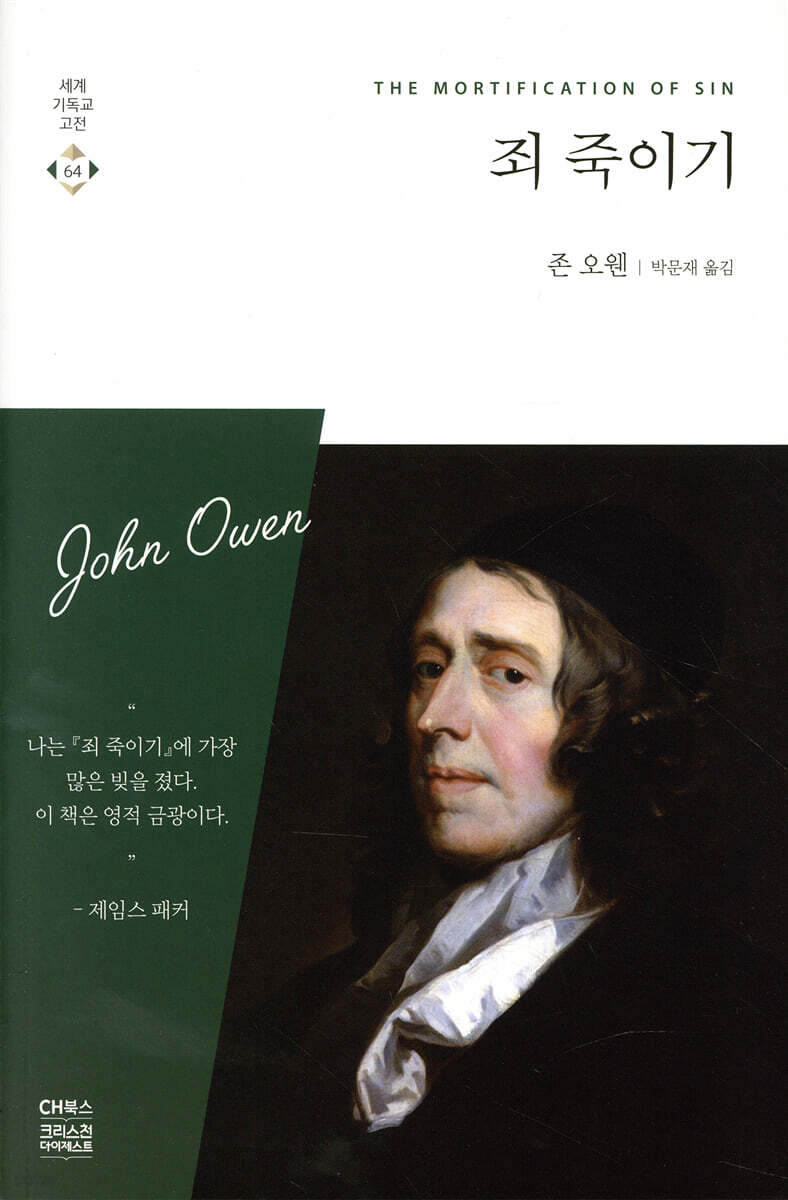
A masterpiece by John Owen, the "Prince of Puritans," recommended by James Packer
John Owen's The Mortification of Sin is the first of his four-part treatise on sanctification.
『The Sin Indwelling in the Believer』 can be considered a sister volume to this book, and together with 『The Dominion of Sin and Grace』 and 『Exposition on Psalm 130』, it constitutes his doctrine of sanctification.
This book, "Killing Sin," is a sermon he preached to university students when he was the Dean and Vice-Chancellor of Oxford University.
By commenting on Romans 8:13 as the main text, he teaches the core of Reformed piety.
Owen gave this lecture with two phenomena in mind at the time.
One was the spiritual lethargy, lethargy, and immoral behavior displayed by the students.
Another reality was that Catholic and state church leaders taught their followers that there was no problem with salvation if they just kept and practiced what the church had established, and by only making them aware of their sins and not offering a cure, they were forcing their followers to live in suffering.
Through his sermons, Owen provides concrete and practical guidelines for living a holy life by carrying out the duty of actually putting sin to death in the lives of believers.
Additionally, the detailed commentary by Pastor Park Moon-jae, a translator well-versed in theology, is of great help in understanding the content.
James Packer, the leading evangelical theologian in the English-speaking world today, said:
“Of all theologians of all time, I am most indebted to John Owen, and of all his writings, I am most indebted to this little book on the mortification of sin.
Every insight I have ever received from John Owen came to me when I first read The Mortification of Sin.
“This little book is a spiritual goldmine.”
John Owen's The Mortification of Sin is the first of his four-part treatise on sanctification.
『The Sin Indwelling in the Believer』 can be considered a sister volume to this book, and together with 『The Dominion of Sin and Grace』 and 『Exposition on Psalm 130』, it constitutes his doctrine of sanctification.
This book, "Killing Sin," is a sermon he preached to university students when he was the Dean and Vice-Chancellor of Oxford University.
By commenting on Romans 8:13 as the main text, he teaches the core of Reformed piety.
Owen gave this lecture with two phenomena in mind at the time.
One was the spiritual lethargy, lethargy, and immoral behavior displayed by the students.
Another reality was that Catholic and state church leaders taught their followers that there was no problem with salvation if they just kept and practiced what the church had established, and by only making them aware of their sins and not offering a cure, they were forcing their followers to live in suffering.
Through his sermons, Owen provides concrete and practical guidelines for living a holy life by carrying out the duty of actually putting sin to death in the lives of believers.
Additionally, the detailed commentary by Pastor Park Moon-jae, a translator well-versed in theology, is of great help in understanding the content.
James Packer, the leading evangelical theologian in the English-speaking world today, said:
“Of all theologians of all time, I am most indebted to John Owen, and of all his writings, I am most indebted to this little book on the mortification of sin.
Every insight I have ever received from John Owen came to me when I first read The Mortification of Sin.
“This little book is a spiritual goldmine.”
- You can preview some of the book's contents.
Preview
index
Haeje Park Moon-jae
Author's Preface
Chapter 1: The Basis of Mortifying Sin (Romans 8:13)
Chapter 2: The First General Principle for Mortifying Sin: Mortifying sin is a lifelong duty of the believer.
Chapter 3: The Second General Principle for Killing Sin: Only the Holy Spirit Can Kill Sin
Chapter 4: The Third General Principle for Mortifying Sin: Mortifying Sin Brings Spiritual Life and Vitality
Chapter 5: What Does Not Kill Sin
Chapter 6 What Does It Mean to Kill Sin?
Chapter 7 General Guidelines for Killing Sin (1)
Chapter 8: General Guidelines for Killing Sin (2)
Chapter 9: Specific Instructions for Killing Sin (1)
Chapter 10: Specific Instructions for Killing Sin (2)
Chapter 11: Specific Instructions for Killing Sin (3)
Chapter 12: Specific Instructions for Killing Sin (4)
Chapter 13: Specific Instructions for Killing Sin (5)
Chapter 14: Direct Instructions for Putting Sin to Death
Author's Preface
Chapter 1: The Basis of Mortifying Sin (Romans 8:13)
Chapter 2: The First General Principle for Mortifying Sin: Mortifying sin is a lifelong duty of the believer.
Chapter 3: The Second General Principle for Killing Sin: Only the Holy Spirit Can Kill Sin
Chapter 4: The Third General Principle for Mortifying Sin: Mortifying Sin Brings Spiritual Life and Vitality
Chapter 5: What Does Not Kill Sin
Chapter 6 What Does It Mean to Kill Sin?
Chapter 7 General Guidelines for Killing Sin (1)
Chapter 8: General Guidelines for Killing Sin (2)
Chapter 9: Specific Instructions for Killing Sin (1)
Chapter 10: Specific Instructions for Killing Sin (2)
Chapter 11: Specific Instructions for Killing Sin (3)
Chapter 12: Specific Instructions for Killing Sin (4)
Chapter 13: Specific Instructions for Killing Sin (5)
Chapter 14: Direct Instructions for Putting Sin to Death
Into the book
The duties of religion are an excellent nourishment for the weak soul, but they are not a remedy for the sick soul.
It would be absurd for someone who eats only food and not medicine to expect great results.
Spiritually sick people do not sweat their way out of their illness by performing the duties of faith.
Yet those who deceive their own souls use such methods.
--- p.61
Sin not only weakens the soul, but also darkens it.
Sin is a cloud and a dark cloud that covers the surface of the soul and blocks out all the rays of God's love and grace.
Sin removes from us all perception that we have been given the privilege of being children of God.
When the soul begins to gather all the thoughts that would comfort and strengthen it, sin quickly scatters them.
--- p.71
Let us say that our conscience points out the sinful desires of our hearts and demands that we put them to death, and that God rebukes us for those desires.
In such a case, if we do not seek forgiveness of sins through the blood of Christ and death of sins through the Spirit of Christ, but instead try to free ourselves from the yoke God has placed on our necks by seeking and presenting some other evidence that we have or think we have, evidence that seems to prove that we are now in a good state, then our condition is very dangerous and our wound is so serious that it is almost incurable.
--- p.120
A believer should have the best possible evidence regarding his spiritual status.
However, it is the duty of a believer to think that the end result of continuing in the evil path is destruction, and anyone who does not think so is an atheist.
I am not saying that the evidence of one's portion in Christ becomes useless when a believer continues to do evil, but rather that the evidence cannot continue to be maintained.
There are two kinds of condemnation in relation to a person.
One is that the soul concludes that it is forsaken by God because it deserves to be cast out from God's presence.
But this does not come from unbelief, but from faith.
Another is that the soul concludes that it is ultimately doomed to eternal destruction, and it actually does.
I am not saying that believers should condemn themselves in that way when they continue to sin.
However, we must keep in mind that the end result of continuing down that evil path is destruction, and we must strive to break away from that evil path.
This is something that every soul who wishes to be free from the grip of sinful desires must bear in mind.
--- p.140
The difference between believers and unbelievers in regard to their knowledge of God lies not so much in the content of that knowledge as in their attitude toward it.
Among unbelievers there are some who know and can speak better about God, His perfections, and His will than many believers.
But they do not know at all how to receive the holy light of heaven and use that knowledge spiritually correctly to attain salvation.
What makes believers superior to them is that, even though they may not know much about God, and even if they know very little, they see that knowledge in the light of God's Holy Spirit, which saves them and transforms their souls.
Because knowledge of God is not given to us to satisfy our thirst for knowledge or curiosity, but to enable us to have fellowship with God.
It would be absurd for someone who eats only food and not medicine to expect great results.
Spiritually sick people do not sweat their way out of their illness by performing the duties of faith.
Yet those who deceive their own souls use such methods.
--- p.61
Sin not only weakens the soul, but also darkens it.
Sin is a cloud and a dark cloud that covers the surface of the soul and blocks out all the rays of God's love and grace.
Sin removes from us all perception that we have been given the privilege of being children of God.
When the soul begins to gather all the thoughts that would comfort and strengthen it, sin quickly scatters them.
--- p.71
Let us say that our conscience points out the sinful desires of our hearts and demands that we put them to death, and that God rebukes us for those desires.
In such a case, if we do not seek forgiveness of sins through the blood of Christ and death of sins through the Spirit of Christ, but instead try to free ourselves from the yoke God has placed on our necks by seeking and presenting some other evidence that we have or think we have, evidence that seems to prove that we are now in a good state, then our condition is very dangerous and our wound is so serious that it is almost incurable.
--- p.120
A believer should have the best possible evidence regarding his spiritual status.
However, it is the duty of a believer to think that the end result of continuing in the evil path is destruction, and anyone who does not think so is an atheist.
I am not saying that the evidence of one's portion in Christ becomes useless when a believer continues to do evil, but rather that the evidence cannot continue to be maintained.
There are two kinds of condemnation in relation to a person.
One is that the soul concludes that it is forsaken by God because it deserves to be cast out from God's presence.
But this does not come from unbelief, but from faith.
Another is that the soul concludes that it is ultimately doomed to eternal destruction, and it actually does.
I am not saying that believers should condemn themselves in that way when they continue to sin.
However, we must keep in mind that the end result of continuing down that evil path is destruction, and we must strive to break away from that evil path.
This is something that every soul who wishes to be free from the grip of sinful desires must bear in mind.
--- p.140
The difference between believers and unbelievers in regard to their knowledge of God lies not so much in the content of that knowledge as in their attitude toward it.
Among unbelievers there are some who know and can speak better about God, His perfections, and His will than many believers.
But they do not know at all how to receive the holy light of heaven and use that knowledge spiritually correctly to attain salvation.
What makes believers superior to them is that, even though they may not know much about God, and even if they know very little, they see that knowledge in the light of God's Holy Spirit, which saves them and transforms their souls.
Because knowledge of God is not given to us to satisfy our thirst for knowledge or curiosity, but to enable us to have fellowship with God.
--- p.171
Publisher's Review
In an era where evangelicalism and Christian ethics are in the spotlight,
Why You Should Still Read "Killing Sin"
When a person acquires an identity as a Christian, the question arises as to how to live according to that identity, and in theology, this question is addressed through the doctrine of sanctification.
This is not a question about a person's status or position, but a question about the life of a person who has attained the status of a righteous person.
Owen makes it clear that he is dealing with the latter, not the former, in Killing Sin.
This is also closely related to his practical nature.
In fact, he states that his goal in this book is not to present any theory about sin and killing sin, but to provide practical guidelines for believers to actually kill sin and achieve holiness in their lives.
As evangelicalism became popular in the 20th century, the doctrine of salvation “by faith alone” was emphasized on the one hand, and the grace and blessings of the gospel were overemphasized on the other, so the issue of sanctification was relatively weakened.
The doctrine of sanctification, which emphasizes killing sin through faith, the Holy Spirit, and grace, has faded, and Christian ethics, which deals with how Christians should live in a secular society, has come to the forefront.
Today, in living as Christians, we do not seriously address the issue of sin within the framework of the doctrine of sanctification, but rather replace it with Christian ethics.
Therefore, today's believers no longer need to deeply contemplate their lives as believers regarding the issue of sin. Instead, they only need to worry about how to live a fairly high moral and ethical life on this earth with the assurance of salvation.
But Owen asserts that such a life cannot live up to one's identity as a Christian.
If we do not use the various means and methods God has provided for believers, and continue to kill sin through faith and grace, following the work of the Holy Spirit while hating and detesting sin, we will end up living a life that is essentially no different from that of an unbeliever and will become Christians in name only.
Here's why you should seriously read the book, "Killing Sin."
Because it is utterly foolish to give up all rights and duties as a believer and even to choose a path that, in the worst case, may not lead to salvation.
Owen wrote this book to teach those who wish to live with a Christian identity how to live according to their rights and duties as true Christians.
Background of the Authorship of "Killing Sin"
The book was published in 1656, and a revised and expanded edition was published in 1658.
This translation used the revised and expanded edition as a base.
The writings included in this book are originally sermons he delivered to students at Oxford University.
At that time, many sermons based on the gospel established by the religious reformers were being delivered, and the Puritans were active, but it was a time when evangelical piety was in decline.
Owen believed that the solution to all of this was to reestablish and practice the pillar of sanctification centered on the problem of sin.
He opened the door to the doctrine of sanctification through his lecture on “Killing Sin,” which contains specific and practical instructions for believers to live a holy life by actually carrying out the duty of killing sin in their lives.
What kind of book is "Killing Sin"?
『Killing Sin』 consists of 14 chapters.
Chapter 1 explains the main text, Romans 8:13, chapters 2-4 explain the general principles of putting to death sin, chapters 5-6 define putting to death sin, chapters 7-8 explain general guidelines for putting to death sin, and chapters 9-13 explain practical guidelines for putting to death sin.
The general and specific guidelines here are preliminary to the practical guidelines in Chapter 14.
Owen, basing his argument on Romans 8:13, demonstrates that putting sin to death is something believers must do and something only believers can do.
The sin that was in the believer was fundamentally struck by the efficacy of the blood of Christ when he believed and was born again, so that it no longer had dominion over him, although it once had.
However, sin still remains within the believer, and it fights against the principle of new life and the Holy Spirit given to him when he was born again.
Therefore, it is a very important duty of believers to fight this fight every day throughout their lives.
Owen also says that while believers should aim to completely kill sin, it is impossible to actually achieve that goal on earth.
Therefore, believers who have already been freed from the dominion of sin must strive to weaken their sinful tendencies and live a life that consistently overcomes sin in most cases and achieves goodness, righteousness, and holiness.
However, the Holy Spirit, who governs the work of killing sin, works through our faith and will.
Owen says, “The Holy Spirit does not work without us or against us, but in us and with us.”
But when our intellect is deceived by sin and cannot make accurate judgments, our will cannot cooperate with the Holy Spirit.
Because our will is largely governed by the commands and judgments of our intellect.
Therefore, Owen emphasizes our intellect when it comes to killing sin.
Owen also says that on the one hand we must know about sin, but on the other hand we must also know about God.
He says that because we know God through faith, it is important to meditate deeply every day on what the Bible says about God's majesty and greatness, and on the promises it makes, so that the words fill our intellect and move our will and emotions.
It is said that when a believer continuously seeks God's help and salvation with all of his intellect, will, and emotions, he can succeed in killing sin.
And when we examine ourselves with our intellect, will, and feelings thus prepared, and truly realize how lowly and worthless we are, and that the power to do good is not in ourselves but in God alone, and when we humble ourselves and seek God's help in faith, then sin dies, says Owen.
Why You Should Still Read "Killing Sin"
When a person acquires an identity as a Christian, the question arises as to how to live according to that identity, and in theology, this question is addressed through the doctrine of sanctification.
This is not a question about a person's status or position, but a question about the life of a person who has attained the status of a righteous person.
Owen makes it clear that he is dealing with the latter, not the former, in Killing Sin.
This is also closely related to his practical nature.
In fact, he states that his goal in this book is not to present any theory about sin and killing sin, but to provide practical guidelines for believers to actually kill sin and achieve holiness in their lives.
As evangelicalism became popular in the 20th century, the doctrine of salvation “by faith alone” was emphasized on the one hand, and the grace and blessings of the gospel were overemphasized on the other, so the issue of sanctification was relatively weakened.
The doctrine of sanctification, which emphasizes killing sin through faith, the Holy Spirit, and grace, has faded, and Christian ethics, which deals with how Christians should live in a secular society, has come to the forefront.
Today, in living as Christians, we do not seriously address the issue of sin within the framework of the doctrine of sanctification, but rather replace it with Christian ethics.
Therefore, today's believers no longer need to deeply contemplate their lives as believers regarding the issue of sin. Instead, they only need to worry about how to live a fairly high moral and ethical life on this earth with the assurance of salvation.
But Owen asserts that such a life cannot live up to one's identity as a Christian.
If we do not use the various means and methods God has provided for believers, and continue to kill sin through faith and grace, following the work of the Holy Spirit while hating and detesting sin, we will end up living a life that is essentially no different from that of an unbeliever and will become Christians in name only.
Here's why you should seriously read the book, "Killing Sin."
Because it is utterly foolish to give up all rights and duties as a believer and even to choose a path that, in the worst case, may not lead to salvation.
Owen wrote this book to teach those who wish to live with a Christian identity how to live according to their rights and duties as true Christians.
Background of the Authorship of "Killing Sin"
The book was published in 1656, and a revised and expanded edition was published in 1658.
This translation used the revised and expanded edition as a base.
The writings included in this book are originally sermons he delivered to students at Oxford University.
At that time, many sermons based on the gospel established by the religious reformers were being delivered, and the Puritans were active, but it was a time when evangelical piety was in decline.
Owen believed that the solution to all of this was to reestablish and practice the pillar of sanctification centered on the problem of sin.
He opened the door to the doctrine of sanctification through his lecture on “Killing Sin,” which contains specific and practical instructions for believers to live a holy life by actually carrying out the duty of killing sin in their lives.
What kind of book is "Killing Sin"?
『Killing Sin』 consists of 14 chapters.
Chapter 1 explains the main text, Romans 8:13, chapters 2-4 explain the general principles of putting to death sin, chapters 5-6 define putting to death sin, chapters 7-8 explain general guidelines for putting to death sin, and chapters 9-13 explain practical guidelines for putting to death sin.
The general and specific guidelines here are preliminary to the practical guidelines in Chapter 14.
Owen, basing his argument on Romans 8:13, demonstrates that putting sin to death is something believers must do and something only believers can do.
The sin that was in the believer was fundamentally struck by the efficacy of the blood of Christ when he believed and was born again, so that it no longer had dominion over him, although it once had.
However, sin still remains within the believer, and it fights against the principle of new life and the Holy Spirit given to him when he was born again.
Therefore, it is a very important duty of believers to fight this fight every day throughout their lives.
Owen also says that while believers should aim to completely kill sin, it is impossible to actually achieve that goal on earth.
Therefore, believers who have already been freed from the dominion of sin must strive to weaken their sinful tendencies and live a life that consistently overcomes sin in most cases and achieves goodness, righteousness, and holiness.
However, the Holy Spirit, who governs the work of killing sin, works through our faith and will.
Owen says, “The Holy Spirit does not work without us or against us, but in us and with us.”
But when our intellect is deceived by sin and cannot make accurate judgments, our will cannot cooperate with the Holy Spirit.
Because our will is largely governed by the commands and judgments of our intellect.
Therefore, Owen emphasizes our intellect when it comes to killing sin.
Owen also says that on the one hand we must know about sin, but on the other hand we must also know about God.
He says that because we know God through faith, it is important to meditate deeply every day on what the Bible says about God's majesty and greatness, and on the promises it makes, so that the words fill our intellect and move our will and emotions.
It is said that when a believer continuously seeks God's help and salvation with all of his intellect, will, and emotions, he can succeed in killing sin.
And when we examine ourselves with our intellect, will, and feelings thus prepared, and truly realize how lowly and worthless we are, and that the power to do good is not in ourselves but in God alone, and when we humble ourselves and seek God's help in faith, then sin dies, says Owen.
GOODS SPECIFICS
- Date of issue: February 10, 2020
- Page count, weight, size: 212 pages | 282g | 150*225*20mm
- ISBN13: 9788944795404
- ISBN10: 8944795401
You may also like
카테고리
korean


korean

![GQ KOREA Mark (Monthly): December [2025]](http://librairie.coreenne.fr/cdn/shop/files/8ef265dbbfbf186523ed75ba7319009d.jpg?v=1765340328&width=3840)


