

Data analysis using Python libraries
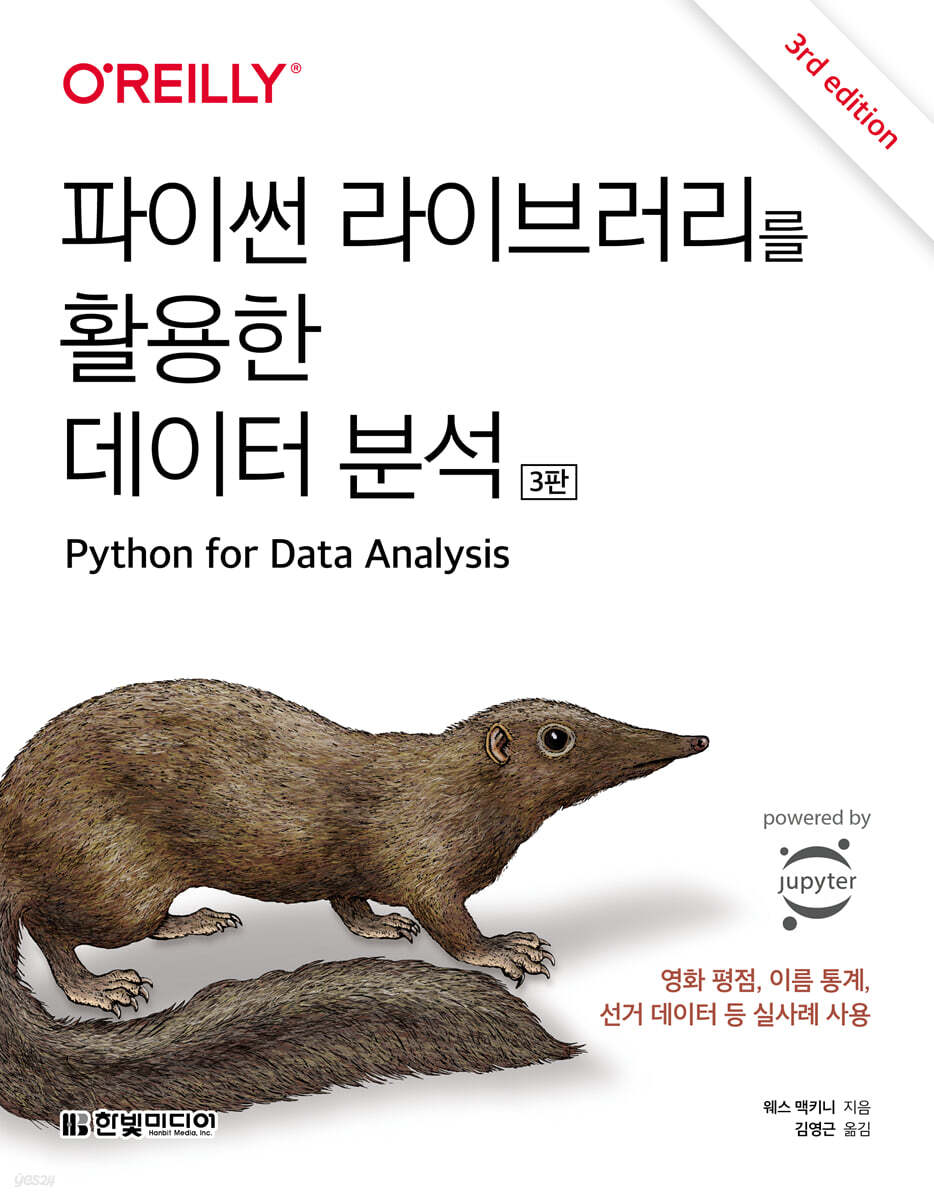 |
Description
Book Introduction
The most complete way to learn data analysis
From how to use Python libraries to hands-on practice using real data.
The trusted and respected Python data analysis book is back in its third edition.
Wes McKinney, the creator of the Python Pandas project, explains how to use Python libraries in a practical and modern way.
The content has been updated based on the latest versions of Python and Pandas, and various examples are examined to learn how to effectively solve data analysis problems.
We introduce various Python libraries, including Pandas, NumPy, IPython, Matplotlib, and Jupyter, and cover not only new features but also advanced usage methods that reduce memory usage and improve performance.
We also introduce the modeling tool statsmodels and the scikit-learn library.
Let's practice with real data, such as newborn name statistics and a presidential election database, and become experts who select the right tools for the data and analyze it effectively.
From how to use Python libraries to hands-on practice using real data.
The trusted and respected Python data analysis book is back in its third edition.
Wes McKinney, the creator of the Python Pandas project, explains how to use Python libraries in a practical and modern way.
The content has been updated based on the latest versions of Python and Pandas, and various examples are examined to learn how to effectively solve data analysis problems.
We introduce various Python libraries, including Pandas, NumPy, IPython, Matplotlib, and Jupyter, and cover not only new features but also advanced usage methods that reduce memory usage and improve performance.
We also introduce the modeling tool statsmodels and the scikit-learn library.
Let's practice with real data, such as newborn name statistics and a presidential election database, and become experts who select the right tools for the data and analyze it effectively.
- You can preview some of the book's contents.
Preview
index
CHAPTER 1 Before You Begin
1.1 Contents covered
1.2 Why Use Python for Data Analysis?
1.3 Required Python Libraries
1.4 Installation and Setup
1.5 Community and Conference
1.6 How to Explore This Book
CHAPTER 2 Python Basics, IPython, and Jupyter Notebooks
2.1 Python Interpreter
2.2. IPython Basics
2.3 Python Basics
2.4 In conclusion
CHAPTER 3 Built-in data structures, functions, and files
3.1 Data Structures and Sequential Data Types
3.2 Function
3.3 Files and the Operating System
3.4 In conclusion
CHAPTER 4 NumPy Basics: Array and Vector Operations
4.1 Multidimensional array object ndarray
4.2 Random number generation
4.3 Universal functions: functions that quickly process each element of an array.
4.4 Array-based programming using arrays
4.5 File input/output of array data
4.6 Linear Algebra
4.7 Example of climbing stairs
4.8 In conclusion
CHAPTER 5: GETTING STARTED WITH PANDAS
5.1 Introduction to Pandas Data Structures
5.2 Core Features
5.3 Calculating and summarizing descriptive statistics
5.4 In conclusion
CHAPTER 6 Data Loading and Saving, File Formats
6.1 How to read and write data from text files
6.2 Binary Data Format
6.3 Using with Web APIs
6.4 Using with a Database
6.5 In conclusion
CHAPTER 7 DATA CLEANING AND PREPARATION
7.1 Handling Missing Data
7.2 Data Transformation
7.3 Extended Data Types
7.4 Handling Strings
7.5 Categorical data
7.6 In conclusion
CHAPTER 8 Preparing Data: Joins, Merging, and Transformations
8.1 Hierarchical Index
8.2 Merging Data
8.3 Reconfiguration and Pivot
8.4 In conclusion
CHAPTER 9 GRAPHS AND VISUALIZATIONS
9.1 A Brief Overview of the Matplotlib API
9.2 Drawing Graphs with Seaborn in Pandas
9.3 Other Python Visualization Tools
9.4 In conclusion
CHAPTER 10 DATA AGGREGATION AND GROUP OPERATIONS
10.1 Considerations on Group Operations
10.2 Data Aggregation
10.3 The apply method: Generalized split-apply-merge
10.4 Group transformations and unwrapped groupby
10.5 Pivot Tables and Crosstabulations
10.6 In conclusion
CHAPTER 11 TIME SERIES
11.1 Date and Time Data Types and Tools
11.2 Time Series Basics
11.3 Date range, frequency, and movement
11.4 Handling Time Zones
11.5 Periods and Period Operations
11.6 Resampling and Frequency Conversion
11.7 Moving Window Function
11.8 In conclusion
CHAPTER 12 Python Modeling Libraries
12.1 Interfacing Pandas with Model Code
12.2 Creating a model with patsy
12.3 Introduction to statsmodels
12.4 Introduction to scikit-learn
12.5 In conclusion
CHAPTER 13 DATA ANALYSIS EXAMPLES
13.1 Bitly's 1.USA.gov data
13.2 Movie Lens movie rating data
13.3 Newborn Names
13.4 USDA Nutrient Information
13.5 2012 Federal Election Commission Database
13.6 In conclusion
APPENDIX A Advanced NumPy
A.1 ndarray object structure
A.2 Advanced Array Manipulation Techniques
A.3 Broadcasting
A.4 Advanced ufunc usage
A.5 Structured Arrays and Record Arrays
A.6 Learn more about alignment
A.7 Writing fast NumPy functions using Numba
A.8 Advanced Array Input/Output
A.9 Useful Performance Tips
APPENDIX B: Learn More About the IPython System
B.1 Terminal Keyboard Shortcuts
B.2 Magic Commands
B.3 Using Command History
B.4 Using with the Operating System
B.5 Software Development Tools
B.6 Tips for Productive Code Development Using IPython
B.7 Advanced IPython Features
B.8 In conclusion
1.1 Contents covered
1.2 Why Use Python for Data Analysis?
1.3 Required Python Libraries
1.4 Installation and Setup
1.5 Community and Conference
1.6 How to Explore This Book
CHAPTER 2 Python Basics, IPython, and Jupyter Notebooks
2.1 Python Interpreter
2.2. IPython Basics
2.3 Python Basics
2.4 In conclusion
CHAPTER 3 Built-in data structures, functions, and files
3.1 Data Structures and Sequential Data Types
3.2 Function
3.3 Files and the Operating System
3.4 In conclusion
CHAPTER 4 NumPy Basics: Array and Vector Operations
4.1 Multidimensional array object ndarray
4.2 Random number generation
4.3 Universal functions: functions that quickly process each element of an array.
4.4 Array-based programming using arrays
4.5 File input/output of array data
4.6 Linear Algebra
4.7 Example of climbing stairs
4.8 In conclusion
CHAPTER 5: GETTING STARTED WITH PANDAS
5.1 Introduction to Pandas Data Structures
5.2 Core Features
5.3 Calculating and summarizing descriptive statistics
5.4 In conclusion
CHAPTER 6 Data Loading and Saving, File Formats
6.1 How to read and write data from text files
6.2 Binary Data Format
6.3 Using with Web APIs
6.4 Using with a Database
6.5 In conclusion
CHAPTER 7 DATA CLEANING AND PREPARATION
7.1 Handling Missing Data
7.2 Data Transformation
7.3 Extended Data Types
7.4 Handling Strings
7.5 Categorical data
7.6 In conclusion
CHAPTER 8 Preparing Data: Joins, Merging, and Transformations
8.1 Hierarchical Index
8.2 Merging Data
8.3 Reconfiguration and Pivot
8.4 In conclusion
CHAPTER 9 GRAPHS AND VISUALIZATIONS
9.1 A Brief Overview of the Matplotlib API
9.2 Drawing Graphs with Seaborn in Pandas
9.3 Other Python Visualization Tools
9.4 In conclusion
CHAPTER 10 DATA AGGREGATION AND GROUP OPERATIONS
10.1 Considerations on Group Operations
10.2 Data Aggregation
10.3 The apply method: Generalized split-apply-merge
10.4 Group transformations and unwrapped groupby
10.5 Pivot Tables and Crosstabulations
10.6 In conclusion
CHAPTER 11 TIME SERIES
11.1 Date and Time Data Types and Tools
11.2 Time Series Basics
11.3 Date range, frequency, and movement
11.4 Handling Time Zones
11.5 Periods and Period Operations
11.6 Resampling and Frequency Conversion
11.7 Moving Window Function
11.8 In conclusion
CHAPTER 12 Python Modeling Libraries
12.1 Interfacing Pandas with Model Code
12.2 Creating a model with patsy
12.3 Introduction to statsmodels
12.4 Introduction to scikit-learn
12.5 In conclusion
CHAPTER 13 DATA ANALYSIS EXAMPLES
13.1 Bitly's 1.USA.gov data
13.2 Movie Lens movie rating data
13.3 Newborn Names
13.4 USDA Nutrient Information
13.5 2012 Federal Election Commission Database
13.6 In conclusion
APPENDIX A Advanced NumPy
A.1 ndarray object structure
A.2 Advanced Array Manipulation Techniques
A.3 Broadcasting
A.4 Advanced ufunc usage
A.5 Structured Arrays and Record Arrays
A.6 Learn more about alignment
A.7 Writing fast NumPy functions using Numba
A.8 Advanced Array Input/Output
A.9 Useful Performance Tips
APPENDIX B: Learn More About the IPython System
B.1 Terminal Keyboard Shortcuts
B.2 Magic Commands
B.3 Using Command History
B.4 Using with the Operating System
B.5 Software Development Tools
B.6 Tips for Productive Code Development Using IPython
B.7 Advanced IPython Features
B.8 In conclusion
Detailed image

Publisher's Review
A Guide to Using Data Analysis Libraries from Pandas Core Developers
[Data Analysis Using Python Libraries], which was published as a revised and supplemented edition in 2013 and has been consistently loved by domestic readers up until the second edition in 2019, is now back in its third edition.
Over the past decade, Python has firmly established itself as a popular language widely used in numerous fields, from data science to machine learning and deep learning, and is constantly updated to serve its users.
The third edition has been refined to reflect changes in the latest versions of Python, NumPy, Pandas, and other projects.
As this book is widely used as a textbook in universities and as a reference book in the workplace, we have put a lot of effort into ensuring that its contents remain relevant for years to come.
I hope this book will be a valuable resource for anyone who needs to work with data using Python.
What's changed in the 3rd edition
- Code updated based on Python 3.11 and Pandas 2.0.
- Reflects NumPy 1.23 and the latest version of Jupyter
- Added new content
Categorical data type
Data group transformation and unwrapped groupby
How to Use IPython's Magic Commands and Command History
This book introduces various basic methods of handling data with Python.
Covers the fundamentals of the Python programming language and libraries that help you efficiently solve data analysis problems.
Although the book's title includes "data analysis," it focuses on Python programming, libraries, and tools rather than data analysis methodology.
Target audience
- Data engineers, data scientists, machine learning engineers, and statisticians who are responsible for data analysis practices.
- IT-related undergraduate students who want to analyze data using Python's representative libraries.
Key Contents
- How to use NumPy basics and advanced features
- Loading, cleaning, joining, and transforming data with Pandas
- Creating useful visualizations with Matplotlib
- Dividing and summarizing data using the Pandas groupby function
- Analyzing and manipulating regular and irregular time series data
- Learn how to solve analytical problems by examining real data.
Translator's Note
Just as the printer was about to press out the third Korean edition, the release of Pandas 2.0 brought back memories of when I translated the first edition 10 years ago.
While translating a book written in Pandas 0.14, the process of fixing many parts as new versions kept coming out was incredibly difficult. Fortunately, this time, installing Pandas 2.0, re-examining the example code, sending a PR to the author, and even requesting confirmation was not as difficult as when working on the first edition.
:)
Pandas has become a stable library that can be used together for a long time, and this book has also been able to be read for a long time, as the author hoped.
If you found the second edition helpful, I would recommend it without hesitation to anyone who wants to explore data using Python.
[Data Analysis Using Python Libraries], which was published as a revised and supplemented edition in 2013 and has been consistently loved by domestic readers up until the second edition in 2019, is now back in its third edition.
Over the past decade, Python has firmly established itself as a popular language widely used in numerous fields, from data science to machine learning and deep learning, and is constantly updated to serve its users.
The third edition has been refined to reflect changes in the latest versions of Python, NumPy, Pandas, and other projects.
As this book is widely used as a textbook in universities and as a reference book in the workplace, we have put a lot of effort into ensuring that its contents remain relevant for years to come.
I hope this book will be a valuable resource for anyone who needs to work with data using Python.
What's changed in the 3rd edition
- Code updated based on Python 3.11 and Pandas 2.0.
- Reflects NumPy 1.23 and the latest version of Jupyter
- Added new content
Categorical data type
Data group transformation and unwrapped groupby
How to Use IPython's Magic Commands and Command History
This book introduces various basic methods of handling data with Python.
Covers the fundamentals of the Python programming language and libraries that help you efficiently solve data analysis problems.
Although the book's title includes "data analysis," it focuses on Python programming, libraries, and tools rather than data analysis methodology.
Target audience
- Data engineers, data scientists, machine learning engineers, and statisticians who are responsible for data analysis practices.
- IT-related undergraduate students who want to analyze data using Python's representative libraries.
Key Contents
- How to use NumPy basics and advanced features
- Loading, cleaning, joining, and transforming data with Pandas
- Creating useful visualizations with Matplotlib
- Dividing and summarizing data using the Pandas groupby function
- Analyzing and manipulating regular and irregular time series data
- Learn how to solve analytical problems by examining real data.
Translator's Note
Just as the printer was about to press out the third Korean edition, the release of Pandas 2.0 brought back memories of when I translated the first edition 10 years ago.
While translating a book written in Pandas 0.14, the process of fixing many parts as new versions kept coming out was incredibly difficult. Fortunately, this time, installing Pandas 2.0, re-examining the example code, sending a PR to the author, and even requesting confirmation was not as difficult as when working on the first edition.
:)
Pandas has become a stable library that can be used together for a long time, and this book has also been able to be read for a long time, as the author hoped.
If you found the second edition helpful, I would recommend it without hesitation to anyone who wants to explore data using Python.
GOODS SPECIFICS
- Date of issue: May 1, 2023
- Page count, weight, size: 696 pages | 1,240g | 183*235*28mm
- ISBN13: 9791169210973
- ISBN10: 116921097X
You may also like
카테고리
korean


korean

![GQ KOREA Mark (Monthly): December [2025]](http://librairie.coreenne.fr/cdn/shop/files/8ef265dbbfbf186523ed75ba7319009d.jpg?v=1765340328&width=3840)


