

Habit is spirituality
 |
Description
Book Introduction
2017 [Christianity Today] Book Award Winner Winner of the 2017 Dallas Willard Center Book Award What you love is what you are! The object of our worship captures our hearts. But we do not know why we love other gods instead of the one we are supposed to love. We want to change the world, but often we are unaware of how the world is changing us. In this book, the author helps us realize the power of culture to shape us and the potential of Christian practice to transform us. Worship is the “reservoir of imagination” that nurtures our love and longing so that our efforts to create culture are directed toward God and His kingdom. Therefore, the worship of the church and the community of believers must become the center and focal point of the formation of Christianity and discipleship. The author creatively uses examples from film, literature, and music to resonate with readers, while adding new material on marriage and family, youth ministry, faith, and work. It also offers suggestions for individual and community practices that shape the Christian life. |
- You can preview some of the book's contents.
Preview
index
preface
Chapter 1: What You Love Is You - The Man Who Worships
Chapter 2 You May Not Love What You Think - How to Read the 'Secular' Past
Chapter 3: The Holy Spirit Meets You Where You Are - Historical Worship for the Postmodern Era
Chapter 4: What Story Are You in? - The Narrative Structure of Formative Christian Worship
Chapter 5: Guard Your Heart - The Past of the Family
Chapter 6: Teach Your Children Well - The Past of Faith Education
Chapter 7 You Create What You Want - The Old Testament of Calling
Blessing Prayer
Acknowledgments / Further Reading / Notes / Index
Chapter 1: What You Love Is You - The Man Who Worships
Chapter 2 You May Not Love What You Think - How to Read the 'Secular' Past
Chapter 3: The Holy Spirit Meets You Where You Are - Historical Worship for the Postmodern Era
Chapter 4: What Story Are You in? - The Narrative Structure of Formative Christian Worship
Chapter 5: Guard Your Heart - The Past of the Family
Chapter 6: Teach Your Children Well - The Past of Faith Education
Chapter 7 You Create What You Want - The Old Testament of Calling
Blessing Prayer
Acknowledgments / Further Reading / Notes / Index
Detailed image
Into the book
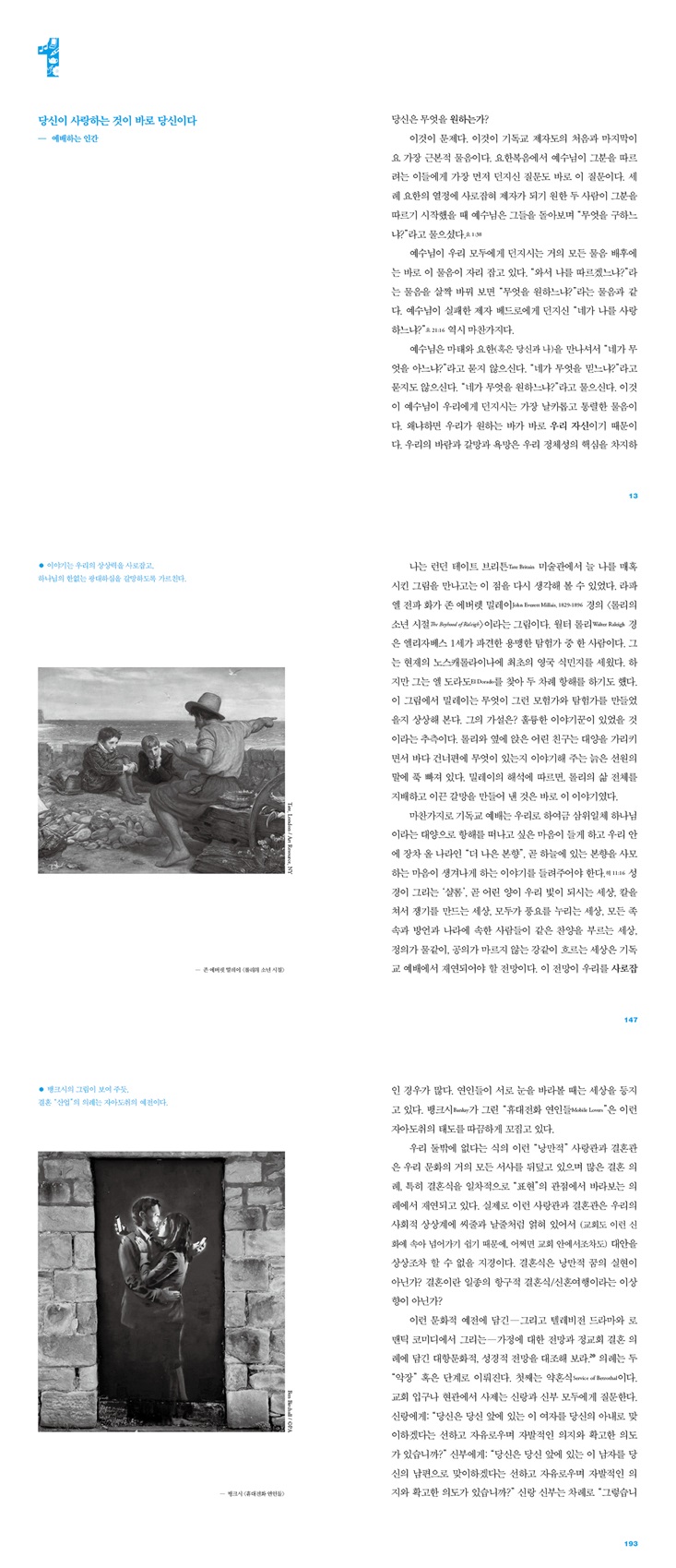
This book addresses the spirituality of cultural creators, showing (I hope) that our immersion in the body of Christ is the heart and driving force of discipleship.
Worship is the “reservoir of imagination” that nurtures our love and longing so that our efforts to create culture are directed toward God and His kingdom.
If you feel passionate about pursuing justice, renewing culture, and fulfilling your calling to unleash the potential of all creation, you must invest in shaping your imagination.
We must worship well.
Because what you love is you.
You worship what you love.
--- From the preface
Discipleship, therefore, is a matter of desire and longing rather than of knowledge and faith.
Jesus' command to follow Him is a command to align our loves and desires with His.
It is a command to want what God wants, to desire what God desires, to yearn and long for God, and to earnestly seek a world where God is all in all.
This is a vision that can be summarized in the abbreviation “Kingdom of God.”
--- From Chapter 1, “You Are What You Love”
The rituals we repeat every day can be read as cultural practices, that is, as “the old days.”
If we wear this lens of the past, we will see the stadium in a completely different way, as a temple of nationalism and militarism.
If you look at college through a traditional lens, you begin to realize that the “ideology” and “message” of the university are often less important than the rituals of its clubs and college athletes.
When we start to think about the rituals that keep us glued to our smartphones all day, rather than just worrying about the content (we see), we will realize that the very form of that practice is full of a self-centered perspective that makes us the center of the universe.
--- From Chapter 2, “You May Not Love What You Think”
Discipleship is a kind of immigration, moving from the kingdom of darkness to the kingdom of the Son of God whom he loves (Col. 1:13).
In Christ we receive a heavenly passport.
Within His body we learn to live as “inhabitants” of that kingdom.
Moving to a new kingdom is not like teleporting to another territory.
You have to get used to a new way of life, learn a new language, and acquire new habits.
We must abandon the habit of competing kingdoms.
Christian worship is the process by which we are transformed into citizens of heaven, people of the coming kingdom.
--- From Chapter 3, “The Holy Spirit Meets You Where You Are”
Christian worship should tell us a story that inspires us to set sail on the ocean of the Triune God and to create in us a longing for a better country, a heavenly one, a country to come (Hebrews 11:16).
The "shalom" envisioned by the Bible—a world where the Lamb is our light, a world where swords are beaten into plowshares, a world where everyone enjoys abundance, a world where people from every tribe, language, and nation sing the same praise, a world where justice flows like water and righteousness like an ever-flowing stream—is a vision that must be reenacted in Christian worship.
This prospect will captivate us.
Not simply because we “know” that this is what God wants, but because the visible practice of Christian worship paints that vision, for example, through the metaphors of biblical stories, the poetry of the Psalms, the rhythm of hymns and choirs, the tangible sacramental elements of bread and wine, and the images painted on stained glass.
All of this influences our imagination and teaches us to want things.
--- From Chapter 4, “What Story Are You In?”
The formative rituals of the family are not simply “private” practices; they have public implications.
Because, like the formation of a community or worship, the formation of a family also ends with sending.
We are not trying to create a “pure” family where we can retreat and hide to protect ourselves from a vast and evil world.
This attitude can only diminish the mission of “go.”
Instead, we want to be intentional about the formative rhythms of the family, and in so doing, let the family become another space of reorientation that shapes us and sends us out into the world to fulfill the cultural mandate and the countercommission, to live as image-bearers of God for and with our neighbors.
--- From Chapter 5, “Guard Your Heart”
Therefore, if education is to be formative, more specifically, if it is to form students in the Christian faith, it must first form those who form them.
If we, as educators, wish to participate in the classical educational project of educating the whole person and training students to love the truth, goodness, and beauty revealed in Christ, we must first be reshaped and transformed.
For example, education reform starts with us.
--- From Chapter 6, “Teach Your Children Well”
If you are what you love and you create what you desire, then to be a faithful creator we must pay attention to how our desires are formed.
We must take good care of our unconscious, the repository of our dominant stories.
Be careful what you worship.
That will determine what you want, and therefore what you create, and how you work.
Worship is the “reservoir of imagination” that nurtures our love and longing so that our efforts to create culture are directed toward God and His kingdom.
If you feel passionate about pursuing justice, renewing culture, and fulfilling your calling to unleash the potential of all creation, you must invest in shaping your imagination.
We must worship well.
Because what you love is you.
You worship what you love.
--- From the preface
Discipleship, therefore, is a matter of desire and longing rather than of knowledge and faith.
Jesus' command to follow Him is a command to align our loves and desires with His.
It is a command to want what God wants, to desire what God desires, to yearn and long for God, and to earnestly seek a world where God is all in all.
This is a vision that can be summarized in the abbreviation “Kingdom of God.”
--- From Chapter 1, “You Are What You Love”
The rituals we repeat every day can be read as cultural practices, that is, as “the old days.”
If we wear this lens of the past, we will see the stadium in a completely different way, as a temple of nationalism and militarism.
If you look at college through a traditional lens, you begin to realize that the “ideology” and “message” of the university are often less important than the rituals of its clubs and college athletes.
When we start to think about the rituals that keep us glued to our smartphones all day, rather than just worrying about the content (we see), we will realize that the very form of that practice is full of a self-centered perspective that makes us the center of the universe.
--- From Chapter 2, “You May Not Love What You Think”
Discipleship is a kind of immigration, moving from the kingdom of darkness to the kingdom of the Son of God whom he loves (Col. 1:13).
In Christ we receive a heavenly passport.
Within His body we learn to live as “inhabitants” of that kingdom.
Moving to a new kingdom is not like teleporting to another territory.
You have to get used to a new way of life, learn a new language, and acquire new habits.
We must abandon the habit of competing kingdoms.
Christian worship is the process by which we are transformed into citizens of heaven, people of the coming kingdom.
--- From Chapter 3, “The Holy Spirit Meets You Where You Are”
Christian worship should tell us a story that inspires us to set sail on the ocean of the Triune God and to create in us a longing for a better country, a heavenly one, a country to come (Hebrews 11:16).
The "shalom" envisioned by the Bible—a world where the Lamb is our light, a world where swords are beaten into plowshares, a world where everyone enjoys abundance, a world where people from every tribe, language, and nation sing the same praise, a world where justice flows like water and righteousness like an ever-flowing stream—is a vision that must be reenacted in Christian worship.
This prospect will captivate us.
Not simply because we “know” that this is what God wants, but because the visible practice of Christian worship paints that vision, for example, through the metaphors of biblical stories, the poetry of the Psalms, the rhythm of hymns and choirs, the tangible sacramental elements of bread and wine, and the images painted on stained glass.
All of this influences our imagination and teaches us to want things.
--- From Chapter 4, “What Story Are You In?”
The formative rituals of the family are not simply “private” practices; they have public implications.
Because, like the formation of a community or worship, the formation of a family also ends with sending.
We are not trying to create a “pure” family where we can retreat and hide to protect ourselves from a vast and evil world.
This attitude can only diminish the mission of “go.”
Instead, we want to be intentional about the formative rhythms of the family, and in so doing, let the family become another space of reorientation that shapes us and sends us out into the world to fulfill the cultural mandate and the countercommission, to live as image-bearers of God for and with our neighbors.
--- From Chapter 5, “Guard Your Heart”
Therefore, if education is to be formative, more specifically, if it is to form students in the Christian faith, it must first form those who form them.
If we, as educators, wish to participate in the classical educational project of educating the whole person and training students to love the truth, goodness, and beauty revealed in Christ, we must first be reshaped and transformed.
For example, education reform starts with us.
--- From Chapter 6, “Teach Your Children Well”
If you are what you love and you create what you desire, then to be a faithful creator we must pay attention to how our desires are formed.
We must take good care of our unconscious, the repository of our dominant stories.
Be careful what you worship.
That will determine what you want, and therefore what you create, and how you work.
--- From Chapter 7, “You Create What You Want”
Publisher's Review
Are you your thoughts, or are you your habits? We often believe we act and move according to our thoughts.
But how many actions do we perform without much thought, without even realizing it? Perhaps our daily routines, ingrained as habits, are closer to our true selves.
And what if those habits and routines were actually my spirituality?
What I love is myself
Christianity has traditionally held the adage that “knowledge is power.”
It is assumed that when you know the truth and thus change your perspective, your actions will naturally change accordingly.
They claim that because they do not know, their eyes are blinded and they are ignorant, they repeat foolish actions.
But what about knowledge? Does knowledge change behavior? Why do so many people know Christian teachings so well, yet their behavior remains the same? It's not that knowledge isn't important, but rather that knowledge alone isn't enough.
Augustine said that what we love defines us.
It is not what we think, but what we love that makes us who we are.
Yes, that's right.
The reason your actions don't change is not because your thoughts don't change, but because only your thoughts have changed.
If we can change what we love, only then will our actions begin to change.
Only then will our ‘existence’ change.
Experience, worship, and love
In Desiring the Kingdom, the first book in his trilogy on “cultural liturgy,” James Smith vividly illustrates the liturgy of secular society that changes our behavior and even our identity.
For example, large shopping malls are modern temples preaching the “gospel of consumerism.”
The act of people entering a shopping mall and experiencing the 'grace' within it is similar to religious worship.
A new identity emerges as experiences, not thoughts, change.
The old ways of operating in secular society are everywhere, not just in shopping malls.
They make us worship them, and ultimately change what we love.
In this way we are born again as new believers.
Even with such a huge tsunami hitting, it is difficult for the church to simply change its thinking.
We are faced with an urgent need to create a desire for the Kingdom of God.
Expansion pack with the core applied
Since its publication, “Desire the Kingdom of God,” which contains such claims, has received keen interest from all walks of life.
The author thought he had written the book at a popular level, but it was a bit too difficult for the average person to digest, so there was a flood of requests to make the book's contents a little easier to understand, and in response to those requests, "Habit is Spirituality" was published.
James Smith has compiled only the key points he has emphasized in his public lectures, and reorganized them by adding new metaphors, images, and examples for better understanding.
In particular, we have applied existing arguments to three areas that were not given much attention in Desire the Kingdom of God.
This is how the chapters on family and home (Chapter 5: The Liturgy of the Family), children and youth (Chapter 6: The Liturgy of Faith Education), and faith and work (Chapter 7: The Liturgy of Vocation) were born.
Since its publication, it has received rave reviews from Publisher's Weekly ("The author's personal story, along with examples from literature, philosophy, film, and art, make this powerful and inspiring study of spiritual formation even more accessible and engaging") and The New York Times ("People are defined primarily by what they desire, not by what they know.")
It has garnered attention from major media outlets and organizations, including [Christianity Today] (“If your New Year’s resolutions always end in failure, you might want to give this book’s arguments a try”) and [Christianity Today] (“If you’re someone who always has three-day resolutions, you might want to give this book a try”), and won the 2017 [Christianity Today] Book Award and the Dallas Willard Center Book Award.
You will benefit even more from the book if you utilize the author's lecture video and 'Discussion Guide' introducing the book's contents.
Readers who wish to engage in a more in-depth discussion after reading this book may wish to tackle the “Cultural Past” trilogy.
But how many actions do we perform without much thought, without even realizing it? Perhaps our daily routines, ingrained as habits, are closer to our true selves.
And what if those habits and routines were actually my spirituality?
What I love is myself
Christianity has traditionally held the adage that “knowledge is power.”
It is assumed that when you know the truth and thus change your perspective, your actions will naturally change accordingly.
They claim that because they do not know, their eyes are blinded and they are ignorant, they repeat foolish actions.
But what about knowledge? Does knowledge change behavior? Why do so many people know Christian teachings so well, yet their behavior remains the same? It's not that knowledge isn't important, but rather that knowledge alone isn't enough.
Augustine said that what we love defines us.
It is not what we think, but what we love that makes us who we are.
Yes, that's right.
The reason your actions don't change is not because your thoughts don't change, but because only your thoughts have changed.
If we can change what we love, only then will our actions begin to change.
Only then will our ‘existence’ change.
Experience, worship, and love
In Desiring the Kingdom, the first book in his trilogy on “cultural liturgy,” James Smith vividly illustrates the liturgy of secular society that changes our behavior and even our identity.
For example, large shopping malls are modern temples preaching the “gospel of consumerism.”
The act of people entering a shopping mall and experiencing the 'grace' within it is similar to religious worship.
A new identity emerges as experiences, not thoughts, change.
The old ways of operating in secular society are everywhere, not just in shopping malls.
They make us worship them, and ultimately change what we love.
In this way we are born again as new believers.
Even with such a huge tsunami hitting, it is difficult for the church to simply change its thinking.
We are faced with an urgent need to create a desire for the Kingdom of God.
Expansion pack with the core applied
Since its publication, “Desire the Kingdom of God,” which contains such claims, has received keen interest from all walks of life.
The author thought he had written the book at a popular level, but it was a bit too difficult for the average person to digest, so there was a flood of requests to make the book's contents a little easier to understand, and in response to those requests, "Habit is Spirituality" was published.
James Smith has compiled only the key points he has emphasized in his public lectures, and reorganized them by adding new metaphors, images, and examples for better understanding.
In particular, we have applied existing arguments to three areas that were not given much attention in Desire the Kingdom of God.
This is how the chapters on family and home (Chapter 5: The Liturgy of the Family), children and youth (Chapter 6: The Liturgy of Faith Education), and faith and work (Chapter 7: The Liturgy of Vocation) were born.
Since its publication, it has received rave reviews from Publisher's Weekly ("The author's personal story, along with examples from literature, philosophy, film, and art, make this powerful and inspiring study of spiritual formation even more accessible and engaging") and The New York Times ("People are defined primarily by what they desire, not by what they know.")
It has garnered attention from major media outlets and organizations, including [Christianity Today] (“If your New Year’s resolutions always end in failure, you might want to give this book’s arguments a try”) and [Christianity Today] (“If you’re someone who always has three-day resolutions, you might want to give this book a try”), and won the 2017 [Christianity Today] Book Award and the Dallas Willard Center Book Award.
You will benefit even more from the book if you utilize the author's lecture video and 'Discussion Guide' introducing the book's contents.
Readers who wish to engage in a more in-depth discussion after reading this book may wish to tackle the “Cultural Past” trilogy.
GOODS SPECIFICS
- Date of issue: April 25, 2018
- Page count, weight, size: 329 pages | 320g | 128*198*16mm
- ISBN13: 9791188255139
- ISBN10: 1188255134
You may also like
카테고리
korean


korean

![GQ KOREA Mark (Monthly): December [2025]](http://librairie.coreenne.fr/cdn/shop/files/8ef265dbbfbf186523ed75ba7319009d.jpg?v=1765340328&width=3840)


