

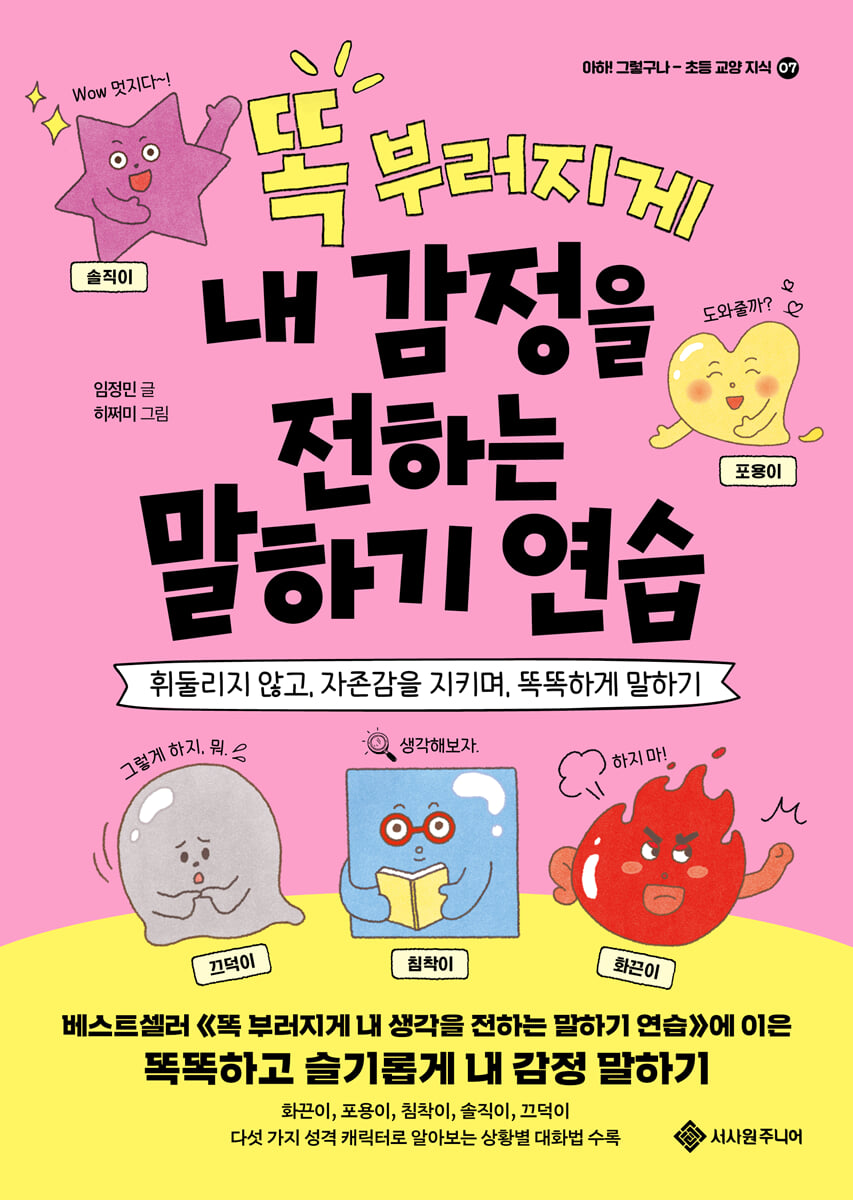
Speaking practice to clearly express my feelings
 |
Description
Book Introduction
Let's become children who can express their emotions clearly!
Depending on your personality, you should speak differently!
Personalized conversation techniques based on personality type and egogram diagnosis
“Don’t ignore it.
“I feel bad.” “I feel like I’m always the one giving in, so it’s unfair.” It takes practice to fully convey what you feel without worrying about what others think or being swayed by them.
The best-selling author of 『Speaking Practice to Clearly Convey Your Thoughts』, Jeongmin Lim, who was the first in Korea to propose speaking methods based on personality type by applying the 'Personality Type Egogram', now teaches you how to clearly convey your feelings to others.
Through the included egogram diagnostic chart and analysis sheet, find out which of the five personality characters you need to strengthen the most: Hot-tempered, Tolerant, Calm, Honest, and Nodding. Also, learn how to convey your emotions to each character by encountering 48 different conversation situations with friends, teachers, and parents in the form of cartoons.
This time, we further strengthened the practice of 'speaking firmly' to deal with serious situations and 'speaking honestly' to express emotions.
In addition, we expanded the scope of conversation to include siblings and adults, as well as online conversations on social media, which have become a daily routine for children, to include more diverse and practical episodes.
If you practice saying your key lines out loud, you will be able to express your feelings clearly and without embarrassment in any situation.
Now, even speaking is tailored to your child's personality! Discover a personalized emotional expression solution for your child.
Depending on your personality, you should speak differently!
Personalized conversation techniques based on personality type and egogram diagnosis
“Don’t ignore it.
“I feel bad.” “I feel like I’m always the one giving in, so it’s unfair.” It takes practice to fully convey what you feel without worrying about what others think or being swayed by them.
The best-selling author of 『Speaking Practice to Clearly Convey Your Thoughts』, Jeongmin Lim, who was the first in Korea to propose speaking methods based on personality type by applying the 'Personality Type Egogram', now teaches you how to clearly convey your feelings to others.
Through the included egogram diagnostic chart and analysis sheet, find out which of the five personality characters you need to strengthen the most: Hot-tempered, Tolerant, Calm, Honest, and Nodding. Also, learn how to convey your emotions to each character by encountering 48 different conversation situations with friends, teachers, and parents in the form of cartoons.
This time, we further strengthened the practice of 'speaking firmly' to deal with serious situations and 'speaking honestly' to express emotions.
In addition, we expanded the scope of conversation to include siblings and adults, as well as online conversations on social media, which have become a daily routine for children, to include more diverse and practical episodes.
If you practice saying your key lines out loud, you will be able to express your feelings clearly and without embarrassment in any situation.
Now, even speaking is tailored to your child's personality! Discover a personalized emotional expression solution for your child.
- You can preview some of the book's contents.
Preview
index
To my parents
To the children
Five personality characters
Read it like this
Before we begin: Diagnosing your personality type
Egogram Analysis Sheet
PART 1: Speak with firmness
1 When a friend does something wrong and doesn't apologize 20
2 When your friend doesn't follow the safety rules 22
3 When a friend steals my lunch 24
4 When your friend throws trash anywhere 26
5 When my friends laugh at me and ignore me 28
6 When your friend plays a dangerous prank 30
7 When I'm the only one left out in a group chat 32
8 When your friend talks rudely about your parents 34
9 When my brothers and sisters hit me 36
10 When Friends Bully a Slow Learner 38
PART 2: Speaking with Empathy through 'Inclusion'
1 When a friend loses his beloved pet 42
2 When a friend cries over something trivial 44
3 When your friend gets annoyed because he can't do what he wants 46
4 When you have a friend who doesn't get along with others and plays alone 48
5 When a friend falls while running 50
6 When you bring another friend to your appointment 52
7 When a friend asks for help running for office 54
8 When a Competitive Friend Ruins the Game 56
9 When you have to help your parents with housework 58
PART 3: Speaking Coherently with 'Calmness'
1 When to introduce yourself in the new semester 62
2 When preparing a presidential election speech 64
*Example Speech 66
3 When you are having trouble deciding which side to go for 68
4 When you get lost outside 70
5 When an online friend asks to see my picture 72
6 When siblings argue and do not give in to each other 74
7 When my younger sibling does something wrong and blames me 76
8 When you don't understand the teacher's explanation well 78
PART 4: Expressing Emotions with Honesty
1 When I heard a compliment from a friend 82
2 When your friend is acting like he's a know-it-all 84
3 When your friend insists on sitting next to you 86
4 When you are recommended to do something you don't want to do 88
5 When you feel bad about your friends' jokes 90
6 When a friend prevents you from playing with other friends 92
7 When my friends don't like my SNS posts 94
8 When I received a DM attacking me 96
98 when you snipe me with status messages
10 When your parents ask you to give in to your younger sibling 100
11 When you need some alone time 102
12 When to Talk to Your Teacher About an Uncomfortable Friendship 104
13 When it's awkward to greet your relatives 106
PART 5: Speaking with a 'nod'
1 When a friend declares a breakup 110
2 When you make a slip of the tongue during a conversation 112
3 When a friend feels left out and gets upset 114
4 When your favorite friend likes another friend 116
5 When a friend doesn't respond to my message 118
6 When you get caught lying to your parents 120
7 When your parents tell you to go to sleep alone 122
8 When you get scolded by an adult 124
Appendix 1: Personality Character-Specific Speaking Instruction Methods 126
Appendix 2: Speaking Practice 30 Sentences 128
Appendix 3: Emotional Word Table 131
To the children
Five personality characters
Read it like this
Before we begin: Diagnosing your personality type
Egogram Analysis Sheet
PART 1: Speak with firmness
1 When a friend does something wrong and doesn't apologize 20
2 When your friend doesn't follow the safety rules 22
3 When a friend steals my lunch 24
4 When your friend throws trash anywhere 26
5 When my friends laugh at me and ignore me 28
6 When your friend plays a dangerous prank 30
7 When I'm the only one left out in a group chat 32
8 When your friend talks rudely about your parents 34
9 When my brothers and sisters hit me 36
10 When Friends Bully a Slow Learner 38
PART 2: Speaking with Empathy through 'Inclusion'
1 When a friend loses his beloved pet 42
2 When a friend cries over something trivial 44
3 When your friend gets annoyed because he can't do what he wants 46
4 When you have a friend who doesn't get along with others and plays alone 48
5 When a friend falls while running 50
6 When you bring another friend to your appointment 52
7 When a friend asks for help running for office 54
8 When a Competitive Friend Ruins the Game 56
9 When you have to help your parents with housework 58
PART 3: Speaking Coherently with 'Calmness'
1 When to introduce yourself in the new semester 62
2 When preparing a presidential election speech 64
*Example Speech 66
3 When you are having trouble deciding which side to go for 68
4 When you get lost outside 70
5 When an online friend asks to see my picture 72
6 When siblings argue and do not give in to each other 74
7 When my younger sibling does something wrong and blames me 76
8 When you don't understand the teacher's explanation well 78
PART 4: Expressing Emotions with Honesty
1 When I heard a compliment from a friend 82
2 When your friend is acting like he's a know-it-all 84
3 When your friend insists on sitting next to you 86
4 When you are recommended to do something you don't want to do 88
5 When you feel bad about your friends' jokes 90
6 When a friend prevents you from playing with other friends 92
7 When my friends don't like my SNS posts 94
8 When I received a DM attacking me 96
98 when you snipe me with status messages
10 When your parents ask you to give in to your younger sibling 100
11 When you need some alone time 102
12 When to Talk to Your Teacher About an Uncomfortable Friendship 104
13 When it's awkward to greet your relatives 106
PART 5: Speaking with a 'nod'
1 When a friend declares a breakup 110
2 When you make a slip of the tongue during a conversation 112
3 When a friend feels left out and gets upset 114
4 When your favorite friend likes another friend 116
5 When a friend doesn't respond to my message 118
6 When you get caught lying to your parents 120
7 When your parents tell you to go to sleep alone 122
8 When you get scolded by an adult 124
Appendix 1: Personality Character-Specific Speaking Instruction Methods 126
Appendix 2: Speaking Practice 30 Sentences 128
Appendix 3: Emotional Word Table 131
Detailed image

Publisher's Review
Situational Conversation Skills: Understanding Five Personality Characters
When your friends ignore you in group chats, when a friend declares they've cut ties with you, when your parents ask you to give in, when you have to introduce yourself for the new semester... There are many moments when you wonder, "What should I say in these situations?"
Among the five personality characters - 'Hwa-geun-i, To-yong-i, Calm-i, Honest-i, and Nod-i' - choose the appropriate character for each situation and practice conveying what you want to say more effectively.
For example, if someone is being rude, I speak with a firm and fiery temper, if a friend needs empathy, I speak with a considerate and tolerant one, and when I need to convey my feelings, I speak with an expressive and honest one.
Remember that being kind and nice isn't always the right answer!
Practice speaking with vivid dialogue that can be used in real life.
You can't make the lines your own just by reading them with your eyes.
This book's unique speaking solution is to actually speak out loud! Observe carefully how the cartoon characters speak, and imagine yourself as each character, repeating key lines over and over again.
It is only effective if you practice as if it were a real-life situation.
For example, Hwa-geun's line, "Don't steal my side dish," is said with a serious expression and firm tone of voice, while Chi-pum's line, "I'm sorry, teacher, but could you say that again?" is said with a calm attitude and calm tone of voice.
From broadening your thinking to speaking coaching based on your personality type.
'Ignoring, etiquette, slow learner, cooperation, lying, independence, SNS...' We've included questions to think about along with keywords for each situation.
Organizing your thoughts on various topics will help you better convey your opinions when you have a conversation about them. I've included three supplementary materials so you can practice speaking coaching at home.
① Speaking instruction method by personality character: If you practice regularly, you will be able to immediately say the appropriate words in situations where you need to communicate using that character.
② Speaking Practice 30 Sentences: I have compiled words that empathize with children, words that help children think and make decisions, and words that foster children’s self-efficacy and agency.
③ Emotion Word Table: Help your child express their feelings more accurately by referring to various emotion words.
When your friends ignore you in group chats, when a friend declares they've cut ties with you, when your parents ask you to give in, when you have to introduce yourself for the new semester... There are many moments when you wonder, "What should I say in these situations?"
Among the five personality characters - 'Hwa-geun-i, To-yong-i, Calm-i, Honest-i, and Nod-i' - choose the appropriate character for each situation and practice conveying what you want to say more effectively.
For example, if someone is being rude, I speak with a firm and fiery temper, if a friend needs empathy, I speak with a considerate and tolerant one, and when I need to convey my feelings, I speak with an expressive and honest one.
Remember that being kind and nice isn't always the right answer!
Practice speaking with vivid dialogue that can be used in real life.
You can't make the lines your own just by reading them with your eyes.
This book's unique speaking solution is to actually speak out loud! Observe carefully how the cartoon characters speak, and imagine yourself as each character, repeating key lines over and over again.
It is only effective if you practice as if it were a real-life situation.
For example, Hwa-geun's line, "Don't steal my side dish," is said with a serious expression and firm tone of voice, while Chi-pum's line, "I'm sorry, teacher, but could you say that again?" is said with a calm attitude and calm tone of voice.
From broadening your thinking to speaking coaching based on your personality type.
'Ignoring, etiquette, slow learner, cooperation, lying, independence, SNS...' We've included questions to think about along with keywords for each situation.
Organizing your thoughts on various topics will help you better convey your opinions when you have a conversation about them. I've included three supplementary materials so you can practice speaking coaching at home.
① Speaking instruction method by personality character: If you practice regularly, you will be able to immediately say the appropriate words in situations where you need to communicate using that character.
② Speaking Practice 30 Sentences: I have compiled words that empathize with children, words that help children think and make decisions, and words that foster children’s self-efficacy and agency.
③ Emotion Word Table: Help your child express their feelings more accurately by referring to various emotion words.
GOODS SPECIFICS
- Date of issue: March 4, 2025
- Page count, weight, size: 132 pages | 272g | 160*225*8mm
- ISBN13: 9791168223882
- ISBN10: 1168223881
- KC Certification: Certification Type: Conformity Confirmation
You may also like
카테고리
korean


korean

![GQ KOREA Mark (Monthly): December [2025]](http://librairie.coreenne.fr/cdn/shop/files/8ef265dbbfbf186523ed75ba7319009d.jpg?v=1765340328&width=3840)


