

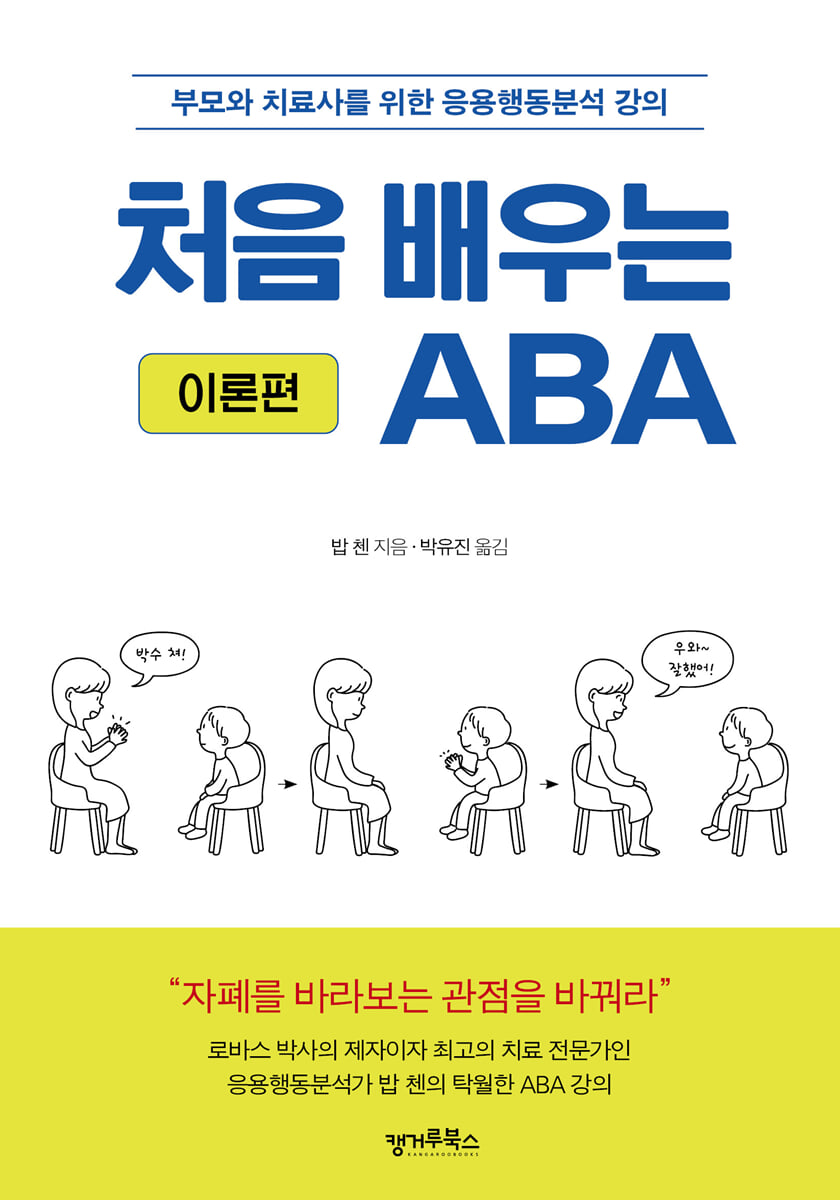
ABA for Beginners: Theory
 |
Description
Book Introduction
People don't expect children with developmental disabilities, including autism spectrum disorder, to lead normal lives.
Because only a very small number of children show signs of overcoming autism spectrum disorder.
However, Bob Chen, a board-certified behavioral analyst (BCBA) and author of ABA for Beginners, argues that ABA can treat autism.
The author suggests that in order to treat children, we must first change our perspective on autism.
This is because autism is a term used to refer to symptoms that commonly appear in children, and is not a real thing.
Autistic children have strengths and weaknesses just like typical children, but they are unique and require different educational approaches.
Therefore, active intervention by parents and therapists is necessary.
Applied Behavior Analysis (ABA) is the only scientifically proven treatment for autism. Early, intensive ABA treatment significantly improves the outcomes of autistic children, as demonstrated by Dr. Robas's experiments in the 1980s.
Above all, if parents learn ABA and provide treatment directly at home, the possibility of recovery increases.
The book presents the principles and methods of ABA therapy based on the author's extensive experience in therapy.
It covers basic concepts of behavior, behavior problem methods, principles that parents and therapists must follow, and effective teaching methods for children with autism, including discrete sequential trials (DTT) and non-instructive teaching (NCT).
Each topic is infused with the author's experience, making it easy for readers to understand.
The author, a disciple of Dr. Robas, learned ABA from him and has since developed his own treatment method by further improving the level of ABA.
He also demonstrated outstanding therapeutic skills by participating in numerous clinical trials where he actually treated children, rather than simply knowing the ABA theory.
If you watch the video of him treating a child, you can see that the child, who was difficult for even the parents to handle, has changed in an amazing way.
Another great thing about this book is that it allows you to watch related videos directly using QR codes in the book.
Because only a very small number of children show signs of overcoming autism spectrum disorder.
However, Bob Chen, a board-certified behavioral analyst (BCBA) and author of ABA for Beginners, argues that ABA can treat autism.
The author suggests that in order to treat children, we must first change our perspective on autism.
This is because autism is a term used to refer to symptoms that commonly appear in children, and is not a real thing.
Autistic children have strengths and weaknesses just like typical children, but they are unique and require different educational approaches.
Therefore, active intervention by parents and therapists is necessary.
Applied Behavior Analysis (ABA) is the only scientifically proven treatment for autism. Early, intensive ABA treatment significantly improves the outcomes of autistic children, as demonstrated by Dr. Robas's experiments in the 1980s.
Above all, if parents learn ABA and provide treatment directly at home, the possibility of recovery increases.
The book presents the principles and methods of ABA therapy based on the author's extensive experience in therapy.
It covers basic concepts of behavior, behavior problem methods, principles that parents and therapists must follow, and effective teaching methods for children with autism, including discrete sequential trials (DTT) and non-instructive teaching (NCT).
Each topic is infused with the author's experience, making it easy for readers to understand.
The author, a disciple of Dr. Robas, learned ABA from him and has since developed his own treatment method by further improving the level of ABA.
He also demonstrated outstanding therapeutic skills by participating in numerous clinical trials where he actually treated children, rather than simply knowing the ABA theory.
If you watch the video of him treating a child, you can see that the child, who was difficult for even the parents to handle, has changed in an amazing way.
Another great thing about this book is that it allows you to watch related videos directly using QR codes in the book.
- You can preview some of the book's contents.
Preview
index
Recommendation
Author's Preface
Chapter 1: Autism Spectrum Disorder and ABA
1.
Change your perspective on autism
2.
That's why ABA is needed
3. The amazing results of ABA therapy
4.
The importance of early intensive treatment
Manage habits before they become established
Why Parents Should Be Involved in Treatment
ABA starts at home
The child's compliance is important.
Chapter 2: Getting Started with ABA
1. The concept of 'behavior' as defined by ABA
What is action?
ABA, always by our side
2.
Different behavioral changes for different people
You need inner motivation to change your behavior.
Let's abandon the idea that there are limits to a child's growth.
If you want to change behavior, first observe the behavior.
● I'm curious
3.
Function of behavior
interest
Avoidance or escape
Get what you want
sensory stimulation
Understanding the Function of Behavior: Even the same behavior has different functions depending on its purpose.
● I'm curious
4.
behavioral terms
Strengthening and punishment
Reinforcement and strengtheners
How to give reinforcement
elimination
Eradication explosion
The meaning of 'positive' and 'negative' in behavioral terms
Positive reinforcement and negative reinforcement, positive punishment and negative punishment
Example 1 of positive reinforcement, positive punishment, negative reinforcement, and negative punishment
Example 2 of positive reinforcement, positive punishment, negative reinforcement, and negative punishment
Conditioning
operant conditioning
classical conditioning
● Food for thought - The difference between reinforcement and bribery
Chapter 3: What Can We Teach with ABA?
1.
Eliminating problem behaviors that interfere with learning
Behavior Intervention Technique 1: Take Control From Your Child
Problem Behavior Intervention #2: Start as soon as possible.
Problem Behavior Intervention Tip 3: Fight Only When You Have the Strength
Problem Behavior Intervention Technique 4: Engage Carefully
2.
Behavioral interventions to change behavior
Individuality of behavioral interventions
Reinforce appropriate behavior
Punishment and eradication
3.
Things to be careful of when using bees
Don't punish when you're angry
Stop just threatening with words.
Don't give too many chances
Don't add more punishment to the punishment
:The more punishment there is, the stronger the child's resistance becomes, and this vicious cycle repeats itself.
Use strong punishments from the beginning for risky problem behaviors.
Use punishment consistently
4.
Other common mistakes parents make
Pay attention to negative behavior
Giving excessive help to children
The habit of explaining things with words only
A complex approach to simple problems
Make a fuss over trivial things
Behavioral intervention outside the home
5.
Towards a better solution, not self-reproach
● I'm curious
Chapter 4: ABA: An Effective Educational Method for Unleashing Your Child's Potential
1.
Set goals and create a teaching plan
Start with simple techniques
Individualized Instruction: Teaching Your Child at Their Level
2.
Be clear when giving instructions.
Instructions are conveyed clearly.
Prepare precise requirements
3.
Provide appropriate assistance with prompting
Providing appropriate support for children to succeed
Urge
Types of urging
Effectively guiding children to success
Consistent Urging
Pointless urging leads to trial and error.
Do not continue to use failed prompts
Using prompting strategies appropriate to the skills you teach
4.
Give feedback accurately
Correct? Incorrect? Clear Feedback
Provide feedback accurately, concisely, and clearly.
5.
What else do you need to know to be an effective teacher?
Identifying a Child Who Has No Attention
Place stimulants (textbooks/teaching aids) in appropriate locations
Wait until the child sees the stimulus
Moving the stimulus for active learning
If your child is trying, shorten the teaching time.
Chapter 5 ABA Teaching Method 1 - Discontinuous Discrete Trial (DTT)
1.
What is the Discontinuous Individual Trial Method?
2.
Components of the Discontinuous Individual Trial Teaching Method
All teaching materials related to discriminative stimuli, instructions, and directions
Discriminative stimuli, clarifying
Discriminative stimuli, keep it simple
Discriminative stimuli, maintaining consistency
Three types of reactions a child exhibits: correct, incorrect, and no response.
Reactions always require a time constraint.
Reinforcing stimulus: reinforcement provided when a correct response is shown
Reinforcement is provided according to the difficulty of the task.
Give feedback with an emotionless "no" to misreactions and no response.
Feedback is provided immediately
The meaning of urging and things to watch out for
Urge and infallible lessons
Trial and error learning without prompting relies on luck.
Prompts should always be given immediately after a command.
3.
Progression of the discontinuous individual trial teaching method
Chapter 6: ABA Teaching Methods 2 - Non-Conductive Teaching (NCT)
1.
What is Non-College Teaching (NCT)?
2.
How to proceed with non-instructional teaching
Select 10 topics to teach
What you learn from NCT is confirmed with DTT.
3.
How to Use Non-Instructional Teaching Methods
4.
Principles and Effects of Non-Instructional Teaching
● Feedback and reinforcement/punishment are not the same
Epilogue - Even in this bleak reality, I hope you walk while looking at the stars.
Parents who received ABA training from Mr. Bob
Author's Preface
Chapter 1: Autism Spectrum Disorder and ABA
1.
Change your perspective on autism
2.
That's why ABA is needed
3. The amazing results of ABA therapy
4.
The importance of early intensive treatment
Manage habits before they become established
Why Parents Should Be Involved in Treatment
ABA starts at home
The child's compliance is important.
Chapter 2: Getting Started with ABA
1. The concept of 'behavior' as defined by ABA
What is action?
ABA, always by our side
2.
Different behavioral changes for different people
You need inner motivation to change your behavior.
Let's abandon the idea that there are limits to a child's growth.
If you want to change behavior, first observe the behavior.
● I'm curious
3.
Function of behavior
interest
Avoidance or escape
Get what you want
sensory stimulation
Understanding the Function of Behavior: Even the same behavior has different functions depending on its purpose.
● I'm curious
4.
behavioral terms
Strengthening and punishment
Reinforcement and strengtheners
How to give reinforcement
elimination
Eradication explosion
The meaning of 'positive' and 'negative' in behavioral terms
Positive reinforcement and negative reinforcement, positive punishment and negative punishment
Example 1 of positive reinforcement, positive punishment, negative reinforcement, and negative punishment
Example 2 of positive reinforcement, positive punishment, negative reinforcement, and negative punishment
Conditioning
operant conditioning
classical conditioning
● Food for thought - The difference between reinforcement and bribery
Chapter 3: What Can We Teach with ABA?
1.
Eliminating problem behaviors that interfere with learning
Behavior Intervention Technique 1: Take Control From Your Child
Problem Behavior Intervention #2: Start as soon as possible.
Problem Behavior Intervention Tip 3: Fight Only When You Have the Strength
Problem Behavior Intervention Technique 4: Engage Carefully
2.
Behavioral interventions to change behavior
Individuality of behavioral interventions
Reinforce appropriate behavior
Punishment and eradication
3.
Things to be careful of when using bees
Don't punish when you're angry
Stop just threatening with words.
Don't give too many chances
Don't add more punishment to the punishment
:The more punishment there is, the stronger the child's resistance becomes, and this vicious cycle repeats itself.
Use strong punishments from the beginning for risky problem behaviors.
Use punishment consistently
4.
Other common mistakes parents make
Pay attention to negative behavior
Giving excessive help to children
The habit of explaining things with words only
A complex approach to simple problems
Make a fuss over trivial things
Behavioral intervention outside the home
5.
Towards a better solution, not self-reproach
● I'm curious
Chapter 4: ABA: An Effective Educational Method for Unleashing Your Child's Potential
1.
Set goals and create a teaching plan
Start with simple techniques
Individualized Instruction: Teaching Your Child at Their Level
2.
Be clear when giving instructions.
Instructions are conveyed clearly.
Prepare precise requirements
3.
Provide appropriate assistance with prompting
Providing appropriate support for children to succeed
Urge
Types of urging
Effectively guiding children to success
Consistent Urging
Pointless urging leads to trial and error.
Do not continue to use failed prompts
Using prompting strategies appropriate to the skills you teach
4.
Give feedback accurately
Correct? Incorrect? Clear Feedback
Provide feedback accurately, concisely, and clearly.
5.
What else do you need to know to be an effective teacher?
Identifying a Child Who Has No Attention
Place stimulants (textbooks/teaching aids) in appropriate locations
Wait until the child sees the stimulus
Moving the stimulus for active learning
If your child is trying, shorten the teaching time.
Chapter 5 ABA Teaching Method 1 - Discontinuous Discrete Trial (DTT)
1.
What is the Discontinuous Individual Trial Method?
2.
Components of the Discontinuous Individual Trial Teaching Method
All teaching materials related to discriminative stimuli, instructions, and directions
Discriminative stimuli, clarifying
Discriminative stimuli, keep it simple
Discriminative stimuli, maintaining consistency
Three types of reactions a child exhibits: correct, incorrect, and no response.
Reactions always require a time constraint.
Reinforcing stimulus: reinforcement provided when a correct response is shown
Reinforcement is provided according to the difficulty of the task.
Give feedback with an emotionless "no" to misreactions and no response.
Feedback is provided immediately
The meaning of urging and things to watch out for
Urge and infallible lessons
Trial and error learning without prompting relies on luck.
Prompts should always be given immediately after a command.
3.
Progression of the discontinuous individual trial teaching method
Chapter 6: ABA Teaching Methods 2 - Non-Conductive Teaching (NCT)
1.
What is Non-College Teaching (NCT)?
2.
How to proceed with non-instructional teaching
Select 10 topics to teach
What you learn from NCT is confirmed with DTT.
3.
How to Use Non-Instructional Teaching Methods
4.
Principles and Effects of Non-Instructional Teaching
● Feedback and reinforcement/punishment are not the same
Epilogue - Even in this bleak reality, I hope you walk while looking at the stars.
Parents who received ABA training from Mr. Bob
Detailed image

Into the book
Autism should not be recognized as a reality.
Parents who want their children to develop must first abandon the idea that autism is real.
If you accept autism as a reality, you will blame it on your child's autism when they behave inappropriately.
---p.24 From “Change Your Perspective on Autism”
Teaching an autistic child to do something they cannot accept is extremely difficult.
Applied Behavior Analysis (ABA) is a solution to these difficulties.
---p.30 From "That's why ABA is needed"
Although various autism treatments have emerged, most have not undergone proper validation. ABA is the only treatment based on scientific research, making it trustworthy.
---p.33 From "That's why ABA is needed"
The need for parents to be involved in treatment cannot be overemphasized.
Parents should continue treatment at home to the extent that the child cannot tell the difference between receiving treatment and not receiving treatment.
The greater the parental involvement, the higher the child's treatment success rate.
---p.43 From “The Importance of Early Intensive Treatment”
People unconsciously use ABA principles in their daily lives, whether they know it or not. ABA principles are like the principles of gravity.
Just as gravity has always existed even though it cannot be seen, the principle of ABA has always existed.
It's just that scholars discovered the principle and named it ABA.
---p.51 From “The Concept of ‘Behavior’ According to ABA”
Applying ABA principles is similar to cooking.
Some people make delicious food with just their talent and experience, even if they don't know how to cook well.
Some people can't get the flavor of their food to taste right, even when they follow a recipe exactly. ABA is similar.
Some people are excellent at teaching children according to ABA principles even without knowing ABA theory, while others are unable to teach children properly even after studying ABA theory.
---pp.51-52 From “The Concept of ‘Behavior’ According to ABA”
If you want to change your child's behavior and improve his or her life, you can't limit his or her growth.
If you want to be a good therapist, you must first let go of the idea that there are limits to what a child can learn while teaching him.
A teacher who places limits on a child's development is giving up before even teaching.
---p.61 From “Behavioral changes that differ from person to person”
Failure to properly recognize the purpose of a behavior can lead to unintentional reinforcement of inappropriate behaviors or failure to reinforce appropriate behaviors.
---p.79 From “The Function of Behavior”
If problem behavior is left untreated, it will be difficult for the child to develop.
To bring out the hidden abilities within a child, problem behaviors must be addressed and eliminated one by one.
---p.120 From “Eliminating Problem Behaviors That Interfere with Learning”
Managing a child's problem behavior and teaching alternative behaviors is called behavior intervention.
Any attempt to change a child's behavior is a behavioral intervention.
Behavioral intervention is largely comprised of the processes of reinforcement and punishment/extinction.
Reinforcement is used to encourage behavior, and punishment is used to reduce or eliminate behavior.
---p.128 From “Behavioral Interventions to Change Behavior”
The attitude of wanting to take meticulous care of one's child is something all parents have in common.
No matter how much you do to love and cherish your child, parents feel like it's not enough.
I completely understand that feeling, but if it goes too far, it can actually ruin the child.
---p.154 From “Other Mistakes Parents Frequently Make”
If you want to teach your child a skill, you shouldn't start with difficult skills.
You should start with the easiest one.
---p.172 From “Set a goal and make a teaching plan”
When a child starts a new program, don't give them a chance to fail; help them right away.
If necessary, demonstrate how to do it and provide appropriate assistance to help your child succeed in the task.
Parents who want their children to develop must first abandon the idea that autism is real.
If you accept autism as a reality, you will blame it on your child's autism when they behave inappropriately.
---p.24 From “Change Your Perspective on Autism”
Teaching an autistic child to do something they cannot accept is extremely difficult.
Applied Behavior Analysis (ABA) is a solution to these difficulties.
---p.30 From "That's why ABA is needed"
Although various autism treatments have emerged, most have not undergone proper validation. ABA is the only treatment based on scientific research, making it trustworthy.
---p.33 From "That's why ABA is needed"
The need for parents to be involved in treatment cannot be overemphasized.
Parents should continue treatment at home to the extent that the child cannot tell the difference between receiving treatment and not receiving treatment.
The greater the parental involvement, the higher the child's treatment success rate.
---p.43 From “The Importance of Early Intensive Treatment”
People unconsciously use ABA principles in their daily lives, whether they know it or not. ABA principles are like the principles of gravity.
Just as gravity has always existed even though it cannot be seen, the principle of ABA has always existed.
It's just that scholars discovered the principle and named it ABA.
---p.51 From “The Concept of ‘Behavior’ According to ABA”
Applying ABA principles is similar to cooking.
Some people make delicious food with just their talent and experience, even if they don't know how to cook well.
Some people can't get the flavor of their food to taste right, even when they follow a recipe exactly. ABA is similar.
Some people are excellent at teaching children according to ABA principles even without knowing ABA theory, while others are unable to teach children properly even after studying ABA theory.
---pp.51-52 From “The Concept of ‘Behavior’ According to ABA”
If you want to change your child's behavior and improve his or her life, you can't limit his or her growth.
If you want to be a good therapist, you must first let go of the idea that there are limits to what a child can learn while teaching him.
A teacher who places limits on a child's development is giving up before even teaching.
---p.61 From “Behavioral changes that differ from person to person”
Failure to properly recognize the purpose of a behavior can lead to unintentional reinforcement of inappropriate behaviors or failure to reinforce appropriate behaviors.
---p.79 From “The Function of Behavior”
If problem behavior is left untreated, it will be difficult for the child to develop.
To bring out the hidden abilities within a child, problem behaviors must be addressed and eliminated one by one.
---p.120 From “Eliminating Problem Behaviors That Interfere with Learning”
Managing a child's problem behavior and teaching alternative behaviors is called behavior intervention.
Any attempt to change a child's behavior is a behavioral intervention.
Behavioral intervention is largely comprised of the processes of reinforcement and punishment/extinction.
Reinforcement is used to encourage behavior, and punishment is used to reduce or eliminate behavior.
---p.128 From “Behavioral Interventions to Change Behavior”
The attitude of wanting to take meticulous care of one's child is something all parents have in common.
No matter how much you do to love and cherish your child, parents feel like it's not enough.
I completely understand that feeling, but if it goes too far, it can actually ruin the child.
---p.154 From “Other Mistakes Parents Frequently Make”
If you want to teach your child a skill, you shouldn't start with difficult skills.
You should start with the easiest one.
---p.172 From “Set a goal and make a teaching plan”
When a child starts a new program, don't give them a chance to fail; help them right away.
If necessary, demonstrate how to do it and provide appropriate assistance to help your child succeed in the task.
---p.179 From “Give appropriate help with prompting”
Publisher's Review
ABA therapy that changes your child's life!
If you want to be a good therapist
Let go of the idea that children's abilities are limited.
ABA is a behavioral correction method that is useful not only for children with developmental disabilities but also for raising children without developmental disabilities.
The author of the book, Bob Chen, is a disciple of Dr. Robas, who established Applied Behavior Analysis (ABA), and is a leading therapist who has established his own unique ABA theory through extensive clinical treatment.
《ABA for Beginners》 is a book that systematically organizes the unique treatment method he established.
He first suggests changing the perspective on developmental disabilities.
This is because developmental disabilities, including autism, are not a real thing, but rather a term used to refer to symptoms that commonly appear in children.
Children with developmental disabilities have strengths and weaknesses just like other children, but they are unique and require different educational approaches.
That is why active intervention by parents and therapists is necessary.
The author also argues that all parents should become ABA therapists.
This is because treatment by a therapist alone has limitations.
A therapist cannot fill every waking moment of a child.
Parents must be involved in the treatment design and program to continue teaching their child after the therapist has finished treatment.
The success rate of treatment for children also increases if parents continue treatment at home to the point where the child cannot tell the difference between receiving treatment and not receiving treatment.
The author argues that if you want to change your child's behavior and improve his or her life, you shouldn't limit his or her growth.
If parents want to be good therapists, they must first abandon the idea that there are limits to what children can learn while teaching them.
Because teachers who place limits on children's development are already declaring that they have given up on teaching before they even begin.
With this premise, the author presents specific methods for parents and therapists to practically treat children.
Author's Note
I am always moved when I see Korean parents sacrifice and dedicate themselves to their children.
Korean parents care for their children with a passion and dedication unmatched in any other country in the world.
If it helps my children, I don't hesitate to participate in education, even late at night or early in the morning, to learn as much as possible.
Even at two or three in the morning, he showed his passion for participating in training.
It's awe-inspiring to see Korean parents pushing themselves to the limit and giving their best to their children.
So, I think that ABA therapy is a more suitable treatment for Korean parents, and that it is a treatment that Korean parents can do better than people from other countries.
Maybe your child is still
They will exhibit a variety of problem behaviors.
If you look beyond your child's present to tomorrow, the day after tomorrow, and even five years from now, your child's future will definitely change.
If you want to be a good therapist
Let go of the idea that children's abilities are limited.
ABA is a behavioral correction method that is useful not only for children with developmental disabilities but also for raising children without developmental disabilities.
The author of the book, Bob Chen, is a disciple of Dr. Robas, who established Applied Behavior Analysis (ABA), and is a leading therapist who has established his own unique ABA theory through extensive clinical treatment.
《ABA for Beginners》 is a book that systematically organizes the unique treatment method he established.
He first suggests changing the perspective on developmental disabilities.
This is because developmental disabilities, including autism, are not a real thing, but rather a term used to refer to symptoms that commonly appear in children.
Children with developmental disabilities have strengths and weaknesses just like other children, but they are unique and require different educational approaches.
That is why active intervention by parents and therapists is necessary.
The author also argues that all parents should become ABA therapists.
This is because treatment by a therapist alone has limitations.
A therapist cannot fill every waking moment of a child.
Parents must be involved in the treatment design and program to continue teaching their child after the therapist has finished treatment.
The success rate of treatment for children also increases if parents continue treatment at home to the point where the child cannot tell the difference between receiving treatment and not receiving treatment.
The author argues that if you want to change your child's behavior and improve his or her life, you shouldn't limit his or her growth.
If parents want to be good therapists, they must first abandon the idea that there are limits to what children can learn while teaching them.
Because teachers who place limits on children's development are already declaring that they have given up on teaching before they even begin.
With this premise, the author presents specific methods for parents and therapists to practically treat children.
Author's Note
I am always moved when I see Korean parents sacrifice and dedicate themselves to their children.
Korean parents care for their children with a passion and dedication unmatched in any other country in the world.
If it helps my children, I don't hesitate to participate in education, even late at night or early in the morning, to learn as much as possible.
Even at two or three in the morning, he showed his passion for participating in training.
It's awe-inspiring to see Korean parents pushing themselves to the limit and giving their best to their children.
So, I think that ABA therapy is a more suitable treatment for Korean parents, and that it is a treatment that Korean parents can do better than people from other countries.
Maybe your child is still
They will exhibit a variety of problem behaviors.
If you look beyond your child's present to tomorrow, the day after tomorrow, and even five years from now, your child's future will definitely change.
GOODS SPECIFICS
- Date of issue: February 20, 2023
- Page count, weight, size: 256 pages | 394g | 140*200*17mm
- ISBN13: 9791197897825
- ISBN10: 1197897828
You may also like
카테고리
korean


korean

![GQ KOREA Mark (Monthly): December [2025]](http://librairie.coreenne.fr/cdn/shop/files/8ef265dbbfbf186523ed75ba7319009d.jpg?v=1765340328&width=3840)


