

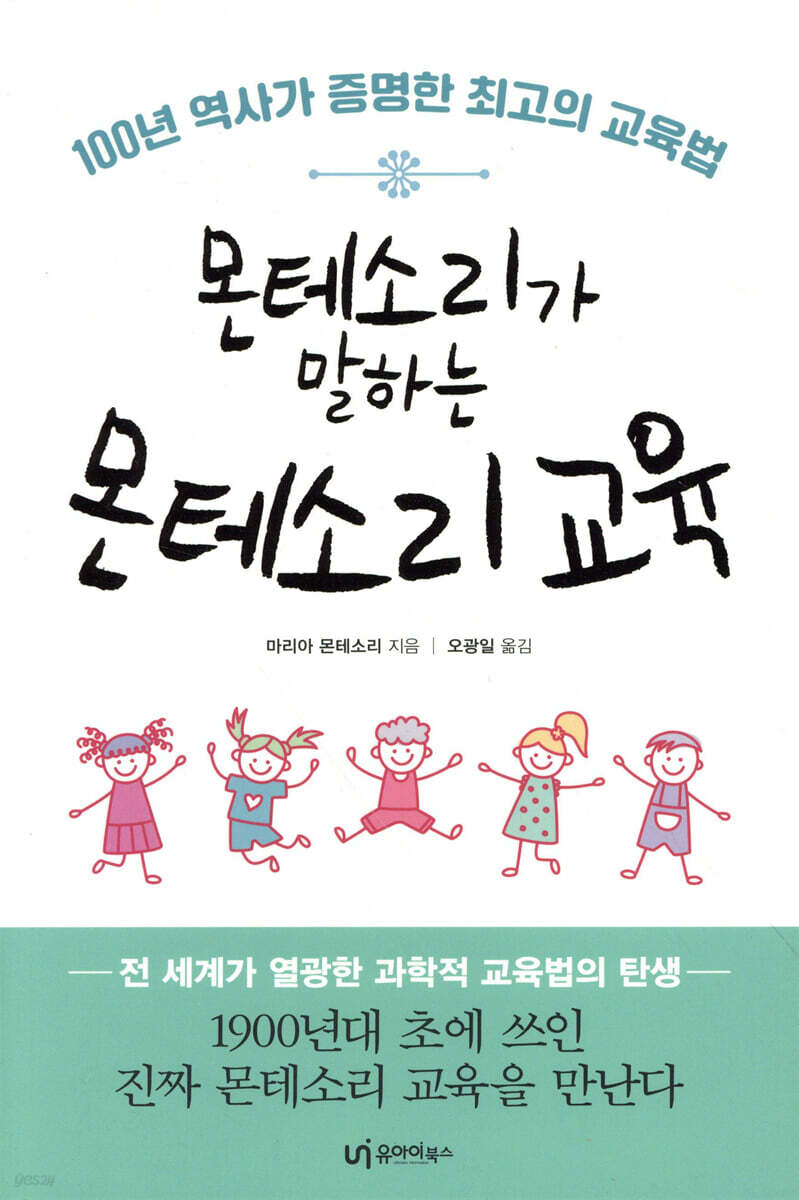
Montessori Education as Told by Montessori
 |
Description
Book Introduction
From sensory and physical abilities to numerical concepts…
Montessori Education Becomes the Standard for Parenting
Montessori education is now considered the 'gold standard of childcare.'
World-renowned celebrities, including Prince George of England, have undergone this training, and it is receiving favorable responses from many parents regardless of era or East or West.
So, what exactly is Montessori education, and what benefits can it bring to children? "Montessori Education: A Guide to Montessori" captures the educational philosophy of Maria Montessori, the founder of Montessori education.
You can experience all the experiences and insights I have gained over many years as a doctor and educator.
What materials and teaching methods did Montessori use to train children in fundamental developmental skills, including physical abilities, senses, language, and number concepts? This book offers the answers for parents who want to help their children develop into confident and proactive individuals.
This is a must-read for educators and experts who wish to study the background and principles that led to the birth of Montessori education.
Montessori Education Becomes the Standard for Parenting
Montessori education is now considered the 'gold standard of childcare.'
World-renowned celebrities, including Prince George of England, have undergone this training, and it is receiving favorable responses from many parents regardless of era or East or West.
So, what exactly is Montessori education, and what benefits can it bring to children? "Montessori Education: A Guide to Montessori" captures the educational philosophy of Maria Montessori, the founder of Montessori education.
You can experience all the experiences and insights I have gained over many years as a doctor and educator.
What materials and teaching methods did Montessori use to train children in fundamental developmental skills, including physical abilities, senses, language, and number concepts? This book offers the answers for parents who want to help their children develop into confident and proactive individuals.
This is a must-read for educators and experts who wish to study the background and principles that led to the birth of Montessori education.
- You can preview some of the book's contents.
Preview
index
I recommend this book 5
Part 1: The Birth of Scientific Education
Chapter 1.
Education Through the Eyes of Science 12
Chapter 2.
Montessori's Path 26
Chapter 3.
Children's Home Inaugural Address 40
Chapter 4.
Education at Children's Home 61
- Considerations from an anthropological perspective
- Classroom environment
Part 2: Teaching Methods for Children
Chapter 1.
Discipline 74
- Teaching independence
- Eliminate visible rewards and punishments
- Freedom from a biological perspective
Chapter 2.
How should classes be conducted? 92
- Concise, simple, and objective
Chapter 3.
Exercises for Everyday Life 103
- Children's Home Winter Schedule
Chapter 4.
Meal 110
- Children's diet
- Meal time distribution
Chapter 5.
Physical Activities That Develop Muscles: Gymnastics 120
- Free body play
- Educational physical play
- Respiratory activity
Chapter 6.
Education with Nature (Raising Plants and Animals) 132
Chapter 7.
Hand Activities 143
Part 3: Teaching Senses and Knowledge
Chapter 1.
Sensory Education 148
Chapter 2.
Sensory Education Using the Parish 165
- Tactile and thermal sensory awareness training
- Training in three-dimensional perception
- Taste and smell education
- Visual education
- Training to distinguish sounds
Chapter 3.
Summary of Sensory Education 200
Chapter 4.
Knowledge Education 208
- A game played while blindfolded
- Observe the surrounding environment through visual education
Part 4: Teaching Language and Numbers
Chapter 1.
Education for Reading and Writing 230
- Acquire written language naturally
Chapter 2.
Reading and Writing Instruction Using the Parish 250
- Step 1: Muscle training using writing tools
- Second step: remember the visual images of the alphabet and the movements required to write it.
- Third Step: Practice for Word Structure
- Read
Chapter 3.
Language in Early Childhood 283
Chapter 4.
Teaching Numbers: The Beginning of Arithmetic 297
- Learning number symbols
- A game to remember numbers
- Addition, subtraction, multiplication, division
- Learning Decimals: Calculations Beyond 10
Part 5: For Effective Education
Chapter 1.
Sequence of Activities 310
- Stages of activities using the parish
Chapter 2.
General Thoughts on Conduct Education 317
Conclusion 334
Part 1: The Birth of Scientific Education
Chapter 1.
Education Through the Eyes of Science 12
Chapter 2.
Montessori's Path 26
Chapter 3.
Children's Home Inaugural Address 40
Chapter 4.
Education at Children's Home 61
- Considerations from an anthropological perspective
- Classroom environment
Part 2: Teaching Methods for Children
Chapter 1.
Discipline 74
- Teaching independence
- Eliminate visible rewards and punishments
- Freedom from a biological perspective
Chapter 2.
How should classes be conducted? 92
- Concise, simple, and objective
Chapter 3.
Exercises for Everyday Life 103
- Children's Home Winter Schedule
Chapter 4.
Meal 110
- Children's diet
- Meal time distribution
Chapter 5.
Physical Activities That Develop Muscles: Gymnastics 120
- Free body play
- Educational physical play
- Respiratory activity
Chapter 6.
Education with Nature (Raising Plants and Animals) 132
Chapter 7.
Hand Activities 143
Part 3: Teaching Senses and Knowledge
Chapter 1.
Sensory Education 148
Chapter 2.
Sensory Education Using the Parish 165
- Tactile and thermal sensory awareness training
- Training in three-dimensional perception
- Taste and smell education
- Visual education
- Training to distinguish sounds
Chapter 3.
Summary of Sensory Education 200
Chapter 4.
Knowledge Education 208
- A game played while blindfolded
- Observe the surrounding environment through visual education
Part 4: Teaching Language and Numbers
Chapter 1.
Education for Reading and Writing 230
- Acquire written language naturally
Chapter 2.
Reading and Writing Instruction Using the Parish 250
- Step 1: Muscle training using writing tools
- Second step: remember the visual images of the alphabet and the movements required to write it.
- Third Step: Practice for Word Structure
- Read
Chapter 3.
Language in Early Childhood 283
Chapter 4.
Teaching Numbers: The Beginning of Arithmetic 297
- Learning number symbols
- A game to remember numbers
- Addition, subtraction, multiplication, division
- Learning Decimals: Calculations Beyond 10
Part 5: For Effective Education
Chapter 1.
Sequence of Activities 310
- Stages of activities using the parish
Chapter 2.
General Thoughts on Conduct Education 317
Conclusion 334
Detailed image
Into the book
Scientific pedagogy, which had been shrouded in thick fog and clouds, gradually emerged in the 19th century thanks to the advancement of science.
Just as a new world was created through scientific advancement, humans must grow on their own through new education.
--- pp.
12~13
Today, we confine our children to school and restrict them with material rewards and punishments that destroy their bodies and minds.
We need to reduce the tools that restrict children and guide them to the end.
Educating children by pouring knowledge from the school curriculum on them is not true education.
--- p.
25
Very young children do not yet have stable muscle control.
As a result, they are unable to walk imperfectly and are unable to perform everyday activities such as dressing and undressing properly.
The activity of sensory organs, such as eye movement, is also immature.
Just as errors can easily be found in the speech of children, the development of language is also primitive.
--- p.
38
When a person is artificially silenced, as if muted, and paralyzed, he is not disciplined, he is annihilated.
A person is considered disciplined when he or she is able to be his or her own master, follow the rules of life, and control his or her own actions.
--- p.
74
Educators should not teach children that being still is good behavior.
It is an old-fashioned education that considers staying still good and moving bad.
Our goal is to get children to be active, do what they are supposed to do, and exhibit good behavior.
--- p.
81
No one can be free without independence.
In order to actively express freedom, children must first engage in independent activities.
What does weaning mean? In reality, it's a child becoming independent from their mother.
--- p.
83
It also tells you to brush your teeth and rinse your mouth.
By doing this activity, children become interested in the body parts they are washing.
Not only that, you will also learn about the tools used to wash your body.
You can naturally learn that you need to wash your eyes with clean water, that you need soap and water to wash your hands, and that you need a toothbrush to brush your teeth.
--- p.
107
There is a widespread misconception among people that children need to be fed well regardless of the time in order to grow well.
This kind of ignorance is very damaging to children.
Children's digestive systems are very sensitive, so they need to eat more regularly than adults.
--- pp.
117~118
Although it's not a very physically demanding exercise, there's one piece of exercise equipment that kids find really fun: the pendulum.
The pendulum game can be played alone or with several people.
Children sitting on chairs hit small balls hanging from strings and send them to their opponents.
Not only is it an exercise for your arms and spine, it also develops your ability to measure distances to moving objects with your eyes.
--- p.
124
The child develops a similar relationship with the teacher observing him or herself in relation to plants and animals.
As interest and observation grow, the child's love for living things also grows.
In this way, the child develops a sense of gratitude for the care of his mother and teachers.
--- p.
138
There is something else important about sensory education methods.
Isolate your senses whenever possible.
For example, auditory training can be successfully done in very quiet places as well as in the dark.
For sensory education such as touch, temperature, weight, and three-dimensional perception activities, we often blindfold children.
--- p.
159
Children are really good at using their sense of touch.
They enjoy the delicate touch of soft, tactile surfaces and are keenly aware of the difference in texture between sandpaper and cards.
--- p.
166
However, it is very difficult to provide sensory education to adults.
It's like how it's hard to develop hands that can play like a pianist after you've grown up.
If you want to perfect the development of your senses through education, you must systematically begin sensory education in infancy and continue it throughout the entire educational period that prepares your child for social life.
--- p.
205
Pointing out a mistake can discourage a child and cause them to overexert themselves to remember the word.
It is also our duty to avoid making children do unnatural things or to make their minds feel uneasy, if possible.
--- p.
210
The first pictures are of flowers, butterflies, trees and animals.
Next, we move on to painting a landscape painting with grass, sky, houses, and people.
Pictures like these can help you see if your child is observing their surroundings and developing naturally with color.
--- p.
228
Where did the outdated idea that children should learn straight lines first come from? Why don't we practice drawing curves? Let's put aside our preconceptions for a moment and try something simpler.
We can help ease the burden on children learning to write.
--- p.
237
Most language deficiencies that persist into adulthood are due to functional errors that occurred while learning language during infancy.
If you properly guide your child's language development while they are still young, you will achieve more practical and valuable results.
--- p.
258
When a mother hears her baby speak for the first time, she feels a joy beyond words.
Perhaps the first word a baby speaks is 'Mom'.
Children must have felt a great sense of joy when they first started saying words.
--- p.
266
I gave the child a book and sat down next to him in a friendly manner.
And I asked like a friend.
“Do you understand what you were reading earlier?” The child answered, “No.”
The child's expression seemed to ask for an explanation as to why he was asking such a thing.
Understanding the complex thoughts of others by reading multiple words is a goal our children will need to achieve in the future.
--- p.
278
We need to teach children all the coordination movements and analyze their movements as much as possible so that they can develop gradually.
So, we need to teach a variety of quiet movements step by step.
For example, getting up and sitting down from a chair, walking, walking on tiptoes, and walking with an upright posture along a line drawn on the floor.
Just as a new world was created through scientific advancement, humans must grow on their own through new education.
--- pp.
12~13
Today, we confine our children to school and restrict them with material rewards and punishments that destroy their bodies and minds.
We need to reduce the tools that restrict children and guide them to the end.
Educating children by pouring knowledge from the school curriculum on them is not true education.
--- p.
25
Very young children do not yet have stable muscle control.
As a result, they are unable to walk imperfectly and are unable to perform everyday activities such as dressing and undressing properly.
The activity of sensory organs, such as eye movement, is also immature.
Just as errors can easily be found in the speech of children, the development of language is also primitive.
--- p.
38
When a person is artificially silenced, as if muted, and paralyzed, he is not disciplined, he is annihilated.
A person is considered disciplined when he or she is able to be his or her own master, follow the rules of life, and control his or her own actions.
--- p.
74
Educators should not teach children that being still is good behavior.
It is an old-fashioned education that considers staying still good and moving bad.
Our goal is to get children to be active, do what they are supposed to do, and exhibit good behavior.
--- p.
81
No one can be free without independence.
In order to actively express freedom, children must first engage in independent activities.
What does weaning mean? In reality, it's a child becoming independent from their mother.
--- p.
83
It also tells you to brush your teeth and rinse your mouth.
By doing this activity, children become interested in the body parts they are washing.
Not only that, you will also learn about the tools used to wash your body.
You can naturally learn that you need to wash your eyes with clean water, that you need soap and water to wash your hands, and that you need a toothbrush to brush your teeth.
--- p.
107
There is a widespread misconception among people that children need to be fed well regardless of the time in order to grow well.
This kind of ignorance is very damaging to children.
Children's digestive systems are very sensitive, so they need to eat more regularly than adults.
--- pp.
117~118
Although it's not a very physically demanding exercise, there's one piece of exercise equipment that kids find really fun: the pendulum.
The pendulum game can be played alone or with several people.
Children sitting on chairs hit small balls hanging from strings and send them to their opponents.
Not only is it an exercise for your arms and spine, it also develops your ability to measure distances to moving objects with your eyes.
--- p.
124
The child develops a similar relationship with the teacher observing him or herself in relation to plants and animals.
As interest and observation grow, the child's love for living things also grows.
In this way, the child develops a sense of gratitude for the care of his mother and teachers.
--- p.
138
There is something else important about sensory education methods.
Isolate your senses whenever possible.
For example, auditory training can be successfully done in very quiet places as well as in the dark.
For sensory education such as touch, temperature, weight, and three-dimensional perception activities, we often blindfold children.
--- p.
159
Children are really good at using their sense of touch.
They enjoy the delicate touch of soft, tactile surfaces and are keenly aware of the difference in texture between sandpaper and cards.
--- p.
166
However, it is very difficult to provide sensory education to adults.
It's like how it's hard to develop hands that can play like a pianist after you've grown up.
If you want to perfect the development of your senses through education, you must systematically begin sensory education in infancy and continue it throughout the entire educational period that prepares your child for social life.
--- p.
205
Pointing out a mistake can discourage a child and cause them to overexert themselves to remember the word.
It is also our duty to avoid making children do unnatural things or to make their minds feel uneasy, if possible.
--- p.
210
The first pictures are of flowers, butterflies, trees and animals.
Next, we move on to painting a landscape painting with grass, sky, houses, and people.
Pictures like these can help you see if your child is observing their surroundings and developing naturally with color.
--- p.
228
Where did the outdated idea that children should learn straight lines first come from? Why don't we practice drawing curves? Let's put aside our preconceptions for a moment and try something simpler.
We can help ease the burden on children learning to write.
--- p.
237
Most language deficiencies that persist into adulthood are due to functional errors that occurred while learning language during infancy.
If you properly guide your child's language development while they are still young, you will achieve more practical and valuable results.
--- p.
258
When a mother hears her baby speak for the first time, she feels a joy beyond words.
Perhaps the first word a baby speaks is 'Mom'.
Children must have felt a great sense of joy when they first started saying words.
--- p.
266
I gave the child a book and sat down next to him in a friendly manner.
And I asked like a friend.
“Do you understand what you were reading earlier?” The child answered, “No.”
The child's expression seemed to ask for an explanation as to why he was asking such a thing.
Understanding the complex thoughts of others by reading multiple words is a goal our children will need to achieve in the future.
--- p.
278
We need to teach children all the coordination movements and analyze their movements as much as possible so that they can develop gradually.
So, we need to teach a variety of quiet movements step by step.
For example, getting up and sitting down from a chair, walking, walking on tiptoes, and walking with an upright posture along a line drawn on the floor.
--- p.
322
322
Publisher's Review
A wise adult does not give answers to a child.
The Fundamentals of Montessori Education, written by a real Montessori
“No!”, “No!” When caring for a child, these words often come out unconsciously.
In Montessori education, we are advised not to say such things to children unless it would harm others.
It is also forbidden to point out a child's mistakes while doing any activity.
Maria Montessori, the founder of Montessori education, valued children's potential and spontaneity.
Therefore, the core of Montessori education is to let children be free and observe them rather than restricting their behavior.
But this is by no means an easy task.
This is because we unconsciously try to correct the child and give him the right answer from an adult's perspective.
Maria Montessori observed children's behavior and collected information while they were engrossed in their own activities, using this as a tool to understand children's psychology and development.
It is education using scientific methods.
Part 1 of “Montessori Education as Told by Montessori” contains an explanation of scientific education, which is the root of Montessori education.
Through this, you can learn about the background and process of Montessori education.
Part 2 reveals the educational methods used in the 'Children's House' established by Montessori.
It contains various activities related to daily life, such as how to properly discipline children, diet, physical play, and raising plants and animals.
These activities lay the foundation for children to grow into independent individuals.
Part 3 focuses on teaching the senses and knowledge.
Through various parishes, you can train your child's senses of touch, heat, three-dimensionality, taste, smell, sight, and hearing, and after sensory education, you can continue with knowledge education.
Part 4 of the book covers teaching written language and numerical calculations.
Children can learn to read and write using their sensory abilities and appropriate teaching aids, and understand number concepts naturally in their daily lives.
The final part 5 introduces some things you should know to apply the previous training more effectively.
《Montessori Education as Spoken by Montessori》 is a translation of Maria Montessori's book written in the 1900s, and reveals the most basic knowledge, activity methods, and use of teaching aids of Montessori education.
Therefore, it can serve as a basic book for parents who want to learn the theory first before starting Montessori play, and it is expected to be a meaningful book for parents who have already read various Montessori-related books because it contains real Montessori stories.
It is also a must-read not only for parents raising children, but also for teachers and education professionals who wish to study and practice Montessori education.
Through this book, you can grasp at a glance the times and social circumstances in which Montessori lived, as well as the trends in pedagogy and various aspects of Montessori education.
The Fundamentals of Montessori Education, written by a real Montessori
“No!”, “No!” When caring for a child, these words often come out unconsciously.
In Montessori education, we are advised not to say such things to children unless it would harm others.
It is also forbidden to point out a child's mistakes while doing any activity.
Maria Montessori, the founder of Montessori education, valued children's potential and spontaneity.
Therefore, the core of Montessori education is to let children be free and observe them rather than restricting their behavior.
But this is by no means an easy task.
This is because we unconsciously try to correct the child and give him the right answer from an adult's perspective.
Maria Montessori observed children's behavior and collected information while they were engrossed in their own activities, using this as a tool to understand children's psychology and development.
It is education using scientific methods.
Part 1 of “Montessori Education as Told by Montessori” contains an explanation of scientific education, which is the root of Montessori education.
Through this, you can learn about the background and process of Montessori education.
Part 2 reveals the educational methods used in the 'Children's House' established by Montessori.
It contains various activities related to daily life, such as how to properly discipline children, diet, physical play, and raising plants and animals.
These activities lay the foundation for children to grow into independent individuals.
Part 3 focuses on teaching the senses and knowledge.
Through various parishes, you can train your child's senses of touch, heat, three-dimensionality, taste, smell, sight, and hearing, and after sensory education, you can continue with knowledge education.
Part 4 of the book covers teaching written language and numerical calculations.
Children can learn to read and write using their sensory abilities and appropriate teaching aids, and understand number concepts naturally in their daily lives.
The final part 5 introduces some things you should know to apply the previous training more effectively.
《Montessori Education as Spoken by Montessori》 is a translation of Maria Montessori's book written in the 1900s, and reveals the most basic knowledge, activity methods, and use of teaching aids of Montessori education.
Therefore, it can serve as a basic book for parents who want to learn the theory first before starting Montessori play, and it is expected to be a meaningful book for parents who have already read various Montessori-related books because it contains real Montessori stories.
It is also a must-read not only for parents raising children, but also for teachers and education professionals who wish to study and practice Montessori education.
Through this book, you can grasp at a glance the times and social circumstances in which Montessori lived, as well as the trends in pedagogy and various aspects of Montessori education.
GOODS SPECIFICS
- Publication date: June 25, 2022
- Page count, weight, size: 344 pages | 518g | 152*225*18mm
- ISBN13: 9791163220749
- ISBN10: 1163220744
You may also like
카테고리
korean


korean

![GQ KOREA Mark (Monthly): December [2025]](http://librairie.coreenne.fr/cdn/shop/files/8ef265dbbfbf186523ed75ba7319009d.jpg?v=1765340328&width=3840)


