

Questions and games
 |
Description
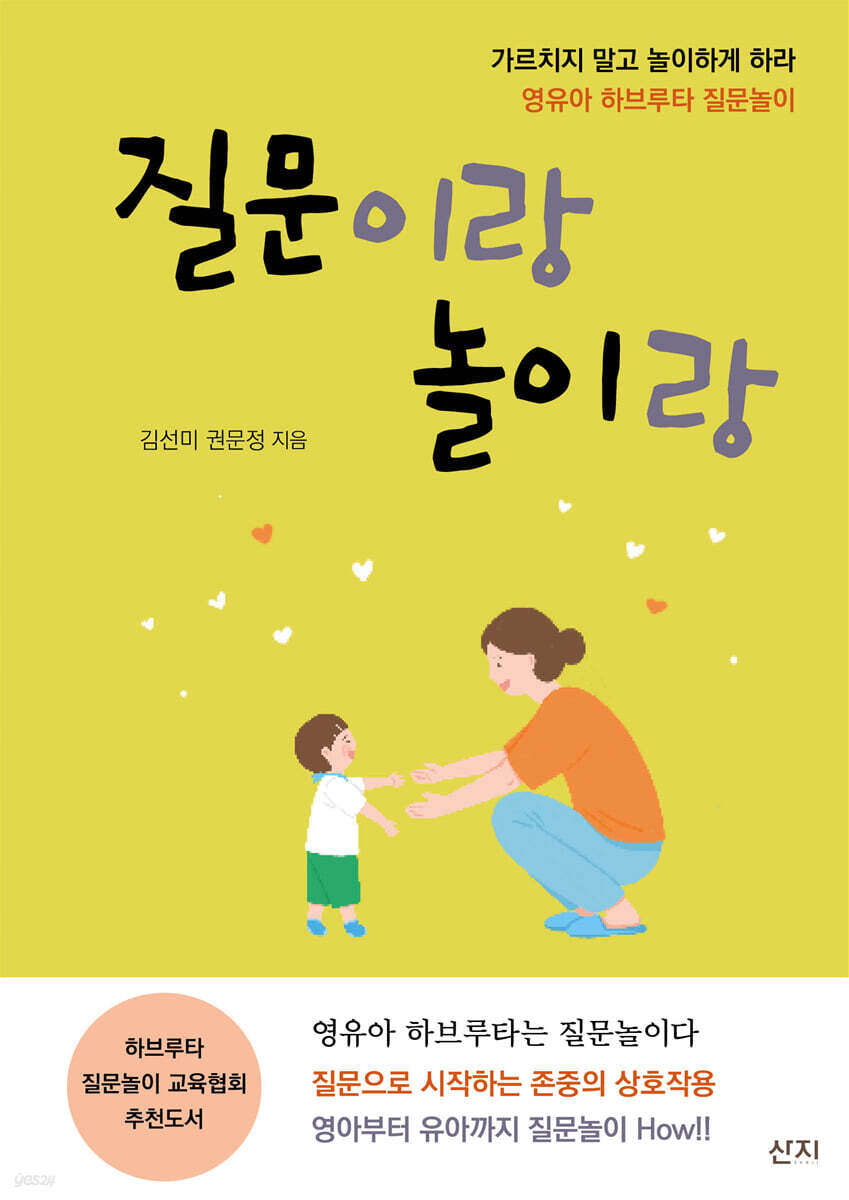
Book Introduction
Havruta is a conversational technique that involves asking questions and discussing with a partner.
Can infants and toddlers aged 0 to 5 participate in havruta? Many parents, especially those who can't even speak yet, are skeptical about the possibility of havruta.
Author Seonmi Kim, who has been working as the director of an early childhood education institution for over 20 years, has been applying Havruta to infants in the field.
Author Kwon Moon-jung, who also taught and spread infant Havruta at early childhood education institutions, also emphasizes the effectiveness of infant Havruta.
The younger you are, the more respectful havruta conversations become a habit and a culture, helping you grow up healthy.
Havruta for infants and toddlers should be approached through play.
So, infant and toddler Havruta is a question game.
This book introduces the Havruta technique, which approaches children from infants to toddlers through play.
It also introduces a question play method for infants who are still not good at speaking.
This book includes real-life examples of how the two authors expanded, studied, and applied havruta for infants.
It is useful for not only those working at early childhood education institutions but also parents.
Can infants and toddlers aged 0 to 5 participate in havruta? Many parents, especially those who can't even speak yet, are skeptical about the possibility of havruta.
Author Seonmi Kim, who has been working as the director of an early childhood education institution for over 20 years, has been applying Havruta to infants in the field.
Author Kwon Moon-jung, who also taught and spread infant Havruta at early childhood education institutions, also emphasizes the effectiveness of infant Havruta.
The younger you are, the more respectful havruta conversations become a habit and a culture, helping you grow up healthy.
Havruta for infants and toddlers should be approached through play.
So, infant and toddler Havruta is a question game.
This book introduces the Havruta technique, which approaches children from infants to toddlers through play.
It also introduces a question play method for infants who are still not good at speaking.
This book includes real-life examples of how the two authors expanded, studied, and applied havruta for infants.
It is useful for not only those working at early childhood education institutions but also parents.
- You can preview some of the book's contents.
Preview
index
Chapter 1: How to start the question game like this!
Learning begins with questions.
The best open education we need now
If kindness is excessive, the child stops asking questions.
Why the faster you start playing Havruta, the better
For children, Havruta is a question game.
Empathy and listening come first before doing havruta.
Havruta of Respect that Opens a Child's Heart
The question game starts with a partner date.
Ask your questions like this
Chapter 2: A Game to Get to Know Questions
5 Games to Get to Know Questions
Play 1 Yo! Yo? Play
Play 2 'Why~~?'
Play 3: Back-and-forth play
Play 4 Partner Interview
Play 5 Five Hills Play
Choosing Picture Books Suitable for Toddler Question Play
Picture book play and picture book question play are different.
Let's play with picture book questions
Chapter 3: Question play according to the developmental stage of infants and toddlers
You can explain the world with short sounds (0-1 years old)
Question play for children aged 0-1 is like this
Everything in the world is new to you (1-2 years old)
Question play for 1-2 year olds is like this
You express your feelings with 'I don't like it' (2-3 years old)
Question play for 2-3 year olds is like this
You are curious, curious, curious about everything (ages 3-4)
Question play for 3-4 year olds is like this
You can talk about your thoughts (ages 4-5)
Question play for 4-5 year olds is like this
Chapter 4: Infant and Toddler Question Play in the Classroom and at Home
Senses Question Play for Children 0-1 Years Old in the Classroom
Watermelon Five Senses Question Game Pumpkin Five Senses Question Game
Daily question play for 1-2 year olds
What did the diaper-wearing mouse say?
Emotional Question Play for 2-3 Year Olds
colored traffic lights
Classic and famous painting question play for ages 3-4
Cuckoo Waltz, The Arnolfini Marriage... A Question-and-answer Game for Picture Books for 4-5 Year Olds
Yo! Yo? Play at home
Jiyoon's Family Picture Book Question Game
Jiyoon (3 years old) and her mother
Seungwan (4 years old) and his mother
Junwoo (7 years old), Daon (4 years old) and their mother
Daon (4 years old) and her mother
Learning begins with questions.
The best open education we need now
If kindness is excessive, the child stops asking questions.
Why the faster you start playing Havruta, the better
For children, Havruta is a question game.
Empathy and listening come first before doing havruta.
Havruta of Respect that Opens a Child's Heart
The question game starts with a partner date.
Ask your questions like this
Chapter 2: A Game to Get to Know Questions
5 Games to Get to Know Questions
Play 1 Yo! Yo? Play
Play 2 'Why~~?'
Play 3: Back-and-forth play
Play 4 Partner Interview
Play 5 Five Hills Play
Choosing Picture Books Suitable for Toddler Question Play
Picture book play and picture book question play are different.
Let's play with picture book questions
Chapter 3: Question play according to the developmental stage of infants and toddlers
You can explain the world with short sounds (0-1 years old)
Question play for children aged 0-1 is like this
Everything in the world is new to you (1-2 years old)
Question play for 1-2 year olds is like this
You express your feelings with 'I don't like it' (2-3 years old)
Question play for 2-3 year olds is like this
You are curious, curious, curious about everything (ages 3-4)
Question play for 3-4 year olds is like this
You can talk about your thoughts (ages 4-5)
Question play for 4-5 year olds is like this
Chapter 4: Infant and Toddler Question Play in the Classroom and at Home
Senses Question Play for Children 0-1 Years Old in the Classroom
Watermelon Five Senses Question Game Pumpkin Five Senses Question Game
Daily question play for 1-2 year olds
What did the diaper-wearing mouse say?
Emotional Question Play for 2-3 Year Olds
colored traffic lights
Classic and famous painting question play for ages 3-4
Cuckoo Waltz, The Arnolfini Marriage... A Question-and-answer Game for Picture Books for 4-5 Year Olds
Yo! Yo? Play at home
Jiyoon's Family Picture Book Question Game
Jiyoon (3 years old) and her mother
Seungwan (4 years old) and his mother
Junwoo (7 years old), Daon (4 years old) and their mother
Daon (4 years old) and her mother
Detailed image
.jpg)
Into the book
1)
Questions develop a child's thinking skills.
Creativity is enhanced.
Furthermore, we create an image of an active future talent through voluntary motivation.
Therefore, we must let the chattering children chatter away to their heart's content.
No, you have to ask questions to get them to talk more.
Infants and toddlers ask so many questions that it tires out both mothers and teachers.
As there are many unfamiliar things around us, there is also a lot of curiosity, a desire to know.
But as they enter school, questions disappear from the children's mouths.
--- p.
17
2)
How can we acquire unique human capabilities?
Our children need the power to think.
Education is not about accepting given knowledge, but about learning through curiosity and self-discovery.
It requires the ability to be curious, to seek out principles, to ask more questions, and to think and judge.
Learning that begins with questions is the best education that will foster the thinking, creativity, and empathy of children who will live in the future.
Through questions, children will begin to think, expand their imagination, and practice free expression.
--- p.
27
3)
Sometimes we try to give our children more knowledge.
Let me explain in more detail and more kindly.
But the child actually stops thinking.
Children do not try to think because passively receiving knowledge is not fun.
Ultimately, it has no effect or help in developing the child's thinking skills.
--- p.
33
4)
Havruta shines even brighter when connected to play.
Havruta and play meet to become question play.
Question play is a game where children pair up to ask questions and play to find answers and develop new knowledge.
Have fun and learn while playing.
How ideal is this learning process? It requires a question-based play that begins with a variety of topics and materials.
--- p.
44
5)
Questions that ask short answers are not fun.
Because short answers do not allow children to expand their thinking.
Questions should be thrown back and forth like ping-pong balls on a ping-pong table.
As the questions continue to arise, the thoughts become more and more complex.
If you've heard your child's thoughts by asking, "What do you think?", ask them again why they think that way.
The question, “Why do you think so?” asks for the child’s basis and reason for his or her thinking.
--- p.
74
6)
How can I become familiar with questions?
It should be fun play, not intentional learning.
Just as you need to share enjoyable times with a friend to become close, you need to have fun practicing questions to become close and feel free to ask questions.
We use five games to help toddlers become familiar with questions.
Yo! Yo? Play.
Why~? Play, back-and-forth play, partner interview, five hills.
--- p.
82
7)
No matter how good a picture book is, if a child does not enjoy reading it, we can no longer expect the book to have value or effectiveness.
You need to create an atmosphere where your child can become familiar with picture books, and wait without rushing them.
As you read picture books with your child, slowly observe, ask questions comfortably, and freely express your thoughts, your child will develop surprisingly creative thinking skills.
Questions develop a child's thinking skills.
Creativity is enhanced.
Furthermore, we create an image of an active future talent through voluntary motivation.
Therefore, we must let the chattering children chatter away to their heart's content.
No, you have to ask questions to get them to talk more.
Infants and toddlers ask so many questions that it tires out both mothers and teachers.
As there are many unfamiliar things around us, there is also a lot of curiosity, a desire to know.
But as they enter school, questions disappear from the children's mouths.
--- p.
17
2)
How can we acquire unique human capabilities?
Our children need the power to think.
Education is not about accepting given knowledge, but about learning through curiosity and self-discovery.
It requires the ability to be curious, to seek out principles, to ask more questions, and to think and judge.
Learning that begins with questions is the best education that will foster the thinking, creativity, and empathy of children who will live in the future.
Through questions, children will begin to think, expand their imagination, and practice free expression.
--- p.
27
3)
Sometimes we try to give our children more knowledge.
Let me explain in more detail and more kindly.
But the child actually stops thinking.
Children do not try to think because passively receiving knowledge is not fun.
Ultimately, it has no effect or help in developing the child's thinking skills.
--- p.
33
4)
Havruta shines even brighter when connected to play.
Havruta and play meet to become question play.
Question play is a game where children pair up to ask questions and play to find answers and develop new knowledge.
Have fun and learn while playing.
How ideal is this learning process? It requires a question-based play that begins with a variety of topics and materials.
--- p.
44
5)
Questions that ask short answers are not fun.
Because short answers do not allow children to expand their thinking.
Questions should be thrown back and forth like ping-pong balls on a ping-pong table.
As the questions continue to arise, the thoughts become more and more complex.
If you've heard your child's thoughts by asking, "What do you think?", ask them again why they think that way.
The question, “Why do you think so?” asks for the child’s basis and reason for his or her thinking.
--- p.
74
6)
How can I become familiar with questions?
It should be fun play, not intentional learning.
Just as you need to share enjoyable times with a friend to become close, you need to have fun practicing questions to become close and feel free to ask questions.
We use five games to help toddlers become familiar with questions.
Yo! Yo? Play.
Why~? Play, back-and-forth play, partner interview, five hills.
--- p.
82
7)
No matter how good a picture book is, if a child does not enjoy reading it, we can no longer expect the book to have value or effectiveness.
You need to create an atmosphere where your child can become familiar with picture books, and wait without rushing them.
As you read picture books with your child, slowly observe, ask questions comfortably, and freely express your thoughts, your child will develop surprisingly creative thinking skills.
--- p.
135
135
Publisher's Review
Havruta Question Play for Toddlers
There have been many books on Havruta question play for young children.
However, Havruta for infants is not yet widely used, so it is not easy to find related books.
Why is Havruta question play necessary for infants who cannot speak? And how is it done? This book will serve as a valuable guide for parents who are curious.
If you communicate with respectful language and questions during the toddler years when babies and toddlers absorb everything like sponges, they will grow into creative children with high self-esteem.
The process of responding to infants' gaze, gestures, body language, and single words and asking questions is introduced.
Includes specific examples of Havruta question play that starts with play.
To capture the attention of infants and toddlers, it must be fun, and play is what creates fun and curiosity.
So, the infant/toddler Havruta is a question-based game.
It is a combination of play and havruta.
This book introduces specific examples of how to apply and utilize Havruta in certain types of play.
These are the author's results, which have been applied in the field for a long time, so they will be helpful if applied to daily life.
There have been many books on Havruta question play for young children.
However, Havruta for infants is not yet widely used, so it is not easy to find related books.
Why is Havruta question play necessary for infants who cannot speak? And how is it done? This book will serve as a valuable guide for parents who are curious.
If you communicate with respectful language and questions during the toddler years when babies and toddlers absorb everything like sponges, they will grow into creative children with high self-esteem.
The process of responding to infants' gaze, gestures, body language, and single words and asking questions is introduced.
Includes specific examples of Havruta question play that starts with play.
To capture the attention of infants and toddlers, it must be fun, and play is what creates fun and curiosity.
So, the infant/toddler Havruta is a question-based game.
It is a combination of play and havruta.
This book introduces specific examples of how to apply and utilize Havruta in certain types of play.
These are the author's results, which have been applied in the field for a long time, so they will be helpful if applied to daily life.
GOODS SPECIFICS
- Date of issue: February 4, 2022
- Page count, weight, size: 256 pages | 422g | 145*205*17mm
- ISBN13: 9791191714067
- ISBN10: 1191714063
You may also like
카테고리
korean


korean

![GQ KOREA Mark (Monthly): December [2025]](http://librairie.coreenne.fr/cdn/shop/files/8ef265dbbfbf186523ed75ba7319009d.jpg?v=1765340328&width=3840)


