

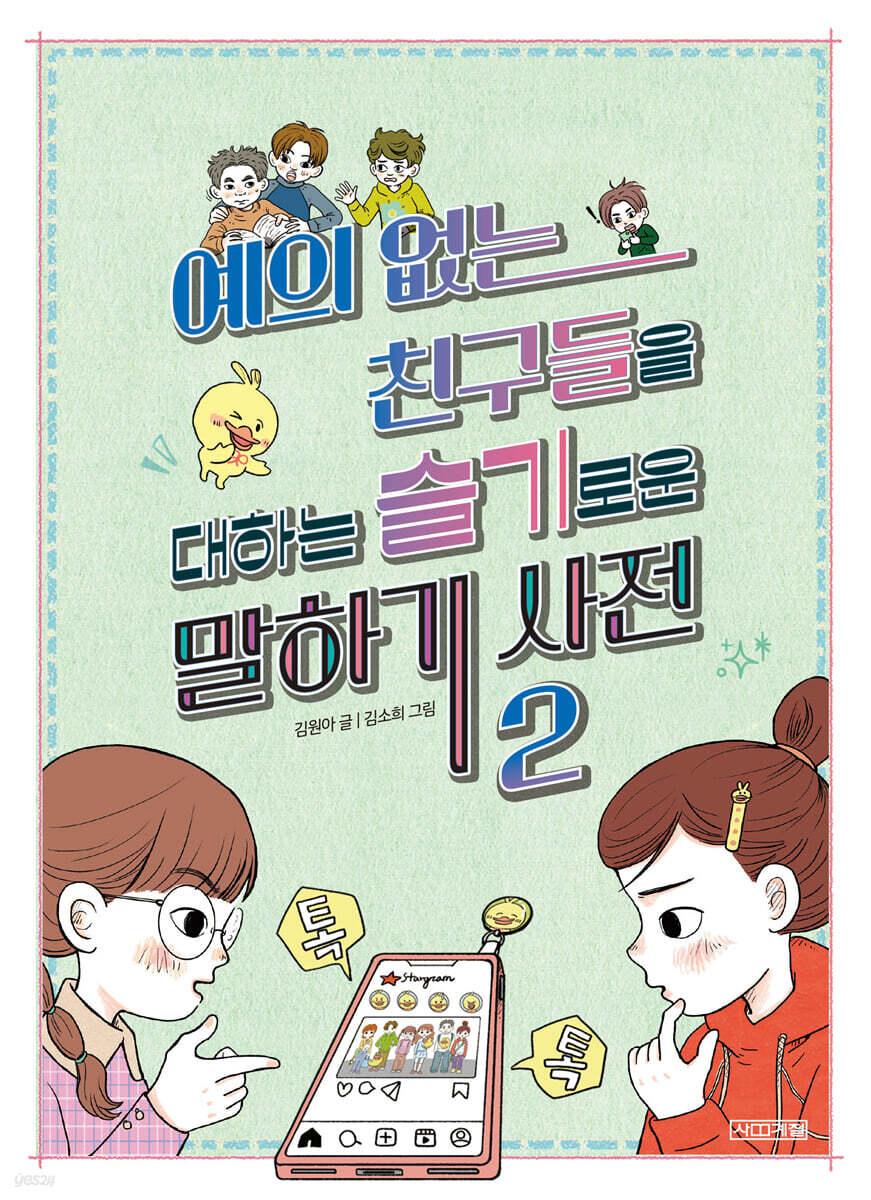
Dictionary of Smart Phrases for Dealing with Rude Friends 2
 |
Description
Book Introduction
The second installment of the children's bestseller, "A Dictionary of Smart Talk for Dealing with Rude Friends."
"The Book You Open Whenever You're Feeling Down" returns with even more detailed and realistic episodes.
The second story in the book, "A Dictionary of Wise Talk to Deal with Rude Friends," which received a lot of attention upon its publication.
It was so well-received by young readers that it earned the nickname, “The book you read whenever you feel upset.”
Thanks to this, we published Volume 2, which collected more diverse cases that were not covered in Volume 1.
Today, we introduce 57 ways to 'gently but clearly convey your feelings' to children who are upset at school or have difficulty resolving relationships.
This time, we present a more nuanced and clear solution in a more diverse and specific situation.
Additionally, Volume 2 separately covers conflicts caused by social media and includes the more serious issue of 'school violence'.
Author Won-Ah Kim's second children's book, which unravels her passionate sincerity with cool-headed solutions, will also be a great source of comfort and encouragement for children.
"The Book You Open Whenever You're Feeling Down" returns with even more detailed and realistic episodes.
The second story in the book, "A Dictionary of Wise Talk to Deal with Rude Friends," which received a lot of attention upon its publication.
It was so well-received by young readers that it earned the nickname, “The book you read whenever you feel upset.”
Thanks to this, we published Volume 2, which collected more diverse cases that were not covered in Volume 1.
Today, we introduce 57 ways to 'gently but clearly convey your feelings' to children who are upset at school or have difficulty resolving relationships.
This time, we present a more nuanced and clear solution in a more diverse and specific situation.
Additionally, Volume 2 separately covers conflicts caused by social media and includes the more serious issue of 'school violence'.
Author Won-Ah Kim's second children's book, which unravels her passionate sincerity with cool-headed solutions, will also be a great source of comfort and encouragement for children.
- You can preview some of the book's contents.
Preview
index
Speak wisely
[About the item]
1.
When you ignore my stuff
2.
When you ask someone to buy you something expensive as a birthday present
3.
When you feel burdened by constantly receiving gifts
4.
When you notice that you bought the same thing
[Getting to know each other]
5.
When silence is awkward
6.
When you make a mistake and feel embarrassed
7.
When asked to do better in group activities
8.
When you roughly listen to what I say
9.
When I feel sad because you forgot my birthday
10.
When it's difficult to ask questions
11.
When you feel upset because you didn't ask to play first
12.
When a friend cries
Apologize
13.
When my friend got hurt while playing with me
14.
When you're wondering whether to apologize or not
15.
When asking for an apology
16.
When you want to receive an apology
17.
When you feel embarrassed because your friend is crying over something trivial
[Reject]
18.
When you're reading a book and someone is reading it next to you, it's uncomfortable
19.
When you have something to do and ask to go to the bathroom together
20.
When you are standing in line and ask to change seats
21.
When a friend acts as he wants, contrary to my wishes
22.
When you hit someone while laughing, it hurts so much
23.
When the conversation is boring
24.
When you insist on playing only with yourself
25.
When you have to go but they keep asking you to play more
26.
When you want to stop playing a losing game
27.
When you want to break up with a friend of the opposite sex
[Make a promise]
28.
When your friend keeps being late for appointments
29.
When you hesitate to invite someone to a birthday party
30.
When a friend brings another friend over without consulting him
31.
When a friend asks to hang out but you have other plans
[Social Media]
32.
When you read a message but there is no reply
33.
When my friend saw my phone, I looked at it and got angry.
34.
When you post my picture on social media without permission
35.
When you secretly take pictures of me and play pranks
36.
When you send a one-sided unpleasant message
[Conflict Resolution]
37.
When you play with the classroom door and block the entrance
38.
When I keep sending trash to my seat during cleaning time
39.
When you call me a snitcher
40.
When you get into a fight
41.
When you feel anxious because your friend is acting dangerously
42.
When you pretend to be smart and ignore others
43.
When you're being sarcastic
44.
When you're jealous of me
45.
When you say you're pretending to be good
46.
When you feel uncomfortable with your friend's tone of voice
47.
When you draw along my drawing
48.
When you meddle and insist that something is wrong
49.
When you criticize my behavior and nag me
50.
When you're new to your partner and you show too much dislike
51.
When you are only unkind to me
52.
When you look at me in a bad mood without saying anything
[School Violence]
53.
When you speak badly of your parents
54.
When several people surround me and get angry
55.
When someone accuses me of something I didn't do
56.
When you keep asking me to run errands
57.
When you threaten someone to stop talking after harassing them
Friendship Concerns Counseling Q&A
1.
I hate that I can't say anything when my friends say something.
2.
No one forces me to do anything, but I keep getting dragged around by my friends.
3.
Even though I received an apology and everything is over, I still feel resentful.
4.
I didn't mean any harm, but I don't know what to do when my friend gets angry.
5.
We're obviously close friends, so why do we keep fighting?
6.
The friend I like doesn't like me.
Is there any way to become friends?
7.
When I'm in a situation where I have to speak, I get flustered and can't think of the right words.
Later, you'll regret saying, "I should have said this!"
8.
I have a small voice and a soft way of speaking, so it's difficult for me to speak properly.
9.
If I apologize but my friend doesn't accept it, I feel like I did it for nothing.
10.
I speak politely, but I feel like I'm at a disadvantage if my friend speaks rudely.
11.
When I'm in a bad mood, I get irritated without realizing it.
12.
No matter how politely a friend refuses, it still feels bad to be rejected.
13.
Can even a minor prank be considered school violence?
14.
Can a rude friend really change with just one word?
15.
I think I'll be made fun of because the expressions in the book are awkward.
Is it actually usable?
16.
There are so many different words in the book that it's hard to remember.
[About the item]
1.
When you ignore my stuff
2.
When you ask someone to buy you something expensive as a birthday present
3.
When you feel burdened by constantly receiving gifts
4.
When you notice that you bought the same thing
[Getting to know each other]
5.
When silence is awkward
6.
When you make a mistake and feel embarrassed
7.
When asked to do better in group activities
8.
When you roughly listen to what I say
9.
When I feel sad because you forgot my birthday
10.
When it's difficult to ask questions
11.
When you feel upset because you didn't ask to play first
12.
When a friend cries
Apologize
13.
When my friend got hurt while playing with me
14.
When you're wondering whether to apologize or not
15.
When asking for an apology
16.
When you want to receive an apology
17.
When you feel embarrassed because your friend is crying over something trivial
[Reject]
18.
When you're reading a book and someone is reading it next to you, it's uncomfortable
19.
When you have something to do and ask to go to the bathroom together
20.
When you are standing in line and ask to change seats
21.
When a friend acts as he wants, contrary to my wishes
22.
When you hit someone while laughing, it hurts so much
23.
When the conversation is boring
24.
When you insist on playing only with yourself
25.
When you have to go but they keep asking you to play more
26.
When you want to stop playing a losing game
27.
When you want to break up with a friend of the opposite sex
[Make a promise]
28.
When your friend keeps being late for appointments
29.
When you hesitate to invite someone to a birthday party
30.
When a friend brings another friend over without consulting him
31.
When a friend asks to hang out but you have other plans
[Social Media]
32.
When you read a message but there is no reply
33.
When my friend saw my phone, I looked at it and got angry.
34.
When you post my picture on social media without permission
35.
When you secretly take pictures of me and play pranks
36.
When you send a one-sided unpleasant message
[Conflict Resolution]
37.
When you play with the classroom door and block the entrance
38.
When I keep sending trash to my seat during cleaning time
39.
When you call me a snitcher
40.
When you get into a fight
41.
When you feel anxious because your friend is acting dangerously
42.
When you pretend to be smart and ignore others
43.
When you're being sarcastic
44.
When you're jealous of me
45.
When you say you're pretending to be good
46.
When you feel uncomfortable with your friend's tone of voice
47.
When you draw along my drawing
48.
When you meddle and insist that something is wrong
49.
When you criticize my behavior and nag me
50.
When you're new to your partner and you show too much dislike
51.
When you are only unkind to me
52.
When you look at me in a bad mood without saying anything
[School Violence]
53.
When you speak badly of your parents
54.
When several people surround me and get angry
55.
When someone accuses me of something I didn't do
56.
When you keep asking me to run errands
57.
When you threaten someone to stop talking after harassing them
Friendship Concerns Counseling Q&A
1.
I hate that I can't say anything when my friends say something.
2.
No one forces me to do anything, but I keep getting dragged around by my friends.
3.
Even though I received an apology and everything is over, I still feel resentful.
4.
I didn't mean any harm, but I don't know what to do when my friend gets angry.
5.
We're obviously close friends, so why do we keep fighting?
6.
The friend I like doesn't like me.
Is there any way to become friends?
7.
When I'm in a situation where I have to speak, I get flustered and can't think of the right words.
Later, you'll regret saying, "I should have said this!"
8.
I have a small voice and a soft way of speaking, so it's difficult for me to speak properly.
9.
If I apologize but my friend doesn't accept it, I feel like I did it for nothing.
10.
I speak politely, but I feel like I'm at a disadvantage if my friend speaks rudely.
11.
When I'm in a bad mood, I get irritated without realizing it.
12.
No matter how politely a friend refuses, it still feels bad to be rejected.
13.
Can even a minor prank be considered school violence?
14.
Can a rude friend really change with just one word?
15.
I think I'll be made fun of because the expressions in the book are awkward.
Is it actually usable?
16.
There are so many different words in the book that it's hard to remember.
Detailed image
Publisher's Review
The second installment of the children's bestseller, "A Dictionary of Smart Talk for Dealing with Rude Friends."
"A Dictionary of Smart Talking to Deal with Rude Friends," a practical guide to children's human relations, has reached over 70,000 readers since its publication in 2022! It's been a long time since a children's nonfiction book, neither a comic nor featuring a celebrity, has received such widespread love.
Isn't 'how to speak without putting yourself down and making the other person feel bad' a lifelong task not only for children but also for adults, and in fact for everyone in the world?
"The Book You Open Whenever You're Feeling Down" returns with even more detailed and realistic episodes.
In a reader review of Volume 1, someone called it "the book I open whenever I'm feeling down."
It's a perfectly appropriate nickname.
Thanks to the support of many readers, author Won-A Kim is back with 57 more episodes.
It is filled with detailed and realistic episodes that would be impossible to imagine unless you were at the school.
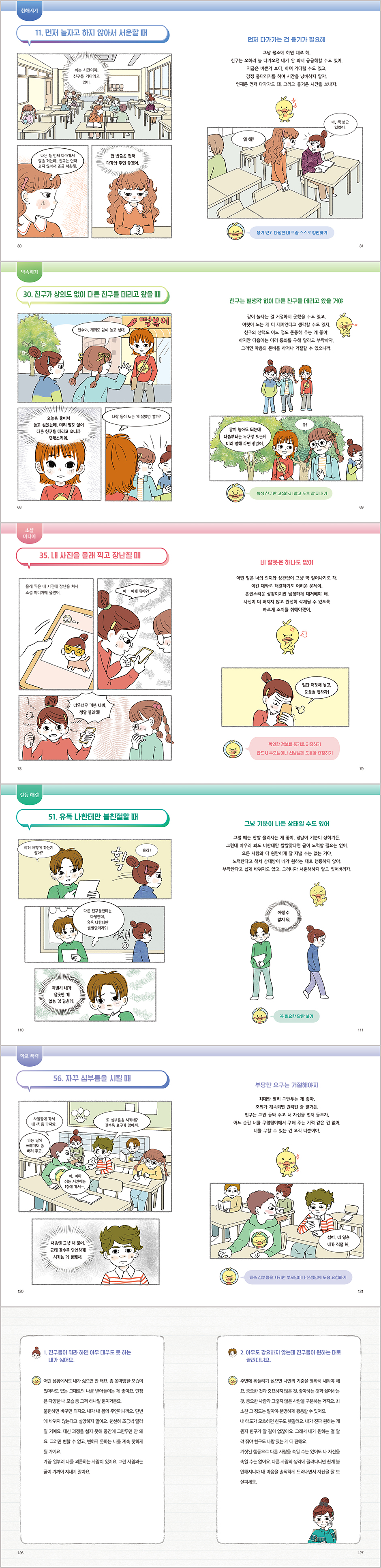
These are seemingly trivial situations, like, "When you ask to go to the bathroom with me because you have something to do," or "When you ask to switch seats while you're standing in line," but they're exactly the kind of situations our children might have encountered at school today.
Cool and realistic advice that doesn't necessarily require reconciliation, such as maintaining an appropriate distance.
One of the reasons why Volume 1 received such an explosive response is probably because people sympathized with author Kim Won-ah's signature "cool advice filled with passionate sincerity."
This is possible because author Won-Ah Kim has extensive experience in the educational field and is full of sincerity towards children.
It is easy to tell writers who are usually inexperienced or only stick to theory to resolve conflicts by persuading and making the other person understand.
The reality is not like that at all.
Not only is it difficult for me to speak well, but the other person doesn't easily admit they're sorry, and the reality is that no matter what I do, the situation doesn't change easily.
In such cases, the method suggested by author Kim Won-ah is appropriate ‘social distancing.’
Maintaining good relationships isn't necessarily the answer.
Sometimes social distancing is the answer, and sometimes a little indifference is the answer.
For our children, bonding with their peers is incredibly important, so it might be hard to imagine doing it right away, but wouldn't it be reassuring to have an adult who tells them, "It's okay to do that," and "That's one of the answers."
A key word that runs through life
The author has compiled the advice he has given to children as a school teacher on their friendship concerns into a Q&A format.
Looking at the questions, you can clearly see the children's realistic concerns.
"No one forces me to do anything, but my friends drag me around." "Even though I received an apology and everything is over, I still feel resentful." "No matter how politely my friend refuses, I still feel bad when they reject me." These feelings are common among both children and adults.
Still, the author says, "I shouldn't hate myself," and "I have to be able to choose my own emotions."
It may seem like a small piece of advice for children, but it is actually a core message that runs through life.
Let's unfold the frustrating days and start with, "I'm a little uncomfortable with that."
For children who have difficulty preparing for and speaking up in various situations no matter how much they read and practice, the author suggests starting with this one phrase: “I feel a little uncomfortable with that.”
On days when you're feeling upset or upset, open Volumes 1 and 2 of "Wise Talking to Deal with Rude Friends" and look for episodes similar to what you've experienced.
You will find comfort, support, and sometimes even practical advice.
Features of this book
The comfort of knowing, "This isn't just happening to me," and "This can happen to me."
Even for adults, it is very difficult to 'express my intentions clearly to the other person without making them feel bad.'
It would be best if you could practice speaking wisely even a little by reading the various episodes in 『Dictionary of Wise Speaking to Deal with Rude Friends』 1 and 2.
However, if that is still difficult, it would be very meaningful for parents and children to read together and talk about how they are not the only ones in this situation and that other situations that they were not aware of could arise.
A shift in thinking that 'it's okay to say this'
The reason we can't say something when we actually need to say it is because we can't think of what to say, because it's difficult to create a conflict situation, or because we're afraid of the other person.
And above all, the biggest reason is 'ignorance and fear of ignorance', which makes you wonder 'Can I say this?'
So, if you look at 『Dictionary of Wise Words for Dealing with Rude Friends』 1 and 2 on a regular basis and know, "Oh, I can say this too," or "It's okay to say this," I expect that the range of things I can say will expand when I encounter such situations.
The reason it stands out among numerous similar books is that it is realistic and gives sincere advice.
Author Kim Won-ah's advice is filled with a cool-headed view of reality and the author's sincerity.
What makes this book stand out among similar books that simply write solutions to things that children cannot even say is its ‘sincerity.’
I made it clear that I could never easily change other people's minds and actions, and it is clear that I put a lot of thought into suggesting a solution within the limits of what the child could do.
It's important to be able to say what I want to say, but to avoid getting stuck in a mud pit, I recommend that you stick to your principles no matter what others say and not be rude like others.
It's also directly related to my pride.
I say that I didn't ruin myself, that I didn't lose anything, because I didn't fall into the mud with them.
I'm saying that it's definitely not true.
This is why author Kim Won-ah's advice is not just about how to speak, but also offers wisdom for life, ways to protect yourself, and advice that permeates life.
Social Media Intensifies School Violence
Volume 2 contains more diverse and detailed episodes.
In particular, we have collected conflicts that can arise from social media, which is becoming increasingly problematic.
Although there was a 'school violence' section in Volume 1, we also added a story about 'school violence' that is a bit more serious.
I hope to once again receive a positive response from young readers by finding my episodes that I couldn't find in Volume 1 in Volume 2.
"A Dictionary of Smart Talking to Deal with Rude Friends," a practical guide to children's human relations, has reached over 70,000 readers since its publication in 2022! It's been a long time since a children's nonfiction book, neither a comic nor featuring a celebrity, has received such widespread love.
Isn't 'how to speak without putting yourself down and making the other person feel bad' a lifelong task not only for children but also for adults, and in fact for everyone in the world?
"The Book You Open Whenever You're Feeling Down" returns with even more detailed and realistic episodes.
In a reader review of Volume 1, someone called it "the book I open whenever I'm feeling down."
It's a perfectly appropriate nickname.
Thanks to the support of many readers, author Won-A Kim is back with 57 more episodes.
It is filled with detailed and realistic episodes that would be impossible to imagine unless you were at the school.
These are seemingly trivial situations, like, "When you ask to go to the bathroom with me because you have something to do," or "When you ask to switch seats while you're standing in line," but they're exactly the kind of situations our children might have encountered at school today.
Cool and realistic advice that doesn't necessarily require reconciliation, such as maintaining an appropriate distance.
One of the reasons why Volume 1 received such an explosive response is probably because people sympathized with author Kim Won-ah's signature "cool advice filled with passionate sincerity."
This is possible because author Won-Ah Kim has extensive experience in the educational field and is full of sincerity towards children.
It is easy to tell writers who are usually inexperienced or only stick to theory to resolve conflicts by persuading and making the other person understand.
The reality is not like that at all.
Not only is it difficult for me to speak well, but the other person doesn't easily admit they're sorry, and the reality is that no matter what I do, the situation doesn't change easily.
In such cases, the method suggested by author Kim Won-ah is appropriate ‘social distancing.’
Maintaining good relationships isn't necessarily the answer.
Sometimes social distancing is the answer, and sometimes a little indifference is the answer.
For our children, bonding with their peers is incredibly important, so it might be hard to imagine doing it right away, but wouldn't it be reassuring to have an adult who tells them, "It's okay to do that," and "That's one of the answers."
A key word that runs through life
The author has compiled the advice he has given to children as a school teacher on their friendship concerns into a Q&A format.
Looking at the questions, you can clearly see the children's realistic concerns.
"No one forces me to do anything, but my friends drag me around." "Even though I received an apology and everything is over, I still feel resentful." "No matter how politely my friend refuses, I still feel bad when they reject me." These feelings are common among both children and adults.
Still, the author says, "I shouldn't hate myself," and "I have to be able to choose my own emotions."
It may seem like a small piece of advice for children, but it is actually a core message that runs through life.
Let's unfold the frustrating days and start with, "I'm a little uncomfortable with that."
For children who have difficulty preparing for and speaking up in various situations no matter how much they read and practice, the author suggests starting with this one phrase: “I feel a little uncomfortable with that.”
On days when you're feeling upset or upset, open Volumes 1 and 2 of "Wise Talking to Deal with Rude Friends" and look for episodes similar to what you've experienced.
You will find comfort, support, and sometimes even practical advice.
Features of this book
The comfort of knowing, "This isn't just happening to me," and "This can happen to me."
Even for adults, it is very difficult to 'express my intentions clearly to the other person without making them feel bad.'
It would be best if you could practice speaking wisely even a little by reading the various episodes in 『Dictionary of Wise Speaking to Deal with Rude Friends』 1 and 2.
However, if that is still difficult, it would be very meaningful for parents and children to read together and talk about how they are not the only ones in this situation and that other situations that they were not aware of could arise.
A shift in thinking that 'it's okay to say this'
The reason we can't say something when we actually need to say it is because we can't think of what to say, because it's difficult to create a conflict situation, or because we're afraid of the other person.
And above all, the biggest reason is 'ignorance and fear of ignorance', which makes you wonder 'Can I say this?'
So, if you look at 『Dictionary of Wise Words for Dealing with Rude Friends』 1 and 2 on a regular basis and know, "Oh, I can say this too," or "It's okay to say this," I expect that the range of things I can say will expand when I encounter such situations.
The reason it stands out among numerous similar books is that it is realistic and gives sincere advice.
Author Kim Won-ah's advice is filled with a cool-headed view of reality and the author's sincerity.
What makes this book stand out among similar books that simply write solutions to things that children cannot even say is its ‘sincerity.’
I made it clear that I could never easily change other people's minds and actions, and it is clear that I put a lot of thought into suggesting a solution within the limits of what the child could do.
It's important to be able to say what I want to say, but to avoid getting stuck in a mud pit, I recommend that you stick to your principles no matter what others say and not be rude like others.
It's also directly related to my pride.
I say that I didn't ruin myself, that I didn't lose anything, because I didn't fall into the mud with them.
I'm saying that it's definitely not true.
This is why author Kim Won-ah's advice is not just about how to speak, but also offers wisdom for life, ways to protect yourself, and advice that permeates life.
Social Media Intensifies School Violence
Volume 2 contains more diverse and detailed episodes.
In particular, we have collected conflicts that can arise from social media, which is becoming increasingly problematic.
Although there was a 'school violence' section in Volume 1, we also added a story about 'school violence' that is a bit more serious.
I hope to once again receive a positive response from young readers by finding my episodes that I couldn't find in Volume 1 in Volume 2.
GOODS SPECIFICS
- Date of issue: November 3, 2023
- Page count, weight, size: 144 pages | 278g | 153*210*9mm
- ISBN13: 9791169811606
- ISBN10: 1169811604
You may also like
카테고리
korean


korean

![GQ KOREA Mark (Monthly): December [2025]](http://librairie.coreenne.fr/cdn/shop/files/8ef265dbbfbf186523ed75ba7319009d.jpg?v=1765340328&width=3840)


