

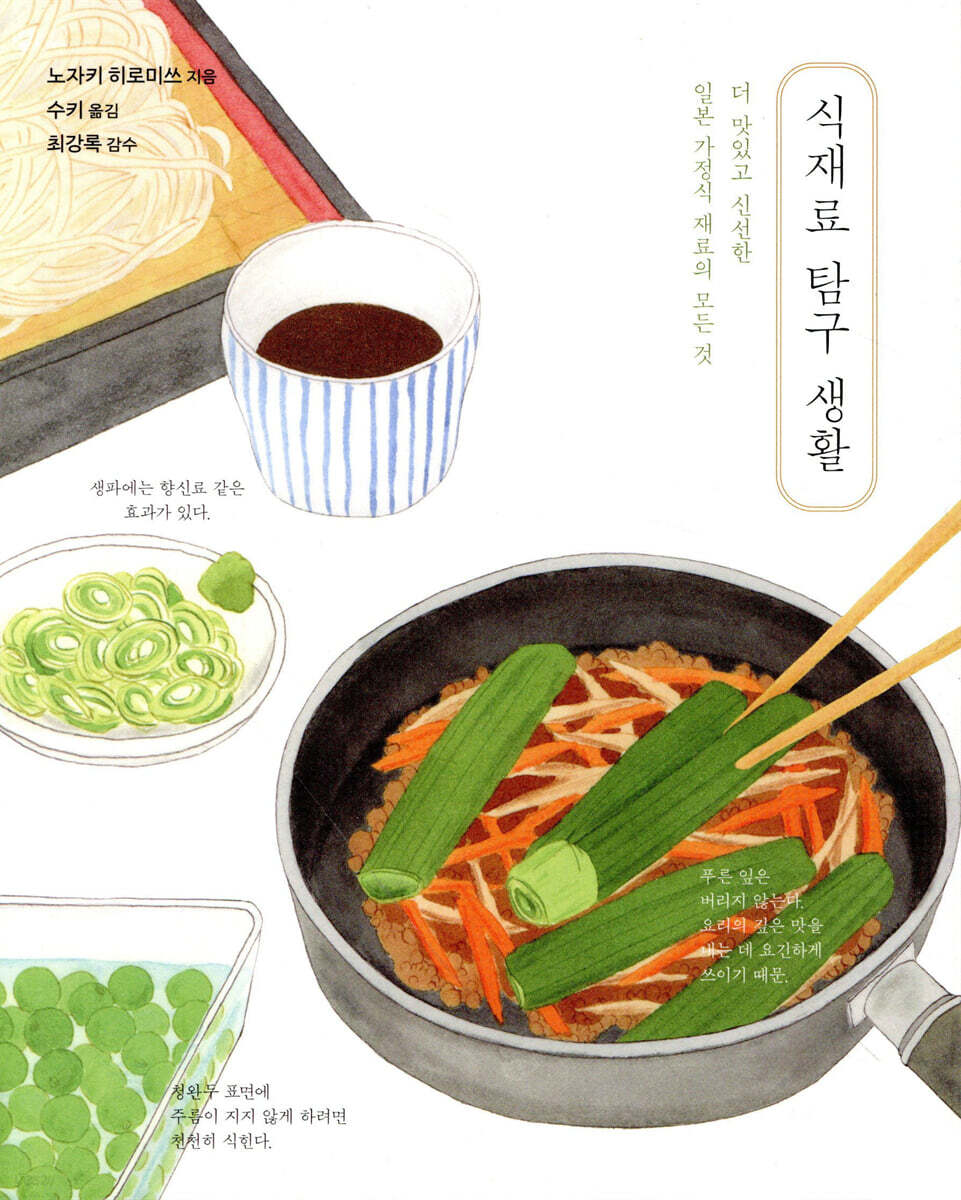
Food Exploration Life
 |
Description
Book Introduction
Delicious food starts with delicious ingredients!
How to choose, cook, and store
Everything you need to know about the 60 most commonly used ingredients!
In a modern society where ingredients are readily available regardless of the season, why is it important to know about seasonality, selection methods, and other related knowledge? The author of this book explains that it's a way to satisfy individual tastes.
Each ingredient has its own unique flavor, and there are specific methods for bringing out its unique flavor.
The author, a chef at the famous Japanese restaurant "Waketokuyama" and an evangelist for "the taste that can only be made at home," explains in detail, step by step, how ingredients used at home can be used to create dishes that taste the best.
This book contains comprehensive information on approximately 60 different food ingredients, including vegetables commonly found on Korean tables such as onions, tomatoes, and eggplants, meats such as pork, beef, and chicken, fish such as mackerel and saury, seasonings such as soy sauce and salt, and even rice.
Some vegetables should be selected by looking at the cross-section, while others should be selected by looking at the leaves.
Some vegetables need to be soaked in cold water after blanching, while others do not.
Fish can be cooked on different sides depending on the location of the heat source, making it appear neater on the plate.
Each cut of meat has a different cooking method, and there is a specific temperature at which it is cooked to its most delicious state.
You might think that salt and soy sauce have the same salty taste, but in fact, they have very different roles.
In addition to the characteristics of each ingredient mentioned above, recipes that can be used immediately are also included.
The recipes are mainly Japanese home-cooked meals that can be made at home without much difficulty.
At the end, there is an 'Appendix' containing only the most essential information about all the materials that appear in the main text.
The appendix provides a summary of how to use the ingredients, along with key nutrients and seasonal availability.
The book's quality has been improved through the supervision of Japanese chef Choi Kang-rok to help Korean readers understand it better, and the translator's explanations have been added to unfamiliar Japanese expressions.
As you learn these things and make them your own, you will be able to get closer to making dishes that are "just right for your taste," as the author says.
How to choose, cook, and store
Everything you need to know about the 60 most commonly used ingredients!
In a modern society where ingredients are readily available regardless of the season, why is it important to know about seasonality, selection methods, and other related knowledge? The author of this book explains that it's a way to satisfy individual tastes.
Each ingredient has its own unique flavor, and there are specific methods for bringing out its unique flavor.
The author, a chef at the famous Japanese restaurant "Waketokuyama" and an evangelist for "the taste that can only be made at home," explains in detail, step by step, how ingredients used at home can be used to create dishes that taste the best.
This book contains comprehensive information on approximately 60 different food ingredients, including vegetables commonly found on Korean tables such as onions, tomatoes, and eggplants, meats such as pork, beef, and chicken, fish such as mackerel and saury, seasonings such as soy sauce and salt, and even rice.
Some vegetables should be selected by looking at the cross-section, while others should be selected by looking at the leaves.
Some vegetables need to be soaked in cold water after blanching, while others do not.
Fish can be cooked on different sides depending on the location of the heat source, making it appear neater on the plate.
Each cut of meat has a different cooking method, and there is a specific temperature at which it is cooked to its most delicious state.
You might think that salt and soy sauce have the same salty taste, but in fact, they have very different roles.
In addition to the characteristics of each ingredient mentioned above, recipes that can be used immediately are also included.
The recipes are mainly Japanese home-cooked meals that can be made at home without much difficulty.
At the end, there is an 'Appendix' containing only the most essential information about all the materials that appear in the main text.
The appendix provides a summary of how to use the ingredients, along with key nutrients and seasonal availability.
The book's quality has been improved through the supervision of Japanese chef Choi Kang-rok to help Korean readers understand it better, and the translator's explanations have been added to unfamiliar Japanese expressions.
As you learn these things and make them your own, you will be able to get closer to making dishes that are "just right for your taste," as the author says.
- You can preview some of the book's contents.
Preview
index
Entering
vegetable
Gyeongsuchae
napa cabbage
broccoli
celery
Spinach and lettuce
*Vegetables that are soaked in water after blanching and those that are not soaked
asparagus
*Vegetables that taste good when dried
cabbage
*How to use outer and inner leaves according to cooking
lettuce
green onion
egg plant
Green beans
*Various green beans
Yeoju
cucumber
okra
*Vegetables blanched in cold water and vegetables blanched in hot water
tomato
pimento
pumpkin
*How to distinguish between vertical and horizontal cutting of vegetables
carrot
radish
turnip
onion
lotus root
burdock
*Thoughts on vegetables with a strong bitter taste
potato
*Major potato varieties
*Vegetables that are not covered and vegetables that are covered
*Vegetables that go well with mayonnaise and vegetables that do not go well with mayonnaise
sweet potato
Toran
garlic
*Vegetables to be blanched before use
mushroom
*Major mushroom varieties
ginger
host
*Useful famous mix
Meat and eggs
*Pork cuts map
pork
*Prepare the meat by lightly blanching it.
*The secret to cooking meat is heating at 65-80℃
*Beef cuts map
beef
*How to salt meat
*Chicken cuts map
chicken
minced meat
*Recommend creating a regular butcher shop
egg
seafood
*How to choose fish
pompano
mackerel
*Things to keep in mind when grilling fish
sardine
mackerel
defense
*Two ways to clean the bottom of a fish
salmon
daegu
tuna
*How to make soybean paste pickles
sea bream
*Rules for thickness of the sheet
tuna
*Things to keep in mind when cooking fish
shrimp
calamari
Clams and clams
dried fish
Seasoning and broth ingredients
sugar
salt
vinegar
soy sauce
soybean paste
dried pollack
kelp
dried anchovies
*3 ways to use broth
*How to use broth according to purpose
supplement
Glossary
vegetable
Gyeongsuchae
napa cabbage
broccoli
celery
Spinach and lettuce
*Vegetables that are soaked in water after blanching and those that are not soaked
asparagus
*Vegetables that taste good when dried
cabbage
*How to use outer and inner leaves according to cooking
lettuce
green onion
egg plant
Green beans
*Various green beans
Yeoju
cucumber
okra
*Vegetables blanched in cold water and vegetables blanched in hot water
tomato
pimento
pumpkin
*How to distinguish between vertical and horizontal cutting of vegetables
carrot
radish
turnip
onion
lotus root
burdock
*Thoughts on vegetables with a strong bitter taste
potato
*Major potato varieties
*Vegetables that are not covered and vegetables that are covered
*Vegetables that go well with mayonnaise and vegetables that do not go well with mayonnaise
sweet potato
Toran
garlic
*Vegetables to be blanched before use
mushroom
*Major mushroom varieties
ginger
host
*Useful famous mix
Meat and eggs
*Pork cuts map
pork
*Prepare the meat by lightly blanching it.
*The secret to cooking meat is heating at 65-80℃
*Beef cuts map
beef
*How to salt meat
*Chicken cuts map
chicken
minced meat
*Recommend creating a regular butcher shop
egg
seafood
*How to choose fish
pompano
mackerel
*Things to keep in mind when grilling fish
sardine
mackerel
defense
*Two ways to clean the bottom of a fish
salmon
daegu
tuna
*How to make soybean paste pickles
sea bream
*Rules for thickness of the sheet
tuna
*Things to keep in mind when cooking fish
shrimp
calamari
Clams and clams
dried fish
Seasoning and broth ingredients
sugar
salt
vinegar
soy sauce
soybean paste
dried pollack
kelp
dried anchovies
*3 ways to use broth
*How to use broth according to purpose
supplement
Glossary
Detailed image
.jpg)
GOODS SPECIFICS
- Publication date: October 18, 2021
- Page count, weight, size: 228 pages | 430g | 153*190*15mm
- ISBN13: 9791190555739
- ISBN10: 1190555735
You may also like
카테고리
korean


korean

![GQ KOREA Mark (Monthly): December [2025]](http://librairie.coreenne.fr/cdn/shop/files/8ef265dbbfbf186523ed75ba7319009d.jpg?v=1765340328&width=3840)


