

Cardinal Kim Soo-hwan
 |
Description
Book Introduction
“For you and for all”
Cardinal Kim Soo-hwan's final recorded voice
Cardinal Kim Soo-hwan, the first Korean cardinal and a “servant of God,” is currently undergoing preliminary examination for beatification and canonization by the Seoul Archdiocese’s Committee for Beatification and Canonization.
A book about his life has been published in a newly revised edition.
His life and thoughts still resonate deeply with readers today, as we know that in times of turmoil, a loud adult voice is needed.
Cardinal Kim Soo-hwan is the only memoir left by Cardinal Kim Soo-hwan, and it calmly contains his life, faith, and thoughts as he navigated modern Korean history.
The book unfolds his journey, with various photographs, from his childhood through his boyhood under Japanese colonial rule, his time in seminary, his conscription as a student soldier, and his rise to the rank of cardinal.
The book honestly reveals the inner conflict he went through before deciding to become a priest and the anguish he felt along the way. It also vividly records the process leading up to his appointment as Korea's first cardinal and the historical moments the Korean Church encountered during his 30 years as Archbishop of Seoul.
This revised edition is presented in hardcover.
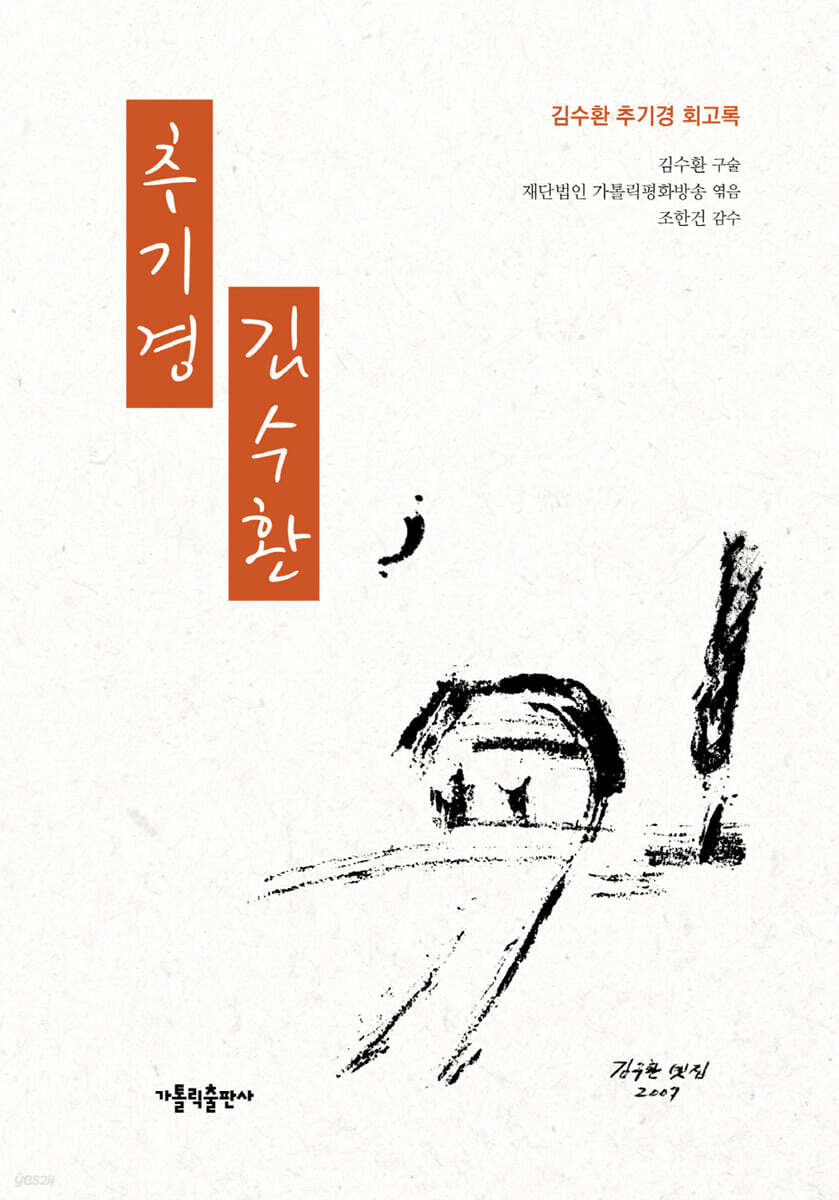
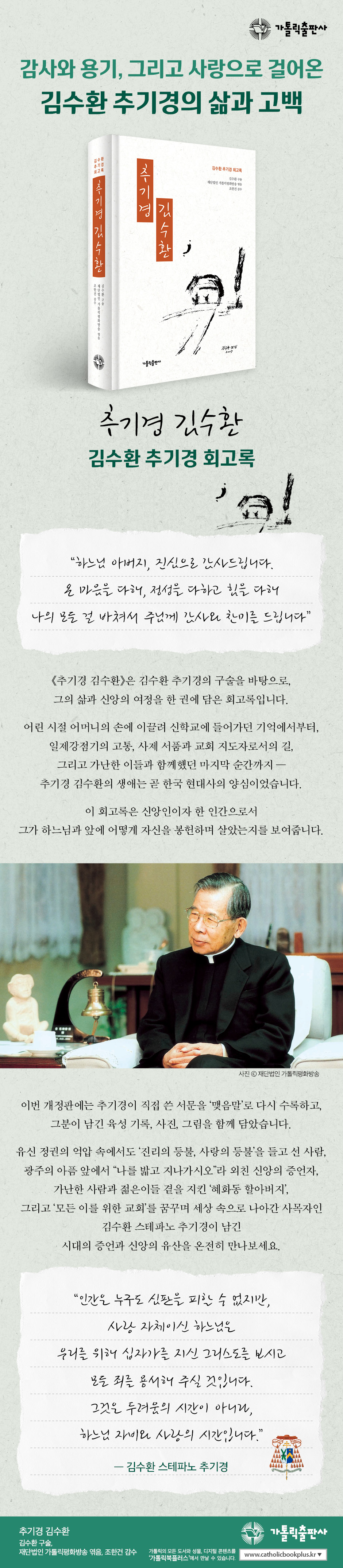
The cover of the book features "Old House," a drawing the Cardinal himself made while recalling the house he lived in as a child, which fully conveys the warm emotions he remembers.
In particular, the symbolism of the book was enhanced by using the font ‘Cardinal Kim Su-hwan’ developed by the Catholic Publishing Company for the title and subtitles.
Cardinal Kim Soo-hwan has dedicated himself to the Korean Church and society, following the example of Jesus' love in giving everything, as his pastoral motto, "For you and for all," suggests.
This book, which honestly captures his life, still resonates even in these changing times.
Through this book, readers will encounter the courage and reflection revealed in the path he has walked.
Cardinal Kim Soo-hwan's final recorded voice
Cardinal Kim Soo-hwan, the first Korean cardinal and a “servant of God,” is currently undergoing preliminary examination for beatification and canonization by the Seoul Archdiocese’s Committee for Beatification and Canonization.
A book about his life has been published in a newly revised edition.
His life and thoughts still resonate deeply with readers today, as we know that in times of turmoil, a loud adult voice is needed.
Cardinal Kim Soo-hwan is the only memoir left by Cardinal Kim Soo-hwan, and it calmly contains his life, faith, and thoughts as he navigated modern Korean history.
The book unfolds his journey, with various photographs, from his childhood through his boyhood under Japanese colonial rule, his time in seminary, his conscription as a student soldier, and his rise to the rank of cardinal.
The book honestly reveals the inner conflict he went through before deciding to become a priest and the anguish he felt along the way. It also vividly records the process leading up to his appointment as Korea's first cardinal and the historical moments the Korean Church encountered during his 30 years as Archbishop of Seoul.
This revised edition is presented in hardcover.
The cover of the book features "Old House," a drawing the Cardinal himself made while recalling the house he lived in as a child, which fully conveys the warm emotions he remembers.
In particular, the symbolism of the book was enhanced by using the font ‘Cardinal Kim Su-hwan’ developed by the Catholic Publishing Company for the title and subtitles.
Cardinal Kim Soo-hwan has dedicated himself to the Korean Church and society, following the example of Jesus' love in giving everything, as his pastoral motto, "For you and for all," suggests.
This book, which honestly captures his life, still resonates even in these changing times.
Through this book, readers will encounter the courage and reflection revealed in the path he has walked.
- You can preview some of the book's contents.
Preview
index
Chapter 1 Dreams and Hopes
The youngest son of a poor potter, 39
Led by my mother to the seminary at 45
I'm leaving the seminary 49
The Youngest Son's Song of Love 57
62 international students burning with hostility
71 students sent to the battlefield as student soldiers
80 Precious Relationships Found on the Battlefield
Why the FBI Tracked Me 86
The arduous journey home 90
Conflict and Temptation 96
Back to Seminary 101
Into the chaos of war 106
Chapter 2: The Happy Country Bride
Born a Priest 113
A Parish Priest's Life: A Dreamlike Beauty 119
124. My brief time as a parish priest's secretary
Mother leaning on my lap with her eyes closed 129
Bride 'Knot' and Flour Believer 134
139 To Germany with a passion for learning
Newspaper CEO 148: Collecting Overdue Subscription Fees
Death row inmate Choi Wol-gap and Hope Center 153
Chapter 3 For you and for all
161 After 15 years of priestly ordination, he became a bishop.
My First Love, Masan Parish 166
The Korean Church's First Statement on Current Affairs 171
Chapter 4: The Shepherd Who Loved His Flock
Ascension to the position of Archbishop of Seoul 179
The Long and Hard-Running 30 Years as Archbishop of Seoul 185
President Park Chung-hee, whom I met 190
Beatification Ceremony for the 24 Martyrs of the Catholic Persecution of 195
Chapter 5: The Lamp of Truth, the Lamp of Love
Appointed as the youngest cardinal in 203
208 as the protagonist of breaking news around the world
I like politics? 213
The August 15th Declaration of the Current Situation led to a head-on clash with the Yushin regime.
Bishop Ji Hak-sun's Declaration of Conscience and Imprisonment 223
Controversy and Division over Church Political Participation 237
Kim Ji-ha, the Resistance Poet I Met 242
Opening the Door to the Yushin Regime 247
The Yushin Regime's Persecution of the Church 252
Jumping into the Dongil Textiles union suppression case 256
The Trampled Peasant Movement 261
Two Papal Elections 267
The Gift of Tears Never Received 272
The End of the Yushin Regime and Spring in Seoul 277
The new military junta and the May 18 Gwangju 286
Chapter 6 Peace on Earth
Mother Teresa I Met 293
298th Faith Convention Commemorating the 150th Anniversary of the Establishment of the Joseon Diocese
Father Kim Dong-han, 303
I wanted to live with the poor 309
Pope's visit to Korea and the canonization of 103 martyrs 315
The Fifth Republic and the Catholic Church 320
“Step over me” 325
Christ, Our Peace 334
Opening the Catholic Media Era 339
The Leisure Brought by the Civilian Government 344
Chairman Kim Il-sung is my 'lamb' 350
A Small Sanctuary Trampled by Public Power 355
Laying Down a Heavy Burden After 30 Years 361
Hyehwa-dong Grandfather 366
Chapter 7: "Hyehwa-dong Grandfather" Kim Su-hwan
Standing in the Field at Dusk 373
I don't have the courage to be with the poor. 378
I longed to run to the flock of sheep in the North who had lost their shepherd, but 383
Life's Teachers 389
Interreligious Dialogue for Young People 394
Cardinal's Tears 399
Episode 403
Looking back on life 410
Reviewer's Note 414
Cardinal Stephen Kim Sou-hwan's Chronology 418
Conclusion 422
The youngest son of a poor potter, 39
Led by my mother to the seminary at 45
I'm leaving the seminary 49
The Youngest Son's Song of Love 57
62 international students burning with hostility
71 students sent to the battlefield as student soldiers
80 Precious Relationships Found on the Battlefield
Why the FBI Tracked Me 86
The arduous journey home 90
Conflict and Temptation 96
Back to Seminary 101
Into the chaos of war 106
Chapter 2: The Happy Country Bride
Born a Priest 113
A Parish Priest's Life: A Dreamlike Beauty 119
124. My brief time as a parish priest's secretary
Mother leaning on my lap with her eyes closed 129
Bride 'Knot' and Flour Believer 134
139 To Germany with a passion for learning
Newspaper CEO 148: Collecting Overdue Subscription Fees
Death row inmate Choi Wol-gap and Hope Center 153
Chapter 3 For you and for all
161 After 15 years of priestly ordination, he became a bishop.
My First Love, Masan Parish 166
The Korean Church's First Statement on Current Affairs 171
Chapter 4: The Shepherd Who Loved His Flock
Ascension to the position of Archbishop of Seoul 179
The Long and Hard-Running 30 Years as Archbishop of Seoul 185
President Park Chung-hee, whom I met 190
Beatification Ceremony for the 24 Martyrs of the Catholic Persecution of 195
Chapter 5: The Lamp of Truth, the Lamp of Love
Appointed as the youngest cardinal in 203
208 as the protagonist of breaking news around the world
I like politics? 213
The August 15th Declaration of the Current Situation led to a head-on clash with the Yushin regime.
Bishop Ji Hak-sun's Declaration of Conscience and Imprisonment 223
Controversy and Division over Church Political Participation 237
Kim Ji-ha, the Resistance Poet I Met 242
Opening the Door to the Yushin Regime 247
The Yushin Regime's Persecution of the Church 252
Jumping into the Dongil Textiles union suppression case 256
The Trampled Peasant Movement 261
Two Papal Elections 267
The Gift of Tears Never Received 272
The End of the Yushin Regime and Spring in Seoul 277
The new military junta and the May 18 Gwangju 286
Chapter 6 Peace on Earth
Mother Teresa I Met 293
298th Faith Convention Commemorating the 150th Anniversary of the Establishment of the Joseon Diocese
Father Kim Dong-han, 303
I wanted to live with the poor 309
Pope's visit to Korea and the canonization of 103 martyrs 315
The Fifth Republic and the Catholic Church 320
“Step over me” 325
Christ, Our Peace 334
Opening the Catholic Media Era 339
The Leisure Brought by the Civilian Government 344
Chairman Kim Il-sung is my 'lamb' 350
A Small Sanctuary Trampled by Public Power 355
Laying Down a Heavy Burden After 30 Years 361
Hyehwa-dong Grandfather 366
Chapter 7: "Hyehwa-dong Grandfather" Kim Su-hwan
Standing in the Field at Dusk 373
I don't have the courage to be with the poor. 378
I longed to run to the flock of sheep in the North who had lost their shepherd, but 383
Life's Teachers 389
Interreligious Dialogue for Young People 394
Cardinal's Tears 399
Episode 403
Looking back on life 410
Reviewer's Note 414
Cardinal Stephen Kim Sou-hwan's Chronology 418
Conclusion 422
Detailed image
Into the book
I really like the red-tinted evening sky.
The sunset over the mountain ridge is my hometown and my mother.
My first memory from childhood was when I was three or four years old and living in Seonsan, Gyeongbuk.
My mother baked and sold chrysanthemum bread in a corner of an empty lot in town where a circus troupe had moved in.
I crouched down next to her and blankly watched my mother do her business.
If my mother, who had gone to the market to sell pottery, did not return by sunset, I would go out onto the main road and watch the mountain pass where my mother would appear.
At that time, the sun was slowly setting on the western peak.
--- p.10
There are many religions and denominations, but Catholicism is one.
Wherever you go in the world, the liturgy, doctrine, and church structure are the same.
Whether in the bustling streets of New York or the jungles of Africa, every Catholic Church on earth is linked by one faith to the Pope, the successor of the Apostle Peter.
That is, all believers are one family, one brother.
So, how happy must it have been for a Korean theology student from a defeated nation, wearing a Japanese military uniform, to meet an American brother on that island?
Thanks to the fact that he was known to be a Catholic seminarian, he was fortunate enough to attend the Christmas Mass that year.
Just before Christmas, the military chaplain called me, the only Catholic among the thousands of Japanese soldiers, and said, “The military chaplain on the island of Yuhwang is coming here to celebrate Christmas Eve Mass. You may attend if you wish.”
There was a military chaplain in Budo, but no military priest.
I can't tell you how excited my heart was at the thought of attending mass.
--- pp.82-83
“Please pass on what I say to the government authorities.
When the police enter the cathedral, the first thing they will see is me.
Then you will see the priests on a temporary siege.
And behind those priests are nuns.
The students you are trying to take away are behind the nuns.
“If you want to arrest the students, step on me, then step on the priests and nuns.” My position was firm.
--- p.328
Becoming a priest was not something I had wanted, but I was led to become one, and the life of a bishop and cardinal was a command, and the long years that followed were not simple.
There were times when I wanted to run away again and again.
I wanted to throw away the cross.
But I couldn't find the courage to make a decision.
In the end, I had no choice but to accept it and say, 'Do as you wish.'
If I think about it, I am a sinner.
He is a man of many faults.
It is no exaggeration to say that he is a great sinner who cannot even raise his head before God.
Nevertheless, through these sins and faults, God has made us realize His love, His mercy, and His abundant grace of forgiveness, as the Apostle Paul says: “Where sin increased, grace did all the more abound” (cf. Romans 5:20).
The sunset over the mountain ridge is my hometown and my mother.
My first memory from childhood was when I was three or four years old and living in Seonsan, Gyeongbuk.
My mother baked and sold chrysanthemum bread in a corner of an empty lot in town where a circus troupe had moved in.
I crouched down next to her and blankly watched my mother do her business.
If my mother, who had gone to the market to sell pottery, did not return by sunset, I would go out onto the main road and watch the mountain pass where my mother would appear.
At that time, the sun was slowly setting on the western peak.
--- p.10
There are many religions and denominations, but Catholicism is one.
Wherever you go in the world, the liturgy, doctrine, and church structure are the same.
Whether in the bustling streets of New York or the jungles of Africa, every Catholic Church on earth is linked by one faith to the Pope, the successor of the Apostle Peter.
That is, all believers are one family, one brother.
So, how happy must it have been for a Korean theology student from a defeated nation, wearing a Japanese military uniform, to meet an American brother on that island?
Thanks to the fact that he was known to be a Catholic seminarian, he was fortunate enough to attend the Christmas Mass that year.
Just before Christmas, the military chaplain called me, the only Catholic among the thousands of Japanese soldiers, and said, “The military chaplain on the island of Yuhwang is coming here to celebrate Christmas Eve Mass. You may attend if you wish.”
There was a military chaplain in Budo, but no military priest.
I can't tell you how excited my heart was at the thought of attending mass.
--- pp.82-83
“Please pass on what I say to the government authorities.
When the police enter the cathedral, the first thing they will see is me.
Then you will see the priests on a temporary siege.
And behind those priests are nuns.
The students you are trying to take away are behind the nuns.
“If you want to arrest the students, step on me, then step on the priests and nuns.” My position was firm.
--- p.328
Becoming a priest was not something I had wanted, but I was led to become one, and the life of a bishop and cardinal was a command, and the long years that followed were not simple.
There were times when I wanted to run away again and again.
I wanted to throw away the cross.
But I couldn't find the courage to make a decision.
In the end, I had no choice but to accept it and say, 'Do as you wish.'
If I think about it, I am a sinner.
He is a man of many faults.
It is no exaggeration to say that he is a great sinner who cannot even raise his head before God.
Nevertheless, through these sins and faults, God has made us realize His love, His mercy, and His abundant grace of forgiveness, as the Apostle Paul says: “Where sin increased, grace did all the more abound” (cf. Romans 5:20).
--- p.412
Publisher's Review
Cardinal Kim Soo-hwan, the "Light of the Age"
The most human side of it
"Cardinal Kim Soo-hwan" is structured to allow readers to experience the cardinal's inner and human side in more detail.
This book consists of seven chapters and presents the cardinal's life and faith from various angles with over 110 photographs.
The book also contains Cardinal Kim Su-hwan's deep concerns and honest confessions.
From his childhood days when he was contemplating running away from seminary to his moments after becoming a priest, he speaks with sincerity about his role and position.
He also expresses his longing for his deceased mother, and the scene where he lies down in his older brother's room to sleep after hearing the news of his older brother's death reveals the weakness of a human being behind the strong image we remember of the cardinal.
In particular, his 'conscience' stood out from his childhood.
During the Japanese colonial period, in a test, when asked to write about his feelings as a subject of the Japanese Empire, a young boy named Kim Su-hwan wrote the following on his answer sheet.
'I am not a subject of the Empire.
So I have no thoughts.'
That courage later led to his conviction that he would say to a high-ranking police official during the June 10th Struggle, “If you want to arrest students, step on me first, and then on the priests and nuns.”
He did not hesitate to share his story honestly.
In the diary written during the retreat, he wrote, “I want to be poor like Christ.
“The poorest of the poor, so poor that I can become a servant to all.”
He also offered humorous consolation, saying, “Even cardinals returned without receiving the gift of tears,” fearing that there might be priests who were discouraged by not receiving the gift of tears at the seminar, saying that they wanted to shed deep tears like the Apostle Peter but were unable to do so.
In this way, we can see the humility and warmth of a believer in the words he left behind.
Cardinal Kim Soo-hwan became a symbol of the Korean Catholic Church in 1969, becoming the youngest cardinal and the first Korean cardinal.
He is currently in the first stage of Catholic beatification and canonization, having been given the title of 'Servant of God'.
Because he became a 'prophet of the times, a bastion of human rights and justice, a friend of the poor, a guardian of all the weak, and a pioneer of social integration, a bridge of harmony.'
There are many words to describe him, such as 'the light of the times', 'the grandfather of Hyehwa-dong', and 'fool Kim Su-hwan', as he called himself.
In this book, we will encounter Cardinal Kim Soo-hwan in his most humane form, a man who humbled himself and put others first, rather than being called by the adjectives he had been given.
Looking back on his life, we are once again asked what it means to live as a true adult and mature Christian in Korean society.
I encourage you to rediscover his life, faith, and warm voice through this revised edition.
The most human side of it
"Cardinal Kim Soo-hwan" is structured to allow readers to experience the cardinal's inner and human side in more detail.
This book consists of seven chapters and presents the cardinal's life and faith from various angles with over 110 photographs.
The book also contains Cardinal Kim Su-hwan's deep concerns and honest confessions.
From his childhood days when he was contemplating running away from seminary to his moments after becoming a priest, he speaks with sincerity about his role and position.
He also expresses his longing for his deceased mother, and the scene where he lies down in his older brother's room to sleep after hearing the news of his older brother's death reveals the weakness of a human being behind the strong image we remember of the cardinal.
In particular, his 'conscience' stood out from his childhood.
During the Japanese colonial period, in a test, when asked to write about his feelings as a subject of the Japanese Empire, a young boy named Kim Su-hwan wrote the following on his answer sheet.
'I am not a subject of the Empire.
So I have no thoughts.'
That courage later led to his conviction that he would say to a high-ranking police official during the June 10th Struggle, “If you want to arrest students, step on me first, and then on the priests and nuns.”
He did not hesitate to share his story honestly.
In the diary written during the retreat, he wrote, “I want to be poor like Christ.
“The poorest of the poor, so poor that I can become a servant to all.”
He also offered humorous consolation, saying, “Even cardinals returned without receiving the gift of tears,” fearing that there might be priests who were discouraged by not receiving the gift of tears at the seminar, saying that they wanted to shed deep tears like the Apostle Peter but were unable to do so.
In this way, we can see the humility and warmth of a believer in the words he left behind.
Cardinal Kim Soo-hwan became a symbol of the Korean Catholic Church in 1969, becoming the youngest cardinal and the first Korean cardinal.
He is currently in the first stage of Catholic beatification and canonization, having been given the title of 'Servant of God'.
Because he became a 'prophet of the times, a bastion of human rights and justice, a friend of the poor, a guardian of all the weak, and a pioneer of social integration, a bridge of harmony.'
There are many words to describe him, such as 'the light of the times', 'the grandfather of Hyehwa-dong', and 'fool Kim Su-hwan', as he called himself.
In this book, we will encounter Cardinal Kim Soo-hwan in his most humane form, a man who humbled himself and put others first, rather than being called by the adjectives he had been given.
Looking back on his life, we are once again asked what it means to live as a true adult and mature Christian in Korean society.
I encourage you to rediscover his life, faith, and warm voice through this revised edition.
GOODS SPECIFICS
- Date of issue: November 10, 2025
- Format: Hardcover book binding method guide
- Page count, weight, size: 424 pages | 664g | 153*216*26mm
- ISBN13: 9788932119809
- ISBN10: 8932119805
You may also like
카테고리
korean


korean

![GQ KOREA Mark (Monthly): December [2025]](http://librairie.coreenne.fr/cdn/shop/files/8ef265dbbfbf186523ed75ba7319009d.jpg?v=1765340328&width=3840)


