

sympathy
 |
Description
Book Introduction
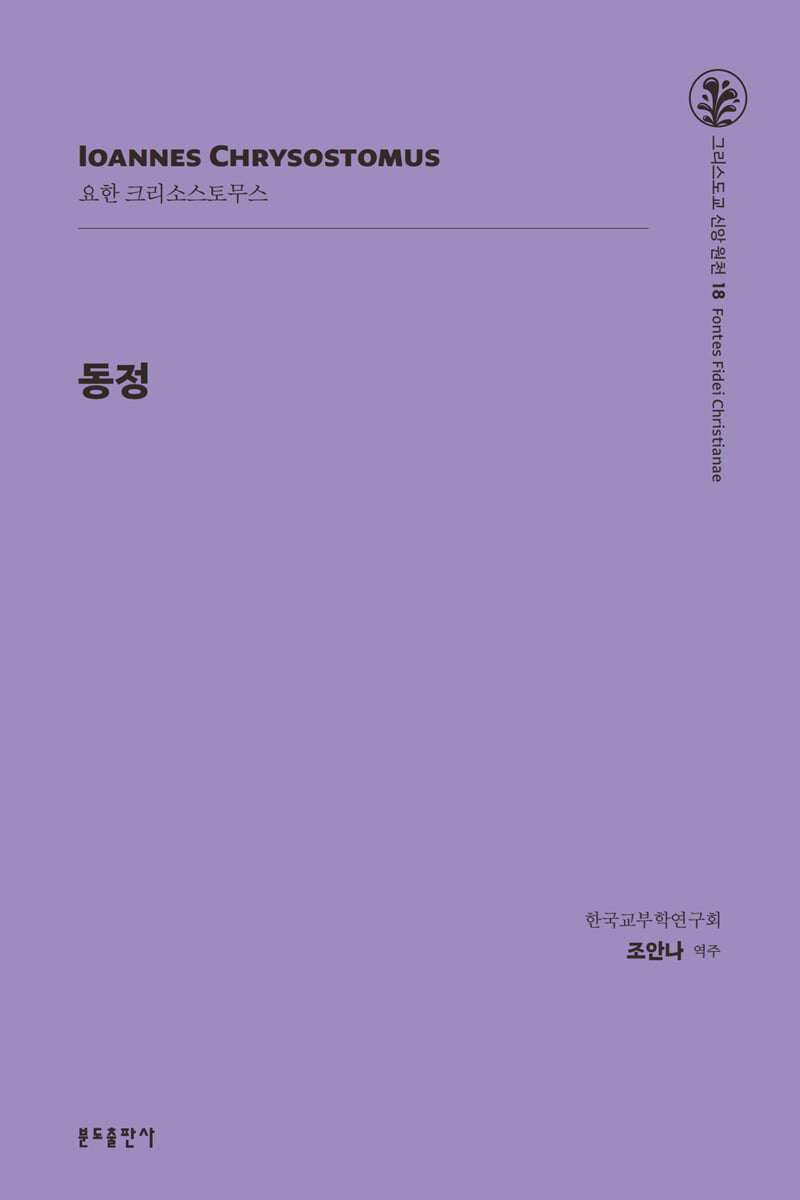
John Chrysostom's "Pity" is a work that praises the excellence of the virginal life.
John, who was ordained a deacon in 381, felt the need to teach the correct way to live as a virgin to the 'extreme asceticism of Antiochian society', 'Christians who opposed virginity', and 'virgins who were pursuing or living a life of virginity', and for this purpose, he commented on 1 Corinthians 7 of the Apostle Paul.
However, rather than writing as a commentator, he wrote with the attitude of a preacher trying to persuade the audience, and the outstanding result of this is 『Sympathy』.
John, who was ordained a deacon in 381, felt the need to teach the correct way to live as a virgin to the 'extreme asceticism of Antiochian society', 'Christians who opposed virginity', and 'virgins who were pursuing or living a life of virginity', and for this purpose, he commented on 1 Corinthians 7 of the Apostle Paul.
However, rather than writing as a commentator, he wrote with the attitude of a preacher trying to persuade the audience, and the outstanding result of this is 『Sympathy』.
- You can preview some of the book's contents.
Preview
index
While presenting the ‘Source of Christian Faith’
clear
1.
The Life of John Chrysostom
2.
John Chrysostom's Sympathy
3.
Date of writing
4.
structure
5.
nuclear power plant
6.
Sympathy's Views on Sympathy and Marriage
7.
The place of Sympathy among the works of John Chrysostom
sympathy
Subject index
Bible Index
clear
1.
The Life of John Chrysostom
2.
John Chrysostom's Sympathy
3.
Date of writing
4.
structure
5.
nuclear power plant
6.
Sympathy's Views on Sympathy and Marriage
7.
The place of Sympathy among the works of John Chrysostom
sympathy
Subject index
Bible Index
Into the book
"So you don't forbid marriage?" people ask. "I hope I don't have to share in your foolishness!" "Then why do you advise us to be single?" Because I believe that virginity is far more valuable than marriage.
That doesn't mean I'm saying marriage is a bad thing.
Rather, I praise marriage.
For those who wish to make good use of the institution of marriage, it is a haven of purity and a restraint on the wildness of nature.
Marriage erects before us a lawful union as a breakwater, against which the swords of passion break, bringing us peace and security.
However, there are some people who do not need this protection at all.
They discipline their intemperate nature by fasting, vigils, asceticism, and other forms of abstinence, according to their status.
I advise them not to marry, but I do not forbid them to marry.
--- pp.69-70
Do you understand the exalted value of compassion? Do you see how compassion allows those living on earth to enjoy the same conditions of existence as those in heaven? Compassion does not want those incarnate to be inferior to those in spiritual power.
Pity makes those who are merely human rivals of angels.
But all this means nothing to you, who degrade so beautiful a thing and slander the Lord, calling Him wicked.
Yes, that's right.
Punishment for the wicked servant awaits you (see Matthew 18:32).
Countless wonderful blessings will be bestowed upon the virgins of the Church.
It is an amazing line that people have never heard with their ears, seen with their eyes, or understood.
That doesn't mean I'm saying marriage is a bad thing.
Rather, I praise marriage.
For those who wish to make good use of the institution of marriage, it is a haven of purity and a restraint on the wildness of nature.
Marriage erects before us a lawful union as a breakwater, against which the swords of passion break, bringing us peace and security.
However, there are some people who do not need this protection at all.
They discipline their intemperate nature by fasting, vigils, asceticism, and other forms of abstinence, according to their status.
I advise them not to marry, but I do not forbid them to marry.
--- pp.69-70
Do you understand the exalted value of compassion? Do you see how compassion allows those living on earth to enjoy the same conditions of existence as those in heaven? Compassion does not want those incarnate to be inferior to those in spiritual power.
Pity makes those who are merely human rivals of angels.
But all this means nothing to you, who degrade so beautiful a thing and slander the Lord, calling Him wicked.
Yes, that's right.
Punishment for the wicked servant awaits you (see Matthew 18:32).
Countless wonderful blessings will be bestowed upon the virgins of the Church.
It is an amazing line that people have never heard with their ears, seen with their eyes, or understood.
--- pp.73-74
Publisher's Review
Towards excellence in compassionate living
Praise of John Chrysostom!
About this series
This series is the result of the 『Ancient Christian Literature Translation Project』, which received government subsidies from the Ministry of Culture, Sports and Tourism, and has received approval for further publication and sales from the Catholic Bishops' Conference of Korea, the supporting project and copyright holder.
We have selected authoritative modern patristic texts faithfully translated into English, French, German, Italian, Spanish, and other languages and translated them into beautiful and accurate Korean.
These books, which touch on the origins of the church, will help you understand not only the Bible but also the 'Holy Tradition' more deeply.
Since patristic literature is a common Christian heritage that must be preserved and nurtured by Catholics, Orthodox Christians, and Protestants, I believe that this effort to return to its source will contribute steadily to the movement for spiritual unity.
About 『Sympathy』
『The Virginity』 is a work written by John Chrysostom, who lived as a priest, bishop, monk, prophet, and martyr in Antioch and Constantinople in the latter half of the 4th century. It is a work that praises the excellence of his ascetic life in the face of the aversion to virginity at the time.
In 381, after returning to Antioch after his ascetic life and being ordained a deacon, John felt the need to teach the correct way to live as a virgin to the 'extreme ascetics of Antioch', 'Christians who opposed virginity', and 'virgins who were pursuing or already living a virginal life', and he commented on 1 Corinthians 7 of the Apostle Paul.
However, he wrote with the attitude of a preacher trying to persuade the audience rather than an expositor, and the valuable result of this is 『Sympathy』.
Here, John uses the rhetorical technique of the Sophists, who imagine a hypothetical interlocutor and respond to his objections, as a tool of persuasion.
The view of marriage in 『Pity』 may seem unfamiliar to modern readers, but this is likely due to the gap between the 4th-century Antiochian church and the 21st-century church.
The beauty and holiness of marriage as a symbol of the union between God and humanity, and its aspect as a sacrament, are difficult to find, especially when marriage is seen as an obstacle to union with God.
This is an overly negative argument for encouraging people to choose sympathy, but it would be a criticism from a modern perspective that does not take into account the times.
One literary technique in the time of John Chrysostom was to list the disadvantages of marriage, the opposite of virginity, in order to praise virginity.
On the other hand, this treatise is a lengthy commentary on 1 Corinthians 7, but it also provides a glimpse into the kind of person John was and his thoughts at the time when he decided to abandon his life in the wilderness and devote himself to pastoral work in Antioch.
Praise of John Chrysostom!
About this series
This series is the result of the 『Ancient Christian Literature Translation Project』, which received government subsidies from the Ministry of Culture, Sports and Tourism, and has received approval for further publication and sales from the Catholic Bishops' Conference of Korea, the supporting project and copyright holder.
We have selected authoritative modern patristic texts faithfully translated into English, French, German, Italian, Spanish, and other languages and translated them into beautiful and accurate Korean.
These books, which touch on the origins of the church, will help you understand not only the Bible but also the 'Holy Tradition' more deeply.
Since patristic literature is a common Christian heritage that must be preserved and nurtured by Catholics, Orthodox Christians, and Protestants, I believe that this effort to return to its source will contribute steadily to the movement for spiritual unity.
About 『Sympathy』
『The Virginity』 is a work written by John Chrysostom, who lived as a priest, bishop, monk, prophet, and martyr in Antioch and Constantinople in the latter half of the 4th century. It is a work that praises the excellence of his ascetic life in the face of the aversion to virginity at the time.
In 381, after returning to Antioch after his ascetic life and being ordained a deacon, John felt the need to teach the correct way to live as a virgin to the 'extreme ascetics of Antioch', 'Christians who opposed virginity', and 'virgins who were pursuing or already living a virginal life', and he commented on 1 Corinthians 7 of the Apostle Paul.
However, he wrote with the attitude of a preacher trying to persuade the audience rather than an expositor, and the valuable result of this is 『Sympathy』.
Here, John uses the rhetorical technique of the Sophists, who imagine a hypothetical interlocutor and respond to his objections, as a tool of persuasion.
The view of marriage in 『Pity』 may seem unfamiliar to modern readers, but this is likely due to the gap between the 4th-century Antiochian church and the 21st-century church.
The beauty and holiness of marriage as a symbol of the union between God and humanity, and its aspect as a sacrament, are difficult to find, especially when marriage is seen as an obstacle to union with God.
This is an overly negative argument for encouraging people to choose sympathy, but it would be a criticism from a modern perspective that does not take into account the times.
One literary technique in the time of John Chrysostom was to list the disadvantages of marriage, the opposite of virginity, in order to praise virginity.
On the other hand, this treatise is a lengthy commentary on 1 Corinthians 7, but it also provides a glimpse into the kind of person John was and his thoughts at the time when he decided to abandon his life in the wilderness and devote himself to pastoral work in Antioch.
GOODS SPECIFICS
- Date of issue: October 30, 2025
- Page count, weight, size: 216 pages | 336g | 152*225*11mm
- ISBN13: 9788941925170
- ISBN10: 8941925177
You may also like
카테고리
korean


korean

![ELLE 엘르 스페셜 에디션 A형 : 12월 [2025]](http://librairie.coreenne.fr/cdn/shop/files/b8e27a3de6c9538896439686c6b0e8fb.jpg?v=1766436872&width=3840)


