

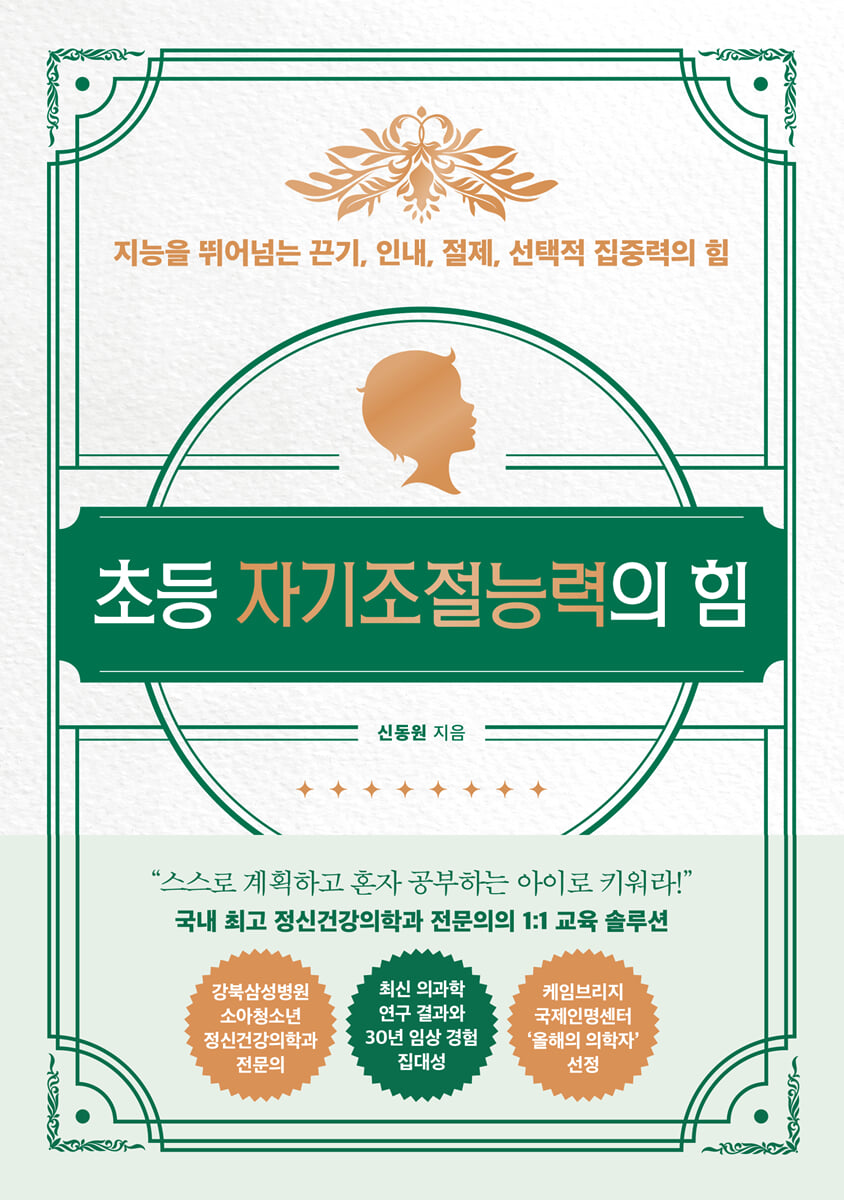
The power of elementary self-regulation
 |
Description
Book Introduction
“Parents educate their children throughout their lives.
“It cannot replace social life.”
I need to raise my child to be someone who can plan and study on his own!
Dong-Won Shin, author of "The Power of Elementary Self-Regulation," received academic attention in 2005 for her research on ADHD and was selected as "Medical Scientist of the Year" by the Cambridge International Biographical Centre in the UK. She is a leading pediatric and adolescent psychiatrist in Korea and a mother of two.
What she has been paying attention to recently is 'children with poor concentration and patience, and parents who look at those children with frustration.'
And these concerns for parents have become a ticking time bomb that every family needs to address immediately, starting with online classes due to COVID-19.
The questions parents asked the author were varied.
'My child has trouble concentrating in class', 'He has difficulty socializing with friends', 'He hates going to school'. These may seem like different problems, but the core issue is the same: 'My child's self-regulation ability'.
Many people think that 'self-control' is the ability to unconditionally endure or unconditionally immerse oneself, but this is a misunderstanding.
'Self-regulation' is the ability to judge and regulate all of these things on one's own: 'selective concentration' to block out unnecessary information and remember important information, 'selective action' to carry out what needs to be done immediately, and 'selective patience' to distinguish when to act and when to endure.
The most important thing to note is that self-regulation is a capacity that goes beyond innate intelligence and can be acquired later in life.
This book clearly presents methods for developing self-regulation, an essential skill for living in the future, through medical science research data and 30 years of clinical experience.
“It cannot replace social life.”
I need to raise my child to be someone who can plan and study on his own!
Dong-Won Shin, author of "The Power of Elementary Self-Regulation," received academic attention in 2005 for her research on ADHD and was selected as "Medical Scientist of the Year" by the Cambridge International Biographical Centre in the UK. She is a leading pediatric and adolescent psychiatrist in Korea and a mother of two.
What she has been paying attention to recently is 'children with poor concentration and patience, and parents who look at those children with frustration.'
And these concerns for parents have become a ticking time bomb that every family needs to address immediately, starting with online classes due to COVID-19.
The questions parents asked the author were varied.
'My child has trouble concentrating in class', 'He has difficulty socializing with friends', 'He hates going to school'. These may seem like different problems, but the core issue is the same: 'My child's self-regulation ability'.
Many people think that 'self-control' is the ability to unconditionally endure or unconditionally immerse oneself, but this is a misunderstanding.
'Self-regulation' is the ability to judge and regulate all of these things on one's own: 'selective concentration' to block out unnecessary information and remember important information, 'selective action' to carry out what needs to be done immediately, and 'selective patience' to distinguish when to act and when to endure.
The most important thing to note is that self-regulation is a capacity that goes beyond innate intelligence and can be acquired later in life.
This book clearly presents methods for developing self-regulation, an essential skill for living in the future, through medical science research data and 30 years of clinical experience.
- You can preview some of the book's contents.
Preview
index
Prologue | Why Self-Regulation is Becoming More and More Important
PART 1.
The number of children who can study independently is decreasing.
Chapter 1.
Self-regulation issues revealed by COVID-19
01.
A child who can't concentrate at all during remote classes
02.
The conditions for success needed to live well
03.
What is self-regulation ability?
[Box] A child who doesn't want to do anything
Chapter 2.
How to Develop Your Child's Self-Regulation Skills
04.
When discipline is needed, self-regulation ability is strong.
05.
If you use your rewards well, your self-regulation skills will grow.
06.
Ultimately, it's a question of trust.
[Box] Use of Play
Chapter 3.
Developmental stages of self-regulation ability
07.
Step 0: Developing self-esteem through attachment
08.
Step 1: Learn to express your feelings in words
09.
Step 2: Distinguish between what to do and what not to do
10.
Step 3: Self-esteem, morality, and patience
PART 2.
Practicing your child's self-regulation skills
Chapter 4.
Self-Regulation Level 1: The Birth of Emotions and Emotion Regulation Practice
01.
When you have trouble falling asleep
02.
When you are very stubborn
03.
When you become attached to an object
04.
If you get angry or irritated easily
05.
When trying to play with dangerous objects
06.
When you get angry, you show violence
07.
When you have a toilet accident
[Box] Developing Parental Self-Regulation
Chapter 5.
Self-Regulation Level 2: Dos and Don'ts
08.
When you say something negative about yourself
09.
When you say something embarrassing to others without hesitation
10.
When you say something that is different from the truth
11.
When you want to eat only snacks all day long
12.
If you have a child who can't play alone
13.
When you bully your younger sibling
14.
When you can't say what you want and just whine
15.
When eating while walking around
16.
If you don't like sitting at a desk
17.
When shyness is too great
18.
When you are too scared
19.
If you keep fighting with your friend
[Box] How to Time Out Correctly
Chapter 6.
Level 2 Self-Regulation: Persistence, Sociability, Morality, and Self-Regulation
20.
When you can't concentrate on your studies
21.
When you can't study alone
22.
When you say you don't want to go to school
23.
When you can't concentrate on your studies and are distracted
24.
When you ask to change partners
25.
When you say you want to eat chicken even though you cooked rice
26.
When you ask someone to buy you expensive brand clothes
27.
If you steal someone else's thing
28.
When you are being swayed by a friend
29.
If your child swears
30.
When you play too many games
31.
When you tell an obvious lie
32.
When you are bullied
[Box] Elementary School Discipline Principles for Developing Self-Regulation
PART 1.
The number of children who can study independently is decreasing.
Chapter 1.
Self-regulation issues revealed by COVID-19
01.
A child who can't concentrate at all during remote classes
02.
The conditions for success needed to live well
03.
What is self-regulation ability?
[Box] A child who doesn't want to do anything
Chapter 2.
How to Develop Your Child's Self-Regulation Skills
04.
When discipline is needed, self-regulation ability is strong.
05.
If you use your rewards well, your self-regulation skills will grow.
06.
Ultimately, it's a question of trust.
[Box] Use of Play
Chapter 3.
Developmental stages of self-regulation ability
07.
Step 0: Developing self-esteem through attachment
08.
Step 1: Learn to express your feelings in words
09.
Step 2: Distinguish between what to do and what not to do
10.
Step 3: Self-esteem, morality, and patience
PART 2.
Practicing your child's self-regulation skills
Chapter 4.
Self-Regulation Level 1: The Birth of Emotions and Emotion Regulation Practice
01.
When you have trouble falling asleep
02.
When you are very stubborn
03.
When you become attached to an object
04.
If you get angry or irritated easily
05.
When trying to play with dangerous objects
06.
When you get angry, you show violence
07.
When you have a toilet accident
[Box] Developing Parental Self-Regulation
Chapter 5.
Self-Regulation Level 2: Dos and Don'ts
08.
When you say something negative about yourself
09.
When you say something embarrassing to others without hesitation
10.
When you say something that is different from the truth
11.
When you want to eat only snacks all day long
12.
If you have a child who can't play alone
13.
When you bully your younger sibling
14.
When you can't say what you want and just whine
15.
When eating while walking around
16.
If you don't like sitting at a desk
17.
When shyness is too great
18.
When you are too scared
19.
If you keep fighting with your friend
[Box] How to Time Out Correctly
Chapter 6.
Level 2 Self-Regulation: Persistence, Sociability, Morality, and Self-Regulation
20.
When you can't concentrate on your studies
21.
When you can't study alone
22.
When you say you don't want to go to school
23.
When you can't concentrate on your studies and are distracted
24.
When you ask to change partners
25.
When you say you want to eat chicken even though you cooked rice
26.
When you ask someone to buy you expensive brand clothes
27.
If you steal someone else's thing
28.
When you are being swayed by a friend
29.
If your child swears
30.
When you play too many games
31.
When you tell an obvious lie
32.
When you are bullied
[Box] Elementary School Discipline Principles for Developing Self-Regulation
Detailed image

Into the book
Adults who are better able to regulate their own behavior and emotions according to the context of their situation and work, who are able to meticulously plan to achieve their goals, execute those plans, and adjust them appropriately, are more likely to succeed socially.
This is not just about being smart.
Being smart can be advantageous when it comes to tests, assignments, and memorization, but being able to comprehensively assess a situation and act accordingly is a whole other level of ability.
--- From "Prologue l Why Self-Regulation Ability is Becoming Increasingly Important"
Self-regulation is not patience.
Self-regulation is the ability to control oneself when faced with a situation, sometimes enduring, sometimes removing obstacles, and sometimes responding actively to overcome the situation in order to reach one's goals.
When you go online to do your homework and an interesting game ad pops up, the decision to postpone logging into the game until later so that you don't forget what you were going to do; the decision to sit down at your desk because you know that you'll feel better if you finish your math homework beforehand even though you want to play right now; the decision to say "I wish we hadn't talked about that" when a friend you like says something mean to you even though it might make things worse, these are all examples of self-regulation.
--- From "Prologue l Why Self-Regulation Ability is Becoming Increasingly Important"
Children are busy chatting in group chat rooms on their smartphones while watching remote classes.
It seems like he's doing his homework, but before he knows it, he's engrossed in a game.
I don't know how many short videos I watch because of YouTube's algorithm.
There are too many fun distractions around children to focus on boring classes or homework.
As we live more closely with digital devices, we find ourselves unable to resist temptation and end up doing other things.
--- 「1-01.
Among the children who cannot concentrate at all in remote classes
Children with higher self-regulation in early elementary school performed better in math and reading by age 13, whereas those with lower self-regulation had higher rates of aggressive behavior, criminal behavior, depressive symptoms, obesity, smoking, and illicit drug use.
Self-regulation skills in early elementary school children were also associated with unemployment, aggressive and criminal behavior, depression, anxiety, obesity, smoking, drinking, drug abuse, and physical illness in adults before age 38.
Numerous studies show that self-regulation is at the heart of success.
A child's self-regulation skills predict later achievement, interpersonal relationships, mental health, and a healthy life.
It is that important to develop self-regulation skills from an early age.
--- 「1-02.
Among the “conditions necessary for living well”
The moment when discipline is needed, that is, the moment when a child's behavior needs to be corrected, is the moment when a window of opportunity opens for parents to develop self-regulation skills.
Self-regulation skills can change depending on parenting styles.
Parents who provide specific guidance and practice repeatedly help their children develop self-regulation skills, while parents who forcefully suppress their children's behavior when discipline is needed prevent their children from developing self-regulation skills.
This is not just about being smart.
Being smart can be advantageous when it comes to tests, assignments, and memorization, but being able to comprehensively assess a situation and act accordingly is a whole other level of ability.
--- From "Prologue l Why Self-Regulation Ability is Becoming Increasingly Important"
Self-regulation is not patience.
Self-regulation is the ability to control oneself when faced with a situation, sometimes enduring, sometimes removing obstacles, and sometimes responding actively to overcome the situation in order to reach one's goals.
When you go online to do your homework and an interesting game ad pops up, the decision to postpone logging into the game until later so that you don't forget what you were going to do; the decision to sit down at your desk because you know that you'll feel better if you finish your math homework beforehand even though you want to play right now; the decision to say "I wish we hadn't talked about that" when a friend you like says something mean to you even though it might make things worse, these are all examples of self-regulation.
--- From "Prologue l Why Self-Regulation Ability is Becoming Increasingly Important"
Children are busy chatting in group chat rooms on their smartphones while watching remote classes.
It seems like he's doing his homework, but before he knows it, he's engrossed in a game.
I don't know how many short videos I watch because of YouTube's algorithm.
There are too many fun distractions around children to focus on boring classes or homework.
As we live more closely with digital devices, we find ourselves unable to resist temptation and end up doing other things.
--- 「1-01.
Among the children who cannot concentrate at all in remote classes
Children with higher self-regulation in early elementary school performed better in math and reading by age 13, whereas those with lower self-regulation had higher rates of aggressive behavior, criminal behavior, depressive symptoms, obesity, smoking, and illicit drug use.
Self-regulation skills in early elementary school children were also associated with unemployment, aggressive and criminal behavior, depression, anxiety, obesity, smoking, drinking, drug abuse, and physical illness in adults before age 38.
Numerous studies show that self-regulation is at the heart of success.
A child's self-regulation skills predict later achievement, interpersonal relationships, mental health, and a healthy life.
It is that important to develop self-regulation skills from an early age.
--- 「1-02.
Among the “conditions necessary for living well”
The moment when discipline is needed, that is, the moment when a child's behavior needs to be corrected, is the moment when a window of opportunity opens for parents to develop self-regulation skills.
Self-regulation skills can change depending on parenting styles.
Parents who provide specific guidance and practice repeatedly help their children develop self-regulation skills, while parents who forcefully suppress their children's behavior when discipline is needed prevent their children from developing self-regulation skills.
--- 「1-04.
In moments when discipline is needed, self-regulation ability is great.
In moments when discipline is needed, self-regulation ability is great.
Publisher's Review
“Parents educate their children throughout their lives.
“It cannot replace social life.”
I need to raise my child to be someone who can plan and study on his own!
Shin Dong-won, author of "The Power of Elementary Self-Regulation," received academic attention in 2005 for her research on ADHD and was selected as "Medical Scientist of the Year" by the Cambridge International Biographical Centre in the UK. She is a leading pediatric and adolescent psychiatrist in Korea and a mother of two.
What she has been paying attention to recently is 'children with poor concentration and patience, and parents who look at those children with frustration.'
And these concerns for parents have become a ticking time bomb that every family needs to address immediately, starting with online classes due to COVID-19.
The questions parents asked the author were varied.
'My child has trouble concentrating in class', 'He has difficulty socializing with friends', 'He hates going to school'. These may seem like different problems, but the core issue is the same: 'My child's self-regulation ability'.
Many people think that 'self-control' is the ability to unconditionally endure or unconditionally immerse oneself, but this is a misunderstanding.
'Self-regulation' is the ability to judge and regulate all of these things on one's own: 'selective concentration' to block out unnecessary information and remember important information, 'selective action' to carry out what needs to be done immediately, and 'selective patience' to distinguish when to act and when to endure.
The most important thing to note is that self-regulation is a capacity that goes beyond innate intelligence and can be acquired later in life.
This book clearly presents methods for developing self-regulation, an essential skill for living in the future, through medical science research data and 30 years of clinical experience.
1:1 educational solution from Korea's top psychiatrist specialists
'Focus on building physical strength for success until the early elementary school years!'
'How can I raise my child well?'
When a child is very young, parents feed, clothe, and do other things for the child, but developmentally, by the age of three, humans begin to leave their parents and prepare to go out into the world.
After going through the social adaptation process at daycare centers and kindergartens, children must have the ability to take care of themselves when entering elementary school.
But what about today? Many families have one or at most two children, and parents today, with their attachment to their children and keen interest in parenting, want to remove obstacles before their children become uncomfortable, prevent dangers in advance, and educate their children in the most comfortable and safe environment possible.
Is this really for the child's benefit?
When a child is young, parents can raise him or her while eliminating all risks and anxieties.
However, even in the upper grades of elementary school and middle school, parents cannot watch over their children 24 hours a day, and their grades will not improve just by having them study by their side.
You won't make friends by pushing yourself too hard, and you won't become a good student by praying hard.
So what can parents do to ensure their children's future? Parents can help their children develop "core skills" that will last a lifetime.
It is the ability to ‘self-regulate.’
"The Power of Elementary Self-Regulation" uses cutting-edge medical science to explain what self-regulation encompasses and how it impacts our lives.
It also provides guidance on how to develop self-regulation skills in everyday situations experienced by children and parents, up to elementary school age, within reach of parents.
'Children with excellent self-control skills succeed!'
Part 1 covers what self-regulation is and how important it is.
This book explains why the issue of self-regulation has become a bigger issue recently, the scope of self-regulation, and the development of self-regulation that a child should have at each stage of growth.
It also points out that the period when parental discipline is necessary is an important time to develop 'self-regulation skills', and that delicate discipline leads to future success.
Part 2, 'Practicing Children's Self-Regulation Abilities', guides parents on how to respond appropriately to everyday episodes experienced by children until they reach the lower grades of elementary school.
A child's 'self-regulation ability' develops at different rates for each child, and depending on the parents' response, it can either improve or worsen compared to the child's innate ability.
Therefore, by presenting common mistakes parents make and the correct responses they should show their children, we aim to help children develop their self-regulation skills in the most positive way possible.
“It cannot replace social life.”
I need to raise my child to be someone who can plan and study on his own!
Shin Dong-won, author of "The Power of Elementary Self-Regulation," received academic attention in 2005 for her research on ADHD and was selected as "Medical Scientist of the Year" by the Cambridge International Biographical Centre in the UK. She is a leading pediatric and adolescent psychiatrist in Korea and a mother of two.
What she has been paying attention to recently is 'children with poor concentration and patience, and parents who look at those children with frustration.'
And these concerns for parents have become a ticking time bomb that every family needs to address immediately, starting with online classes due to COVID-19.
The questions parents asked the author were varied.
'My child has trouble concentrating in class', 'He has difficulty socializing with friends', 'He hates going to school'. These may seem like different problems, but the core issue is the same: 'My child's self-regulation ability'.
Many people think that 'self-control' is the ability to unconditionally endure or unconditionally immerse oneself, but this is a misunderstanding.
'Self-regulation' is the ability to judge and regulate all of these things on one's own: 'selective concentration' to block out unnecessary information and remember important information, 'selective action' to carry out what needs to be done immediately, and 'selective patience' to distinguish when to act and when to endure.
The most important thing to note is that self-regulation is a capacity that goes beyond innate intelligence and can be acquired later in life.
This book clearly presents methods for developing self-regulation, an essential skill for living in the future, through medical science research data and 30 years of clinical experience.
1:1 educational solution from Korea's top psychiatrist specialists
'Focus on building physical strength for success until the early elementary school years!'
'How can I raise my child well?'
When a child is very young, parents feed, clothe, and do other things for the child, but developmentally, by the age of three, humans begin to leave their parents and prepare to go out into the world.
After going through the social adaptation process at daycare centers and kindergartens, children must have the ability to take care of themselves when entering elementary school.
But what about today? Many families have one or at most two children, and parents today, with their attachment to their children and keen interest in parenting, want to remove obstacles before their children become uncomfortable, prevent dangers in advance, and educate their children in the most comfortable and safe environment possible.
Is this really for the child's benefit?
When a child is young, parents can raise him or her while eliminating all risks and anxieties.
However, even in the upper grades of elementary school and middle school, parents cannot watch over their children 24 hours a day, and their grades will not improve just by having them study by their side.
You won't make friends by pushing yourself too hard, and you won't become a good student by praying hard.
So what can parents do to ensure their children's future? Parents can help their children develop "core skills" that will last a lifetime.
It is the ability to ‘self-regulate.’
"The Power of Elementary Self-Regulation" uses cutting-edge medical science to explain what self-regulation encompasses and how it impacts our lives.
It also provides guidance on how to develop self-regulation skills in everyday situations experienced by children and parents, up to elementary school age, within reach of parents.
'Children with excellent self-control skills succeed!'
Part 1 covers what self-regulation is and how important it is.
This book explains why the issue of self-regulation has become a bigger issue recently, the scope of self-regulation, and the development of self-regulation that a child should have at each stage of growth.
It also points out that the period when parental discipline is necessary is an important time to develop 'self-regulation skills', and that delicate discipline leads to future success.
Part 2, 'Practicing Children's Self-Regulation Abilities', guides parents on how to respond appropriately to everyday episodes experienced by children until they reach the lower grades of elementary school.
A child's 'self-regulation ability' develops at different rates for each child, and depending on the parents' response, it can either improve or worsen compared to the child's innate ability.
Therefore, by presenting common mistakes parents make and the correct responses they should show their children, we aim to help children develop their self-regulation skills in the most positive way possible.
GOODS SPECIFICS
- Date of issue: July 7, 2021
- Page count, weight, size: 296 pages | 430g | 148*210*20mm
- ISBN13: 9791165216023
- ISBN10: 1165216027
You may also like
카테고리
korean


korean

![GQ KOREA Mark (Monthly): December [2025]](http://librairie.coreenne.fr/cdn/shop/files/8ef265dbbfbf186523ed75ba7319009d.jpg?v=1765340328&width=3840)


