

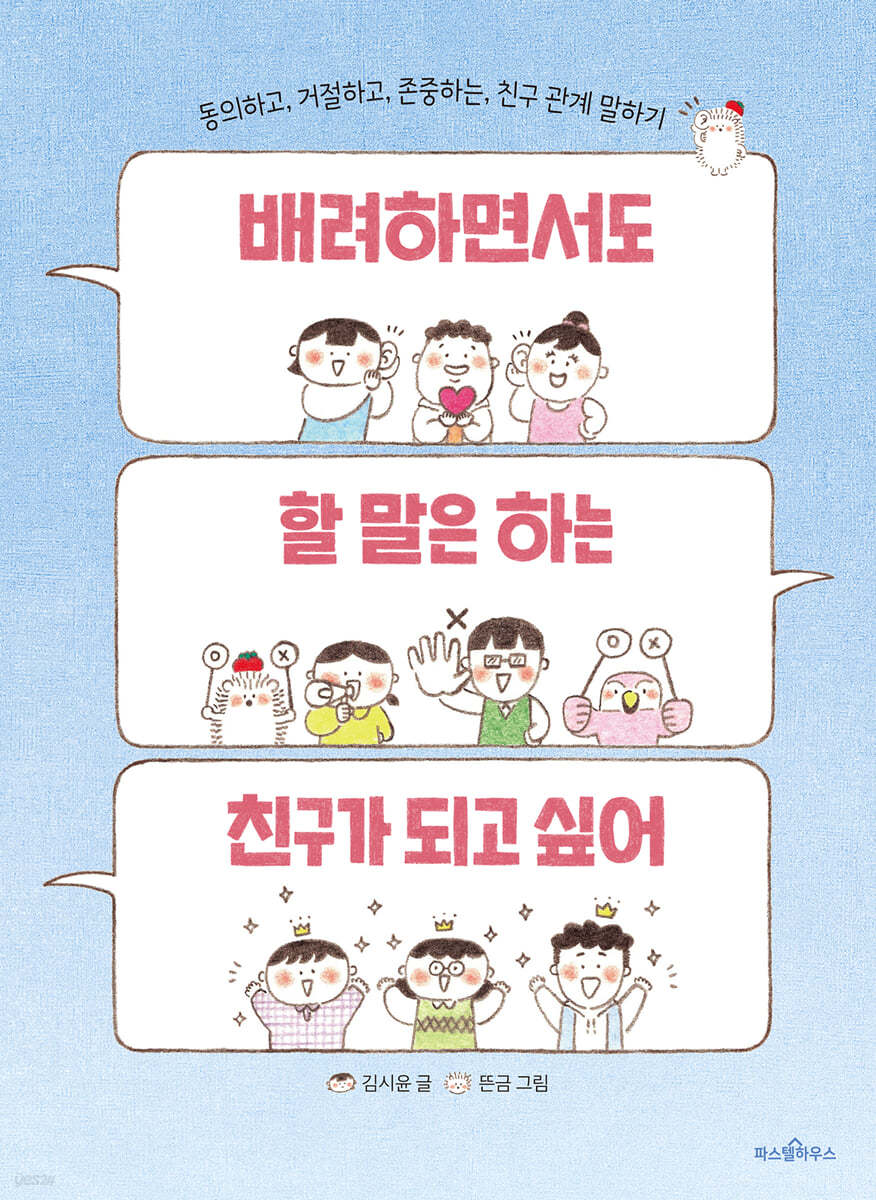
I want to be a friend who is considerate but also speaks his mind.
 |
Description
Book Introduction
How to be a friend who protects me and you?
Let's start by talking about a relationship that is both considerate and confident!
Kim Si-yoon, an elementary school teacher, often receives questions about her friends' concerns during school counseling sessions, such as, "My friend only does what she wants," "My mom tells me not to be dragged around by my friend," and "My friend is upset by my pranks."
Everyone wants to be a good friend, but sometimes it's not as easy as you might think.
So, the author planned this book to help solve the various concerns of friends he met through actual school settings and counseling.
A child who is soft-hearted and always tries to please others, a child who doesn't express his or her dislikes, a child who has a hard time because his or her friends turn their backs on him or her... The worries and conflicts between friends are often caused by imbalances in the relationship.
The author introduces words and practices that make friendships equal and healthy, like riding a bicycle with balance.
You learn three main things.
1) Respect each other's boundaries 2) Communicate properly 3) Say no when necessary.
A 'boundary' is a line that demarcates my personal space that must be respected by everyone.
If you learn to recognize and respect boundaries, you'll be much less likely to hurt your friends.
If I learn how to properly agree and decline here, I will be able to cherish both myself and my friends equally.
It's good to hear advice, but if you learn the basics of friendship, children will have the power to think for themselves and wisely resolve any friendship concerns that arise.
Furthermore, as an adult, I will be able to take charge of the interpersonal relationships I experience and deal with them in a healthy way.
Let's start by talking about a relationship that is both considerate and confident!
Kim Si-yoon, an elementary school teacher, often receives questions about her friends' concerns during school counseling sessions, such as, "My friend only does what she wants," "My mom tells me not to be dragged around by my friend," and "My friend is upset by my pranks."
Everyone wants to be a good friend, but sometimes it's not as easy as you might think.
So, the author planned this book to help solve the various concerns of friends he met through actual school settings and counseling.
A child who is soft-hearted and always tries to please others, a child who doesn't express his or her dislikes, a child who has a hard time because his or her friends turn their backs on him or her... The worries and conflicts between friends are often caused by imbalances in the relationship.
The author introduces words and practices that make friendships equal and healthy, like riding a bicycle with balance.
You learn three main things.
1) Respect each other's boundaries 2) Communicate properly 3) Say no when necessary.
A 'boundary' is a line that demarcates my personal space that must be respected by everyone.
If you learn to recognize and respect boundaries, you'll be much less likely to hurt your friends.
If I learn how to properly agree and decline here, I will be able to cherish both myself and my friends equally.
It's good to hear advice, but if you learn the basics of friendship, children will have the power to think for themselves and wisely resolve any friendship concerns that arise.
Furthermore, as an adult, I will be able to take charge of the interpersonal relationships I experience and deal with them in a healthy way.
- You can preview some of the book's contents.
Preview
index
Chapter 1: The boundary that protects you and me
“I feel comfortable in times like this.” 12
“Ask me.” 14
“Shall we shake hands for you?” 16
“I like the way I look.” 18
“I want to do it when we get closer.” 20
“I want to be your best friend, how about you?” 22
“Can I post this photo on social media?” 24
“Let’s text again later.” 26
“I don’t want to talk about that.” 28
“This is what truly benefits me.” 30
Boundary Practice: How to Establish Boundaries Between Friends 32
Chapter 2: The Agreement That Connects You and Me
“Can I do this?” 36
“If you don’t like it, just tell me.” 38
“I need time to think.” 40
“Sorry, I have to go first.” 42
“Would you listen to my opinion too?” 44
“That’s not what I want to do.” 46
“Let’s hear everyone’s opinion.” 48
“Respect my wishes.” 50
"No! No!" 52
“What do you think?”54
Consent Practice: 3 Keys to Healthy Consent 56
Chapter 3: Wise Rejection for Everyone
“Let’s do it together next time.” 60
“Well, I don’t know.” 62
"No! Don't do it!" 64
“I don’t want to.” 66
“Cheer for me.” 68
“That’s how I feel.” 70
“I don’t want to date yet.” 72
“Please, it’s necessary.” 74
“Okay, I understand.” 76
“Don’t tease me!” 78
Practice Saying No _ Why is saying no so hard? 80
Chapter 4: Respect for You and Me
“I am precious just as I am.” 84
“You are like that.” 86
"That could be possible." 88
"Are you okay? You must be upset." 90
“It’s cool to see you trying so hard.” 92
“Thanks, it was fun.” 94
"Sorry.
“I’ll be careful.” 96
“I want to do this.” 98
Practical practice of respect _ Learn how to communicate respectfully and in chat rooms 100
supplement
Activities after reading the book 104
106 Boundary Respect Stories for Leaders
References and Materials 110
“I feel comfortable in times like this.” 12
“Ask me.” 14
“Shall we shake hands for you?” 16
“I like the way I look.” 18
“I want to do it when we get closer.” 20
“I want to be your best friend, how about you?” 22
“Can I post this photo on social media?” 24
“Let’s text again later.” 26
“I don’t want to talk about that.” 28
“This is what truly benefits me.” 30
Boundary Practice: How to Establish Boundaries Between Friends 32
Chapter 2: The Agreement That Connects You and Me
“Can I do this?” 36
“If you don’t like it, just tell me.” 38
“I need time to think.” 40
“Sorry, I have to go first.” 42
“Would you listen to my opinion too?” 44
“That’s not what I want to do.” 46
“Let’s hear everyone’s opinion.” 48
“Respect my wishes.” 50
"No! No!" 52
“What do you think?”54
Consent Practice: 3 Keys to Healthy Consent 56
Chapter 3: Wise Rejection for Everyone
“Let’s do it together next time.” 60
“Well, I don’t know.” 62
"No! Don't do it!" 64
“I don’t want to.” 66
“Cheer for me.” 68
“That’s how I feel.” 70
“I don’t want to date yet.” 72
“Please, it’s necessary.” 74
“Okay, I understand.” 76
“Don’t tease me!” 78
Practice Saying No _ Why is saying no so hard? 80
Chapter 4: Respect for You and Me
“I am precious just as I am.” 84
“You are like that.” 86
"That could be possible." 88
"Are you okay? You must be upset." 90
“It’s cool to see you trying so hard.” 92
“Thanks, it was fun.” 94
"Sorry.
“I’ll be careful.” 96
“I want to do this.” 98
Practical practice of respect _ Learn how to communicate respectfully and in chat rooms 100
supplement
Activities after reading the book 104
106 Boundary Respect Stories for Leaders
References and Materials 110
Detailed image

Publisher's Review
Features of this book
·Secrets to vividly talking about friendships from school
The author, an elementary school teacher, observed and personally counseled friends at school, and captured their concerns in a cartoon format.
The parents and children who participated in this book's reader planning group said that it is a story that everyone has thought about and can relate to, to the point that they have experienced it at least once.
Hear the author's warm comfort and practical advice on what to say and do in these situations, and learn the foundation of healthy relationships.
In particular, 'how to say it' is very important.
I've actually included some clever answers in color to make it easier for friends to practice.
·The beginning of a good friendship is learning boundaries!
Friendship struggles and conflicts usually start from a lack of respect for each other's boundaries.
'Border' refers to the area that must be protected and cherished solely by me, such as my mind, my body, and my belongings.
The key to building good friendships is to respect each other and not cross this line carelessly.
So, if children know the boundaries well, they can find the answer on their own when they have a problem with a friend.
It's good to hear advice from others, but this understanding will help you reflect on your friendships, respond wisely, and develop the ability to discuss and resolve issues with others.
I hope that the most common problems in friendships that occur at school, such as touching friends' belongings or touching their bodies, can be resolved through thorough boundary education and practice.
·Be considerate and speak your mind! Practice agreeing and refusing.
Many parents worry that their children's friendships are becoming skewed, such as always accommodating their friends or having trouble saying no when they should.
A good friendship is only complete when what I want and what my friend wants are in balance.
In other words, you need to be considerate of your friends' wishes while also being able to confidently express your own wishes.
To do this, learn how to respect your friends, agree, protect yourself, and refuse wisely.
Especially since 'refusal' is something that many people find difficult, learn how to say it wisely, gently, and naturally.
Refusal is also essential to protect yourself from school bullies and dangerous adults.
Reading the book and practicing the follow-up activities will be very helpful.
·Basics of preventing online verbal abuse and school violence
While the book primarily covers everyday communication skills for friends, it also includes several other essential topics for children to understand. It covers how to communicate online, such as on social media and in chat rooms; how to deal with serious boundary violations, such as school violence; and how to communicate with unfamiliar adults.
Learning how to protect yourself in these situations can help you avoid being blind to or overlooking serious boundary violations that are occurring.
It helps you prevent serious situations and develops the ability to deal wisely with interpersonal relationships as an adult.
·If you learn well, you will become a friend who respects and is respected by everyone.
I've tried to avoid sounding judgmental or cold when giving examples of speaking in a friendship.
So that I can protect myself while also being considerate and warm to others.
Even when refusing, learn to speak thoughtfully and considerately so as not to embarrass the other person.
If I have a friend who makes me uncomfortable, I suggest we read and study this book together.
There are no such things as bad or rude friends. There are just friends who have learned and practiced boundaries, agreements, and rejections, and friends who are still unaware or make mistakes.
The friends in the book also sometimes make mistakes in their friendships without realizing it, but as they learn and practice more every day, they all become great friends.
·A book that can be used in classes on respecting boundaries, consent, and refusal.
The basic concepts of respecting boundaries, consent, and refusal are explained in simple words and pictures.
It can also be used as a resource when conducting boundary respect classes in kindergartens and schools.
In particular, since these concepts are explained through various real-life examples from elementary school friends, you will be able to learn these concepts naturally while empathizing with them.
·Secrets to vividly talking about friendships from school
The author, an elementary school teacher, observed and personally counseled friends at school, and captured their concerns in a cartoon format.
The parents and children who participated in this book's reader planning group said that it is a story that everyone has thought about and can relate to, to the point that they have experienced it at least once.
Hear the author's warm comfort and practical advice on what to say and do in these situations, and learn the foundation of healthy relationships.
In particular, 'how to say it' is very important.
I've actually included some clever answers in color to make it easier for friends to practice.
·The beginning of a good friendship is learning boundaries!
Friendship struggles and conflicts usually start from a lack of respect for each other's boundaries.
'Border' refers to the area that must be protected and cherished solely by me, such as my mind, my body, and my belongings.
The key to building good friendships is to respect each other and not cross this line carelessly.
So, if children know the boundaries well, they can find the answer on their own when they have a problem with a friend.
It's good to hear advice from others, but this understanding will help you reflect on your friendships, respond wisely, and develop the ability to discuss and resolve issues with others.
I hope that the most common problems in friendships that occur at school, such as touching friends' belongings or touching their bodies, can be resolved through thorough boundary education and practice.
·Be considerate and speak your mind! Practice agreeing and refusing.
Many parents worry that their children's friendships are becoming skewed, such as always accommodating their friends or having trouble saying no when they should.
A good friendship is only complete when what I want and what my friend wants are in balance.
In other words, you need to be considerate of your friends' wishes while also being able to confidently express your own wishes.
To do this, learn how to respect your friends, agree, protect yourself, and refuse wisely.
Especially since 'refusal' is something that many people find difficult, learn how to say it wisely, gently, and naturally.
Refusal is also essential to protect yourself from school bullies and dangerous adults.
Reading the book and practicing the follow-up activities will be very helpful.
·Basics of preventing online verbal abuse and school violence
While the book primarily covers everyday communication skills for friends, it also includes several other essential topics for children to understand. It covers how to communicate online, such as on social media and in chat rooms; how to deal with serious boundary violations, such as school violence; and how to communicate with unfamiliar adults.
Learning how to protect yourself in these situations can help you avoid being blind to or overlooking serious boundary violations that are occurring.
It helps you prevent serious situations and develops the ability to deal wisely with interpersonal relationships as an adult.
·If you learn well, you will become a friend who respects and is respected by everyone.
I've tried to avoid sounding judgmental or cold when giving examples of speaking in a friendship.
So that I can protect myself while also being considerate and warm to others.
Even when refusing, learn to speak thoughtfully and considerately so as not to embarrass the other person.
If I have a friend who makes me uncomfortable, I suggest we read and study this book together.
There are no such things as bad or rude friends. There are just friends who have learned and practiced boundaries, agreements, and rejections, and friends who are still unaware or make mistakes.
The friends in the book also sometimes make mistakes in their friendships without realizing it, but as they learn and practice more every day, they all become great friends.
·A book that can be used in classes on respecting boundaries, consent, and refusal.
The basic concepts of respecting boundaries, consent, and refusal are explained in simple words and pictures.
It can also be used as a resource when conducting boundary respect classes in kindergartens and schools.
In particular, since these concepts are explained through various real-life examples from elementary school friends, you will be able to learn these concepts naturally while empathizing with them.
GOODS SPECIFICS
- Date of issue: April 4, 2023
- Page count, weight, size: 112 pages | 254g | 168*230*7mm
- ISBN13: 9791197494291
- ISBN10: 1197494294
- KC Certification: Certification Type: Conformity Confirmation
You may also like
카테고리
korean


korean

![GQ KOREA Mark (Monthly): December [2025]](http://librairie.coreenne.fr/cdn/shop/files/8ef265dbbfbf186523ed75ba7319009d.jpg?v=1765340328&width=3840)


