

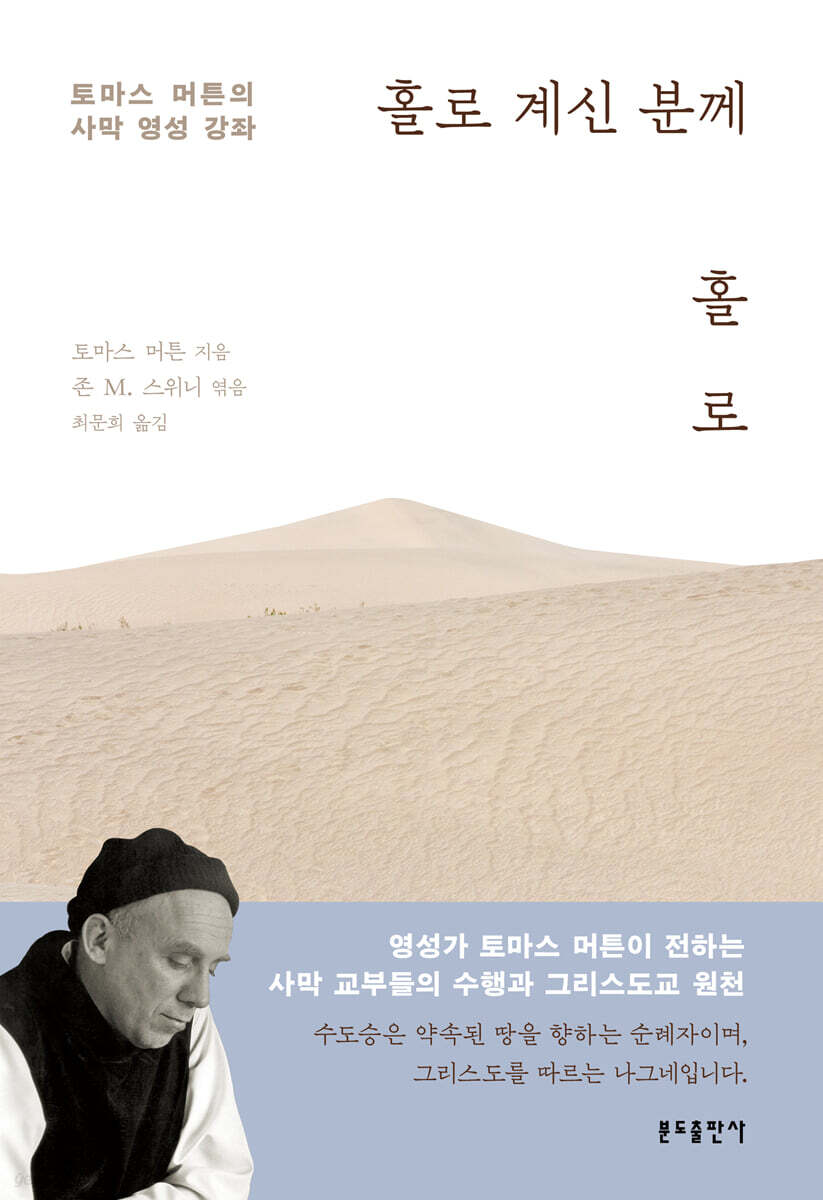
Alone to the one who is alone
 |
Description
Book Introduction
Thomas Merton believed that desert spirituality could be applied not only to monks but to everyone.
Even the ascetic journey in the desert is a process of finding answers to the questions, "How should I live? How should I become free?"
This book presents a mysterious path to spirituality to us who run forward without looking back.
The simple life of the Desert Fathers will show modern people who have lost their meaning what is truly important.
Even the ascetic journey in the desert is a process of finding answers to the questions, "How should I live? How should I become free?"
This book presents a mysterious path to spirituality to us who run forward without looking back.
The simple life of the Desert Fathers will show modern people who have lost their meaning what is truly important.
- You can preview some of the book's contents.
Preview
index
Header
Editor's Preface
Author's Preface
Lecture 1: Early Christian Spirituality, 1st and 2nd Centuries
Spirituality in the Age of Martyrdom | The Ideals of the Compassionate and the Ascetic
Lecture 2: The Early Deviations
Carnality | Montanism | Neoplatonism | Gnosticism
Third Lecture: Christian Teachers of Alexandria
Clement of Alexandria | Origen
Lecture Four: Saint Anthony in the Desert
A Brief Look at Saint Anthony | The Doctrine of Anthony | The Last Years of Saint Anthony
Lecture Five: Saint Pachomius and the Princess Monk
The Princess Monk and the Solitary Monk | The Life of Saint Pachomius | The Rule of Pachomius
Lecture Six: Saint Basil of Caesarea
Life | Writings of St. Basil | The Monastic Life of the Princess Basil
Lecture Seven: Other Cappadocian Fathers, Two Gregories
Saint Gregory of Nazianzus | Saint Gregory of Nyssa | Writings of Saint Gregory of Nyssa
Lecture Eight: The Monastic Life of Palestine and St. Jerome
St. Jerome | Other Controversies in the Life of Jerome | Jerome's Teachings on Monks
Lecture Ninth: The Community of Saint Melania
Saint Melania of Noble | Saint Melania of the Young | Roman Monastic Life in Palestine | Melania's Monastic Life in the East
Lecture Ten: Monastic Life in Mesopotamia and Syria
The Hermits of Nitria and Scetis | Characteristics of Desert Spirituality
Lecture Eleven: Saint Macarius and Pseudo-Macarius
Saint Macarius | Messalianism | Pseudo-Macarius
Lecture Twelfth: On Prayer by Evagir of Pontus
The Importance of Evagrius | What Does Evagrius Mean by Prayer? | Summary of the Stages of Prayer
Lecture Thirteen: John Cassian, Master of the Spiritual Life
Cassian's Error | The Life and Background of Cassian | Finupius Abba | The Desert of Scetis and Nitria | The Origen Controversy | Constantinople and Gaul
Lecture Fourteen: Cassian's Discourses
Discourse 1: The Purpose and Goal of Monasticism | Discourse 2: On Discernment | Discourse 4: Daniel Abba on the Desires of the Flesh and Spirit | Discourses 9 and 10: Isaac Abba on Prayer
Lecture Fifteen: Philoxenus of Marbug
The Foundation of the Spiritual Life | What Is Simplicity? | Letter to a Jewish Proselyte | Letter to a Novice | Desert Sanctuary | On Adultery
A collection of group discussion topics, questions, and additional resources.
English editor's note
List of Patristic Literature
Editor's Preface
Author's Preface
Lecture 1: Early Christian Spirituality, 1st and 2nd Centuries
Spirituality in the Age of Martyrdom | The Ideals of the Compassionate and the Ascetic
Lecture 2: The Early Deviations
Carnality | Montanism | Neoplatonism | Gnosticism
Third Lecture: Christian Teachers of Alexandria
Clement of Alexandria | Origen
Lecture Four: Saint Anthony in the Desert
A Brief Look at Saint Anthony | The Doctrine of Anthony | The Last Years of Saint Anthony
Lecture Five: Saint Pachomius and the Princess Monk
The Princess Monk and the Solitary Monk | The Life of Saint Pachomius | The Rule of Pachomius
Lecture Six: Saint Basil of Caesarea
Life | Writings of St. Basil | The Monastic Life of the Princess Basil
Lecture Seven: Other Cappadocian Fathers, Two Gregories
Saint Gregory of Nazianzus | Saint Gregory of Nyssa | Writings of Saint Gregory of Nyssa
Lecture Eight: The Monastic Life of Palestine and St. Jerome
St. Jerome | Other Controversies in the Life of Jerome | Jerome's Teachings on Monks
Lecture Ninth: The Community of Saint Melania
Saint Melania of Noble | Saint Melania of the Young | Roman Monastic Life in Palestine | Melania's Monastic Life in the East
Lecture Ten: Monastic Life in Mesopotamia and Syria
The Hermits of Nitria and Scetis | Characteristics of Desert Spirituality
Lecture Eleven: Saint Macarius and Pseudo-Macarius
Saint Macarius | Messalianism | Pseudo-Macarius
Lecture Twelfth: On Prayer by Evagir of Pontus
The Importance of Evagrius | What Does Evagrius Mean by Prayer? | Summary of the Stages of Prayer
Lecture Thirteen: John Cassian, Master of the Spiritual Life
Cassian's Error | The Life and Background of Cassian | Finupius Abba | The Desert of Scetis and Nitria | The Origen Controversy | Constantinople and Gaul
Lecture Fourteen: Cassian's Discourses
Discourse 1: The Purpose and Goal of Monasticism | Discourse 2: On Discernment | Discourse 4: Daniel Abba on the Desires of the Flesh and Spirit | Discourses 9 and 10: Isaac Abba on Prayer
Lecture Fifteen: Philoxenus of Marbug
The Foundation of the Spiritual Life | What Is Simplicity? | Letter to a Jewish Proselyte | Letter to a Novice | Desert Sanctuary | On Adultery
A collection of group discussion topics, questions, and additional resources.
English editor's note
List of Patristic Literature
Into the book
This book is also appealing to those of us who live outside the monastery.
This is thanks to Merton's remarkable ability to examine key figures, synthesize their writings, and inspire audiences and readers with their implications for the spiritual life.
What makes this book so appealing to non-monks is Merton's belief, clearly expressed in his lectures, that the wisdom and spirituality of the monks can be applied to everyone.
--- pp.15-16
The greatest concern of desert life was finding God, finding salvation.
A common greeting among the Desert Fathers was sotheis, meaning "save me."
Many of the maxims we know as the Desert Fathers' maxims are actually answers to the question, "What should I do?"
--- p.24
My brother, you who are greater than the world, what are you doing in this world? … Are you afraid of the poverty of the desert? But Christ says, "Blessed are the poor."
Are you afraid of hard work? But no athlete can win without sweat and effort.
Are you thinking about the food you'll get here? But if your faith is strong, you won't fear hunger.
Are you afraid that your limbs will be bruised on the bare floor after fasting, your body gaunt? But the Lord lies down with you on the floor.
Are you afraid that your hair will become tangled because you can't wash it? But Christ is your head.
Are you daunted by the boundless expanse of the desert? But in your thoughts, you will step into heaven.
This is thanks to Merton's remarkable ability to examine key figures, synthesize their writings, and inspire audiences and readers with their implications for the spiritual life.
What makes this book so appealing to non-monks is Merton's belief, clearly expressed in his lectures, that the wisdom and spirituality of the monks can be applied to everyone.
--- pp.15-16
The greatest concern of desert life was finding God, finding salvation.
A common greeting among the Desert Fathers was sotheis, meaning "save me."
Many of the maxims we know as the Desert Fathers' maxims are actually answers to the question, "What should I do?"
--- p.24
My brother, you who are greater than the world, what are you doing in this world? … Are you afraid of the poverty of the desert? But Christ says, "Blessed are the poor."
Are you afraid of hard work? But no athlete can win without sweat and effort.
Are you thinking about the food you'll get here? But if your faith is strong, you won't fear hunger.
Are you afraid that your limbs will be bruised on the bare floor after fasting, your body gaunt? But the Lord lies down with you on the floor.
Are you afraid that your hair will become tangled because you can't wash it? But Christ is your head.
Are you daunted by the boundless expanse of the desert? But in your thoughts, you will step into heaven.
--- pp.114-115
Publisher's Review
Guidance for life found in the origins of spirituality
What should I do? This question is a shadow that follows us throughout.
When the moment of choice comes, we agonize.
Should I do this or that? Our hectic daily lives always seem to force us to make choices, and modern society subtly encourages us to set personal standards based on what the times venerate.
We enjoy the benefits of a diverse and prosperous society, but the noise of this world sometimes confuses us.
Thomas Merton tells us the story of the early Christian desert fathers.
They are people who were born into the world, but left the world and entered the desert to become one with God.
Some began the monastic tradition by living alone, while others lived communally with other monks.
Merton thought their story would be beneficial to us, not just monks.
Because they too had the same concerns as we do as we live in modern society.
They stood in the desert and asked how they should live, and they found their own answer.
This book tells the story of what they found through Merton's own words.
The Lives of the Desert Fathers by Thomas Merton
Merton organically explains the history of the Desert Fathers, from the period of Christian persecution to the Origen controversy, which triggered the migration of Eastern monasticism to the West.
In this period, when monastic life was not yet fully systematized, monks were at risk of falling into the wrong path due to their own judgment.
Desert monks built monasteries and established standards to prevent this danger.
Obedience and discernment are established as virtues, while distraction, pride, and jealousy are strictly forbidden.
This contains a deeper philosophy than the meaning of the word itself.
The ultimate goal of monastic life was union with God.
Even if you thoroughly practice external rules, fasting, prayer, and labor, it is meaningless if you do not obey from the heart.
The Desert Fathers warn against those who are obsessed with work or fasting, and against those who break the monastic rules through their own arrogance.
Their hearts were impure and they could not discern what was truly important.
What is seen in the solitude of the desert
The most important thing to avoid following their example is discernment, Merton emphasizes.
Just as the Desert Fathers discerned right from wrong based on Christian tradition and Scripture, we too must find our own standards.
Desert spirituality was practiced by simplifying the mind and following the Word of God.
The life of a desert monk was one of constant self-discipline and, at the same time, reconciliation with oneself through God's grace.
This book simultaneously shows their teachings and their real-life experiences, providing readers with both enlightenment and counter-instructions.
This does not mean simply imparting knowledge or following what they did.
This book offers advice on breaking free from the world's demands that oppress us, following the example of Jesus' life, which the Desert Fathers ultimately sought to emulate, and the Word of God.
Desert spirituality takes us into the desert of that time, immersing us in its traditions and giving us the opportunity to re-examine our lives.
What should I do? This question is a shadow that follows us throughout.
When the moment of choice comes, we agonize.
Should I do this or that? Our hectic daily lives always seem to force us to make choices, and modern society subtly encourages us to set personal standards based on what the times venerate.
We enjoy the benefits of a diverse and prosperous society, but the noise of this world sometimes confuses us.
Thomas Merton tells us the story of the early Christian desert fathers.
They are people who were born into the world, but left the world and entered the desert to become one with God.
Some began the monastic tradition by living alone, while others lived communally with other monks.
Merton thought their story would be beneficial to us, not just monks.
Because they too had the same concerns as we do as we live in modern society.
They stood in the desert and asked how they should live, and they found their own answer.
This book tells the story of what they found through Merton's own words.
The Lives of the Desert Fathers by Thomas Merton
Merton organically explains the history of the Desert Fathers, from the period of Christian persecution to the Origen controversy, which triggered the migration of Eastern monasticism to the West.
In this period, when monastic life was not yet fully systematized, monks were at risk of falling into the wrong path due to their own judgment.
Desert monks built monasteries and established standards to prevent this danger.
Obedience and discernment are established as virtues, while distraction, pride, and jealousy are strictly forbidden.
This contains a deeper philosophy than the meaning of the word itself.
The ultimate goal of monastic life was union with God.
Even if you thoroughly practice external rules, fasting, prayer, and labor, it is meaningless if you do not obey from the heart.
The Desert Fathers warn against those who are obsessed with work or fasting, and against those who break the monastic rules through their own arrogance.
Their hearts were impure and they could not discern what was truly important.
What is seen in the solitude of the desert
The most important thing to avoid following their example is discernment, Merton emphasizes.
Just as the Desert Fathers discerned right from wrong based on Christian tradition and Scripture, we too must find our own standards.
Desert spirituality was practiced by simplifying the mind and following the Word of God.
The life of a desert monk was one of constant self-discipline and, at the same time, reconciliation with oneself through God's grace.
This book simultaneously shows their teachings and their real-life experiences, providing readers with both enlightenment and counter-instructions.
This does not mean simply imparting knowledge or following what they did.
This book offers advice on breaking free from the world's demands that oppress us, following the example of Jesus' life, which the Desert Fathers ultimately sought to emulate, and the Word of God.
Desert spirituality takes us into the desert of that time, immersing us in its traditions and giving us the opportunity to re-examine our lives.
GOODS SPECIFICS
- Date of issue: September 4, 2025
- Page count, weight, size: 292 pages | 400g | 144*210*15mm
- ISBN13: 9788941925132
- ISBN10: 8941925134
You may also like
카테고리
korean


korean

![ELLE 엘르 스페셜 에디션 A형 : 12월 [2025]](http://librairie.coreenne.fr/cdn/shop/files/b8e27a3de6c9538896439686c6b0e8fb.jpg?v=1766436872&width=3840)


