

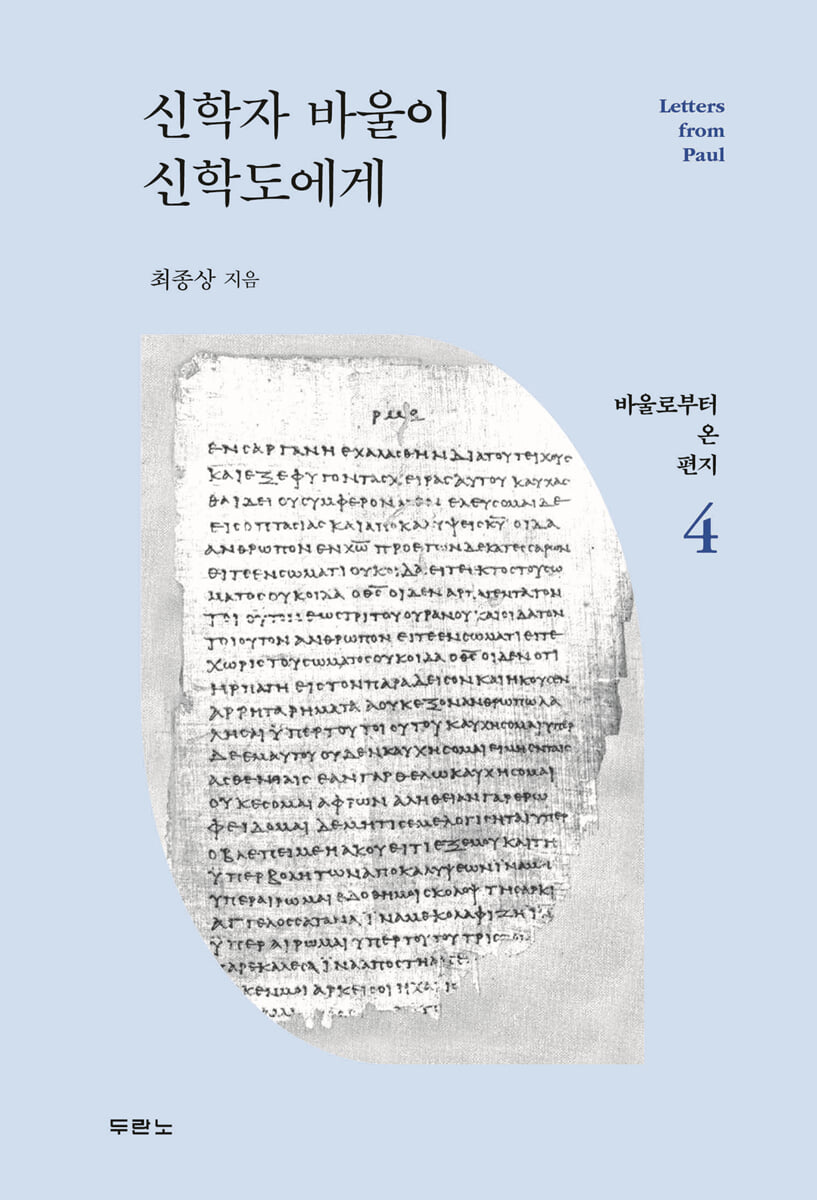
Theologian Paul to the seminary students
 |
Description
Book Introduction
Grand Prize at the 41st Korea Christian Publishing Culture Awards
『From Paul』 Missionary Choi Jong-sang's long-standing masterpiece!
Four letters from Paul to modern Christians
Lastly, six theological exhortations to seminarians.
This book can be said to be an old masterpiece by missionary Choi Jong-sang, an expert on Paul.
The author, who received a doctorate in Paul, planned to write a series of letters titled “From Paul to Us” that he had been pondering while publishing the book “From Paul” in 2024.
Although it was a long-time plan, it was after the publication of “From Paul” that he began writing it, and while working on various projects, he received many questions asking, “What would the Apostle Paul say if he met us now?”
Even at the 41st Korea Christian Publishing Culture Awards ceremony, the author delved deeply into Paul, saying, “The Apostle Paul was a one-man publisher.”
In the sermon for the event, the author explained that after Paul received the mission of evangelism, he clearly learned through Paul's letters how crucial it was to spread the gospel through word and writing even in the midst of persecution and crisis.
In this context, rather than highlighting Paul as a single person, the author seeks to highlight the mission of evangelism and Christians in this day and age through the letters and messages Paul left behind.
The author plans to compile the Pauline epistles into a total of four volumes, and this book, the final story, contains a message of challenge and advice from the senior theologian Paul to students embarking on the path of theology and to his juniors.
Through a total of six contents, it is emphasized that theology should not remain at the level of reason like other academic disciplines or doctrines, but should advance to the level of life and practice, and above all, it should be established on the basis of the Bible, the word of truth, rather than on doctrines or theories.
It also contains Paul's know-how essential for developing and systematizing theology as an academic discipline, providing a proper guidepost for those on the path of theology.
This book, like its predecessor, provides 'meditation and sharing' and 'Paul's Ten Theological Commandments', making it ideal for use in small groups.
Through the story of Paul, who was a pastor, missionary, and writer, but above all, a theologian respected and followed by many scholars to this day, I believe this book will serve as Paul's warm advice and encouragement to today's theology students who seek to walk the unwavering path of truth.
『From Paul』 Missionary Choi Jong-sang's long-standing masterpiece!
Four letters from Paul to modern Christians
Lastly, six theological exhortations to seminarians.
This book can be said to be an old masterpiece by missionary Choi Jong-sang, an expert on Paul.
The author, who received a doctorate in Paul, planned to write a series of letters titled “From Paul to Us” that he had been pondering while publishing the book “From Paul” in 2024.
Although it was a long-time plan, it was after the publication of “From Paul” that he began writing it, and while working on various projects, he received many questions asking, “What would the Apostle Paul say if he met us now?”
Even at the 41st Korea Christian Publishing Culture Awards ceremony, the author delved deeply into Paul, saying, “The Apostle Paul was a one-man publisher.”
In the sermon for the event, the author explained that after Paul received the mission of evangelism, he clearly learned through Paul's letters how crucial it was to spread the gospel through word and writing even in the midst of persecution and crisis.
In this context, rather than highlighting Paul as a single person, the author seeks to highlight the mission of evangelism and Christians in this day and age through the letters and messages Paul left behind.
The author plans to compile the Pauline epistles into a total of four volumes, and this book, the final story, contains a message of challenge and advice from the senior theologian Paul to students embarking on the path of theology and to his juniors.
Through a total of six contents, it is emphasized that theology should not remain at the level of reason like other academic disciplines or doctrines, but should advance to the level of life and practice, and above all, it should be established on the basis of the Bible, the word of truth, rather than on doctrines or theories.
It also contains Paul's know-how essential for developing and systematizing theology as an academic discipline, providing a proper guidepost for those on the path of theology.
This book, like its predecessor, provides 'meditation and sharing' and 'Paul's Ten Theological Commandments', making it ideal for use in small groups.
Through the story of Paul, who was a pastor, missionary, and writer, but above all, a theologian respected and followed by many scholars to this day, I believe this book will serve as Paul's warm advice and encouragement to today's theology students who seek to walk the unwavering path of truth.
- You can preview some of the book's contents.
Preview
index
| Series Preface |
| Prologue |
1_ Become a theologian who practices and teaches.
2_ Balance theology, practice, and faith
3_ Look at the forest of the Bible first, then look at the trees in the text.
4_ Read the Bible with a missionary perspective
5_ Defend the truth rather than doctrines or theories.
6_ Listen humbly to the opinions of others.
| Epilogue |
| Meditation and Sharing |
| The Ten Commandments of Theology from Paul |
| My Theological Confession |
| Prologue |
1_ Become a theologian who practices and teaches.
2_ Balance theology, practice, and faith
3_ Look at the forest of the Bible first, then look at the trees in the text.
4_ Read the Bible with a missionary perspective
5_ Defend the truth rather than doctrines or theories.
6_ Listen humbly to the opinions of others.
| Epilogue |
| Meditation and Sharing |
| The Ten Commandments of Theology from Paul |
| My Theological Confession |
Detailed image

Into the book
In the series "Letters from Paul," we will describe in letter form what the Apostle Paul would say if he were to deliver a message of encouragement and challenge to Christians living in this age.
In general, the Pauline letters were addressed to believers, including church leaders, and were written based on the situation faced by the first-century churches.
Therefore, finding messages for "me" living in the 21st century in his letters, especially for "me" in each of the positions of "pastor," "believer," "missionary," and "theologian," may not be as easy as one might think. Therefore, I have organized the letters into four volumes, each addressing a specific role.
『Paul the Pastor to Pastors』, 『Paul the Apostle to Saints』, 『Paul the Missionary to Missionaries』, 『Paul the Theologian to Theology Students』.
In this series, we have collected the messages that the Apostle Paul shared with each ministry.
However, it was nearly impossible to clearly distinguish them by position.
Because the Apostle Paul alone assumed various roles, and because Paul's letters were pastoral, missionary, and theological at the same time, and because these elements were complexly intertwined, some overlap in content and subject matter was inevitable.
However, I wanted to focus on who I am talking to.
Reading all of the Epistles from Paul, as they are interconnected, will provide a comprehensive understanding of Paul's apostolic, pastoral, missionary, and theological teachings.
--- From the "Series Preface"
Dear theology students in the Lord!
The recipients of this letter, the 'theological students', include all theological students, theologians, pastors and missionaries who graduated from theological schools, and believers who have a deep interest in theological topics.
First, I would like to congratulate and thank all the seminary students who have entered the seminary to study the Bible and theology intensively and are preparing to become servants of the Lord.
Most people have entered this path with a calling and desire to pursue full-time ministry, missions, or theological studies.
No matter what field you choose as your primary ministry, you will ultimately find yourself in a position to teach the saints.
Rather than thinking lightly about building up the qualifications to become a full-time minister, I believe you approached it with the determination to lay a solid foundation for a lifetime of ministry.
Please make the best use of the three years or more that God has given you, and prepare as much as you can.
There won't be much time left in the future to focus solely on studying like this.
Study the overall overview and interconnectedness of the Bible, and learn the original languages of the Bible, such as Greek and Hebrew.
The Lord may lead you to study further, so you should do your best in your current course.
That will best prepare you for your next degree step.
Above all, I hope that during this period you will learn about God's character, His ways of working, and His principles, and prepare yourself to become a servant of God.
I bless you with the joy of being moved by the gospel and knowing God more deeply.
As a person set apart for the work of God's kingdom, have a mission, but always study humbly, broadly, and deeply.
--- From the "Prologue"
Christianity has the Bible, written under the inspiration of the Holy Spirit.
Through this scripture, we learn about the existence, nature, vision, teachings, and working principles of God, the Creator and the only God.
This is the realm of theology.
Furthermore, Christianity is a religion that does not stop at worshipping and studying God, but values the practice of living a life that emulates His teachings and character.
--- p.19
I hope that you too will become a theology student who continuously evangelizes in the field of life.
Your theological work will also gain greater vitality in the field of communion with souls, and your insight into the Bible and theology in the context of life and evangelism will be enriched.
If what you teach and what you do are consistent, your teaching will come to life (2 Corinthians 10:11).
--- p.26
The primary mission of a seminary is to produce good theologians, pastors, and missionaries.
The mission of seminaries and theologians is to train full-time ministers who will serve sacrificially and spread the gospel to anyone, anytime, anywhere.
Seminaries should emphasize the practice of pastoral ministry and evangelism as much as academic training, and should focus on cultivating disciples of Jesus through a curriculum that cultivates the character of seminarians.
We must be mindful that Christianity does not degenerate into a religion of lectures, but becomes a religion of practice.
Theology should not focus solely on imparting academic knowledge.
Therefore, seminaries must consciously strive to cultivate the spirituality and character of their students and find ways to breathe life into the saints, the church, and theology.
--- p.37~38
One crucial axis for correctly understanding Paul's letters and Pauline theology is understanding the background and content of my refutation of the theological errors of the Judaizers, demonstrating that the salvation received by Gentile believers through faith is sufficient.
Since the Judaizers insisted that Gentile believers must be circumcised and keep the Law in order to obtain complete salvation, I, in the process of refuting their claim, declared that there was no need to keep the Law or circumcision.
It was not that he opposed the Jewish law and circumcision.
If we examine the context in which I positively mention the law (Rom. 7:7-8, 10, 12, 14, 16; 9:4) and circumcision (Rom. 3:1-2; 1 Cor. 7:18-19; Gal. 6:15), we will see that I am not making contradictory claims.
--- p.72~73
Jesus summarized the suffering and resurrection of Christ and the worldwide spread of the gospel as the core of the Old Testament.
He said that these are not two separate things, but a big picture of the Old Testament that is inextricably linked.
When the disciples heard this explanation, they understood the Scriptures and felt their hearts burning within them (Luke 24:32, 45).
Missions go beyond simply having a biblical basis; the entire Bible is the textbook and result of God's mission.
Even today, when reading or studying the Old Testament, it is important to grasp the context of the entire Old Testament with this big-picture perspective, and to understand each book and story from a Christ-centered and global missionary perspective.
--- p.90
Theologians must explain the importance of themes in the Bible, labeling them as important and less important as less important.
Furthermore, we must grasp the context and flow of the Bible and help believers understand it more comprehensively and easily.
My theology was based on the gospel, which contains the divinity, death, and resurrection of Jesus.
“This gospel is what God promised beforehand through his prophets in the [Old Testament] Holy Scriptures” (Rom. 1:2; John 5:39, 46; Luke 24:44).
So I preached the most important message: “Christ died for our sins according to the Scriptures, and that he was buried, and that he was raised on the third day according to the Scriptures” (1 Corinthians 15:3-4).
--- p.140~141
All material mentioned in the Bible should be accepted and used with equal weight.
If we easily accept or assert to an extreme what conforms to our existing presuppositions and treat as insignificant what does not, then that is not the right attitude toward God's Word.
It is also not a good attitude to be overconfident in one's own academic intelligence and wisdom and to underestimate the other person's arguments or data.
To hold a large magnifying glass over only the biblical data that supports one's own premises or beliefs and to insist that it is the most important and only source is not the attitude that one should have when entrusted with the task of studying, interpreting, and teaching God's Word.
--- p.177~178
Christian theology should not remain merely an academic discipline.
It must become a discipline that lives and moves like life and saves life.
I hope that we can go beyond simply imparting knowledge (information) to seminary students and lead them to transformation (transformation) in their lives.
This will be possible when education is balanced between theology, practice, and faith.
I have a word of advice for those who have become seminary professors and theologians.
Keep in mind that I was not just a theologian who studied in the library, but also an evangelist who was out in the field. I hope you will find balance by connecting your theology to the field of ministry.
When interpreting Paul's letters, it would be good to take into account the context in which I was situated.
Teach your students with the determination to lead them to action, following the principle, “What you learned and received and heard and saw in me, put into practice” (Philippians 4:9).
They will teach the saints in the future as they learned from you.
I pray that God will bless your theological research and teaching ministry, so that you will be equipped with excellent pastors, missionaries, and theologians to strengthen the local church and the kingdom of God.
We encourage seminary students who have decided to enter full-time ministry to serve the Lord and are entering seminary.
In this precious time granted by the Lord, I hope you will do your best to learn and prepare about the Holy Trinity and the Bible with the right perspective and attitude.
I hope that those who have already completed their theological training and are serving in pastoral or missionary fields will also provide sound teachings to the congregation with a correct and balanced perspective and interpretation of doctrine and various biblical topics.
I pray that through the dedication of theologians, seminarians, and ministers who have completed theological courses, collectively known as seminarians, the local church and the Kingdom of God will be firmly established on the truth.
In general, the Pauline letters were addressed to believers, including church leaders, and were written based on the situation faced by the first-century churches.
Therefore, finding messages for "me" living in the 21st century in his letters, especially for "me" in each of the positions of "pastor," "believer," "missionary," and "theologian," may not be as easy as one might think. Therefore, I have organized the letters into four volumes, each addressing a specific role.
『Paul the Pastor to Pastors』, 『Paul the Apostle to Saints』, 『Paul the Missionary to Missionaries』, 『Paul the Theologian to Theology Students』.
In this series, we have collected the messages that the Apostle Paul shared with each ministry.
However, it was nearly impossible to clearly distinguish them by position.
Because the Apostle Paul alone assumed various roles, and because Paul's letters were pastoral, missionary, and theological at the same time, and because these elements were complexly intertwined, some overlap in content and subject matter was inevitable.
However, I wanted to focus on who I am talking to.
Reading all of the Epistles from Paul, as they are interconnected, will provide a comprehensive understanding of Paul's apostolic, pastoral, missionary, and theological teachings.
--- From the "Series Preface"
Dear theology students in the Lord!
The recipients of this letter, the 'theological students', include all theological students, theologians, pastors and missionaries who graduated from theological schools, and believers who have a deep interest in theological topics.
First, I would like to congratulate and thank all the seminary students who have entered the seminary to study the Bible and theology intensively and are preparing to become servants of the Lord.
Most people have entered this path with a calling and desire to pursue full-time ministry, missions, or theological studies.
No matter what field you choose as your primary ministry, you will ultimately find yourself in a position to teach the saints.
Rather than thinking lightly about building up the qualifications to become a full-time minister, I believe you approached it with the determination to lay a solid foundation for a lifetime of ministry.
Please make the best use of the three years or more that God has given you, and prepare as much as you can.
There won't be much time left in the future to focus solely on studying like this.
Study the overall overview and interconnectedness of the Bible, and learn the original languages of the Bible, such as Greek and Hebrew.
The Lord may lead you to study further, so you should do your best in your current course.
That will best prepare you for your next degree step.
Above all, I hope that during this period you will learn about God's character, His ways of working, and His principles, and prepare yourself to become a servant of God.
I bless you with the joy of being moved by the gospel and knowing God more deeply.
As a person set apart for the work of God's kingdom, have a mission, but always study humbly, broadly, and deeply.
--- From the "Prologue"
Christianity has the Bible, written under the inspiration of the Holy Spirit.
Through this scripture, we learn about the existence, nature, vision, teachings, and working principles of God, the Creator and the only God.
This is the realm of theology.
Furthermore, Christianity is a religion that does not stop at worshipping and studying God, but values the practice of living a life that emulates His teachings and character.
--- p.19
I hope that you too will become a theology student who continuously evangelizes in the field of life.
Your theological work will also gain greater vitality in the field of communion with souls, and your insight into the Bible and theology in the context of life and evangelism will be enriched.
If what you teach and what you do are consistent, your teaching will come to life (2 Corinthians 10:11).
--- p.26
The primary mission of a seminary is to produce good theologians, pastors, and missionaries.
The mission of seminaries and theologians is to train full-time ministers who will serve sacrificially and spread the gospel to anyone, anytime, anywhere.
Seminaries should emphasize the practice of pastoral ministry and evangelism as much as academic training, and should focus on cultivating disciples of Jesus through a curriculum that cultivates the character of seminarians.
We must be mindful that Christianity does not degenerate into a religion of lectures, but becomes a religion of practice.
Theology should not focus solely on imparting academic knowledge.
Therefore, seminaries must consciously strive to cultivate the spirituality and character of their students and find ways to breathe life into the saints, the church, and theology.
--- p.37~38
One crucial axis for correctly understanding Paul's letters and Pauline theology is understanding the background and content of my refutation of the theological errors of the Judaizers, demonstrating that the salvation received by Gentile believers through faith is sufficient.
Since the Judaizers insisted that Gentile believers must be circumcised and keep the Law in order to obtain complete salvation, I, in the process of refuting their claim, declared that there was no need to keep the Law or circumcision.
It was not that he opposed the Jewish law and circumcision.
If we examine the context in which I positively mention the law (Rom. 7:7-8, 10, 12, 14, 16; 9:4) and circumcision (Rom. 3:1-2; 1 Cor. 7:18-19; Gal. 6:15), we will see that I am not making contradictory claims.
--- p.72~73
Jesus summarized the suffering and resurrection of Christ and the worldwide spread of the gospel as the core of the Old Testament.
He said that these are not two separate things, but a big picture of the Old Testament that is inextricably linked.
When the disciples heard this explanation, they understood the Scriptures and felt their hearts burning within them (Luke 24:32, 45).
Missions go beyond simply having a biblical basis; the entire Bible is the textbook and result of God's mission.
Even today, when reading or studying the Old Testament, it is important to grasp the context of the entire Old Testament with this big-picture perspective, and to understand each book and story from a Christ-centered and global missionary perspective.
--- p.90
Theologians must explain the importance of themes in the Bible, labeling them as important and less important as less important.
Furthermore, we must grasp the context and flow of the Bible and help believers understand it more comprehensively and easily.
My theology was based on the gospel, which contains the divinity, death, and resurrection of Jesus.
“This gospel is what God promised beforehand through his prophets in the [Old Testament] Holy Scriptures” (Rom. 1:2; John 5:39, 46; Luke 24:44).
So I preached the most important message: “Christ died for our sins according to the Scriptures, and that he was buried, and that he was raised on the third day according to the Scriptures” (1 Corinthians 15:3-4).
--- p.140~141
All material mentioned in the Bible should be accepted and used with equal weight.
If we easily accept or assert to an extreme what conforms to our existing presuppositions and treat as insignificant what does not, then that is not the right attitude toward God's Word.
It is also not a good attitude to be overconfident in one's own academic intelligence and wisdom and to underestimate the other person's arguments or data.
To hold a large magnifying glass over only the biblical data that supports one's own premises or beliefs and to insist that it is the most important and only source is not the attitude that one should have when entrusted with the task of studying, interpreting, and teaching God's Word.
--- p.177~178
Christian theology should not remain merely an academic discipline.
It must become a discipline that lives and moves like life and saves life.
I hope that we can go beyond simply imparting knowledge (information) to seminary students and lead them to transformation (transformation) in their lives.
This will be possible when education is balanced between theology, practice, and faith.
I have a word of advice for those who have become seminary professors and theologians.
Keep in mind that I was not just a theologian who studied in the library, but also an evangelist who was out in the field. I hope you will find balance by connecting your theology to the field of ministry.
When interpreting Paul's letters, it would be good to take into account the context in which I was situated.
Teach your students with the determination to lead them to action, following the principle, “What you learned and received and heard and saw in me, put into practice” (Philippians 4:9).
They will teach the saints in the future as they learned from you.
I pray that God will bless your theological research and teaching ministry, so that you will be equipped with excellent pastors, missionaries, and theologians to strengthen the local church and the kingdom of God.
We encourage seminary students who have decided to enter full-time ministry to serve the Lord and are entering seminary.
In this precious time granted by the Lord, I hope you will do your best to learn and prepare about the Holy Trinity and the Bible with the right perspective and attitude.
I hope that those who have already completed their theological training and are serving in pastoral or missionary fields will also provide sound teachings to the congregation with a correct and balanced perspective and interpretation of doctrine and various biblical topics.
I pray that through the dedication of theologians, seminarians, and ministers who have completed theological courses, collectively known as seminarians, the local church and the Kingdom of God will be firmly established on the truth.
--- From "Epilogue"
GOODS SPECIFICS
- Date of issue: August 20, 2025
- Page count, weight, size: 192 pages | 216g | 128*188*12mm
- ISBN13: 9788953151482
- ISBN10: 8953151481
You may also like
카테고리
korean


korean

![GQ KOREA Mark (Monthly): December [2025]](http://librairie.coreenne.fr/cdn/shop/files/8ef265dbbfbf186523ed75ba7319009d.jpg?v=1765340328&width=3840)


