

Biblical Critical Theory
 |
Description
Book Introduction
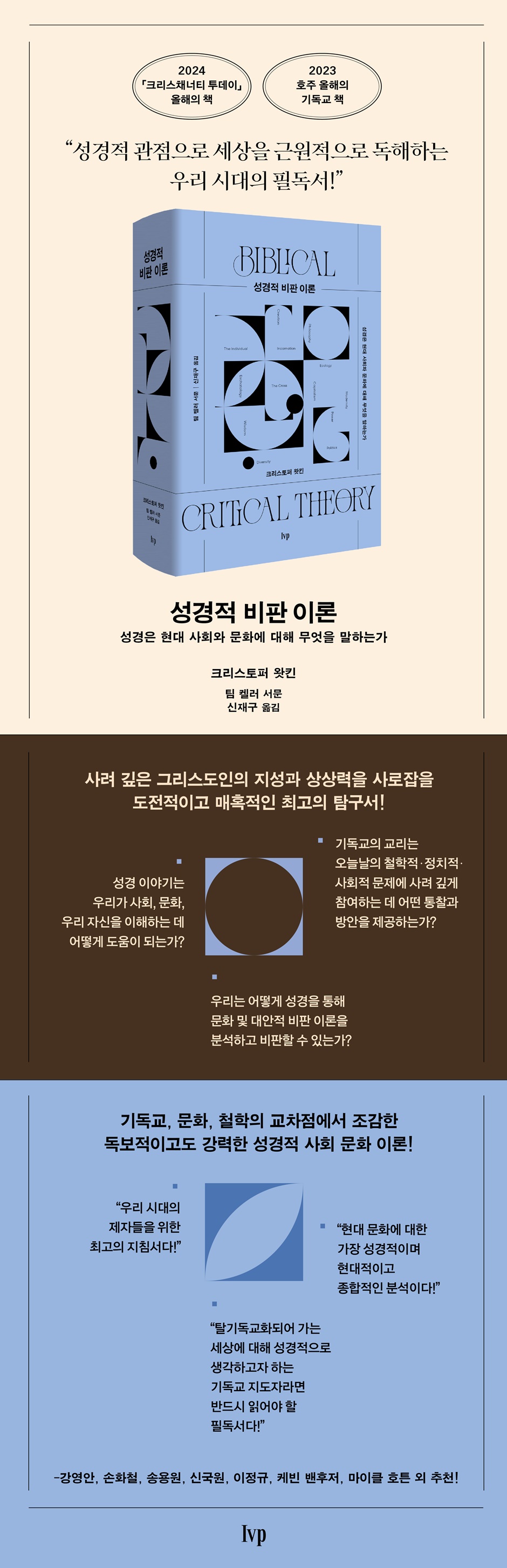
★ 2024 Christianity Today Book of the Year ★
★ 2023 Australian Christian Book of the Year ★
“How can we be the questions God poses to the world?”
A must-read for our time that fundamentally interprets the world from a biblical perspective!
“The ultimate guide for disciples of our time!”
“The most biblical, contemporary, and comprehensive analysis of modern culture!”
-Recommended by Kang Young-an, Son Hwa-cheol, Song Yong-won, Shin Guk-won, Lee Jeong-gyu, Kevin Vanhoozer, Michael Horton, and more!
An unparalleled guide introducing 'biblical critical theory' and guiding readers on how to interpret the world through it.
Critical theory, which aims to make visible the deep structures of the society and culture in which we live in order to reveal and change them, is an important axis of modern social theory.
The author, a scholar specializing in modern European thought and language, illuminates that the Bible holds a more fundamental critical theory than these theories that attempt to explain the world, and uses this as a basis for insightful interpretations of modern society and culture.
This is a must-read, essential reference book for Christians who wish to understand the world in a biblically faithful and culturally relevant way.
★ 2023 Australian Christian Book of the Year ★
“How can we be the questions God poses to the world?”
A must-read for our time that fundamentally interprets the world from a biblical perspective!
“The ultimate guide for disciples of our time!”
“The most biblical, contemporary, and comprehensive analysis of modern culture!”
-Recommended by Kang Young-an, Son Hwa-cheol, Song Yong-won, Shin Guk-won, Lee Jeong-gyu, Kevin Vanhoozer, Michael Horton, and more!
An unparalleled guide introducing 'biblical critical theory' and guiding readers on how to interpret the world through it.
Critical theory, which aims to make visible the deep structures of the society and culture in which we live in order to reveal and change them, is an important axis of modern social theory.
The author, a scholar specializing in modern European thought and language, illuminates that the Bible holds a more fundamental critical theory than these theories that attempt to explain the world, and uses this as a basis for insightful interpretations of modern society and culture.
This is a must-read, essential reference book for Christians who wish to understand the world in a biblically faithful and culturally relevant way.
- You can preview some of the book's contents.
Preview
index
Foreword_ Tim Keller
preface
Acknowledgements
introduction
Chapter 1: The Trinity
Chapter 2 Creation
Chapter 3 Humans
Chapter 4: Sin and Society
Chapter 5: Sin and Autonomy
Chapter 6: Sin, Anthropology, and Asymmetry
Chapter 7 From Lamech to Noah
Chapter 8 Babel
Chapter 9 Abraham and the Promise
Chapter 10 Abraham and the Covenant
Chapter 11: Moses, Exodus, and the Torah
Chapter 12 Prophecy and Power
Chapter 13: Prophecy and Cultural Criticism
Chapter 14: Wisdom Literature
Chapter 15: Incarnation, Space, and Time
Chapter 16: Incarnation, Materiality, and Personhood
Chapter 17: Jesus' Ministry, Love of God, Love of Neighbor
Chapter 18: The Cross, Overthrow, and Grace
Chapter 19: Cross, Asymmetry, Paradox
Chapter 20: Resurrection, Transformation, and Power
Chapter 21: The Last Days, Church, and Society
Chapter 22: The Last Days and the Time Difference
Chapter 23 The Last Days and the Emperor's Things to the Emperor
Chapter 24: The Last Days and Modernity
Chapter 25: Eschatology and the Apocalypse
Chapter 26: Eschatology and Time
Chapter 27: Eschatology and Identity
Chapter 28: Eschatology and Culture
conclusion
References
Browse Topics
Search the Bible
Find a person
preface
Acknowledgements
introduction
Chapter 1: The Trinity
Chapter 2 Creation
Chapter 3 Humans
Chapter 4: Sin and Society
Chapter 5: Sin and Autonomy
Chapter 6: Sin, Anthropology, and Asymmetry
Chapter 7 From Lamech to Noah
Chapter 8 Babel
Chapter 9 Abraham and the Promise
Chapter 10 Abraham and the Covenant
Chapter 11: Moses, Exodus, and the Torah
Chapter 12 Prophecy and Power
Chapter 13: Prophecy and Cultural Criticism
Chapter 14: Wisdom Literature
Chapter 15: Incarnation, Space, and Time
Chapter 16: Incarnation, Materiality, and Personhood
Chapter 17: Jesus' Ministry, Love of God, Love of Neighbor
Chapter 18: The Cross, Overthrow, and Grace
Chapter 19: Cross, Asymmetry, Paradox
Chapter 20: Resurrection, Transformation, and Power
Chapter 21: The Last Days, Church, and Society
Chapter 22: The Last Days and the Time Difference
Chapter 23 The Last Days and the Emperor's Things to the Emperor
Chapter 24: The Last Days and Modernity
Chapter 25: Eschatology and the Apocalypse
Chapter 26: Eschatology and Time
Chapter 27: Eschatology and Identity
Chapter 28: Eschatology and Culture
conclusion
References
Browse Topics
Search the Bible
Find a person
Detailed image
Into the book
For the past several years I have been arguing that there should be some kind of 'Christian High Theory'.
What Chris Watkin is doing in this book is exactly what I had in mind.
He thought it better to call it “biblical critical theory,” and I am convinced that I would do well to adopt that name.
The reasons he gives are sufficient.
That is, (1) we must build our critical theory not only on theology in general but also through direct contact with Scripture, and (2) our stance on culture must take into account all the major "turning points" in the biblical history of redemption, rather than focusing on just one aspect, as many denominations and Christian traditions tend to do.
Using the term “biblical” helps us keep this goal in mind.
--- From the Introduction (Tim Keller)
We learn about 'what?' and 'why?' but not so much about 'so?'
Likewise, we don't learn much about the "so what?" questions about sin, judgment, promise, covenant, law, prophecy, exile, incarnation, cross, resurrection, ascension, end times, and the end times.
So what about humanity? So what about society, our hopes, fears, and deepest values? So what about art, justice, history, and the environment? These biblical truths, and many others, have far-reaching consequences across all spheres.
Moreover, these results often provide fresh and constructive perspectives on the persistent social and cultural problems of our time.
--- From "Introduction: How Can We Become the Questions God Asks the World?"
There is a sad irony in the attempts of many Christians today to constructively engage in intellectual and social debate.
The very biblical truths and passages that Christians tend to avoid and find perplexing are often the ones that can most decisively and innovatively shape new thinking in key areas.
Few doctrines cause as much confusion and embarrassment among Christians today as the Trinity.
But in this chapter, I hope to show that the doctrine of the Trinity, far from hindering sophisticated debate and creative social and cultural insights, provides a platform for thoughtful Christians to constructively engage with the most important philosophical, political, and social questions of our time.
--- 「Chapter 1.
From "Trinity"
This paradigm of gifts puts us in the position of recipients.
We are given existence, given meaning, and loved.
As we will see clearly in the following chapters, we are creative recipients.
Being given the gift of the world does not make us passive.
But still, the fact remains that we are the recipients.
One thing we should not do with a gift is pretend that we bought or made it.
Since the giver is usually the one who receives the gratitude, our fundamental orientation toward existence in the paradigm of the gift is praise and gratitude.
--- Chapter 2.
From "Creation"
To put it simply, the more we talk about sin, the better for society.
In fact, it's good for democracy, it's good for equality, it's good for defeating despotism and imperialism, and it's good for finding meaning in life.
Sin itself is not good.
There is no problem in saying that we would be better off if there were no sin.
But approaching society without turning a blind eye to the Bible's robust doctrine of sin and judgment can present a far fresher, truer, and more positive vision than failing to see what the Bible blatantly conceals.
--- Chapter 4.
From “Sin and Society”
Ultimately, the phrase “God himself will provide the lamb” does not support the culture of human sacrifice, but actively and irreversibly overturns it.
This replaces the N-shaped paradigm of offering sacrifices—“You scratch my back, and I’ll scratch yours”—with a U-shaped dynamic in which God freely initiates a relationship with humanity and humanity responds with an attitude of gratitude.
--- Chapter 10.
From “Abraham and the Covenant”
The Bible has no ground zero genre, no neutral narrative style from which all other genres deviate or are transformed.
Each genre has its own conventions and assumptions, revealing a set of characteristics, orientations, and perspectives that cannot be perfectly reproduced in any other literary form.
If this radical genre diversity is not unusual among major religious and philosophical texts, it certainly must be unusual.
Moreover, the Bible's multiplicity of genres entangles much of modern Western thought, diagonalizing the superficial dichotomy between reason and imagination, exemplified in the conflict between Enlightenment rationalism and Romantic imagination.
The biblical texts engage our reason, our imagination, and our will, and are not considered secondary or unimportant to any of them.
The tea party of Hegel and Kierkegaard was joined by the fiery-hearted Byron and the perfectly rational Kant.
--- Chapter 14.
From “Wisdom Literature”
Our materialism and immaterialism are not two unrelated tendencies.
This is the inevitable dichotomous result of losing the perfect union of the material and the spiritual in the incarnate Christ.
When we abandon the incarnation, we find ourselves in a deadlock, caught between two extremes.
In other words, they endow material goods with inappropriate immaterial value, while at the same time avoiding material things and pursuing a utopian immateriality.
An anonymous Ugandan missionary diagnoses this dichotomous movement as a return to an alien form of life.
In other words, “we are drifting back to the polytheism of old, when the prophets of God waged great wars and fought.
“The true core of pagan thought is the division of the various concerns of human life into several compartments.”
--- 「Chapter 16.
From “Incarnation, Materiality, and Person”
Resurrection is a biblical figure that enables a new way of being in the world.
It diagonalizes some of the fundamental existential dichotomies that frustrate our experience of life in this life and force this world to conform to alien and inhuman ideologies.
It also diagonalizes the inappropriate attitudes that view death as simply good, simply evil, or simply insensitive.
It breaks open the logic of necessity and determinism that plagues the closed universe.
--- 「Chapter 20.
From “Resurrection, Change, Power”
Christian cultural theory is an agape theory, which is in contrast to the hermeneutics of violence.
The hermeneutics of violence systematically denies each of the four points that characterize the hermeneutics of love.
It views cultural communication in terms of power rather than relationships.
It interprets not to understand, but to assert and dominate.
It simplifies, distorts, or deliberately misrepresents the meaning of a cultural product, either to achieve one's own ends, to impose one's own interpretation, or to discredit or denigrate the creator.
It interprets itself to justify itself, even to the point of condemning others.
This is the hermeneutics of malice.
--- 「Chapter 23.
From "The Last Day and the Emperor's Things to the Emperor"
As we consider how the reality of God's judgment will impact the lives of Christians in the last days, I would like to add one more thought.
There is no need to think that reading the Bible faithfully requires that passages like Revelation 14 resonate completely with you.
Discomfort and confusion can be just as productive as understanding and mastery, and in some cases, they can even be more genuine responses.
There is precedent for such a response in the Bible.
There is little evidence that the reality of God's overwhelming judgment was comfortably accepted by the prophets.
There is much more evidence to the contrary.
By providing the genre of lament, the Bible offers an honest approach to facing such overwhelming realities.
What Chris Watkin is doing in this book is exactly what I had in mind.
He thought it better to call it “biblical critical theory,” and I am convinced that I would do well to adopt that name.
The reasons he gives are sufficient.
That is, (1) we must build our critical theory not only on theology in general but also through direct contact with Scripture, and (2) our stance on culture must take into account all the major "turning points" in the biblical history of redemption, rather than focusing on just one aspect, as many denominations and Christian traditions tend to do.
Using the term “biblical” helps us keep this goal in mind.
--- From the Introduction (Tim Keller)
We learn about 'what?' and 'why?' but not so much about 'so?'
Likewise, we don't learn much about the "so what?" questions about sin, judgment, promise, covenant, law, prophecy, exile, incarnation, cross, resurrection, ascension, end times, and the end times.
So what about humanity? So what about society, our hopes, fears, and deepest values? So what about art, justice, history, and the environment? These biblical truths, and many others, have far-reaching consequences across all spheres.
Moreover, these results often provide fresh and constructive perspectives on the persistent social and cultural problems of our time.
--- From "Introduction: How Can We Become the Questions God Asks the World?"
There is a sad irony in the attempts of many Christians today to constructively engage in intellectual and social debate.
The very biblical truths and passages that Christians tend to avoid and find perplexing are often the ones that can most decisively and innovatively shape new thinking in key areas.
Few doctrines cause as much confusion and embarrassment among Christians today as the Trinity.
But in this chapter, I hope to show that the doctrine of the Trinity, far from hindering sophisticated debate and creative social and cultural insights, provides a platform for thoughtful Christians to constructively engage with the most important philosophical, political, and social questions of our time.
--- 「Chapter 1.
From "Trinity"
This paradigm of gifts puts us in the position of recipients.
We are given existence, given meaning, and loved.
As we will see clearly in the following chapters, we are creative recipients.
Being given the gift of the world does not make us passive.
But still, the fact remains that we are the recipients.
One thing we should not do with a gift is pretend that we bought or made it.
Since the giver is usually the one who receives the gratitude, our fundamental orientation toward existence in the paradigm of the gift is praise and gratitude.
--- Chapter 2.
From "Creation"
To put it simply, the more we talk about sin, the better for society.
In fact, it's good for democracy, it's good for equality, it's good for defeating despotism and imperialism, and it's good for finding meaning in life.
Sin itself is not good.
There is no problem in saying that we would be better off if there were no sin.
But approaching society without turning a blind eye to the Bible's robust doctrine of sin and judgment can present a far fresher, truer, and more positive vision than failing to see what the Bible blatantly conceals.
--- Chapter 4.
From “Sin and Society”
Ultimately, the phrase “God himself will provide the lamb” does not support the culture of human sacrifice, but actively and irreversibly overturns it.
This replaces the N-shaped paradigm of offering sacrifices—“You scratch my back, and I’ll scratch yours”—with a U-shaped dynamic in which God freely initiates a relationship with humanity and humanity responds with an attitude of gratitude.
--- Chapter 10.
From “Abraham and the Covenant”
The Bible has no ground zero genre, no neutral narrative style from which all other genres deviate or are transformed.
Each genre has its own conventions and assumptions, revealing a set of characteristics, orientations, and perspectives that cannot be perfectly reproduced in any other literary form.
If this radical genre diversity is not unusual among major religious and philosophical texts, it certainly must be unusual.
Moreover, the Bible's multiplicity of genres entangles much of modern Western thought, diagonalizing the superficial dichotomy between reason and imagination, exemplified in the conflict between Enlightenment rationalism and Romantic imagination.
The biblical texts engage our reason, our imagination, and our will, and are not considered secondary or unimportant to any of them.
The tea party of Hegel and Kierkegaard was joined by the fiery-hearted Byron and the perfectly rational Kant.
--- Chapter 14.
From “Wisdom Literature”
Our materialism and immaterialism are not two unrelated tendencies.
This is the inevitable dichotomous result of losing the perfect union of the material and the spiritual in the incarnate Christ.
When we abandon the incarnation, we find ourselves in a deadlock, caught between two extremes.
In other words, they endow material goods with inappropriate immaterial value, while at the same time avoiding material things and pursuing a utopian immateriality.
An anonymous Ugandan missionary diagnoses this dichotomous movement as a return to an alien form of life.
In other words, “we are drifting back to the polytheism of old, when the prophets of God waged great wars and fought.
“The true core of pagan thought is the division of the various concerns of human life into several compartments.”
--- 「Chapter 16.
From “Incarnation, Materiality, and Person”
Resurrection is a biblical figure that enables a new way of being in the world.
It diagonalizes some of the fundamental existential dichotomies that frustrate our experience of life in this life and force this world to conform to alien and inhuman ideologies.
It also diagonalizes the inappropriate attitudes that view death as simply good, simply evil, or simply insensitive.
It breaks open the logic of necessity and determinism that plagues the closed universe.
--- 「Chapter 20.
From “Resurrection, Change, Power”
Christian cultural theory is an agape theory, which is in contrast to the hermeneutics of violence.
The hermeneutics of violence systematically denies each of the four points that characterize the hermeneutics of love.
It views cultural communication in terms of power rather than relationships.
It interprets not to understand, but to assert and dominate.
It simplifies, distorts, or deliberately misrepresents the meaning of a cultural product, either to achieve one's own ends, to impose one's own interpretation, or to discredit or denigrate the creator.
It interprets itself to justify itself, even to the point of condemning others.
This is the hermeneutics of malice.
--- 「Chapter 23.
From "The Last Day and the Emperor's Things to the Emperor"
As we consider how the reality of God's judgment will impact the lives of Christians in the last days, I would like to add one more thought.
There is no need to think that reading the Bible faithfully requires that passages like Revelation 14 resonate completely with you.
Discomfort and confusion can be just as productive as understanding and mastery, and in some cases, they can even be more genuine responses.
There is precedent for such a response in the Bible.
There is little evidence that the reality of God's overwhelming judgment was comfortably accepted by the prophets.
There is much more evidence to the contrary.
By providing the genre of lament, the Bible offers an honest approach to facing such overwhelming realities.
--- 「Chapter 25.
From “Eschatology and Apocalypse”
From “Eschatology and Apocalypse”
Publisher's Review
Imagine a stranger coming into your home and decorating it, picking out what you'd wear, deciding where your children would go to school, and driving your car without permission.
If you think about it for a moment, it's ridiculous.
But what if something like this were happening in our lives right now?
From the moment we open our eyes in the morning until we fall asleep at night, we live under the light of specific sociocultural theories deeply embedded in society and culture.
Every decision in life, big or small, such as where you spend your money or how you spend your free time, is influenced by this theory.
But do we truly understand the true nature of this theory? Christopher Watkin, author of "Biblical Critical Theory," says that "living life without recognizing the theoretical assumptions that shape it and the responsibilities that are attached to them" is like handing over the direction of your life to a stranger.
A bird's eye view at the intersection of Christianity, culture, and philosophy
A unique and powerful biblical socio-cultural theory!
Critical theory, which has emerged in various forms since the mid-20th century, including literary theory, feminist theory, and critical race theory, and has been widely applied to understanding modern society, aims to identify what a culture says about itself and what is not apparent on the surface, and to expose and weaken the oppressive structures within it.
What Watkin presents to us through this book is none other than ‘biblical critical theory.’
By examining the unique story of the Bible from Genesis to Revelation, he offers a powerful Christian alternative for Christians in the world by examining the society and culture in which we live.
Why is "biblical critical theory" necessary? Many Christians perceive the Bible and the world as separate, falling into dichotomous polarities that either reject culture or lead to excessive cultural assimilation.
Sometimes living life from a biblical perspective can seem like an empty slogan.
But as Watkin demonstrates, the Bible already contains a theory that sufficiently and completely explains the world.
Successfully integrating his expertise as a scholar specializing in modern European thought and languages with his profound faith as a sincere Christian, Watkin follows the flow of the biblical narrative and responds to a variety of issues and discourses in contemporary society in a nuanced and empirical manner.
Captivate the intellect and imagination of thoughtful Christians
A challenging and fascinating exploration at its finest!
Just as Augustine explored the nature of the Roman Empire and unfolded the truth of Christianity in The City of God, Watkin presents a way for postmodern Christians to participate in culture and interpret society based on the Bible in Biblical Critical Theory.
In particular, the 'diagonalization' he primarily uses is an original and persuasive interpretive tool drawn from the Bible.
Through this, he challenges us to dismantle the dichotomous choices deeply embedded in modern society and culture—good and evil, science and art, tradition and modernity, the sacred and the secular, conservatism and progressivism—and to follow the third way pointed out by the Bible.
This book thus answers the following questions:
How do Bible stories help us understand society, culture, and ourselves?
ㆍWhat insights and methods do Christian doctrines provide for thoughtful engagement with today's philosophical, political, and social issues?
How can we analyze and critique cultural and alternative critical theories through the Bible?
In the introduction, Tim Keller strongly recommends the book, saying that Watkin has accomplished precisely what he set out to do with Biblical Critical Theory, calling it “a book I have been eagerly awaiting for many years.”
Beginning with the Trinity and concluding with eschatology, Watkin's theological soundness, his erudition that crosses disciplinary boundaries while building on a solid foundation, and his masterful use of current and vivid examples and clearly visualized diagrams make this praise well-deserved.
Rather than trying to fit the Bible into existing theories or ideologies, this unique book fundamentally explains the world and culture through the biblical narrative. It will quench the thirst of Christians seeking a theology rooted in reality and a spirituality in harmony with intellect.
Features of this book
- The three-dimensionality of interpreting modern society and culture through stories from the Bible
- A broad intellectual dialogue that crosses philosophy, theology, and cultural criticism.
-Practical application of biblical perspectives on today's major social issues
- Not only does it critically analyze culture, but it also presents an alternative perspective on the Bible.
-Reinterpreting the traditional evangelical understanding of the Bible in today's language
- Provides practical guidance with clear visuals and questions for deeper study.
Target audience
- Pastors and seminarians who seek to understand the culture of this era through the grand narrative of the Bible.
-A minister who seeks to analyze society, culture, and politics based on a Christian worldview.
-Christians who seek to critically reflect on modern philosophy and thought through the lens of the Bible.
-Leaders and leaders who want to seriously consider what the Bible is saying here and now.
-Christians who seek to understand the world and communicate with it within the framework of the Bible.
If you think about it for a moment, it's ridiculous.
But what if something like this were happening in our lives right now?
From the moment we open our eyes in the morning until we fall asleep at night, we live under the light of specific sociocultural theories deeply embedded in society and culture.
Every decision in life, big or small, such as where you spend your money or how you spend your free time, is influenced by this theory.
But do we truly understand the true nature of this theory? Christopher Watkin, author of "Biblical Critical Theory," says that "living life without recognizing the theoretical assumptions that shape it and the responsibilities that are attached to them" is like handing over the direction of your life to a stranger.
A bird's eye view at the intersection of Christianity, culture, and philosophy
A unique and powerful biblical socio-cultural theory!
Critical theory, which has emerged in various forms since the mid-20th century, including literary theory, feminist theory, and critical race theory, and has been widely applied to understanding modern society, aims to identify what a culture says about itself and what is not apparent on the surface, and to expose and weaken the oppressive structures within it.
What Watkin presents to us through this book is none other than ‘biblical critical theory.’
By examining the unique story of the Bible from Genesis to Revelation, he offers a powerful Christian alternative for Christians in the world by examining the society and culture in which we live.
Why is "biblical critical theory" necessary? Many Christians perceive the Bible and the world as separate, falling into dichotomous polarities that either reject culture or lead to excessive cultural assimilation.
Sometimes living life from a biblical perspective can seem like an empty slogan.
But as Watkin demonstrates, the Bible already contains a theory that sufficiently and completely explains the world.
Successfully integrating his expertise as a scholar specializing in modern European thought and languages with his profound faith as a sincere Christian, Watkin follows the flow of the biblical narrative and responds to a variety of issues and discourses in contemporary society in a nuanced and empirical manner.
Captivate the intellect and imagination of thoughtful Christians
A challenging and fascinating exploration at its finest!
Just as Augustine explored the nature of the Roman Empire and unfolded the truth of Christianity in The City of God, Watkin presents a way for postmodern Christians to participate in culture and interpret society based on the Bible in Biblical Critical Theory.
In particular, the 'diagonalization' he primarily uses is an original and persuasive interpretive tool drawn from the Bible.
Through this, he challenges us to dismantle the dichotomous choices deeply embedded in modern society and culture—good and evil, science and art, tradition and modernity, the sacred and the secular, conservatism and progressivism—and to follow the third way pointed out by the Bible.
This book thus answers the following questions:
How do Bible stories help us understand society, culture, and ourselves?
ㆍWhat insights and methods do Christian doctrines provide for thoughtful engagement with today's philosophical, political, and social issues?
How can we analyze and critique cultural and alternative critical theories through the Bible?
In the introduction, Tim Keller strongly recommends the book, saying that Watkin has accomplished precisely what he set out to do with Biblical Critical Theory, calling it “a book I have been eagerly awaiting for many years.”
Beginning with the Trinity and concluding with eschatology, Watkin's theological soundness, his erudition that crosses disciplinary boundaries while building on a solid foundation, and his masterful use of current and vivid examples and clearly visualized diagrams make this praise well-deserved.
Rather than trying to fit the Bible into existing theories or ideologies, this unique book fundamentally explains the world and culture through the biblical narrative. It will quench the thirst of Christians seeking a theology rooted in reality and a spirituality in harmony with intellect.
Features of this book
- The three-dimensionality of interpreting modern society and culture through stories from the Bible
- A broad intellectual dialogue that crosses philosophy, theology, and cultural criticism.
-Practical application of biblical perspectives on today's major social issues
- Not only does it critically analyze culture, but it also presents an alternative perspective on the Bible.
-Reinterpreting the traditional evangelical understanding of the Bible in today's language
- Provides practical guidance with clear visuals and questions for deeper study.
Target audience
- Pastors and seminarians who seek to understand the culture of this era through the grand narrative of the Bible.
-A minister who seeks to analyze society, culture, and politics based on a Christian worldview.
-Christians who seek to critically reflect on modern philosophy and thought through the lens of the Bible.
-Leaders and leaders who want to seriously consider what the Bible is saying here and now.
-Christians who seek to understand the world and communicate with it within the framework of the Bible.
GOODS SPECIFICS
- Date of issue: July 18, 2025
- Format: Hardcover book binding method guide
- Page count, weight, size: 1,024 pages | 1,610g | 163*230*54mm
- ISBN13: 9788932823553
- ISBN10: 8932823553
You may also like
카테고리
korean


korean

![ELLE 엘르 스페셜 에디션 A형 : 12월 [2025]](http://librairie.coreenne.fr/cdn/shop/files/b8e27a3de6c9538896439686c6b0e8fb.jpg?v=1766436872&width=3840)


