

Thich Nhat Hanh Happiness
 |
Description
Book Introduction
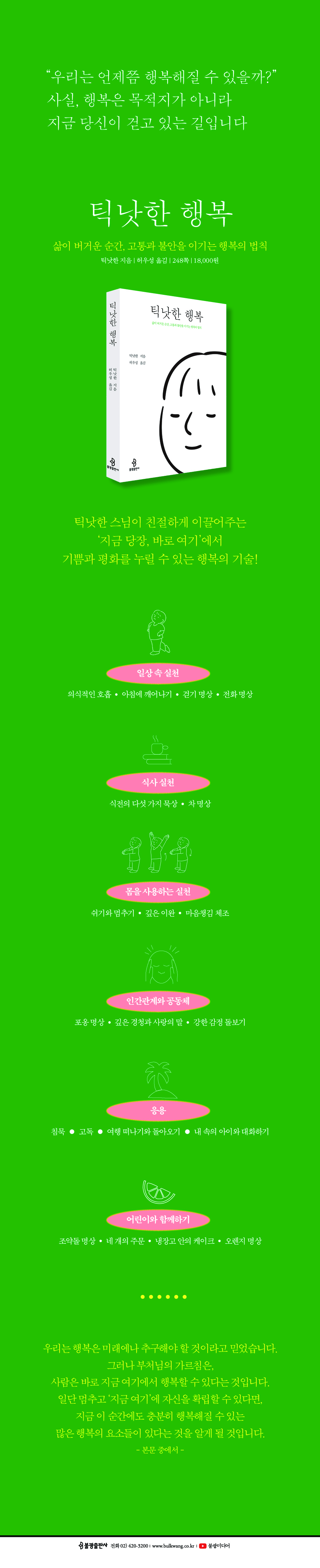
'When will we ever be happy?'
In fact, happiness is not a destination.
This is the path you are walking on
Thich Nhat Hanh kindly guides us
Right here, right now
The law of happiness that allows you to enjoy joy and peace!
“We believe that happiness and well-being are impossible here and now.
That belief is deeply ingrained in us. Isn't it true? We believe that to truly be happy, we must fulfill something we lack now, strive harder, and sacrifice today for a better tomorrow.
But Thich Nhat Hanh says that is not the case.
The past is already gone, and the future has not yet arrived.
The monk says that the path to true happiness is to fully experience the joy and peace of this present moment in which we live.
So how can we live "fully in the present moment"? Thich Nhat Hanh, who found the answer in mindfulness and meditation, says there's no need to go to a special place or make a great effort to meditate.
This book teaches meditation that can be practiced in every small, ordinary moment of everyday life.
It contains methods to discover present joy and happiness through mindfulness while breathing, walking, talking on the phone, preparing a meal in the kitchen, eating, drinking tea, and even when doing nothing.
Chapters 1 through 3 of the book cover how to find peace and happiness within yourself through the practice of mindfulness meditation, and from Chapter 4 onwards, it covers how to exist as a complete self and live with family, friends, and children through that process.
Throughout his life, Thich Nhat Hanh taught the concept of “interbeing,” emphasizing that all things in the world are connected and that none of us can exist alone.
The monk's teachings, written in a simple and friendly manner, will teach modern people, who live in a constantly rushed state, how to feel completely happy and connect with the world at their own pace.
In fact, happiness is not a destination.
This is the path you are walking on
Thich Nhat Hanh kindly guides us
Right here, right now
The law of happiness that allows you to enjoy joy and peace!
“We believe that happiness and well-being are impossible here and now.
That belief is deeply ingrained in us. Isn't it true? We believe that to truly be happy, we must fulfill something we lack now, strive harder, and sacrifice today for a better tomorrow.
But Thich Nhat Hanh says that is not the case.
The past is already gone, and the future has not yet arrived.
The monk says that the path to true happiness is to fully experience the joy and peace of this present moment in which we live.
So how can we live "fully in the present moment"? Thich Nhat Hanh, who found the answer in mindfulness and meditation, says there's no need to go to a special place or make a great effort to meditate.
This book teaches meditation that can be practiced in every small, ordinary moment of everyday life.
It contains methods to discover present joy and happiness through mindfulness while breathing, walking, talking on the phone, preparing a meal in the kitchen, eating, drinking tea, and even when doing nothing.
Chapters 1 through 3 of the book cover how to find peace and happiness within yourself through the practice of mindfulness meditation, and from Chapter 4 onwards, it covers how to exist as a complete self and live with family, friends, and children through that process.
Throughout his life, Thich Nhat Hanh taught the concept of “interbeing,” emphasizing that all things in the world are connected and that none of us can exist alone.
The monk's teachings, written in a simple and friendly manner, will teach modern people, who live in a constantly rushed state, how to feel completely happy and connect with the world at their own pace.
- You can preview some of the book's contents.
Preview
index
introduction
Chapter 1: Daily Practice
Conscious Breathing, Sitting Meditation, Walking Meditation, Waking Up in the Morning, Mindfulness Bell, Telephone Meditation, Bowing, Song, I Have Arrived, Returning to My Home, Taking Refuge, Five Mindfulness Practices
Chapter 2: Dietary Practice
Mindful Eating, Five Pre-Meal Meditations, Kitchen, and Tea Meditation
Chapter 3: Practice of Using the Body
Rest and Pause, Deep Relaxation, and Mindfulness Exercises
Chapter 4: Human Relations and Community Practice
Building and Maintaining the Sangha, Starting Over, Peace Agreements, The Second Self, Embracing Meditation, Deep Listening and Loving Words, Caring for Anger and Other Strong Emotions, Shining the Light, Writing Love Letters
Chapter 5 Applications
Solitude, Silence, Lazy Days, Listening to Dharma Talks, Dharma Talks, Touching the Earth, Going on a Journey and Returning from a Journey, Loving Compassion, Meditation on Love, Unilateral Disarmament, Talking to the Child Within, Fourteen Mindfulness Practices
Chapter 6: Practicing with Children
Listening to Children, Walking Meditation with Children, Helping Children with Anger and Other Strong Emotions, Family Meals, Inviting the Bell, Pebble Meditation, Breathing Room, Four Spells, Cake in the Fridge, Orange Meditation, Hug the Tree, Today's Anniversary
conclusion
Chapter 1: Daily Practice
Conscious Breathing, Sitting Meditation, Walking Meditation, Waking Up in the Morning, Mindfulness Bell, Telephone Meditation, Bowing, Song, I Have Arrived, Returning to My Home, Taking Refuge, Five Mindfulness Practices
Chapter 2: Dietary Practice
Mindful Eating, Five Pre-Meal Meditations, Kitchen, and Tea Meditation
Chapter 3: Practice of Using the Body
Rest and Pause, Deep Relaxation, and Mindfulness Exercises
Chapter 4: Human Relations and Community Practice
Building and Maintaining the Sangha, Starting Over, Peace Agreements, The Second Self, Embracing Meditation, Deep Listening and Loving Words, Caring for Anger and Other Strong Emotions, Shining the Light, Writing Love Letters
Chapter 5 Applications
Solitude, Silence, Lazy Days, Listening to Dharma Talks, Dharma Talks, Touching the Earth, Going on a Journey and Returning from a Journey, Loving Compassion, Meditation on Love, Unilateral Disarmament, Talking to the Child Within, Fourteen Mindfulness Practices
Chapter 6: Practicing with Children
Listening to Children, Walking Meditation with Children, Helping Children with Anger and Other Strong Emotions, Family Meals, Inviting the Bell, Pebble Meditation, Breathing Room, Four Spells, Cake in the Fridge, Orange Meditation, Hug the Tree, Today's Anniversary
conclusion
Detailed image
Into the book
The seed of mindfulness is within each of us, but we often forget to water it.
If we learn to make our breath and steps our refuge, we can touch the seeds of peace and joy and nurture them into even greater joy.
--- p.9
Walking meditation is simply walking for the sake of enjoying walking.
Not walking to get somewhere, that's the skill.
In Sanskrit, there is a word called apra?ihita (無願, wishless).
It means 'no hope' or 'no purpose', meaning that there is nothing in front of you and you do not pursue it.
When we do walking meditation, we walk with this spirit.
--- p.28
I wake up this morning and smile / A new 24 hours await me / I vow to live every moment faithfully / To look upon all living beings with eyes of mercy
--- p.35
Love is impossible without understanding.
To understand another person, you must know them, become their body, and feel them.
At such times, we can treat them with compassion.
The source of love is our fully awake heart.
--- p.36
Stopping running is a very important practice.
We've been running all our lives.
We believe that peace, happiness, and success exist in different places and times.
They don't realize that peace, happiness, stability, and everything else are to be found here and now.
This place, the intersection of now and here, is the address of life.
--- p.53
We are like a ship crossing the sea.
If a ship encounters a storm and everyone panics, the ship will capsize.
But if just one person can remain calm, others will be inspired to remain calm.
Then the ship will be filled with hope.
Who can remain calm in such a calamitous situation? Each of us.
We depend on each other.
--- p.57
Our lives should have meaning, and that meaning should help people experience less suffering and access the joys of life.
When we have compassion in our hearts and realize that we can help others suffer less, our lives begin to take on more meaning.
--- p.72
Caring for yourself is caring for the whole community.
--- p.86
The original meaning of 'to be' is 'to inter-be'.
Flowers depend on sunlight, clouds, and earth to exist.
We are too.
None of us can exist alone.
Interbeing is the Buddha's teaching that everything is created and constituted by everything else.
--- p.113
You must be able to tell yourself, “I am listening to the other person because I want to ease his or her pain.”
This is what is called listening with compassion, or attentiveness.
--- p.136
Strong emotions are like storms and can cause great damage.
(…) It is our practice to keep our body and mind safe from the storm.
With each passing storm, we become stronger and more resilient, and soon we no longer fear the storm.
We no longer pray for peaceful skies and calm seas.
Instead, we pray for wisdom and strength to deal with the challenges that arise in life.
--- p.139
It is not that things are impermanent and therefore suffer.
We suffer because we do not know that things are impermanent, even though they are.
--- p.142
Not being caught up in the past, not being swept up in the future or the crowd, always being present, body and mind united, aware of what is happening in the present moment—this is how we practice the ideal solitude defined by the Buddha.
Without the ability to be alone, we become poorer and poorer.
There is not enough food for oneself and not much to offer to others.
--- p.156
Living alone doesn't mean being cut off from other people.
Because I am lonely, I can connect with the world.
I feel connected to you because I am completely myself.
--- p.158
You think you're wasting time when you're doing nothing.
That's wrong.
Your time is, first and foremost, time for you to exist.
It is a time to be alive, peaceful, joyful and loving.
(…) We usually say this.
“Don’t just sit there, do something.” But if we turn that around, we can say, “Don’t do anything, just sit there.” Only then can peace, understanding, and compassion become possible.
--- p.163
Peace begins with me.
Reconciliation begins with me.
Healing also begins with me.
--- p.186
It is very difficult to feel happy if there is not enough space in your heart.
When you arrange flowers, you understand that flowers need space around them to radiate their beauty.
People need some space too.
If you love someone, one of the most precious things you can give them is space.
(…) Imagine the moon sailing across the sky.
The moon has a lot of space around it, and that's part of its beauty.
Many of the Buddha's disciples depicted him as a full moon sailing across an empty sky.
--- p.223~224
All the practices introduced in this book share a common underlying purpose.
It is about sending the mind back into the body, creating our true being, becoming vividly alive, and allowing everything to occur in the light of mindfulness.
Each practice is very simple.
(…) But this very simple practice can help us get in touch with our true nature, which is without birth or death or separation.
If we learn to make our breath and steps our refuge, we can touch the seeds of peace and joy and nurture them into even greater joy.
--- p.9
Walking meditation is simply walking for the sake of enjoying walking.
Not walking to get somewhere, that's the skill.
In Sanskrit, there is a word called apra?ihita (無願, wishless).
It means 'no hope' or 'no purpose', meaning that there is nothing in front of you and you do not pursue it.
When we do walking meditation, we walk with this spirit.
--- p.28
I wake up this morning and smile / A new 24 hours await me / I vow to live every moment faithfully / To look upon all living beings with eyes of mercy
--- p.35
Love is impossible without understanding.
To understand another person, you must know them, become their body, and feel them.
At such times, we can treat them with compassion.
The source of love is our fully awake heart.
--- p.36
Stopping running is a very important practice.
We've been running all our lives.
We believe that peace, happiness, and success exist in different places and times.
They don't realize that peace, happiness, stability, and everything else are to be found here and now.
This place, the intersection of now and here, is the address of life.
--- p.53
We are like a ship crossing the sea.
If a ship encounters a storm and everyone panics, the ship will capsize.
But if just one person can remain calm, others will be inspired to remain calm.
Then the ship will be filled with hope.
Who can remain calm in such a calamitous situation? Each of us.
We depend on each other.
--- p.57
Our lives should have meaning, and that meaning should help people experience less suffering and access the joys of life.
When we have compassion in our hearts and realize that we can help others suffer less, our lives begin to take on more meaning.
--- p.72
Caring for yourself is caring for the whole community.
--- p.86
The original meaning of 'to be' is 'to inter-be'.
Flowers depend on sunlight, clouds, and earth to exist.
We are too.
None of us can exist alone.
Interbeing is the Buddha's teaching that everything is created and constituted by everything else.
--- p.113
You must be able to tell yourself, “I am listening to the other person because I want to ease his or her pain.”
This is what is called listening with compassion, or attentiveness.
--- p.136
Strong emotions are like storms and can cause great damage.
(…) It is our practice to keep our body and mind safe from the storm.
With each passing storm, we become stronger and more resilient, and soon we no longer fear the storm.
We no longer pray for peaceful skies and calm seas.
Instead, we pray for wisdom and strength to deal with the challenges that arise in life.
--- p.139
It is not that things are impermanent and therefore suffer.
We suffer because we do not know that things are impermanent, even though they are.
--- p.142
Not being caught up in the past, not being swept up in the future or the crowd, always being present, body and mind united, aware of what is happening in the present moment—this is how we practice the ideal solitude defined by the Buddha.
Without the ability to be alone, we become poorer and poorer.
There is not enough food for oneself and not much to offer to others.
--- p.156
Living alone doesn't mean being cut off from other people.
Because I am lonely, I can connect with the world.
I feel connected to you because I am completely myself.
--- p.158
You think you're wasting time when you're doing nothing.
That's wrong.
Your time is, first and foremost, time for you to exist.
It is a time to be alive, peaceful, joyful and loving.
(…) We usually say this.
“Don’t just sit there, do something.” But if we turn that around, we can say, “Don’t do anything, just sit there.” Only then can peace, understanding, and compassion become possible.
--- p.163
Peace begins with me.
Reconciliation begins with me.
Healing also begins with me.
--- p.186
It is very difficult to feel happy if there is not enough space in your heart.
When you arrange flowers, you understand that flowers need space around them to radiate their beauty.
People need some space too.
If you love someone, one of the most precious things you can give them is space.
(…) Imagine the moon sailing across the sky.
The moon has a lot of space around it, and that's part of its beauty.
Many of the Buddha's disciples depicted him as a full moon sailing across an empty sky.
--- p.223~224
All the practices introduced in this book share a common underlying purpose.
It is about sending the mind back into the body, creating our true being, becoming vividly alive, and allowing everything to occur in the light of mindfulness.
Each practice is very simple.
(…) But this very simple practice can help us get in touch with our true nature, which is without birth or death or separation.
--- p.243
Publisher's Review
Thich Nhat Hanh, the icon of peace and non-violence
Realizing that every moment of our lives is happiness
50 Mindfulness Meditation Techniques for Everyday Life
“Becoming a monk is about taking time for personal transformation and healing.
“And then it’s about helping others change and heal,” Thich Nhat Hanh said in a 2010 interview with Oprah Winfrey.
To support this, after publishing his autobiographical book, Vietnam: Lotus in a Sea of Fire, in 1967, the monk continued to write and publish articles to help more people find peace and happiness until his passing in 2022.
Thich Nhat Hanh has written over 100 books on a variety of topics and methods, including meditation, mindfulness, engaged Buddhism, poetry, fairy tales, and commentaries on ancient Buddhist texts, and there are 30 translated books circulating in Korea alone.
What makes this book, “Thich Nhat Hanh’s Happiness,” so special among so many books is that it gathers together the monk’s numerous meditation techniques scattered throughout various books into one volume.
There is also a separate introduction to meditation methods for children.
This book introduces 50 mindfulness meditation techniques that even beginners can practice without much difficulty in every moment of daily life, whether while eating, stretching, or interacting with family and others around them. With Thich Nhat Hanh's uniquely affectionate writing style and concise, clear instructions, this book helps you discover happiness in the present moment.
As this book is being introduced in Korea after 20 years since its original publication, the meditation methods that had been revised over time were replaced with the latest text after a thorough review by Plum Village, and illustrations were added to the section introducing mindfulness exercises to aid understanding.
Stop the endless race of desire
To be fully myself here and now
Why "happiness"? Happiness, according to Thich Nhat Hanh, means "not being distracted or swept away by regrets about the past, worries about the future, longings, anger, or jealousy in the present."
“The quality of being determines the quality of doing,” because the skill of being aware of what is happening here and now and of being peacefully, firmly, and completely myself is the basis of all action.
Many of our daily actions feel so simple and like a process for reaching a specific outcome that we don't focus on them.
While walking or eating, I look at my phone, my head is filled with other thoughts, and I don't pay attention to the steps I take or the spoonful of food I put in my mouth.
The monk teaches us how to focus on the most basic actions of breathing and walking, bringing our wandering minds back to the here and now, and feeling ourselves and the things around us as they are.
“Life is full of suffering.
If you don't stockpile enough happiness, you won't have the means to deal with despair.
Please enjoy the practice with a comfortable and gentle attitude, and with an open and receptive mind.
Do it for understanding, not for form or appearance.
Mindfulness can help you maintain inner joy and better cope with life's challenges.
“We can lay the foundation for freedom, peace, and love within ourselves.” (From the preface)
Realizing that every moment of our lives is happiness
50 Mindfulness Meditation Techniques for Everyday Life
“Becoming a monk is about taking time for personal transformation and healing.
“And then it’s about helping others change and heal,” Thich Nhat Hanh said in a 2010 interview with Oprah Winfrey.
To support this, after publishing his autobiographical book, Vietnam: Lotus in a Sea of Fire, in 1967, the monk continued to write and publish articles to help more people find peace and happiness until his passing in 2022.
Thich Nhat Hanh has written over 100 books on a variety of topics and methods, including meditation, mindfulness, engaged Buddhism, poetry, fairy tales, and commentaries on ancient Buddhist texts, and there are 30 translated books circulating in Korea alone.
What makes this book, “Thich Nhat Hanh’s Happiness,” so special among so many books is that it gathers together the monk’s numerous meditation techniques scattered throughout various books into one volume.
There is also a separate introduction to meditation methods for children.
This book introduces 50 mindfulness meditation techniques that even beginners can practice without much difficulty in every moment of daily life, whether while eating, stretching, or interacting with family and others around them. With Thich Nhat Hanh's uniquely affectionate writing style and concise, clear instructions, this book helps you discover happiness in the present moment.
As this book is being introduced in Korea after 20 years since its original publication, the meditation methods that had been revised over time were replaced with the latest text after a thorough review by Plum Village, and illustrations were added to the section introducing mindfulness exercises to aid understanding.
Stop the endless race of desire
To be fully myself here and now
Why "happiness"? Happiness, according to Thich Nhat Hanh, means "not being distracted or swept away by regrets about the past, worries about the future, longings, anger, or jealousy in the present."
“The quality of being determines the quality of doing,” because the skill of being aware of what is happening here and now and of being peacefully, firmly, and completely myself is the basis of all action.
Many of our daily actions feel so simple and like a process for reaching a specific outcome that we don't focus on them.
While walking or eating, I look at my phone, my head is filled with other thoughts, and I don't pay attention to the steps I take or the spoonful of food I put in my mouth.
The monk teaches us how to focus on the most basic actions of breathing and walking, bringing our wandering minds back to the here and now, and feeling ourselves and the things around us as they are.
“Life is full of suffering.
If you don't stockpile enough happiness, you won't have the means to deal with despair.
Please enjoy the practice with a comfortable and gentle attitude, and with an open and receptive mind.
Do it for understanding, not for form or appearance.
Mindfulness can help you maintain inner joy and better cope with life's challenges.
“We can lay the foundation for freedom, peace, and love within ourselves.” (From the preface)
GOODS SPECIFICS
- Date of issue: April 25, 2025
- Page count, weight, size: 248 pages | 334g | 146*200*16mm
- ISBN13: 9791172611699
- ISBN10: 1172611696
You may also like
카테고리
korean


korean

![ELLE 엘르 스페셜 에디션 A형 : 12월 [2025]](http://librairie.coreenne.fr/cdn/shop/files/b8e27a3de6c9538896439686c6b0e8fb.jpg?v=1766436872&width=3840)


