

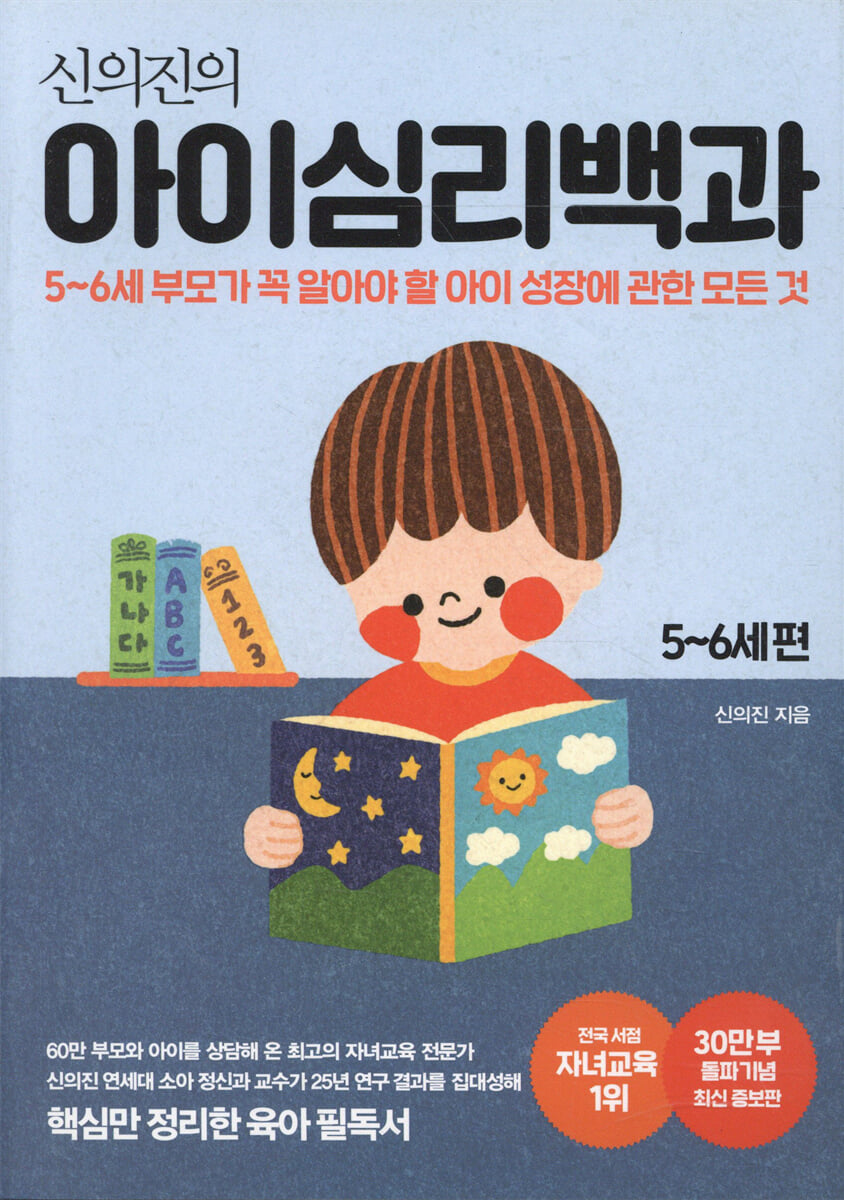
Shin Ui-jin's Encyclopedia of Child Psychology for Ages 5-6 (Newest Expanded Edition to Commemorate 300,000 Copies)
 |
Description
Book Introduction
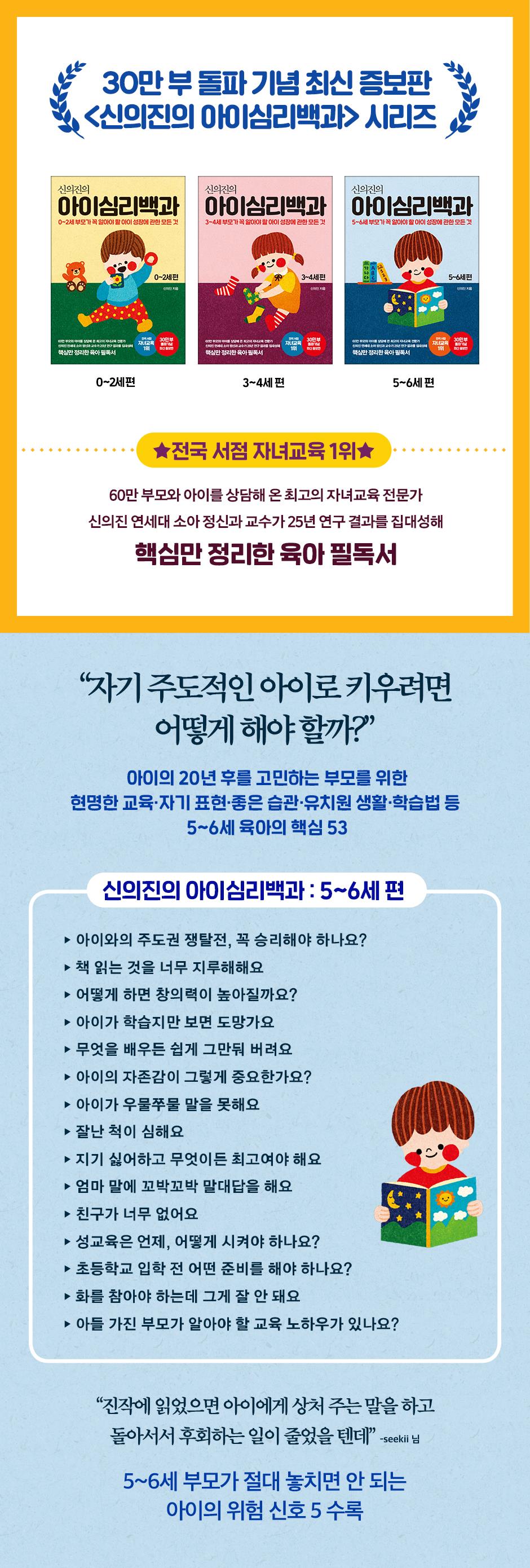
Korea's leading child education expert, who has counseled 600,000 parents and children for 25 years. Everything you need to know about the growth of children aged 5-6, compiled by Professor Shin Eui-jin of the Department of Child Psychiatry at Yonsei University. Professor Shin Eui-jin, Korea's leading expert on child education, has summarized the core principles of parenting for 5-6 year olds into 53 key points, focusing on keywords such as wise education, self-expression, good habits, kindergarten life, and learning methods. Do I have to win the battle for dominance with my child?, My child runs away when I see a workbook, My child easily quits whatever he is learning, He is a show-off, He hates losing and has to be the best at everything, He doesn't have many friends, I have to control my anger but I have trouble with that, Are there any parenting tips that parents with sons should know? For parents of 5-6 year olds who struggle with their children who brag about themselves several times a day and talk back to them without fail, this book provides accurate information and useful solutions about the psychology of 5-6 year olds by compiling 25 years of clinical records, proven developmental theories, and the experience and parenting know-how of a mother who raised two troubled children. In particular, it contains detailed information on early education, private education, creativity, and self-directed learning, which parents who are seriously considering educational issues at this time are curious about. The latest expanded edition, published to commemorate the 300,000-copy milestone, includes '5 warning signs that parents of 5-6 year-olds should never miss', allowing them to self-diagnose their child's development. |
- You can preview some of the book's contents.
Preview
index
Publishing a 300,000 copy commemorative edition
Prologue | For parents of children in their 5th or 6th year
Top 20 Questions Parents of 5-6 Year Olds Ask
1.
I don't want to go to kindergarten
2.
Do you have to win the battle for dominance with your child?
3.
My child is distracted and has trouble concentrating.
4.
When and how should sex education be provided?
5.
I find reading books so boring.
6.
How can I become more creative?
7.
The tantrums are getting worse and worse.
8.
Should I reward my child for helping with chores?
9.
Is it wrong to take a 5-6 year old boy to a girls' bathhouse?
10.
I think my child is being bullied at kindergarten.
11.
How can I get rid of the nail biting habit?
12.
I have to be away from my child for some reason. Is that okay?
13.
Every time I feed you, I fight a war
14.
My child can't put down his digital device.
15.
If a 5-year-old doesn't know how to read Korean, does that mean they have a learning disability?
16.
Whenever I speak in front of a group of people, I suddenly start stuttering.
17.
When should brothers and sisters start sleeping separately?
18.
My child caught me fighting with my husband.
19.
He's a boy, but he wants to buy girls' clothes.
20.
Are there any educational tips that parents with sons should know?
5-6 years old (49-72 months)
Characteristics of 5-6 year olds that parents must know: They move out into the world based on a stable self-image.
Chapter 1.
learning problems
My child runs away when he sees only study materials.
Every time I teach a child, my stomach turns.
I don't think my child has a concept of numbers.
Whatever you learn, you can easily give up.
Chapter 2.
Wise education
Early education, is it really necessary to not provide it?
Private education, what should I do?
They say creativity is important, but how can we foster it?
I often ask questions about death.
Is a child's self-esteem that important?
Chapter 3.
Proper sex education
My child keeps giving me peppers from anywhere.
If you have an awkward question, say this
My child masturbates. Does this mean he or she has a mental problem?
If your child has been sexually abused
Mom and Dad's sex life was discovered?
Chapter 4.
good habits
The child is not eating.
What should I do with my child who is addicted to games?
I always talk back to my mom.
How do I break a bad habit?
Chapter 5.
self-expression
My child is mumbling and can't speak.
I have no presentation skills
You're acting like a know-it-all
Chapter 6.
Kindergarten life
Hit and tease other children
I hate losing and I have to be the best at everything I do.
My child has been going to the same daycare for 3 years. Should I switch?
I don't have many friends
The kindergarten teacher said there was something wrong with the child.
Chapter 7.
Reading a book
I hate reading books
I have no interest in anything around me and only like books.
Chapter 8.
Admission preparation
What preparations should I make before entering elementary school?
I still haven't mastered Korean
Do I need to teach writing separately?
Chapter 9.
Parents' hearts
I love the second one more than the first one
I have to hold back my anger, but I'm not very good at it.
5 Danger Signs Parents of 5-6 Year Olds Should Never Ignore
1.
Your thinking is too simple
2.
Unique repetitive behaviors last too long
3.
I'm so distracted and have trouble concentrating.
4.
I can't express my opinion in front of others and I don't even speak well.
5.
Give up or avoid difficult situations in advance
Prologue | For parents of children in their 5th or 6th year
Top 20 Questions Parents of 5-6 Year Olds Ask
1.
I don't want to go to kindergarten
2.
Do you have to win the battle for dominance with your child?
3.
My child is distracted and has trouble concentrating.
4.
When and how should sex education be provided?
5.
I find reading books so boring.
6.
How can I become more creative?
7.
The tantrums are getting worse and worse.
8.
Should I reward my child for helping with chores?
9.
Is it wrong to take a 5-6 year old boy to a girls' bathhouse?
10.
I think my child is being bullied at kindergarten.
11.
How can I get rid of the nail biting habit?
12.
I have to be away from my child for some reason. Is that okay?
13.
Every time I feed you, I fight a war
14.
My child can't put down his digital device.
15.
If a 5-year-old doesn't know how to read Korean, does that mean they have a learning disability?
16.
Whenever I speak in front of a group of people, I suddenly start stuttering.
17.
When should brothers and sisters start sleeping separately?
18.
My child caught me fighting with my husband.
19.
He's a boy, but he wants to buy girls' clothes.
20.
Are there any educational tips that parents with sons should know?
5-6 years old (49-72 months)
Characteristics of 5-6 year olds that parents must know: They move out into the world based on a stable self-image.
Chapter 1.
learning problems
My child runs away when he sees only study materials.
Every time I teach a child, my stomach turns.
I don't think my child has a concept of numbers.
Whatever you learn, you can easily give up.
Chapter 2.
Wise education
Early education, is it really necessary to not provide it?
Private education, what should I do?
They say creativity is important, but how can we foster it?
I often ask questions about death.
Is a child's self-esteem that important?
Chapter 3.
Proper sex education
My child keeps giving me peppers from anywhere.
If you have an awkward question, say this
My child masturbates. Does this mean he or she has a mental problem?
If your child has been sexually abused
Mom and Dad's sex life was discovered?
Chapter 4.
good habits
The child is not eating.
What should I do with my child who is addicted to games?
I always talk back to my mom.
How do I break a bad habit?
Chapter 5.
self-expression
My child is mumbling and can't speak.
I have no presentation skills
You're acting like a know-it-all
Chapter 6.
Kindergarten life
Hit and tease other children
I hate losing and I have to be the best at everything I do.
My child has been going to the same daycare for 3 years. Should I switch?
I don't have many friends
The kindergarten teacher said there was something wrong with the child.
Chapter 7.
Reading a book
I hate reading books
I have no interest in anything around me and only like books.
Chapter 8.
Admission preparation
What preparations should I make before entering elementary school?
I still haven't mastered Korean
Do I need to teach writing separately?
Chapter 9.
Parents' hearts
I love the second one more than the first one
I have to hold back my anger, but I'm not very good at it.
5 Danger Signs Parents of 5-6 Year Olds Should Never Ignore
1.
Your thinking is too simple
2.
Unique repetitive behaviors last too long
3.
I'm so distracted and have trouble concentrating.
4.
I can't express my opinion in front of others and I don't even speak well.
5.
Give up or avoid difficult situations in advance
Detailed image
Into the book
When there is a conflict of opinion with a child, many mothers try to give in to their child's opinion until the very end, thinking, "I have to win the battle for dominance so I don't lose to my child."
In terms of the relationship with the child, it is right for the mother to lose because the child is young.
If you scold your child by saying, “Don’t do that,” “That’s not right,” or “Why did you do that” every time he misbehaves about something that should be done naturally, the child will get angry and not listen to you anymore.
When you have a conflict of opinion with your child, you need to find a way to convey your values through compromise, even if it is difficult and takes a long time.
Sometimes people say that children deliberately pick fights to test their mothers, but this is not true.
All children have an instinctive desire to be loved and accepted by their mothers.
Children's greatest fear is that they might lose their mother's love at any moment.
That's why well-raised children don't assert themselves intentionally to test their mothers or to start fights with them.
Children who do not have a good relationship with their mothers rebel to express their anger.
If you are having a very difficult time with your child due to conflicts of opinion, you need to look back on your relationship with your child.
---From "Do I have to win the battle for dominance with my child?"
It is said that the temporal lobe, which is related to language development, and the parietal lobe, which is related to number concepts, develop in the brain around the age of 6.
So, if you teach Korean or math during this period, most children will accept it.
If your child is still having trouble learning Korean even after the age of 6, you should look into the cause.
This may be due to a learning disability, but there are more children who have trouble learning due to poor concentration or a lack of motivation to study.
This usually occurs in children who have been learning since they were 3 or 4 years old. They get bored because they do it too much when they are young, so they lose concentration and have no desire to do it.
If you start teaching at age 5 or 6, it will take a month or two, but if you start at age 3 or 4, it will take a year, and the child's interest will decrease during the process.
My eldest child, Gyeongmo, was only able to learn Korean two months before he entered school.
Because he was a child who had a strong aversion to things he didn't want to do, we had no choice but to delay his Korean language education.
But I learned Korean at a frightening speed.
It wasn't because the child was outstanding, but because his brain was developed enough to be able to learn.
So, please, as soon as possible, let go of the obsession with having to teach anything as quickly as possible.
---“If a 5-year-old can’t read and write Korean, does that mean he or she has a learning disability?”
When a kindergarten is filled with a diverse group of children, there may be one or two who enjoy bullying other children.
Most children will protest when they are bullied by such a child.
It's a bit difficult for children aged 3-4, but around 5-6, children develop the ability to protect themselves and talk back to children who are bullying them or tell their teachers or mothers.
It is perfectly normal for a child to report the injustice they have experienced, but if the child just watches and does not protest, and the parents end up sensing it, then it can be a problem.
Sometimes children who are anxious or lack confidence may exhibit this behavior.
Anxiety disorders and lack of self-confidence can occur when a child does not form a good attachment to their parents.
Children who are not well attached are not good at protecting themselves when their parents are not around.
If a child like this enters elementary school in this condition, he or she will develop depression.
If a child is bullied by a friend, he or she may become afraid of friends and want to be alone, which can cause serious problems in social development, so the problem must be resolved quickly.
Even children who are naturally introverted may not speak up when bullied by a friend, but this is different from the children discussed above.
Children may not speak out when they are being bullied, but normal children will speak out if you give them specific instructions on how to behave.
Parents should step in and talk to the bully, consult with the teacher, and resolve the issue. Then, teach the child something like, “Next time you’re being bullied, tell me.”
Then, even the most introverted child will talk about what happened to him.
---From "I think my child is being bullied at kindergarten"
Parents should not tell their children everything they think or feel.
If you say whatever you feel or think, your parents' authority will be diminished.
Because everything that comes out of parents' mouths ends up being nagging.
So, in order to convey to your child a message that you think is truly important, you also need the wisdom to overlook minor mistakes.
For example, which message is more important to a child: "Clean up your desk" or "Don't be lazy"? Of course, this depends on your values, but many parents would want their children to be less organized, but not lazy.
In order to strongly convey the message, "Don't be lazy," you should refrain from saying, "Clean up your desk."
Otherwise, saying "don't be lazy" can be reduced to the level of nagging, like saying "clean up your desk."
So, before bringing up a topic with a child, parents should always consider whether it is something that must be said or something that can be passed over, whether it is something important that must be said right now or something that can be said later, and whether it can be said in a low voice without getting angry.
This is the only way to effectively convey the values that children need to know.
---From "How to keep your parents' words from becoming nagging"
During this period, the child's self-esteem increases significantly as he or she learns and is able to do many things.
They always try to verify, "Am I a good kid?" and when they get a "yes" in that verification, they want to brag about it to everyone.
This is why ‘pretending to be smart’ and ‘pretending to know everything’ are getting worse.
So, it is perfectly normal for a child to try to tell others what he or she knows, to ask "Did I do a good job?" after doing something he or she is supposed to do, and to try to receive every little reward given at kindergarten.
However, it is not right to just ignore it just because it is in the normal range.
This is because it can hinder social development, such as interpersonal relationships.
In such cases, encourage them to be considerate of others by saying things like, “○○ is doing really well, so I’m happy, but I think it would be better if all his other friends did well too,” or “It would be even better if you taught his younger sibling next time.”
If you suppress your child's show-off by saying things like, "Why are you doing that?", "Yeah, you're great", or "You shouldn't say things like that," your child may lose confidence, which is a virtue he or she really needs to have.
In terms of the relationship with the child, it is right for the mother to lose because the child is young.
If you scold your child by saying, “Don’t do that,” “That’s not right,” or “Why did you do that” every time he misbehaves about something that should be done naturally, the child will get angry and not listen to you anymore.
When you have a conflict of opinion with your child, you need to find a way to convey your values through compromise, even if it is difficult and takes a long time.
Sometimes people say that children deliberately pick fights to test their mothers, but this is not true.
All children have an instinctive desire to be loved and accepted by their mothers.
Children's greatest fear is that they might lose their mother's love at any moment.
That's why well-raised children don't assert themselves intentionally to test their mothers or to start fights with them.
Children who do not have a good relationship with their mothers rebel to express their anger.
If you are having a very difficult time with your child due to conflicts of opinion, you need to look back on your relationship with your child.
---From "Do I have to win the battle for dominance with my child?"
It is said that the temporal lobe, which is related to language development, and the parietal lobe, which is related to number concepts, develop in the brain around the age of 6.
So, if you teach Korean or math during this period, most children will accept it.
If your child is still having trouble learning Korean even after the age of 6, you should look into the cause.
This may be due to a learning disability, but there are more children who have trouble learning due to poor concentration or a lack of motivation to study.
This usually occurs in children who have been learning since they were 3 or 4 years old. They get bored because they do it too much when they are young, so they lose concentration and have no desire to do it.
If you start teaching at age 5 or 6, it will take a month or two, but if you start at age 3 or 4, it will take a year, and the child's interest will decrease during the process.
My eldest child, Gyeongmo, was only able to learn Korean two months before he entered school.
Because he was a child who had a strong aversion to things he didn't want to do, we had no choice but to delay his Korean language education.
But I learned Korean at a frightening speed.
It wasn't because the child was outstanding, but because his brain was developed enough to be able to learn.
So, please, as soon as possible, let go of the obsession with having to teach anything as quickly as possible.
---“If a 5-year-old can’t read and write Korean, does that mean he or she has a learning disability?”
When a kindergarten is filled with a diverse group of children, there may be one or two who enjoy bullying other children.
Most children will protest when they are bullied by such a child.
It's a bit difficult for children aged 3-4, but around 5-6, children develop the ability to protect themselves and talk back to children who are bullying them or tell their teachers or mothers.
It is perfectly normal for a child to report the injustice they have experienced, but if the child just watches and does not protest, and the parents end up sensing it, then it can be a problem.
Sometimes children who are anxious or lack confidence may exhibit this behavior.
Anxiety disorders and lack of self-confidence can occur when a child does not form a good attachment to their parents.
Children who are not well attached are not good at protecting themselves when their parents are not around.
If a child like this enters elementary school in this condition, he or she will develop depression.
If a child is bullied by a friend, he or she may become afraid of friends and want to be alone, which can cause serious problems in social development, so the problem must be resolved quickly.
Even children who are naturally introverted may not speak up when bullied by a friend, but this is different from the children discussed above.
Children may not speak out when they are being bullied, but normal children will speak out if you give them specific instructions on how to behave.
Parents should step in and talk to the bully, consult with the teacher, and resolve the issue. Then, teach the child something like, “Next time you’re being bullied, tell me.”
Then, even the most introverted child will talk about what happened to him.
---From "I think my child is being bullied at kindergarten"
Parents should not tell their children everything they think or feel.
If you say whatever you feel or think, your parents' authority will be diminished.
Because everything that comes out of parents' mouths ends up being nagging.
So, in order to convey to your child a message that you think is truly important, you also need the wisdom to overlook minor mistakes.
For example, which message is more important to a child: "Clean up your desk" or "Don't be lazy"? Of course, this depends on your values, but many parents would want their children to be less organized, but not lazy.
In order to strongly convey the message, "Don't be lazy," you should refrain from saying, "Clean up your desk."
Otherwise, saying "don't be lazy" can be reduced to the level of nagging, like saying "clean up your desk."
So, before bringing up a topic with a child, parents should always consider whether it is something that must be said or something that can be passed over, whether it is something important that must be said right now or something that can be said later, and whether it can be said in a low voice without getting angry.
This is the only way to effectively convey the values that children need to know.
---From "How to keep your parents' words from becoming nagging"
During this period, the child's self-esteem increases significantly as he or she learns and is able to do many things.
They always try to verify, "Am I a good kid?" and when they get a "yes" in that verification, they want to brag about it to everyone.
This is why ‘pretending to be smart’ and ‘pretending to know everything’ are getting worse.
So, it is perfectly normal for a child to try to tell others what he or she knows, to ask "Did I do a good job?" after doing something he or she is supposed to do, and to try to receive every little reward given at kindergarten.
However, it is not right to just ignore it just because it is in the normal range.
This is because it can hinder social development, such as interpersonal relationships.
In such cases, encourage them to be considerate of others by saying things like, “○○ is doing really well, so I’m happy, but I think it would be better if all his other friends did well too,” or “It would be even better if you taught his younger sibling next time.”
If you suppress your child's show-off by saying things like, "Why are you doing that?", "Yeah, you're great", or "You shouldn't say things like that," your child may lose confidence, which is a virtue he or she really needs to have.
---From "You're acting like you know everything"
Publisher's Review
The #1 children's education book in bookstores nationwide, the latest expanded edition celebrating sales of over 300,000 copies!
For parents who are worried about their child's future 20 years from now
53 Keys to Parenting 5-6 Year Olds: Smart Education, Self-Expression, Good Habits, Preschool Life, Learning Methods, and More
Do I have to win the battle for dominance with my child?, My child finds reading books too boring. My child runs away when they see worksheets. Is my child's self-esteem that important?, My child is a show-off. He hates losing and has to be the best at everything. He talks back to me every time. He doesn't have many friends. What preparations should I make before starting elementary school? I have to control my anger, but I'm not good at that...
Professor Shin Eui-jin, Korea's leading expert on child education, has compiled 53 key child-rearing tips for parents of 5-6 year olds, focusing on keywords such as wise education, self-expression, good habits, kindergarten life, and learning methods.
When a child turns five or more years old, parents finally feel a sense of liberation as they begin to attend daycare or kindergarten.
But even though I am physically comfortable, my mind is not at ease.
Because we are starting to seriously think about education issues.
There's a ton of educational information on various websites, but there's no way to know for sure whether it's accurate or the right approach for your child.
For parents who want to raise smart, self-directed children but are worried because they don't know how to do it, Professor Shin Ui-jin has compiled her clinical records from counseling 600,000 people over 25 years, proven developmental theories, and her experiences and parenting know-how as a mother who raised two children with many problems.
And this book contains accurate information and useful solutions to the questions parents are most curious about.
In particular, the latest expanded edition, compiled to commemorate the 300,000th copy sold, includes '5 warning signs that parents of 5-6 year olds should never miss', allowing them to self-diagnose their child's development.
For parents who are concerned about their child's future 20 years from now, rather than just now, we have compiled realistic and feasible answers.
“How can I raise a self-directed child?”
A book that provides an easy-to-understand overview of a child's psychological development, which can be easily overlooked when focusing solely on visible growth.
Professor Shin Ui-jin says that there is only one reason why parenting is difficult.
This is because parents do not know their child's developmental process and psychological state.
Because the formation of self-image that begins at the age of two is almost complete after the age of five, children aged five or six have a stable self-image as a girl or boy, and this is not easily shaken.
During this period, boys fight tooth and nail with swords and guns, and girls become obsessed with the image of princesses and try to wear only pink clothes, all in an effort to solidify their stable self-image.
But parents often ask, “Why does my child only ask for princess dresses?” or “My child plays fighting with robots every day. Isn’t this making him or her violent?”
This is nothing to worry about.
Rather, if you let your child play as much as he or she wants, he or she will play to his or her heart's content and then go on to find new interests on his or her own.
'Children try to do something to their heart's content and then finish it on their own', this is a basic principle of development.
Also, children at this age become incredibly intelligent.
So, instead of getting angry or throwing a tantrum when what they want doesn't come true, they try to persuade their parents with words.
Also, when rules are set, they try to follow them, but sometimes this can be excessive and they appear rigid.
They are inflexible and do not understand that rules can change depending on the situation and insist that they must be applied in all cases.
At this time, it is good for parents to logically explain the reason to the child.
Since children can now think logically, they will easily accept something once they know the reason.
Children aged 5-6 unconsciously and constantly ask themselves questions.
'Am I a good person?' This is the process of confirming one's current self-image, and in the process, one often ends up bragging about trivial things.
“Aren’t my shoes pretty?” “Am I a good person for helping Mom?” From a parent’s perspective, even if something doesn’t feel right, they should unconditionally acknowledge that show-off.
This is because through the process of showing off and getting recognition, you build up the belief that 'I am a really good kid.'
Sometimes parents worry that their children will become spoiled, but even if parents don't tell them the truth, children will learn more about themselves as they go to kindergarten and school and meet other people.
Even when they enter school, they begin to care more about the evaluations of their school friends and teachers than their parents.
Therefore, at this time, it is important to raise your child's self-esteem to the sky, at least at home.
“If I had read it earlier, I would have said fewer hurtful things to my child and then regretted it later.”
Professor Shin Ui-jin's realistic and clear parenting mentoring will help you escape the daily stress of parenting.
Even if parents are familiar with their child's development and try to establish principles for their child's care, day-to-day parenting is never easy.
What makes it especially difficult for parents during this period is the issue of education.
As children become more intelligent, parents become more involved in their children's education. However, the truly important learning at this time is not speaking one more word of English, writing well, or being good at addition and subtraction.
It is at this very moment that we must lay the foundation necessary for living in the world in the future, such as emotional control, impulse control, concentration, empathy, morality, sociality, and curiosity for new knowledge.
These are not things you can learn by sitting down.
It is something that children naturally come to understand through playing with peers, interacting with their parents, and actually seeing and experiencing a wider variety of situations.
So, parents should not just focus on their children's English and Korean studies, but should take their children by the hand and take them outside to show them the wide world.
We must always remember that the moments when children feel their parents' warmth and spend time together, or when they laugh and play with friends, are the best times for them to learn.
By the age of six, a child's ego is 70 percent developed.
This means that 70 percent of the foundation for living life is laid during this period.
This book contains detailed information from start to finish on what parents should do now for their children 20 years from now, who struggle with workbook issues every day and worry about their children who have not yet mastered Korean and numbers.
For parents who are worried about their child's future 20 years from now
53 Keys to Parenting 5-6 Year Olds: Smart Education, Self-Expression, Good Habits, Preschool Life, Learning Methods, and More
Do I have to win the battle for dominance with my child?, My child finds reading books too boring. My child runs away when they see worksheets. Is my child's self-esteem that important?, My child is a show-off. He hates losing and has to be the best at everything. He talks back to me every time. He doesn't have many friends. What preparations should I make before starting elementary school? I have to control my anger, but I'm not good at that...
Professor Shin Eui-jin, Korea's leading expert on child education, has compiled 53 key child-rearing tips for parents of 5-6 year olds, focusing on keywords such as wise education, self-expression, good habits, kindergarten life, and learning methods.
When a child turns five or more years old, parents finally feel a sense of liberation as they begin to attend daycare or kindergarten.
But even though I am physically comfortable, my mind is not at ease.
Because we are starting to seriously think about education issues.
There's a ton of educational information on various websites, but there's no way to know for sure whether it's accurate or the right approach for your child.
For parents who want to raise smart, self-directed children but are worried because they don't know how to do it, Professor Shin Ui-jin has compiled her clinical records from counseling 600,000 people over 25 years, proven developmental theories, and her experiences and parenting know-how as a mother who raised two children with many problems.
And this book contains accurate information and useful solutions to the questions parents are most curious about.
In particular, the latest expanded edition, compiled to commemorate the 300,000th copy sold, includes '5 warning signs that parents of 5-6 year olds should never miss', allowing them to self-diagnose their child's development.
For parents who are concerned about their child's future 20 years from now, rather than just now, we have compiled realistic and feasible answers.
“How can I raise a self-directed child?”
A book that provides an easy-to-understand overview of a child's psychological development, which can be easily overlooked when focusing solely on visible growth.
Professor Shin Ui-jin says that there is only one reason why parenting is difficult.
This is because parents do not know their child's developmental process and psychological state.
Because the formation of self-image that begins at the age of two is almost complete after the age of five, children aged five or six have a stable self-image as a girl or boy, and this is not easily shaken.
During this period, boys fight tooth and nail with swords and guns, and girls become obsessed with the image of princesses and try to wear only pink clothes, all in an effort to solidify their stable self-image.
But parents often ask, “Why does my child only ask for princess dresses?” or “My child plays fighting with robots every day. Isn’t this making him or her violent?”
This is nothing to worry about.
Rather, if you let your child play as much as he or she wants, he or she will play to his or her heart's content and then go on to find new interests on his or her own.
'Children try to do something to their heart's content and then finish it on their own', this is a basic principle of development.
Also, children at this age become incredibly intelligent.
So, instead of getting angry or throwing a tantrum when what they want doesn't come true, they try to persuade their parents with words.
Also, when rules are set, they try to follow them, but sometimes this can be excessive and they appear rigid.
They are inflexible and do not understand that rules can change depending on the situation and insist that they must be applied in all cases.
At this time, it is good for parents to logically explain the reason to the child.
Since children can now think logically, they will easily accept something once they know the reason.
Children aged 5-6 unconsciously and constantly ask themselves questions.
'Am I a good person?' This is the process of confirming one's current self-image, and in the process, one often ends up bragging about trivial things.
“Aren’t my shoes pretty?” “Am I a good person for helping Mom?” From a parent’s perspective, even if something doesn’t feel right, they should unconditionally acknowledge that show-off.
This is because through the process of showing off and getting recognition, you build up the belief that 'I am a really good kid.'
Sometimes parents worry that their children will become spoiled, but even if parents don't tell them the truth, children will learn more about themselves as they go to kindergarten and school and meet other people.
Even when they enter school, they begin to care more about the evaluations of their school friends and teachers than their parents.
Therefore, at this time, it is important to raise your child's self-esteem to the sky, at least at home.
“If I had read it earlier, I would have said fewer hurtful things to my child and then regretted it later.”
Professor Shin Ui-jin's realistic and clear parenting mentoring will help you escape the daily stress of parenting.
Even if parents are familiar with their child's development and try to establish principles for their child's care, day-to-day parenting is never easy.
What makes it especially difficult for parents during this period is the issue of education.
As children become more intelligent, parents become more involved in their children's education. However, the truly important learning at this time is not speaking one more word of English, writing well, or being good at addition and subtraction.
It is at this very moment that we must lay the foundation necessary for living in the world in the future, such as emotional control, impulse control, concentration, empathy, morality, sociality, and curiosity for new knowledge.
These are not things you can learn by sitting down.
It is something that children naturally come to understand through playing with peers, interacting with their parents, and actually seeing and experiencing a wider variety of situations.
So, parents should not just focus on their children's English and Korean studies, but should take their children by the hand and take them outside to show them the wide world.
We must always remember that the moments when children feel their parents' warmth and spend time together, or when they laugh and play with friends, are the best times for them to learn.
By the age of six, a child's ego is 70 percent developed.
This means that 70 percent of the foundation for living life is laid during this period.
This book contains detailed information from start to finish on what parents should do now for their children 20 years from now, who struggle with workbook issues every day and worry about their children who have not yet mastered Korean and numbers.
GOODS SPECIFICS
- Date of issue: June 8, 2020
- Page count, weight, size: 300 pages | 422g | 150*210*20mm
- ISBN13: 9791190538084
- ISBN10: 1190538083
You may also like
카테고리
korean


korean

![GQ KOREA Mark (Monthly): December [2025]](http://librairie.coreenne.fr/cdn/shop/files/8ef265dbbfbf186523ed75ba7319009d.jpg?v=1765340328&width=3840)


