

Sherlock Holmes: A Study in Scarlet
 |
Description
Book Introduction
The first novel that has captivated countless Sherlockians from the Victorian era to the present day.
A definitive edition of beautiful illustrations that Sherlockians and Holmesians cannot miss!
1887 was a monumental year in which Sherlock Holmes was introduced.
In Korea, electric lights were first installed in Gyeongbokgung Palace, and in the United States, inventor Thomas Edison obtained a patent for a projector. In England, Arthur Conan Doyle shook up the public by introducing Sherlock Holmes, a detective who was straightforward with evidence and logic, through A Study in Scarlet.
Published at the same time as these ancient events, A Study in Scarlet has remained a masterpiece for generations, never going out of print for nearly 140 years.
What is it about this work that has captivated readers so much? The fact that it's the first novel featuring Sherlock Holmes is reason enough to read A Study in Scarlet, but the moment you open the book, you'll be instantly drawn in by its fun, pace, and logic.
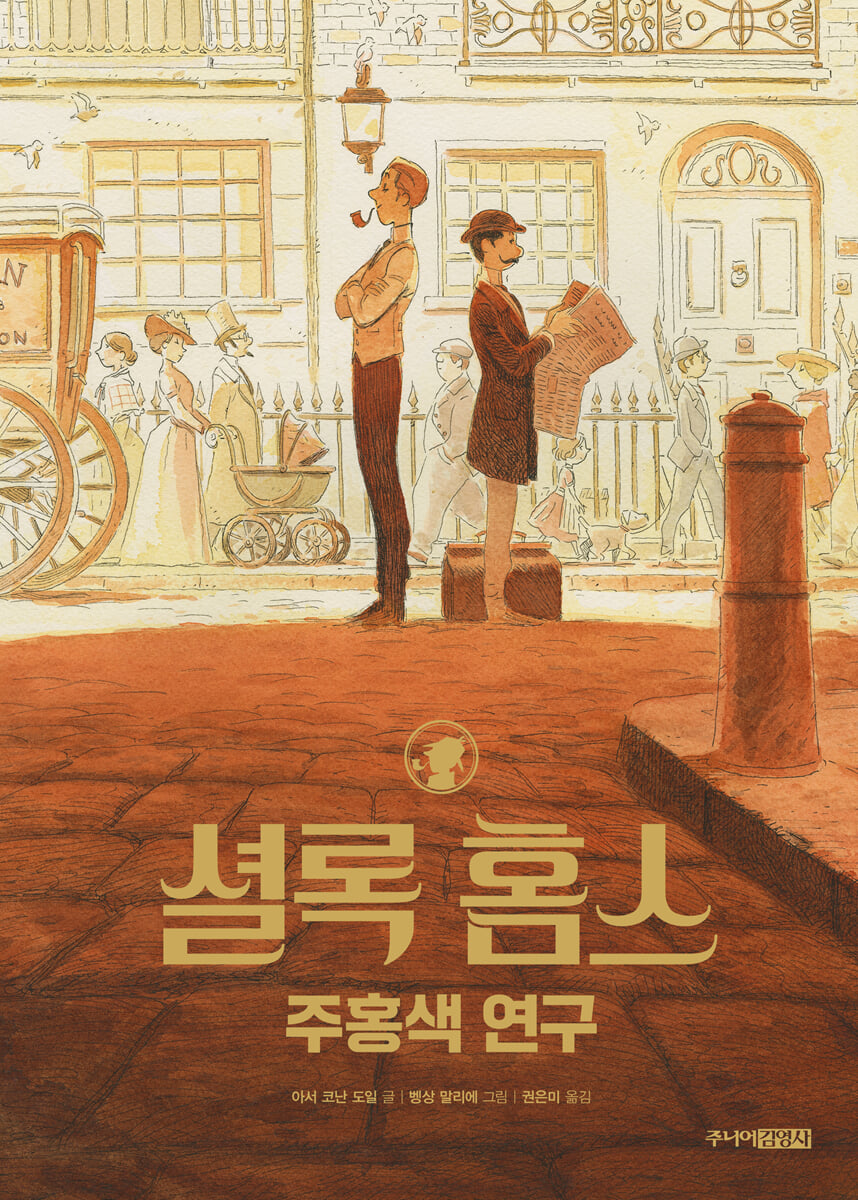
Featuring exquisite illustrations by Vincent Malier and a faithful translation for the modern era, this book will provide intellectual pleasure to young readers encountering Sherlock Holmes for the first time.
A definitive edition of beautiful illustrations that Sherlockians and Holmesians cannot miss!
1887 was a monumental year in which Sherlock Holmes was introduced.
In Korea, electric lights were first installed in Gyeongbokgung Palace, and in the United States, inventor Thomas Edison obtained a patent for a projector. In England, Arthur Conan Doyle shook up the public by introducing Sherlock Holmes, a detective who was straightforward with evidence and logic, through A Study in Scarlet.
Published at the same time as these ancient events, A Study in Scarlet has remained a masterpiece for generations, never going out of print for nearly 140 years.
What is it about this work that has captivated readers so much? The fact that it's the first novel featuring Sherlock Holmes is reason enough to read A Study in Scarlet, but the moment you open the book, you'll be instantly drawn in by its fun, pace, and logic.
Featuring exquisite illustrations by Vincent Malier and a faithful translation for the modern era, this book will provide intellectual pleasure to young readers encountering Sherlock Holmes for the first time.
- You can preview some of the book's contents.
Preview
index
(Part 1)
1.
Mr. Sherlock Holmes
2.
The Science of Reasoning
3.
The Mystery of Lauriston Gardens
4.
John Rance's testimony
5.
Customers who came after seeing the advertisement
6.
Tobias Gregson shows off his skills
7.
Light in the Darkness
(Part 2)
8.
In the vast salt desert
9.
Flowers of Utah
10.
John Ferrier Talks with the Prophet
11.
escape
12.
Angels of Vengeance
13.
Dr. Watson's Memoir Continues
14.
conclusion
Translator's Note
1.
Mr. Sherlock Holmes
2.
The Science of Reasoning
3.
The Mystery of Lauriston Gardens
4.
John Rance's testimony
5.
Customers who came after seeing the advertisement
6.
Tobias Gregson shows off his skills
7.
Light in the Darkness
(Part 2)
8.
In the vast salt desert
9.
Flowers of Utah
10.
John Ferrier Talks with the Prophet
11.
escape
12.
Angels of Vengeance
13.
Dr. Watson's Memoir Continues
14.
conclusion
Translator's Note
Detailed image

Into the book
“Dr. Watson, Mr. Sherlock Holmes.”
Stamford introduced us to each other.
“Hello. I see you’ve been to Afghanistan.”
He took my hand and spoke kindly, but his grip was much stronger than I expected.
“No, how on earth do you know that?”
I asked in surprise.
--- p.14
“Are you saying you can sit still and solve a problem that others, even with all the information at their disposal, can’t solve?”
“Yes, that’s right.
I have a kind of intuition about this area.
Sometimes, when a more complex case arises, I rush over and see it with my own eyes.
(...) observation is second nature to me.”
--- p.33
I was thinking that as soon as Sherlock Holmes arrived, he would rush into the house to solve the mystery.
But it was just the opposite.
Despite the urgent situation, he seemed to be at peace, as if on purpose.
I walked briskly from one end of the road to the other, staring blankly at the ground, the sky, the houses across the street, and the railing.
Then he slowly walked down the road in front of the house, walking on the grass at the edge of the road instead of in the middle, and he kept looking at the ground.
He stopped twice, once with a smile and a sigh of satisfaction.
--- p.44
At that time, I was completely focused on the ominous figure lying motionless on the floor.
Blurred, empty eyes stared at the faded ceiling.
(...) I have witnessed many forms of death, but I have never seen anything more horrible than what I saw in this gloomy, dark room, facing one of the great thoroughfares on the outskirts of London.
--- p.47
“This is a women’s wedding ring.”
He placed the ring on his palm.
We approached him to observe the ring.
There was no doubt that this wedding ring, made of pure gold, would one day adorn the finger of a young bride.
“The case is at a dead end.
It's already complicated enough.”
Gregson said.
“Don’t you think this clue will actually simplify the case?”
Holmes added, pointing out:
--- p.51
Detective Lestrade struck a match on the sole of his shoe and held it high along the wall.
“Look at that.”
He said it with pride.
As I've already pointed out, the wallpaper was peeling off in several places, and a large piece of wallpaper had been torn off in a corner, exposing a square yellowish plaster wall.
And where the wallpaper had peeled off, a word was scrawled in blood.
Rache
--- p.53
“If this man was murdered, what was the cause of death?”
Lestrade asked.
“It’s poison.”
Sherlock Holmes spoke curtly and left the room.
“One more thing, Detective Lestrade.”
When he reached the front door, he turned around and added:
“Rache” means ‘revenge’ in German.
So don't waste your time looking for a girl named Rachel.”
After firing one last sharp arrow, he walked away, leaving his two rivals gaping in bewilderment.
Stamford introduced us to each other.
“Hello. I see you’ve been to Afghanistan.”
He took my hand and spoke kindly, but his grip was much stronger than I expected.
“No, how on earth do you know that?”
I asked in surprise.
--- p.14
“Are you saying you can sit still and solve a problem that others, even with all the information at their disposal, can’t solve?”
“Yes, that’s right.
I have a kind of intuition about this area.
Sometimes, when a more complex case arises, I rush over and see it with my own eyes.
(...) observation is second nature to me.”
--- p.33
I was thinking that as soon as Sherlock Holmes arrived, he would rush into the house to solve the mystery.
But it was just the opposite.
Despite the urgent situation, he seemed to be at peace, as if on purpose.
I walked briskly from one end of the road to the other, staring blankly at the ground, the sky, the houses across the street, and the railing.
Then he slowly walked down the road in front of the house, walking on the grass at the edge of the road instead of in the middle, and he kept looking at the ground.
He stopped twice, once with a smile and a sigh of satisfaction.
--- p.44
At that time, I was completely focused on the ominous figure lying motionless on the floor.
Blurred, empty eyes stared at the faded ceiling.
(...) I have witnessed many forms of death, but I have never seen anything more horrible than what I saw in this gloomy, dark room, facing one of the great thoroughfares on the outskirts of London.
--- p.47
“This is a women’s wedding ring.”
He placed the ring on his palm.
We approached him to observe the ring.
There was no doubt that this wedding ring, made of pure gold, would one day adorn the finger of a young bride.
“The case is at a dead end.
It's already complicated enough.”
Gregson said.
“Don’t you think this clue will actually simplify the case?”
Holmes added, pointing out:
--- p.51
Detective Lestrade struck a match on the sole of his shoe and held it high along the wall.
“Look at that.”
He said it with pride.
As I've already pointed out, the wallpaper was peeling off in several places, and a large piece of wallpaper had been torn off in a corner, exposing a square yellowish plaster wall.
And where the wallpaper had peeled off, a word was scrawled in blood.
Rache
--- p.53
“If this man was murdered, what was the cause of death?”
Lestrade asked.
“It’s poison.”
Sherlock Holmes spoke curtly and left the room.
“One more thing, Detective Lestrade.”
When he reached the front door, he turned around and added:
“Rache” means ‘revenge’ in German.
So don't waste your time looking for a girl named Rachel.”
After firing one last sharp arrow, he walked away, leaving his two rivals gaping in bewilderment.
--- p.57
Publisher's Review
The sad revenge of a man who lost his beloved lover
Holmes' scientific and delicate reasoning that penetrates the process is intertwined!
During the Victorian era in England, Arthur Conan Doyle's 'Sherlock Holmes' caused quite a stir.
Published in 1887, A Study in Scarlet is the first novel to introduce Sherlock Holmes to the public, and it holds great significance for fans as it marks the first meeting between Holmes and Watson.
This book, written from Watson's perspective, is largely divided into two parts.
Part 1 unfolds in the present.
Watson and Holmes meet for the first time, and they settle down at 221B Baker Street.
Soon, the two are commissioned by a detective to investigate a murder scene, and Holmes meticulously piece together the clues he has gathered to successfully apprehend the culprit.
Part 2 moves from a flashback to the present.
The "Great Religious Migration" of the American West in 1847 and the story of a criminal's revenge from 1860 to 1881 are intertwined with murder cases like warp and weft.
At the end, two stories that seemed completely different become closely connected, which naturally evokes a sense of wonder.
Why is the work titled "A Study in Scarlet"? It's a story about a bloody murder, as Holmes describes it: "The red thread of murder tangled in the colorless skein of life."
This work meticulously explores human psychology, such as the sins lurking within those who act like true believers and the vengeful desire that clings to the hearts of those who have lost a lover, gradually increasing the emotional level, and delivering a refreshing experience with Sherlock Holmes' scientific investigative methods and uncluttered reasoning.
A beautiful edition that will thrill the hearts of Korean readers!
The story of a genius detective who solves cases using logical reasoning and the power of observation.
This edition of Junior Kim Young-sa's book contains over 60 beautiful paintings by Vincent Malier.
Large and small pictures that blend in with the text, sometimes in black and white and sometimes in color, help readers immerse themselves.
It's also quite fun to look at the little cuts of mice that appear every time you turn the page.
In addition, we tried to be faithful to the original text, but we also corrected awkward direct translations and unfamiliar expressions so that readers can read it without feeling awkward.
In 1881, when the story begins, Sherlock Holmes analyzes the case by combining various clues from the scene, such as the victim's clothing, belongings, shoe prints, carriage wheel tracks, and letters left in blood.
He is well-versed in everything from Latin knowledge and blood analysis methods to the types of poisons and tobacco ash, and he uses each ability in the right place at the right time.
He also has the cunning ability to hide some of the details of his reasoning until the case is solved, if necessary.
To those who say, "This is a complicated case, I can't figure it out," he asks, "Wouldn't that clue actually make the case simpler?" This may seem arrogant at first glance, but it's very charming.
Although he displays such a rational and cynical attitude, he also gets very excited when his reasoning does not match up and gets excited when he recalls a beautiful violin melody.
Arthur Conan Doyle spreads the human side of Holmes, who was thought to be perfect, throughout the story, thereby increasing the reader's intimacy with the protagonist.
The creative background of Doyle, who left his mark on the history of mystery novels.
In the previously published novel, "Arsène Lupin, the Gentleman Thief," the legendary detective 'Hullock Shoms', who is Lupin's rival, appears.
This is a brief example that acknowledges the status of Sherlock Holmes and shows just how much influence he had on readers and the literary world.
Arthur Conan Doyle, who wrote the Sherlock Holmes series with systematic and logical scientific knowledge and popular creative ability, was originally a medical student who also pursued writing.
When Doyle was in college, his teacher, Joseph Bell, had the ability to observe and infer others' occupations and accurately guess their occupations. This inspired Doyle to create the character of Sherlock Holmes.
Moreover, Sherlock Holmes's image of finding criminals based on observation and evidence fit with the atmosphere of the times that valued science, advanced engineering, and technology, and achieved great popularity.
Sherlock Holmes, the detective among detectives, has reached the pinnacle of admiration.
Those who love him have formed fandoms called 'Sherlockians' and 'Holmesians', and continue to elevate Sherlock Holmes to the level of the public's memory.
The great Sherlock Holmes, who spawned imitators such as 'Sherlock Combs' and 'Soller Ponds', is constantly loved as a 'vivid character' in books, movies, and dramas in addition to the original 60 novels.
Adding to this flow, Junior Kim Young-sa's "Sherlock Holmes: A Study in Scarlet" vividly conveys the atmosphere of 221B Baker Street with Professor Eun-mi Kwon's faithful translation based on the original text and the elaborate illustrations of Vincent Mallier.
This beautiful edition is a perfect balance of fun, fast-paced action, and logic, and will delight both returning Holmes fans and new readers experiencing the series for the first time.
Holmes' scientific and delicate reasoning that penetrates the process is intertwined!
During the Victorian era in England, Arthur Conan Doyle's 'Sherlock Holmes' caused quite a stir.
Published in 1887, A Study in Scarlet is the first novel to introduce Sherlock Holmes to the public, and it holds great significance for fans as it marks the first meeting between Holmes and Watson.
This book, written from Watson's perspective, is largely divided into two parts.
Part 1 unfolds in the present.
Watson and Holmes meet for the first time, and they settle down at 221B Baker Street.
Soon, the two are commissioned by a detective to investigate a murder scene, and Holmes meticulously piece together the clues he has gathered to successfully apprehend the culprit.
Part 2 moves from a flashback to the present.
The "Great Religious Migration" of the American West in 1847 and the story of a criminal's revenge from 1860 to 1881 are intertwined with murder cases like warp and weft.
At the end, two stories that seemed completely different become closely connected, which naturally evokes a sense of wonder.
Why is the work titled "A Study in Scarlet"? It's a story about a bloody murder, as Holmes describes it: "The red thread of murder tangled in the colorless skein of life."
This work meticulously explores human psychology, such as the sins lurking within those who act like true believers and the vengeful desire that clings to the hearts of those who have lost a lover, gradually increasing the emotional level, and delivering a refreshing experience with Sherlock Holmes' scientific investigative methods and uncluttered reasoning.
A beautiful edition that will thrill the hearts of Korean readers!
The story of a genius detective who solves cases using logical reasoning and the power of observation.
This edition of Junior Kim Young-sa's book contains over 60 beautiful paintings by Vincent Malier.
Large and small pictures that blend in with the text, sometimes in black and white and sometimes in color, help readers immerse themselves.
It's also quite fun to look at the little cuts of mice that appear every time you turn the page.
In addition, we tried to be faithful to the original text, but we also corrected awkward direct translations and unfamiliar expressions so that readers can read it without feeling awkward.
In 1881, when the story begins, Sherlock Holmes analyzes the case by combining various clues from the scene, such as the victim's clothing, belongings, shoe prints, carriage wheel tracks, and letters left in blood.
He is well-versed in everything from Latin knowledge and blood analysis methods to the types of poisons and tobacco ash, and he uses each ability in the right place at the right time.
He also has the cunning ability to hide some of the details of his reasoning until the case is solved, if necessary.
To those who say, "This is a complicated case, I can't figure it out," he asks, "Wouldn't that clue actually make the case simpler?" This may seem arrogant at first glance, but it's very charming.
Although he displays such a rational and cynical attitude, he also gets very excited when his reasoning does not match up and gets excited when he recalls a beautiful violin melody.
Arthur Conan Doyle spreads the human side of Holmes, who was thought to be perfect, throughout the story, thereby increasing the reader's intimacy with the protagonist.
The creative background of Doyle, who left his mark on the history of mystery novels.
In the previously published novel, "Arsène Lupin, the Gentleman Thief," the legendary detective 'Hullock Shoms', who is Lupin's rival, appears.
This is a brief example that acknowledges the status of Sherlock Holmes and shows just how much influence he had on readers and the literary world.
Arthur Conan Doyle, who wrote the Sherlock Holmes series with systematic and logical scientific knowledge and popular creative ability, was originally a medical student who also pursued writing.
When Doyle was in college, his teacher, Joseph Bell, had the ability to observe and infer others' occupations and accurately guess their occupations. This inspired Doyle to create the character of Sherlock Holmes.
Moreover, Sherlock Holmes's image of finding criminals based on observation and evidence fit with the atmosphere of the times that valued science, advanced engineering, and technology, and achieved great popularity.
Sherlock Holmes, the detective among detectives, has reached the pinnacle of admiration.
Those who love him have formed fandoms called 'Sherlockians' and 'Holmesians', and continue to elevate Sherlock Holmes to the level of the public's memory.
The great Sherlock Holmes, who spawned imitators such as 'Sherlock Combs' and 'Soller Ponds', is constantly loved as a 'vivid character' in books, movies, and dramas in addition to the original 60 novels.
Adding to this flow, Junior Kim Young-sa's "Sherlock Holmes: A Study in Scarlet" vividly conveys the atmosphere of 221B Baker Street with Professor Eun-mi Kwon's faithful translation based on the original text and the elaborate illustrations of Vincent Mallier.
This beautiful edition is a perfect balance of fun, fast-paced action, and logic, and will delight both returning Holmes fans and new readers experiencing the series for the first time.
GOODS SPECIFICS
- Date of issue: October 24, 2025
- Format: Hardcover book binding method guide
- Page count, weight, size: 224 pages | 528g | 170*240*20mm
- ISBN13: 9791173323065
- ISBN10: 1173323066
- KC Certification: Certification Type: Conformity Confirmation
You may also like
카테고리
korean


korean

![GQ KOREA Mark (Monthly): December [2025]](http://librairie.coreenne.fr/cdn/shop/files/8ef265dbbfbf186523ed75ba7319009d.jpg?v=1765340328&width=3840)


