

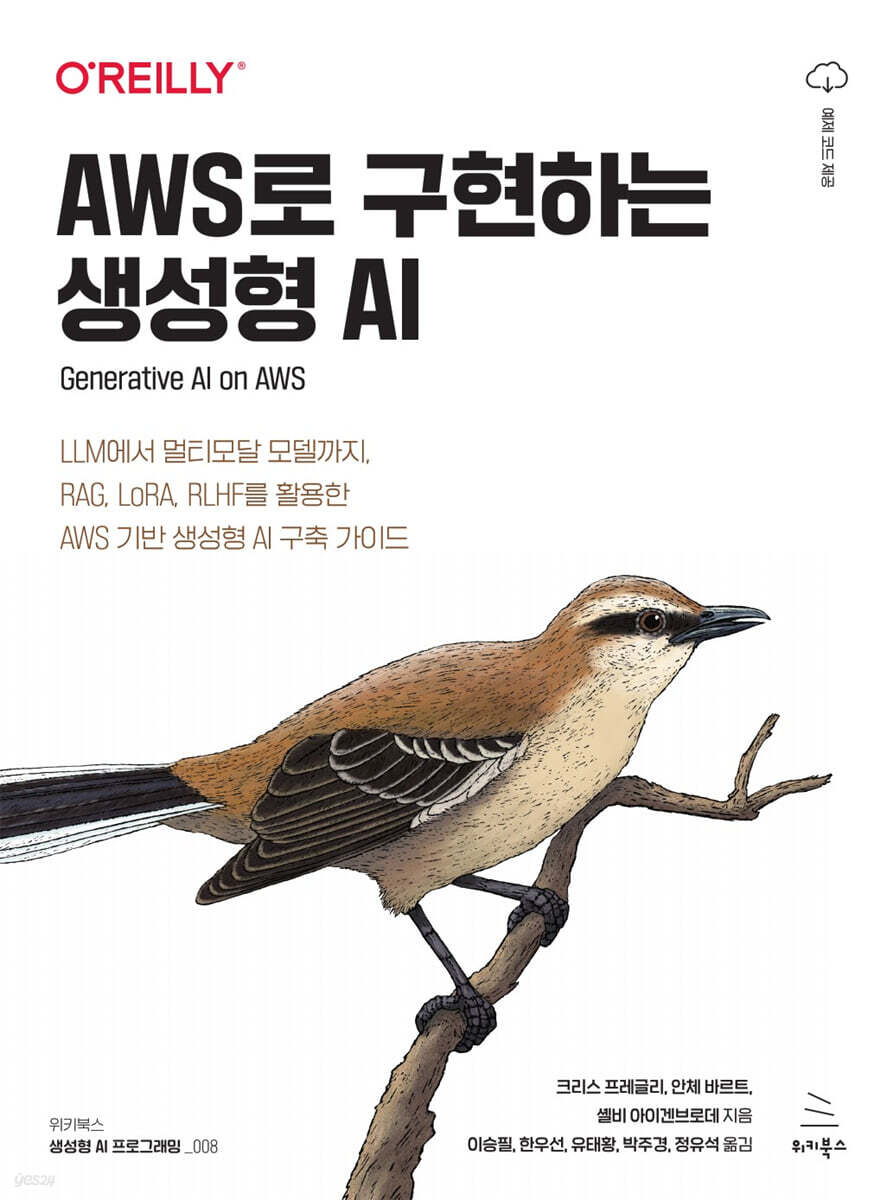
Generative AI with AWS
 |
Description
Book Introduction
Understand the most common generative AI use cases and tasks across industry and academia!
Today, companies are rapidly adopting generative AI into their products and services.
However, there is a lot of hype and misunderstanding about the impact and potential of this technology. In this book, AWS's Chris Fregley, Antje Barth, and Shelby Eigenbrode help CTOs, machine learning practitioners, application developers, business analysts, data engineers, and data scientists find practical ways to leverage this exciting new technology.
This book will teach you the lifecycle of a generative AI project, including defining use cases, selecting models, fine-tuning models, augmented generation, reinforcement learning with human feedback, model quantization, optimization, and deployment.
We also explore different types of models, including large-scale language models (LLMs), stable diffusion for image generation, Flamingo for image question answering, and multimodal models like IDEFICS.
Today, companies are rapidly adopting generative AI into their products and services.
However, there is a lot of hype and misunderstanding about the impact and potential of this technology. In this book, AWS's Chris Fregley, Antje Barth, and Shelby Eigenbrode help CTOs, machine learning practitioners, application developers, business analysts, data engineers, and data scientists find practical ways to leverage this exciting new technology.
This book will teach you the lifecycle of a generative AI project, including defining use cases, selecting models, fine-tuning models, augmented generation, reinforcement learning with human feedback, model quantization, optimization, and deployment.
We also explore different types of models, including large-scale language models (LLMs), stable diffusion for image generation, Flamingo for image question answering, and multimodal models like IDEFICS.
- You can preview some of the book's contents.
Preview
index
▣ Chapter 1: Generative AI Use Cases, Fundamentals, and Project Lifecycle
Use Cases and Tasks
Foundation Model and Model Hub
The Life Cycle of a Generative AI Project
Generative AI on AWS
Why Use Generative AI on AWS
Building Generative AI Applications on AWS
summation
▣ Chapter 2: Prompt Engineering and Learning in Context
Prompts and Completions
token
Prompt Engineering
Prompt structure
___instruction
___Context
Learning in context with few-shot inference
___Zero-shot inference
___One-shot inference
___Few-shot inference
___A Case of In-Context Learning Going Wrong
___Best Practices for Learning in Context
Prompt Engineering Best Practices
Inference configuration parameters
summation
▣ Chapter 3: Large Language Foundation Model
Large Language Foundation Model
Tokenizer
Embedding vector
Transformer architecture
___Input and Context Windows
___Embedding layer
___encoder
___Self-Attention
___decoder
___Softmax output
Transformer-based foundation model type
Pre-training dataset
Scaling laws
Computational optimization model
summation
▣ Chapter 4: Memory and Computation Optimization
memory problems
Data types and numeric precision
Quantization
___fp16
___bfloat16
___fp8
___int8
Optimizing the self-attention layer
___Flash Attention
___Group Query Attention
distributed computing
___Distributed Data Parallel Processing
___Fully sharded data parallel processing
Performance comparison of ___DDP and FSDP
AWS Distributed Computing
___Fully sharded data parallel processing with Amazon SageMaker
___AWS Neuron SDK and AWS Training
summation
▣ Chapter 5: Fine-tuning and Evaluation
Instruction-based fine-tuning
___Llama 2-Chat
___Falcon-Chat
___FLAN-T5
Instruction data set
___Multitasking Instruction Data Set
___FLAN: Multitask Instruction Data Set Example
___Prompt Template
___Converting a user-defined data set to an instruction data set
Instruction-based fine-tuning
___Amazon SageMaker Studio
___Amazon SageMaker Jumpstart
Amazon SageMaker Estimator for ___Hugging Face
evaluation
___Evaluation Criteria
___Benchmarks and Datasets
summation
▣ Chapter 6: Efficient Parameter Fine-Tuning (PEFT)
Comparison of Full Fine-tuning and PEFT
LoRA and QLoRA
___LoRA Basic Principles
___ranking
___Target Modules and Layers
___LoRA application
___Merge LoRA adapter with original model
___LoRA adapter tenant-specific maintenance
___Comparing Full Fine-Tuning and LoRA Performance
___QLoRA
Prompt tuning and soft prompts
summation
▣ Chapter 7: Fine-tuning with Reinforcement Learning Through Human Feedback
Human Alignment: Usefulness, Honesty, Non-Maliciousness
Reinforcement Learning Overview
Learning a customized reward model
___Collecting learning data using Human-in-the-Loop
Example Instructions for ___Labelers
___Using Amazon SageMaker Ground Truth to Collect Human-Only Annotations
___Preparing ranking data to train the reward model
___Training the reward model
Existing Compensation Model: Meta's Harm Reader
Fine-tuning with reinforcement learning through human feedback
___Using the compensation model in RLHF
___Proximity Policy Optimization Reinforcement Learning Algorithm
Perform RLHF fine-tuning with ___PPO
___Compensation Hack Mitigation
___Using efficient parameter fine-tuning (PEFT) in RLHF
Evaluation of fine-tuned models using RLHF
___Qualitative Evaluation
___Quantitative Evaluation
___Import the evaluation model
___Definition of evaluation index aggregation function
Comparison of evaluation indicators before and after RLHF application
summation
▣ Chapter 8: Optimizing Model Deployment
Model Inference Optimization
___pruning
___GPTQ Post-Training Quantization
___distillation
Large-scale model inference container
AWS Inferentia: Dedicated Inference Hardware
Model Update and Deployment Strategy
___A/B testing
___Shadow Distribution
Indicators and Monitoring
Autoscaling
___Autoscaling policy
___Define autoscaling policy
summation
▣ Chapter 9: Context-Aware Inference Applications Using RAG and Agents
Limitations of large-scale language models
___hallucination
___knowledge gap
RAG
___External knowledge sources
___RAG Workflow
___Document loading
___Chunking
___Document search and reordering
___Prompt Augmentation
RAG Orchestration and Implementation
___Document loading and chunking
___Vector Embedding Storage and Retrieval
___search chain
___Reordering using maximum marginal relevance (MMR)
agent
___ReAct Framework
___Program Support Language Framework
Generative AI applications
FMOps: Lifecycle Operations for Generative AI Projects
___Experimental Phase Considerations
___Development Phase Considerations
___Operational Deployment Phase Considerations
summation
▣ Chapter 10: Multimodal Foundation Model
Use Cases
Examples of Multimodal Prompt Engineering Utilization
Image creation and quality enhancement
___Image Creation
___Image editing and quality enhancement
Inpainting, outpainting, depth-to-image
___inpainting
___Outpainting
___Depth to Image
Image Captioning and Visual Q&A
___Image Captioning
___Content Moderation
___Visual Q&A
Model evaluation
___Text-to-image generation tasks
___Image-to-text generation task
___Nonverbal reasoning
Diffusion Architecture Fundamentals
___forward diffusion
___reverse diffusion
___U-Net
Stable Diffusion 2 Architecture
___text encoder
___U-Net and the diffusion process
___Text Conditioning
___Cross-attention
___Scheduler
___Image Decoder
Stable Diffusion XL Architecture
___U-Net and Cross Attention
___purifier
___conditioning
summation
▣ Chapter 11: Generation Control and Fine-Tuning through Stable Diffusion
ControlNet
Fine tuning
___Dream Booth
___Dream Booth and PEFT-LoRA
___Textual Inversion
Aligning human values with reinforcement learning through human feedback
summation
▣ Chapter 12: Amazon Bedrock - Generative AI Managed Service
Bedrock Foundation Model
___Amazon Titan Foundation Model
___Stability AI's Stable Diffusion Foundation Model
Bedrock Inference API
Large-scale language models
___SQL code generation
___Text Summary
___embedding
Fine tuning
agent
multimodal model
___Create image from text
Create an image from ___image
Data Privacy and Network Security
Governance and Monitoring
summation
Use Cases and Tasks
Foundation Model and Model Hub
The Life Cycle of a Generative AI Project
Generative AI on AWS
Why Use Generative AI on AWS
Building Generative AI Applications on AWS
summation
▣ Chapter 2: Prompt Engineering and Learning in Context
Prompts and Completions
token
Prompt Engineering
Prompt structure
___instruction
___Context
Learning in context with few-shot inference
___Zero-shot inference
___One-shot inference
___Few-shot inference
___A Case of In-Context Learning Going Wrong
___Best Practices for Learning in Context
Prompt Engineering Best Practices
Inference configuration parameters
summation
▣ Chapter 3: Large Language Foundation Model
Large Language Foundation Model
Tokenizer
Embedding vector
Transformer architecture
___Input and Context Windows
___Embedding layer
___encoder
___Self-Attention
___decoder
___Softmax output
Transformer-based foundation model type
Pre-training dataset
Scaling laws
Computational optimization model
summation
▣ Chapter 4: Memory and Computation Optimization
memory problems
Data types and numeric precision
Quantization
___fp16
___bfloat16
___fp8
___int8
Optimizing the self-attention layer
___Flash Attention
___Group Query Attention
distributed computing
___Distributed Data Parallel Processing
___Fully sharded data parallel processing
Performance comparison of ___DDP and FSDP
AWS Distributed Computing
___Fully sharded data parallel processing with Amazon SageMaker
___AWS Neuron SDK and AWS Training
summation
▣ Chapter 5: Fine-tuning and Evaluation
Instruction-based fine-tuning
___Llama 2-Chat
___Falcon-Chat
___FLAN-T5
Instruction data set
___Multitasking Instruction Data Set
___FLAN: Multitask Instruction Data Set Example
___Prompt Template
___Converting a user-defined data set to an instruction data set
Instruction-based fine-tuning
___Amazon SageMaker Studio
___Amazon SageMaker Jumpstart
Amazon SageMaker Estimator for ___Hugging Face
evaluation
___Evaluation Criteria
___Benchmarks and Datasets
summation
▣ Chapter 6: Efficient Parameter Fine-Tuning (PEFT)
Comparison of Full Fine-tuning and PEFT
LoRA and QLoRA
___LoRA Basic Principles
___ranking
___Target Modules and Layers
___LoRA application
___Merge LoRA adapter with original model
___LoRA adapter tenant-specific maintenance
___Comparing Full Fine-Tuning and LoRA Performance
___QLoRA
Prompt tuning and soft prompts
summation
▣ Chapter 7: Fine-tuning with Reinforcement Learning Through Human Feedback
Human Alignment: Usefulness, Honesty, Non-Maliciousness
Reinforcement Learning Overview
Learning a customized reward model
___Collecting learning data using Human-in-the-Loop
Example Instructions for ___Labelers
___Using Amazon SageMaker Ground Truth to Collect Human-Only Annotations
___Preparing ranking data to train the reward model
___Training the reward model
Existing Compensation Model: Meta's Harm Reader
Fine-tuning with reinforcement learning through human feedback
___Using the compensation model in RLHF
___Proximity Policy Optimization Reinforcement Learning Algorithm
Perform RLHF fine-tuning with ___PPO
___Compensation Hack Mitigation
___Using efficient parameter fine-tuning (PEFT) in RLHF
Evaluation of fine-tuned models using RLHF
___Qualitative Evaluation
___Quantitative Evaluation
___Import the evaluation model
___Definition of evaluation index aggregation function
Comparison of evaluation indicators before and after RLHF application
summation
▣ Chapter 8: Optimizing Model Deployment
Model Inference Optimization
___pruning
___GPTQ Post-Training Quantization
___distillation
Large-scale model inference container
AWS Inferentia: Dedicated Inference Hardware
Model Update and Deployment Strategy
___A/B testing
___Shadow Distribution
Indicators and Monitoring
Autoscaling
___Autoscaling policy
___Define autoscaling policy
summation
▣ Chapter 9: Context-Aware Inference Applications Using RAG and Agents
Limitations of large-scale language models
___hallucination
___knowledge gap
RAG
___External knowledge sources
___RAG Workflow
___Document loading
___Chunking
___Document search and reordering
___Prompt Augmentation
RAG Orchestration and Implementation
___Document loading and chunking
___Vector Embedding Storage and Retrieval
___search chain
___Reordering using maximum marginal relevance (MMR)
agent
___ReAct Framework
___Program Support Language Framework
Generative AI applications
FMOps: Lifecycle Operations for Generative AI Projects
___Experimental Phase Considerations
___Development Phase Considerations
___Operational Deployment Phase Considerations
summation
▣ Chapter 10: Multimodal Foundation Model
Use Cases
Examples of Multimodal Prompt Engineering Utilization
Image creation and quality enhancement
___Image Creation
___Image editing and quality enhancement
Inpainting, outpainting, depth-to-image
___inpainting
___Outpainting
___Depth to Image
Image Captioning and Visual Q&A
___Image Captioning
___Content Moderation
___Visual Q&A
Model evaluation
___Text-to-image generation tasks
___Image-to-text generation task
___Nonverbal reasoning
Diffusion Architecture Fundamentals
___forward diffusion
___reverse diffusion
___U-Net
Stable Diffusion 2 Architecture
___text encoder
___U-Net and the diffusion process
___Text Conditioning
___Cross-attention
___Scheduler
___Image Decoder
Stable Diffusion XL Architecture
___U-Net and Cross Attention
___purifier
___conditioning
summation
▣ Chapter 11: Generation Control and Fine-Tuning through Stable Diffusion
ControlNet
Fine tuning
___Dream Booth
___Dream Booth and PEFT-LoRA
___Textual Inversion
Aligning human values with reinforcement learning through human feedback
summation
▣ Chapter 12: Amazon Bedrock - Generative AI Managed Service
Bedrock Foundation Model
___Amazon Titan Foundation Model
___Stability AI's Stable Diffusion Foundation Model
Bedrock Inference API
Large-scale language models
___SQL code generation
___Text Summary
___embedding
Fine tuning
agent
multimodal model
___Create image from text
Create an image from ___image
Data Privacy and Network Security
Governance and Monitoring
summation
Detailed image

Publisher's Review
★ What this book covers ★
How to Apply Generative AI to Business
How to determine the best generative AI model for your task
◎ Perform prompt engineering and learning in context
◎ Fine-tune generative AI models to fit your dataset with low-rank adaptation (LoRA).
◎ How to Align Generative AI Models with Human Values Using Reinforcement Learning with Human Feedback (RLHF)
◎ Augmenting models with augmented search generation (RAG)
◎ Developing agents and actions using libraries like LangChain and ReAct
How to Build Generative AI Applications with Amazon Bedrock
How to Apply Generative AI to Business
How to determine the best generative AI model for your task
◎ Perform prompt engineering and learning in context
◎ Fine-tune generative AI models to fit your dataset with low-rank adaptation (LoRA).
◎ How to Align Generative AI Models with Human Values Using Reinforcement Learning with Human Feedback (RLHF)
◎ Augmenting models with augmented search generation (RAG)
◎ Developing agents and actions using libraries like LangChain and ReAct
How to Build Generative AI Applications with Amazon Bedrock
GOODS SPECIFICS
- Date of issue: October 24, 2024
- Page count, weight, size: 328 pages | 175*235*14mm
- ISBN13: 9791158395513
You may also like
카테고리
korean


korean

![GQ KOREA Mark (Monthly): December [2025]](http://librairie.coreenne.fr/cdn/shop/files/8ef265dbbfbf186523ed75ba7319009d.jpg?v=1765340328&width=3840)


