

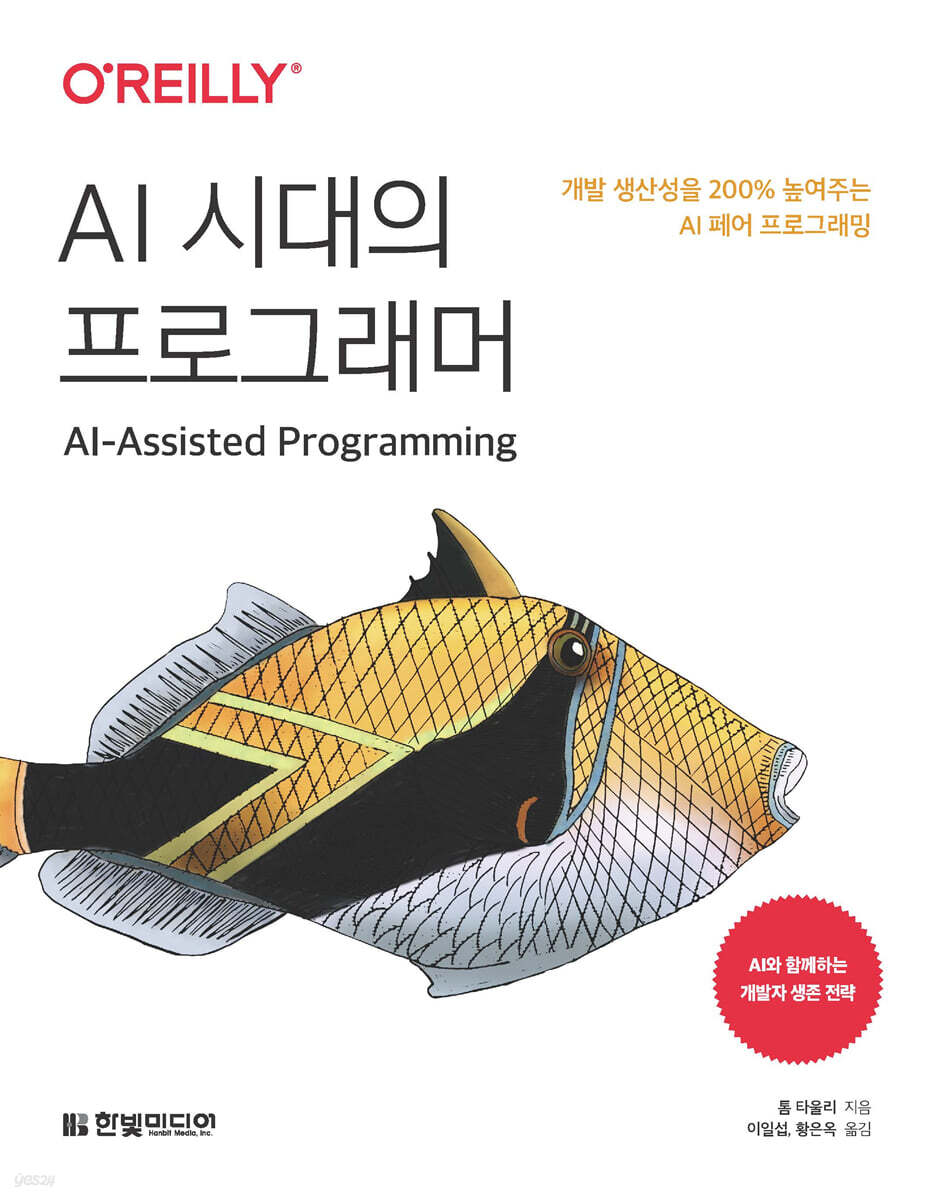
Programmers in the AI Age
 |
Description
Book Introduction
Programmers: Surviving in the AI World
AI has now become a powerful companion for programmers.
Master AI tools with this book to dramatically reduce development time while improving code quality.
Take your development capabilities to the next level with AI in a rapidly changing technological landscape.
A 200% productivity boost is just the beginning. AI development tools provide practical advice for every stage of programming, from requirements definition and planning to design, coding, debugging, testing, and documentation.
This book covers how to use a variety of tools, from LLMs like ChatGPT and Claude to code-specific AIs like GitHub Copilot and Amazon Q Developer.
From beginners to experienced programmers, increase your development productivity with AI.
AI has now become a powerful companion for programmers.
Master AI tools with this book to dramatically reduce development time while improving code quality.
Take your development capabilities to the next level with AI in a rapidly changing technological landscape.
A 200% productivity boost is just the beginning. AI development tools provide practical advice for every stage of programming, from requirements definition and planning to design, coding, debugging, testing, and documentation.
This book covers how to use a variety of tools, from LLMs like ChatGPT and Claude to code-specific AIs like GitHub Copilot and Amazon Q Developer.
From beginners to experienced programmers, increase your development productivity with AI.
- You can preview some of the book's contents.
Preview
index
CHAPTER 1 A New World Open to Developers
_1.1 Evolution and Innovation
_1.2 Generative AI
_1.3 Use Cases
_1.4 Limitations
_1.5 A New Approach for Developers
_1.6 Conclusion
CHAPTER 2: How AI Assistants Work
_2.1 Main Features
_2.2 Comparison with Intelligent Code Completion
_2.3 Comparison with compilers
_2.4 Competency Level
_2.5 Generative AI and Large Language Models (LLMs)
_2.6 LLM Performance Evaluation
_2.7 Open Source LLM
_2.8 AI Assistant Programming Tool Evaluation
_2.9 Conclusion
CHAPTER 3 PROMPT ENGINEERING
_3.1 Arts and Sciences
_3.2 Challenges
_3.3 Prompt
_3.4 Context
_3.5 Instructions
_3.6 Input data
_3.7 Output Format
_3.8 Best Practices
_3.9 Reduced hallucinations
_3.10 Security and Privacy
_3.11 Autonomous AI Agents
_3.12 Conclusion
CHAPTER 4 GitHub Co-Pilot
_4.1 GitHub Copilot
_4.2 Getting Started
_4.3 Co-Pilot Partner Program
_4.4 Conclusion
CHAPTER 5 Other AI Assistant Programming Tools
_5.1 Amazon Q Developer
_5.2 Gemini Code Assist
_5.3 Tab Nine
_5.4 Leaflet
_5.5 Code GPT
_5.6 Cody
_5.7 CodeWP
_5.8 Warp
_5.9 Vito AI
_5.10 Cursor
_5.11 Code Rama
_5.12 Other open source models
_5.13 Conclusion
CHAPTER 6 ChatGPT and Other General LLMs
_6.1 ChatGPT
_6.2 Code generation capability of GPT model
_6.3 Exploring ChatGPT
_6.4 Web Browsing
_6.5 Repetitive tasks
_6.6 Cross-browser compatibility
_6.7 Bash Commands
_6.8 GitHub Actions
_6.9 GPTs
_6.10 Gemini
_6.11 Claude
_6.12 Conclusion
CHAPTER 7 Planning
_7.1 Brainstorming
_7.2 Market Research
_7.3 Competitive Analysis
_7.4 Writing Requirements
_7.5 Project Management
_7.6 Conclusion
CHAPTER 8 Coding
_8.1 Code Review
_8.2 Judgment Call
_8.3 Learning
_8.4 Notes
_8.5 Modular Programming
_8.6 Starting a Project
_8.7 Auto-Complete
_8.8 Refactoring
_8.9 function
_8.10 Object-Oriented Programming
_8.11 Frameworks and Libraries
_8.12 data
_8.13 Front-end development
_8.14 API
_8.15 Conclusion
CHAPTER 9 Debugging, Testing, and Deployment
_9.1 Debugging
_9.2 Document
_9.3 Code Review
_9.4 distribution
_9.5 Conclusion
CHAPTER 10 Tips for Developers in the AI Era
_10.1 How AI Has Changed Programming
_10.2 Benefits of AI Assistants
_10.3 Things to keep in mind about AI assistants
_10.4 Characteristics of Prompt Engineering
_10.5 Beyond Programming
_10.6 The Role of the Programmer
_10.7 Conclusion
APPENDIX A Claude 3.5
_A.1 Claude Artifact
_A.2 Claude Project
_1.1 Evolution and Innovation
_1.2 Generative AI
_1.3 Use Cases
_1.4 Limitations
_1.5 A New Approach for Developers
_1.6 Conclusion
CHAPTER 2: How AI Assistants Work
_2.1 Main Features
_2.2 Comparison with Intelligent Code Completion
_2.3 Comparison with compilers
_2.4 Competency Level
_2.5 Generative AI and Large Language Models (LLMs)
_2.6 LLM Performance Evaluation
_2.7 Open Source LLM
_2.8 AI Assistant Programming Tool Evaluation
_2.9 Conclusion
CHAPTER 3 PROMPT ENGINEERING
_3.1 Arts and Sciences
_3.2 Challenges
_3.3 Prompt
_3.4 Context
_3.5 Instructions
_3.6 Input data
_3.7 Output Format
_3.8 Best Practices
_3.9 Reduced hallucinations
_3.10 Security and Privacy
_3.11 Autonomous AI Agents
_3.12 Conclusion
CHAPTER 4 GitHub Co-Pilot
_4.1 GitHub Copilot
_4.2 Getting Started
_4.3 Co-Pilot Partner Program
_4.4 Conclusion
CHAPTER 5 Other AI Assistant Programming Tools
_5.1 Amazon Q Developer
_5.2 Gemini Code Assist
_5.3 Tab Nine
_5.4 Leaflet
_5.5 Code GPT
_5.6 Cody
_5.7 CodeWP
_5.8 Warp
_5.9 Vito AI
_5.10 Cursor
_5.11 Code Rama
_5.12 Other open source models
_5.13 Conclusion
CHAPTER 6 ChatGPT and Other General LLMs
_6.1 ChatGPT
_6.2 Code generation capability of GPT model
_6.3 Exploring ChatGPT
_6.4 Web Browsing
_6.5 Repetitive tasks
_6.6 Cross-browser compatibility
_6.7 Bash Commands
_6.8 GitHub Actions
_6.9 GPTs
_6.10 Gemini
_6.11 Claude
_6.12 Conclusion
CHAPTER 7 Planning
_7.1 Brainstorming
_7.2 Market Research
_7.3 Competitive Analysis
_7.4 Writing Requirements
_7.5 Project Management
_7.6 Conclusion
CHAPTER 8 Coding
_8.1 Code Review
_8.2 Judgment Call
_8.3 Learning
_8.4 Notes
_8.5 Modular Programming
_8.6 Starting a Project
_8.7 Auto-Complete
_8.8 Refactoring
_8.9 function
_8.10 Object-Oriented Programming
_8.11 Frameworks and Libraries
_8.12 data
_8.13 Front-end development
_8.14 API
_8.15 Conclusion
CHAPTER 9 Debugging, Testing, and Deployment
_9.1 Debugging
_9.2 Document
_9.3 Code Review
_9.4 distribution
_9.5 Conclusion
CHAPTER 10 Tips for Developers in the AI Era
_10.1 How AI Has Changed Programming
_10.2 Benefits of AI Assistants
_10.3 Things to keep in mind about AI assistants
_10.4 Characteristics of Prompt Engineering
_10.5 Beyond Programming
_10.6 The Role of the Programmer
_10.7 Conclusion
APPENDIX A Claude 3.5
_A.1 Claude Artifact
_A.2 Claude Project
Detailed image

Publisher's Review
In the age of AI, the role of programmers is changing.
With the advent of ChatGPT and GitHub Copilot, the role of the programmer is now revolutionizing.
Programmers must now become problem solvers who come up with creative solutions, not just code writers.
Learn how to leverage rapidly changing AI technologies in your programming processes without getting caught up in them.
This book goes beyond simply teaching you how to use AI tools; it presents strategies for maximizing your development capabilities using AI.
This book will teach you the essential skills a programmer must possess and how to collaborate with AI to create better results. Maximize your development productivity with AI, become a programmer in the AI era, and stand at the forefront of innovation.
Target audience
● Developers who want to actively utilize AI in the programming process
Programmers who feel threatened by the emergence of AI
● Students who feel like they are heading to the bare ground after looking at the assignment sample code
What you learn
● Core features of AI-based tools
● Prompt Engineering for Developers
● Pros and Cons and Use Cases of Code Assistance Systems Like GitHub Copilot and Amazon Q Developer
● How to use AI tools in the software development life cycle, including requirements definition, planning, coding, debugging, and testing.
● How to use LLM services such as ChatGPT, Gemini, and Claude in the programming course
Author's Note
Programming has changed dramatically with the advent of GitHub Copilot and ChatGPT.
It felt like a complete game changer, like when I first used an iPhone.
Ask ChatGPT to write code in natural language or enter the code you want in Visual Studio Code, and it will generate the code you want.
Additionally, ChatGPT even converts images into code.
I actually started using ChatGPT while building an app.
ChatGPT has helped me with many tasks, including brainstorming, organizing requirements, and setting up unit tests.
It contains useful information for all developers, from beginners taking their first steps into the development field to senior developers with many years of experience.
I hope this book will serve as a helpful guide for your practice.
-Tom Towley
Translator's Note
While discussions about applying and adapting generative AI to business domains remain active, this book focuses on AI assistant programming tools.
We detail how to use the general-purpose LLM across all areas of development, from planning to deployment, including the capabilities provided by AI assistants specialized in code generation.
I hope this book will help readers experience and compare the amazing advancements in AI assistants and find the pair programmer that best suits their needs.
-Lee Il-seop, Hwang Eun-ok
With the advent of ChatGPT and GitHub Copilot, the role of the programmer is now revolutionizing.
Programmers must now become problem solvers who come up with creative solutions, not just code writers.
Learn how to leverage rapidly changing AI technologies in your programming processes without getting caught up in them.
This book goes beyond simply teaching you how to use AI tools; it presents strategies for maximizing your development capabilities using AI.
This book will teach you the essential skills a programmer must possess and how to collaborate with AI to create better results. Maximize your development productivity with AI, become a programmer in the AI era, and stand at the forefront of innovation.
Target audience
● Developers who want to actively utilize AI in the programming process
Programmers who feel threatened by the emergence of AI
● Students who feel like they are heading to the bare ground after looking at the assignment sample code
What you learn
● Core features of AI-based tools
● Prompt Engineering for Developers
● Pros and Cons and Use Cases of Code Assistance Systems Like GitHub Copilot and Amazon Q Developer
● How to use AI tools in the software development life cycle, including requirements definition, planning, coding, debugging, and testing.
● How to use LLM services such as ChatGPT, Gemini, and Claude in the programming course
Author's Note
Programming has changed dramatically with the advent of GitHub Copilot and ChatGPT.
It felt like a complete game changer, like when I first used an iPhone.
Ask ChatGPT to write code in natural language or enter the code you want in Visual Studio Code, and it will generate the code you want.
Additionally, ChatGPT even converts images into code.
I actually started using ChatGPT while building an app.
ChatGPT has helped me with many tasks, including brainstorming, organizing requirements, and setting up unit tests.
It contains useful information for all developers, from beginners taking their first steps into the development field to senior developers with many years of experience.
I hope this book will serve as a helpful guide for your practice.
-Tom Towley
Translator's Note
While discussions about applying and adapting generative AI to business domains remain active, this book focuses on AI assistant programming tools.
We detail how to use the general-purpose LLM across all areas of development, from planning to deployment, including the capabilities provided by AI assistants specialized in code generation.
I hope this book will help readers experience and compare the amazing advancements in AI assistants and find the pair programmer that best suits their needs.
-Lee Il-seop, Hwang Eun-ok
GOODS SPECIFICS
- Date of issue: August 23, 2024
- Page count, weight, size: 284 pages | 520g | 183*235*11mm
- ISBN13: 9791169212830
- ISBN10: 1169212832
You may also like
카테고리
korean


korean

![GQ KOREA Mark (Monthly): December [2025]](http://librairie.coreenne.fr/cdn/shop/files/8ef265dbbfbf186523ed75ba7319009d.jpg?v=1765340328&width=3840)


