

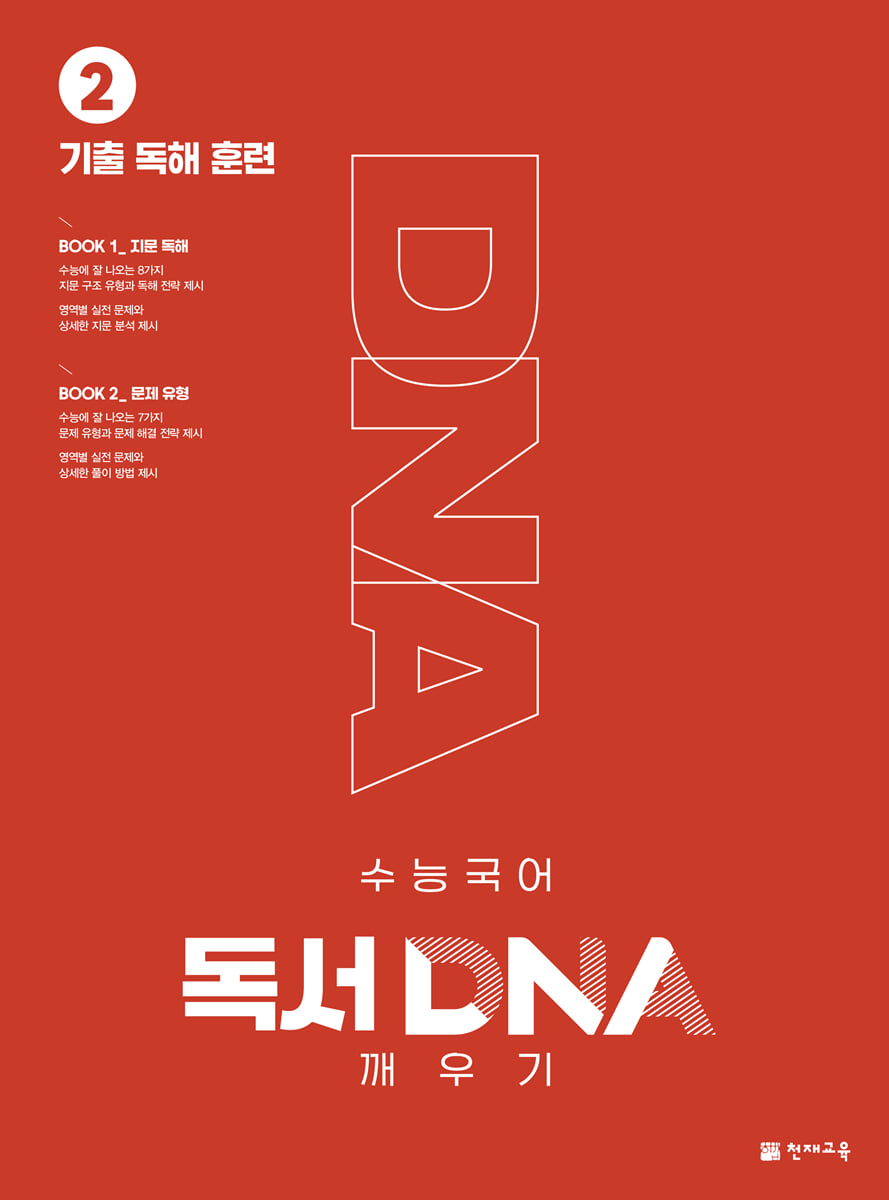
Awakening the CSAT Korean Reading DNA: Volume 2: Reading Practice
 |
Description
Book Introduction
『Awakening the CSAT Korean Reading DNA ② Past Reading Comprehension Training』 is a textbook designed to help students learn the structure and types of passages and questions in the CSAT Korean reading section, and to develop reading comprehension and problem-solving skills by solving actual problems.
It is composed of '[BOOK 1 Reading Comprehension], [BOOK 2 Problem Types]' so that you can learn step by step, and it presents a method for reading passages and a solution strategy for each problem type by analyzing the college entrance exam, mock exam, and academic ability assessment for 1st to 3rd year high school students.
And based on this, we have prepared for the actual CSAT by solving past exam questions in the humanities and arts, society and culture, science and technology, and convergence and complex fields.
It is composed of '[BOOK 1 Reading Comprehension], [BOOK 2 Problem Types]' so that you can learn step by step, and it presents a method for reading passages and a solution strategy for each problem type by analyzing the college entrance exam, mock exam, and academic ability assessment for 1st to 3rd year high school students.
And based on this, we have prepared for the actual CSAT by solving past exam questions in the humanities and arts, society and culture, science and technology, and convergence and complex fields.
- You can preview some of the book's contents.
Preview
index
[BOOK 1 Reading Comprehension]
Fingerprint Structure Types
Go over the reading for the CSAT
01 General-Special Structure
02 List structure
03 Comparison and contrast structure
04 Cause-effect structure
05 Problem-Solving Structure
06 Course Structure
07 Analysis Structure
08 Classification Structure
[Special Lecture] Exam Trends in Each Subject Area Based on Past Exam Questions
〈Practical Reading by Area〉
Ⅰ Humanities and Arts
01 [Philosophy] Epicureanism
02 [Philosophy] Thoughts on Memory and Forgetting
03 [Philosophy] Various Perspectives on Moral Conflict
04 [Psychology] Transactional Analysis Theory
05 [Sculpture] Sculpture style of the temple bell
06 [Music] Conductor's Interpretation of Music
Essential Vocabulary ZIP
Ⅱ Society and Culture
01 [Economics] Tax Efficiency and Fairness
02 [Economics] Price Elasticity of Demand
03 [Economics] Unemployment in Economics
04 [Law] Contract as a Legal Act
05 [Law] Personal Information Protection Act
06 [Law] Contents Certification System
Essential Vocabulary ZIP
Ⅲ Science and Technology
01 [Physics] Fourier's law of heat conduction
02 [Chemistry] Enzyme activity in our body
03 [Life Science] The Human Immune Response
04 [Construction] Tower Crane
05 [Information and Communication] Natural Language Processing Technology
06 [Information and Communication] OTP Technology
Essential Vocabulary ZIP
Ⅳ Convergence and Complexity
01 [Art + Technology] Art Restoration Work
02 [Society + Technology] Correlation Analysis
03 [Humanities + Humanities] (A) Aquinas's view on love (B) Kant's view on love
04 [Humanities + Arts] (a) The Development of Enlightenment (b) Expressionism
Essential Vocabulary ZIP
[BOOK 2 Problem Types]
Problem Type
Go over the reading for the CSAT
01 [Factual Understanding] Understanding the Content of the Text
02 [Factual Understanding] Understanding the Development Method
03 [Inferential Understanding] Inferring Omitted Information
04 [Inferential Understanding] Applying to Specific Cases or Situations
05 [Critical Understanding] Criticizing the Content and Viewpoint of a Text
06 [Critical Understanding] Judging the Appropriateness of a Response
07 [Vocabulary] Understanding the meaning of words
[Special Lecture] Reconstructing the Meaning of a Text by Synthesizing Its Content
〈Practical Reading by Area〉
Ⅰ Humanities and Arts
01 [Reading] The Function and Value of Reading
02 [Psychology] Emotional Labor and Emotion Regulation Strategies
03 [Philosophy of Language] Frege and Proper Names
04 [Philosophy] The Philosophical Meaning of Labor
05 [Photo] Bresson's Decisive Moment
06 [Contemporary Art] Hyperrealism
Essential Vocabulary ZIP
Ⅱ Society and Culture
01 [Economy] Financial Products and Customer Investment Tendencies
02 [Society and Culture] Collective Ritual
03 [Politics] Alliances in the International Community
04 [International Law] Methods of Resolving Disputes Between Nations
05 [Economy] Rational Choice
06 [Judicial] Judicial Contracts and Their Effects
Essential Vocabulary ZIP
Ⅲ Science and Technology
01 [Physical Chemistry] Phases and Phase Changes
02 [Life Science] Drug Action
03 [Life Science] Respiration and Circulation
04 [Semiconductor] Touchscreen Panel
05 [Information Processing] Virtual Space Experience
06 [Information Processing] Around View System
Essential Vocabulary ZIP
Ⅳ Convergence and Complexity
01 [Science + Art] Principles of Perspective Implementation
02 [Science + Humanities] Kuhn's Hypothesis of Scientific Revolutions
03 [Humanities + Humanities] Hegel's Aesthetics
04 [Society + Society] The Function and Impact of Advertising
Essential Vocabulary ZIP
[Answer and Explanation]
Fingerprint Structure Types
Go over the reading for the CSAT
01 General-Special Structure
02 List structure
03 Comparison and contrast structure
04 Cause-effect structure
05 Problem-Solving Structure
06 Course Structure
07 Analysis Structure
08 Classification Structure
[Special Lecture] Exam Trends in Each Subject Area Based on Past Exam Questions
〈Practical Reading by Area〉
Ⅰ Humanities and Arts
01 [Philosophy] Epicureanism
02 [Philosophy] Thoughts on Memory and Forgetting
03 [Philosophy] Various Perspectives on Moral Conflict
04 [Psychology] Transactional Analysis Theory
05 [Sculpture] Sculpture style of the temple bell
06 [Music] Conductor's Interpretation of Music
Essential Vocabulary ZIP
Ⅱ Society and Culture
01 [Economics] Tax Efficiency and Fairness
02 [Economics] Price Elasticity of Demand
03 [Economics] Unemployment in Economics
04 [Law] Contract as a Legal Act
05 [Law] Personal Information Protection Act
06 [Law] Contents Certification System
Essential Vocabulary ZIP
Ⅲ Science and Technology
01 [Physics] Fourier's law of heat conduction
02 [Chemistry] Enzyme activity in our body
03 [Life Science] The Human Immune Response
04 [Construction] Tower Crane
05 [Information and Communication] Natural Language Processing Technology
06 [Information and Communication] OTP Technology
Essential Vocabulary ZIP
Ⅳ Convergence and Complexity
01 [Art + Technology] Art Restoration Work
02 [Society + Technology] Correlation Analysis
03 [Humanities + Humanities] (A) Aquinas's view on love (B) Kant's view on love
04 [Humanities + Arts] (a) The Development of Enlightenment (b) Expressionism
Essential Vocabulary ZIP
[BOOK 2 Problem Types]
Problem Type
Go over the reading for the CSAT
01 [Factual Understanding] Understanding the Content of the Text
02 [Factual Understanding] Understanding the Development Method
03 [Inferential Understanding] Inferring Omitted Information
04 [Inferential Understanding] Applying to Specific Cases or Situations
05 [Critical Understanding] Criticizing the Content and Viewpoint of a Text
06 [Critical Understanding] Judging the Appropriateness of a Response
07 [Vocabulary] Understanding the meaning of words
[Special Lecture] Reconstructing the Meaning of a Text by Synthesizing Its Content
〈Practical Reading by Area〉
Ⅰ Humanities and Arts
01 [Reading] The Function and Value of Reading
02 [Psychology] Emotional Labor and Emotion Regulation Strategies
03 [Philosophy of Language] Frege and Proper Names
04 [Philosophy] The Philosophical Meaning of Labor
05 [Photo] Bresson's Decisive Moment
06 [Contemporary Art] Hyperrealism
Essential Vocabulary ZIP
Ⅱ Society and Culture
01 [Economy] Financial Products and Customer Investment Tendencies
02 [Society and Culture] Collective Ritual
03 [Politics] Alliances in the International Community
04 [International Law] Methods of Resolving Disputes Between Nations
05 [Economy] Rational Choice
06 [Judicial] Judicial Contracts and Their Effects
Essential Vocabulary ZIP
Ⅲ Science and Technology
01 [Physical Chemistry] Phases and Phase Changes
02 [Life Science] Drug Action
03 [Life Science] Respiration and Circulation
04 [Semiconductor] Touchscreen Panel
05 [Information Processing] Virtual Space Experience
06 [Information Processing] Around View System
Essential Vocabulary ZIP
Ⅳ Convergence and Complexity
01 [Science + Art] Principles of Perspective Implementation
02 [Science + Humanities] Kuhn's Hypothesis of Scientific Revolutions
03 [Humanities + Humanities] Hegel's Aesthetics
04 [Society + Society] The Function and Impact of Advertising
Essential Vocabulary ZIP
[Answer and Explanation]
Detailed image

Publisher's Review
* Textbook Features
ㆍStep-by-step structure to solidify reading comprehension skills
- Structure of '[BOOK 1 Reading Comprehension] → [BOOK 2 Problem Type]'
- Each volume consists of 'Theory + Field-Specific Practical Reading'
ㆍIncludes the latest 5-year exam questions (CSAT, mock exams, and academic achievement assessments for 1st to 3rd year high school students)
ㆍAnalyze and explain frequently appearing text structure types and question types on the CSAT
ㆍIncludes special sections on 'Fingerprint Highlights (Fingerprint Analysis/BOOK 1)' and 'Problem Highlights (Problem Solving Strategies/BOOK 2)'
ㆍDetailed and friendly explanations of correct and incorrect answers
* How to use the textbook
[BOOK 1 Reading Comprehension]
STEP 1.
Fingerprint structure types
We study the characteristics of text structures that frequently appear in the CSAT and strategies for reading texts.
STEP 2.
Field-specific practical reading
ㆍReading passages and solving problems
Apply the fingerprint structure you studied in STEP 1 to solve actual past exam questions.
① Check ‘fingerprint difficulty’ and ‘fingerprint length’
② Learn additional background knowledge related to the text in Background Knowledge+
③ Check your own problem-solving through 'self-check' and 'basis for correct answer'
ㆍFingerprint Highlights
Reread the previous exam passages and analyze their content and structure.
① Reread the previous exam passage and analyze its content and structure.
② Check the overall structure in the 'Fingerprint Structure Note' and organize the fingerprint release.
STEP 3.
Essential Vocabulary ZIP
At the end of each unit, solve simple problems to learn the meaning and usage of vocabulary used in past exam questions.
[BOOK 2 Problem Types]
STEP 1.
Problem type
Let's study the characteristics of the types of questions that appear in the Korean language reading section of the CSAT.
STEP 2.
Field-specific practical reading
ㆍReading passages and solving problems
Let's solve actual past exam questions and apply the problem-solving strategies we learned earlier.
① Check ‘fingerprint difficulty’ and ‘fingerprint length’
② Learn additional background knowledge related to the text in Background Knowledge+
③ Check your own problem-solving through 'self-check' and 'basis for correct answer'
④ Check the entire fingerprint content and structure diagram at a glance in the 'Fingerprint Structure Note'
ㆍProblem Highlights
① Apply problem-solving strategies to analyze the prophecy
② Solve the additional options that may be presented in 'Prophecy+'
STEP 3.
Essential Vocabulary ZIP
At the end of each unit, solve simple problems to learn the meaning and usage of vocabulary used in past exam questions.
ㆍStep-by-step structure to solidify reading comprehension skills
- Structure of '[BOOK 1 Reading Comprehension] → [BOOK 2 Problem Type]'
- Each volume consists of 'Theory + Field-Specific Practical Reading'
ㆍIncludes the latest 5-year exam questions (CSAT, mock exams, and academic achievement assessments for 1st to 3rd year high school students)
ㆍAnalyze and explain frequently appearing text structure types and question types on the CSAT
ㆍIncludes special sections on 'Fingerprint Highlights (Fingerprint Analysis/BOOK 1)' and 'Problem Highlights (Problem Solving Strategies/BOOK 2)'
ㆍDetailed and friendly explanations of correct and incorrect answers
* How to use the textbook
[BOOK 1 Reading Comprehension]
STEP 1.
Fingerprint structure types
We study the characteristics of text structures that frequently appear in the CSAT and strategies for reading texts.
STEP 2.
Field-specific practical reading
ㆍReading passages and solving problems
Apply the fingerprint structure you studied in STEP 1 to solve actual past exam questions.
① Check ‘fingerprint difficulty’ and ‘fingerprint length’
② Learn additional background knowledge related to the text in Background Knowledge+
③ Check your own problem-solving through 'self-check' and 'basis for correct answer'
ㆍFingerprint Highlights
Reread the previous exam passages and analyze their content and structure.
① Reread the previous exam passage and analyze its content and structure.
② Check the overall structure in the 'Fingerprint Structure Note' and organize the fingerprint release.
STEP 3.
Essential Vocabulary ZIP
At the end of each unit, solve simple problems to learn the meaning and usage of vocabulary used in past exam questions.
[BOOK 2 Problem Types]
STEP 1.
Problem type
Let's study the characteristics of the types of questions that appear in the Korean language reading section of the CSAT.
STEP 2.
Field-specific practical reading
ㆍReading passages and solving problems
Let's solve actual past exam questions and apply the problem-solving strategies we learned earlier.
① Check ‘fingerprint difficulty’ and ‘fingerprint length’
② Learn additional background knowledge related to the text in Background Knowledge+
③ Check your own problem-solving through 'self-check' and 'basis for correct answer'
④ Check the entire fingerprint content and structure diagram at a glance in the 'Fingerprint Structure Note'
ㆍProblem Highlights
① Apply problem-solving strategies to analyze the prophecy
② Solve the additional options that may be presented in 'Prophecy+'
STEP 3.
Essential Vocabulary ZIP
At the end of each unit, solve simple problems to learn the meaning and usage of vocabulary used in past exam questions.
GOODS SPECIFICS
- Publication date: November 28, 2022
- Page count, weight, size: 352 pages | 918g | 221*297*30mm
- ISBN13: 9791125972204
- ISBN10: 1125972203
- Reference book for use in: 1st year of high school
- Reference book difficulty: Medium Reference book difficulty guide
You may also like
카테고리
korean


korean

![GQ KOREA Mark (Monthly): December [2025]](http://librairie.coreenne.fr/cdn/shop/files/8ef265dbbfbf186523ed75ba7319009d.jpg?v=1765340328&width=3840)


