

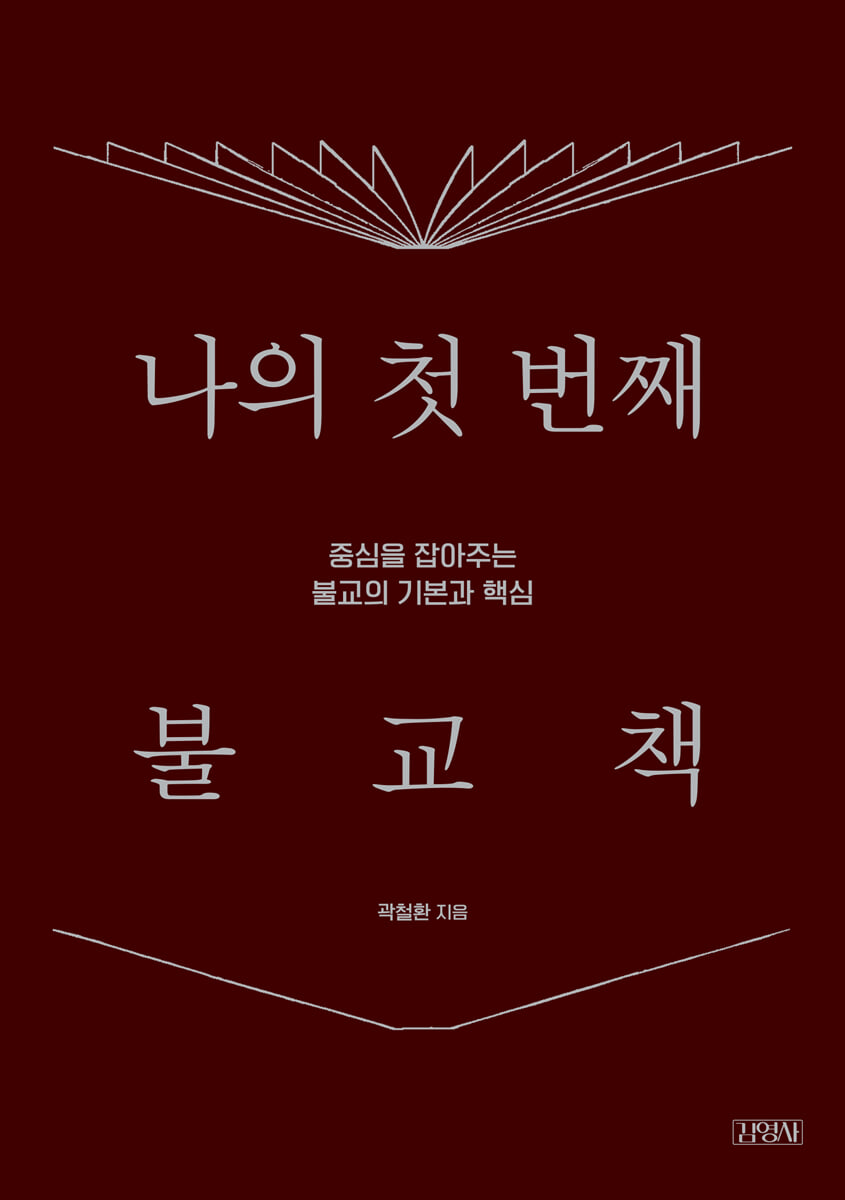
My first Buddhist book
 |
Description
Book Introduction
If it's difficult and complicated, it's not Buddhism.
Get to the core and find your center!
“Can’t we simply and clearly understand the core of the 2,600-year-old Buddhist doctrine?” Kwak Cheol-hwan, author of “All About Buddhism,” “This is the Core of Buddhism,” and “Encyclopedia of Time and Space Buddhism,” has clearly organized the key doctrinal trends and conceptual points of 2,600 years of Buddhism to convey this one core of “Buddha’s Teachings.”
All dry and difficult theoretical explanations were eliminated, and only the scriptures that are absolutely necessary and accurate for understanding the doctrine were cited, so that only the core of complex doctrines were described in an easy and accurate manner.
This is a proper introduction to Buddhism that provides a central point of study for beginners who are new to Buddhism, as well as for Buddhists who are tired of various commentaries and scriptures, and penetrates the core of Buddhist doctrine.
Get to the core and find your center!
“Can’t we simply and clearly understand the core of the 2,600-year-old Buddhist doctrine?” Kwak Cheol-hwan, author of “All About Buddhism,” “This is the Core of Buddhism,” and “Encyclopedia of Time and Space Buddhism,” has clearly organized the key doctrinal trends and conceptual points of 2,600 years of Buddhism to convey this one core of “Buddha’s Teachings.”
All dry and difficult theoretical explanations were eliminated, and only the scriptures that are absolutely necessary and accurate for understanding the doctrine were cited, so that only the core of complex doctrines were described in an easy and accurate manner.
This is a proper introduction to Buddhism that provides a central point of study for beginners who are new to Buddhism, as well as for Buddhists who are tired of various commentaries and scriptures, and penetrates the core of Buddhist doctrine.
- You can preview some of the book's contents.
Preview
index
Header _ 4
Chapter 1: Early Buddhism _ 13
1.
Gautama Buddha _ 19
1) Leaving home _ 19
2) Asceticism, Practice, and Enlightenment _ 21
2.
Teachings and Practice - From Suffering to Nirvana _ 25
1) Four Noble Truths _ 25
(1) Go Seong-je _ 36
(2) Glue-type adhesive _ 40
(3) Extinction agent _ 45
(4) Doseongje _ 46
2) 12 places _ 53
3) 5 on _ 56
4) 12 Links of Linked Catechism _ 62
5) Impermanence, Suffering, and Anatta _ 66
6) Nirvana _ 70
7) The Path of Practice - Into the 37 Bodhi-Divisions _ 77
(1) 4 Jeonggeun _ 78
(2) 4-legged _ 80
(3) 5th root _ 80
(4) 4th place _ 81
(5) 7 angles _ 86
8) Samatha and Vipatsana _ 88
9) 3rd grade _ 92
10) 4 Infinite Minds _ 94
11) Precepts _ 97
(1) 5 Commandments _ 98
(2) 10 Commandments _ 98
(3) Gujokgye _ 99
3.
The Death of Buddha _ 101
Chapter 2: Sectarian Buddhism _ 107
1.
The Meaning of Law _ 110
2.
A Detailed Analysis of the Five Ons _ 113
1) Color Law - Discrimination _ 115
2) Heart Law - Mind _ 116
3) The Law of the Mind - The Breaking of the Mind _ 116
4) The Law of Non-Corresponding Minds - Beings Not with the Mind _ 118
5) The Law of Non-action _ 119
3.
3rd generation real estate _ 120
4.
The Path to Arahatship _ 122
1) Jiando _ 122
2) Capital _ 122
3) Uneducated _ 124
Chapter 3: Mahayana Buddhism _ 127
1.
Core Ideas of Mahayana Buddhism _ 129
1) Bodhisattva _ 129
2) Six Paramitas _ 131
(1) The Perfection of Giving _ 131
(2) The Perfection of Precepts _ 132
(3) The Perfection of Patience _ 132
(4) The Perfection of Diligence _ 134
(5) Selection Paramita _ 134
(6) Prajna Paramita _ 134
3) Ball _ 135
2.
The Trends and Branches of Mahayana Buddhism _ 139
1) Middle official _ 139
2) Yusik _ 150
3) Tathagatagarbha _ 160
4) Avatamsaka Sutra _ 166
5) Pure Land _ 180
6) The Lotus Sutra _ 186
7) Cheontae _ 190
8) Esoteric Buddhism _ 194
Chapter 4: Line _ 201
1.
Dharma and Hyega _ 203
2.
Seungchan, Dosin, and Hongin _ 205
3.
Shinsoo and Hyeneng _ 213
4.
Majo and Seokdu worlds _ 220
1) Majo and his disciples _ 220
(1) Majo Doyle _ 220
(2) Daeju Hyehae _ 225
(3) The Great Sale Act _ 230
(4) Hwangbyeok Huiun _ 232
(5) Imje Uihyeon _ 234
(6) Angsan Hyejeok _ 236
2) Seokdu and his disciples _ 238
(1) Seokdu Heecheon _ 238
(2) Yaksan Yueom _ 243
(3) Dongsan Yanggae _ 244
(4) Dependence on Seolbong _ 247
(5) Poetry text _ 251
Genealogy of the Majo and Seokdu clans _ 254
5.
The Ganhwa Line and the Silent Line _ 256
1) Simplified line _ 256
2) Silent Ship _ 262
Genealogy of the Ganhwaseon and the Silent Joseon _ 264
Search _ 265
Chapter 1: Early Buddhism _ 13
1.
Gautama Buddha _ 19
1) Leaving home _ 19
2) Asceticism, Practice, and Enlightenment _ 21
2.
Teachings and Practice - From Suffering to Nirvana _ 25
1) Four Noble Truths _ 25
(1) Go Seong-je _ 36
(2) Glue-type adhesive _ 40
(3) Extinction agent _ 45
(4) Doseongje _ 46
2) 12 places _ 53
3) 5 on _ 56
4) 12 Links of Linked Catechism _ 62
5) Impermanence, Suffering, and Anatta _ 66
6) Nirvana _ 70
7) The Path of Practice - Into the 37 Bodhi-Divisions _ 77
(1) 4 Jeonggeun _ 78
(2) 4-legged _ 80
(3) 5th root _ 80
(4) 4th place _ 81
(5) 7 angles _ 86
8) Samatha and Vipatsana _ 88
9) 3rd grade _ 92
10) 4 Infinite Minds _ 94
11) Precepts _ 97
(1) 5 Commandments _ 98
(2) 10 Commandments _ 98
(3) Gujokgye _ 99
3.
The Death of Buddha _ 101
Chapter 2: Sectarian Buddhism _ 107
1.
The Meaning of Law _ 110
2.
A Detailed Analysis of the Five Ons _ 113
1) Color Law - Discrimination _ 115
2) Heart Law - Mind _ 116
3) The Law of the Mind - The Breaking of the Mind _ 116
4) The Law of Non-Corresponding Minds - Beings Not with the Mind _ 118
5) The Law of Non-action _ 119
3.
3rd generation real estate _ 120
4.
The Path to Arahatship _ 122
1) Jiando _ 122
2) Capital _ 122
3) Uneducated _ 124
Chapter 3: Mahayana Buddhism _ 127
1.
Core Ideas of Mahayana Buddhism _ 129
1) Bodhisattva _ 129
2) Six Paramitas _ 131
(1) The Perfection of Giving _ 131
(2) The Perfection of Precepts _ 132
(3) The Perfection of Patience _ 132
(4) The Perfection of Diligence _ 134
(5) Selection Paramita _ 134
(6) Prajna Paramita _ 134
3) Ball _ 135
2.
The Trends and Branches of Mahayana Buddhism _ 139
1) Middle official _ 139
2) Yusik _ 150
3) Tathagatagarbha _ 160
4) Avatamsaka Sutra _ 166
5) Pure Land _ 180
6) The Lotus Sutra _ 186
7) Cheontae _ 190
8) Esoteric Buddhism _ 194
Chapter 4: Line _ 201
1.
Dharma and Hyega _ 203
2.
Seungchan, Dosin, and Hongin _ 205
3.
Shinsoo and Hyeneng _ 213
4.
Majo and Seokdu worlds _ 220
1) Majo and his disciples _ 220
(1) Majo Doyle _ 220
(2) Daeju Hyehae _ 225
(3) The Great Sale Act _ 230
(4) Hwangbyeok Huiun _ 232
(5) Imje Uihyeon _ 234
(6) Angsan Hyejeok _ 236
2) Seokdu and his disciples _ 238
(1) Seokdu Heecheon _ 238
(2) Yaksan Yueom _ 243
(3) Dongsan Yanggae _ 244
(4) Dependence on Seolbong _ 247
(5) Poetry text _ 251
Genealogy of the Majo and Seokdu clans _ 254
5.
The Ganhwa Line and the Silent Line _ 256
1) Simplified line _ 256
2) Silent Ship _ 262
Genealogy of the Ganhwaseon and the Silent Joseon _ 264
Search _ 265
Into the book
The basic framework of Buddhism is to move from suffering to the cessation of suffering, from discrimination to non-discrimination, and from mental instability to stability.
The entire development from Chapter 1 to Chapter 4 of this book is a learning process to discipline and purify the mind and achieve stability.
--- p.4, from the “Introduction”
The body is 'here and now', but 'thoughts' leave here and go somewhere, creating all kinds of discrimination.
Even though our thoughts seem to go to many places, they only go to two places: the past and the future.
Going to the past creates regret and resentment, and going to the future creates anxiety and worry.
If your thoughts wander to the past and future, immediately notice them and practice consistently focusing on the 'now'. This will gradually lead to stability.
In the ‘now’ where the beginning and end are disconnected, there is no room for delusion to enter.
--- p.5, from the “Introduction”
Therefore, the Nikayas and Agamas are a mixture of teachings that were directly preached by Gautama Buddha and those that were not.
This is an inevitable consequence of the history of Buddhism that compiled the sutras.
Therefore, when studying early Buddhism, we must understand and approach the core teachings of the Nikayas and Agamas.
Chapter 1 of this book Early Buddhism (2.
The contents of the teachings and practices are a brief explanation of the main points of the teachings that are repeatedly expounded in the Nikayas and Agamas.
--- p.18, from “Chapter 1 Early Buddhism”
Siddhartha clearly understood the truths of suffering, the truth of the cause of suffering, and the truth of the cessation of suffering, and repeatedly practiced and attained the truth of the path, and realized the 'wisdom of the complete cessation of all defilements' and became Buddha.
This wisdom is called 'Nujinmyeong'.
As the Buddha said, “Bhikkhus, as in the past, so now I teach only suffering and the cessation of suffering” (Samyutta Nikaya 22:86, Anuradha), Buddhism begins with suffering and ends with the cessation of suffering, that is, nirvana.
Since the Four Noble Truths are the only path from suffering to nirvana, these Four Noble Truths are the beginning and the end of early Buddhism.
Therefore, it is said, “Just as all the footprints of animals are included in the footprints of elephants, all teachings are included in the Four Noble Truths” (Madhyamakagamma Sutra, Volume 7, “Symbolic Sutra on the Traces of Images”).
--- p.26, 「Chapter 1 Early Buddhism, 2.
From “Teachings and Practice”
Therefore, the six senses are actions that need to be extinguished, but the six senses are not actions that need to be extinguished.
The extinction of the six senses, that is, the extinction of the function of perception, is wood, stone, or death.
In the twelve links of dependent origination, it is said that ‘when name and form cease, the six senses cease, and when the six senses cease, contact ceases’, which means that the function of the six senses that discriminate ceases, not that the function of perception ceases.
What arises from the ignorance of the twelve links of dependent origination are the six senses, not the six sense organs.
An Arahant is a saint who has not extinguished the six senses, but has extinguished the six sense bases.
--- p.54~55, 「Chapter 1 Early Buddhism, 2.
From “Teachings and Practice”
Without this insight, Abhidharma is meaningless.
Because Abhidharma is not an exploration of external objects, but an internal observation that breaks down one's own consciousness into its constituent elements, and constantly notices the arising and passing away of those elements at this very moment, thereby penetrating into their impermanence, suffering, and non-self, thereby eliminating greed, anger, and foolishness.
--- p.112, 「Chapter 2 Sectarian Buddhism, 1.
From “The Meaning of Law”
The most important phrase in this sutra is 'Jo-gyeon-five-skandhas-gong-il-gae ...
'Seeing through the emptiness of the five aggregates' means seeing through the state of the five aggregates, which successively give rise to all kinds of greed, discrimination, and attachment, to be cut off, and reaching non-discrimination.
In other words, the function of the five aggregates has been extinguished and the state of emptiness without discrimination has been reached. This is similar to the state of Zen Buddhism, where one sees through and sees the Buddha nature that one originally possesses.
--- p.137, 「Chapter 3 Mahayana Buddhism, 1.
From “The Core Ideas of Mahayana Buddhism”
This dichotomy of distinction and opposition arises from language.
But this is not a defect of language, it is the nature of language.
Language itself is dichotomous.
This is because the function of language is to distinguish between objects or concepts and to name each object.
However, since humans think in language, dichotomy is also a characteristic of thought.
All existence has no boundaries to begin with, but we divide it through thought and name it with language to distinguish it.
Therefore, all concepts that we perceive as distinct through language and thought are merely boundaries of fiction.
Yongsu argues that since 'existence' itself cannot be expressed in language, all fictional concepts must be denied and repudiated.
〈Jungsong〉 is not a verse that advocates a theory with a certain system, but rather a verse that repeatedly negates negations in order to break down the two-part distinction and fixed ideas.
If you assert something positively rather than negatively, the assertion itself (because it is expressed in language) can be subject to criticism due to the fictitious nature of language.
--- p.140~141, 「Chapter 3 Mahayana Buddhism, 2.
From “The Flow and Branches of Mahayana Buddhism”
The essence of Vijñāṇaṇa is often said to be 'the absence of consciousness and the absence of boundaries.'
That is, 'there is only a mental activity and no object.'
However, we must not deny the object of the five senses, that is, the object that exists outside now.
Then the perception function does not work.
Any perceptual process requires three elements:
One is the sense organs, two are real external objects, and three are the perceptual function of organizing and interpreting the signals received from the sense organs.
Therefore, if the object itself is denied, the perception process does not occur.
Then it is inanimate.
The object [realm] that is denied in 'no realm' is a fictional object created by imagination and an object that the five previous consciousnesses have distinguished as 'good/bad' under the influence of the manas-vijnana and alaya-vijnana.
These distinctions are not objectively real, but are all fictions created by the mind.
--- p.156~157, 「Chapter 3 Mahayana Buddhism, 2.
From “The Flow and Branches of Mahayana Buddhism”
Likewise, the saying, ‘Everything is created solely by the mind’ means that all things, including illusions, imagination, and the discrimination of the five senses, are all created by the mind, not that the objects of the five senses themselves are created by the mind.
Mountains and seas, trees and grass, flowers and butterflies, etc. are not created by the mind.
However, each person who sees them has different thoughts and feelings, and those thoughts and feelings are created by the mind.
--- p.157, 「Chapter 3 Mahayana Buddhism, 2.
From “The Flow and Branches of Mahayana Buddhism”
Mindlessness does not mean that there are no thoughts, but that one does not leave thoughts and is not attached to or bound by them.
So, it is said, 'I am in my thoughts but I am not thinking.'
This absence of thought is the perfection of wisdom, that is, Prajna Paramita.
This wisdom is ‘the wisdom of non-attachment’ and ‘the wisdom of non-discrimination.’
Even if you think about something and see, hear, feel, or know something, you are not bound by it and are always free, and you are not dragged around by the binary concepts of existence and non-existence, pleasure and suffering, birth and death, love and hate, happiness and unhappiness, etc. This is no-thought.
--- p.216, Chapter 4, Line 3.
From “Shinsu and Hyeneng”
The phrase "One should not be bound by anything and give birth to one's mind" from the Diamond Sutra is often quoted and comes from Huineng's sermons.
So, ever since Bodhidharma transmitted the 《Nengga Sutra》 to Hye-ga, this sutra has been passed down as the fundamental sutra of Seon Buddhism, and after Hye-neng, the 《Diamond Sutra》 became the fundamental sutra.
Hye-neng said that Zen is when one's pure nature is always at ease, when one's mind is stirred and moved within an object, and when one's mind is always upright, whether walking, staying, sitting, or lying down.
Hye-neng's method of goodness is sudden enlightenment and seeing one's own pure nature in an instant.
--- p.217, 「Chapter 4, Line, 3.
From “Shinsu and Hyeneng”
Just as the word mango is a tool for pointing to a mango, not the mango itself, so the word enlightenment is a tool for pointing to enlightenment, not enlightenment itself.
Words and names are merely thoughts given to an object or state, not the object or state itself, so all talk about enlightenment can only be expedient.
So, to those who seek Buddha outside, he warns, "The mind is Buddha," and to those who are obsessed with it, he warns, "It is neither mind nor Buddha," and to those who do not need to talk about mind and Buddha, he says, "It is nothing."
To climb up to the roof, you need a ladder, and to cross the stream, you need to step on stepping stones. However, Mazu was worried that if he was fixated on the ladder and stepping stones and was thinking about how to use them, he would fall off the ladder and fall into the stream.
The entire development from Chapter 1 to Chapter 4 of this book is a learning process to discipline and purify the mind and achieve stability.
--- p.4, from the “Introduction”
The body is 'here and now', but 'thoughts' leave here and go somewhere, creating all kinds of discrimination.
Even though our thoughts seem to go to many places, they only go to two places: the past and the future.
Going to the past creates regret and resentment, and going to the future creates anxiety and worry.
If your thoughts wander to the past and future, immediately notice them and practice consistently focusing on the 'now'. This will gradually lead to stability.
In the ‘now’ where the beginning and end are disconnected, there is no room for delusion to enter.
--- p.5, from the “Introduction”
Therefore, the Nikayas and Agamas are a mixture of teachings that were directly preached by Gautama Buddha and those that were not.
This is an inevitable consequence of the history of Buddhism that compiled the sutras.
Therefore, when studying early Buddhism, we must understand and approach the core teachings of the Nikayas and Agamas.
Chapter 1 of this book Early Buddhism (2.
The contents of the teachings and practices are a brief explanation of the main points of the teachings that are repeatedly expounded in the Nikayas and Agamas.
--- p.18, from “Chapter 1 Early Buddhism”
Siddhartha clearly understood the truths of suffering, the truth of the cause of suffering, and the truth of the cessation of suffering, and repeatedly practiced and attained the truth of the path, and realized the 'wisdom of the complete cessation of all defilements' and became Buddha.
This wisdom is called 'Nujinmyeong'.
As the Buddha said, “Bhikkhus, as in the past, so now I teach only suffering and the cessation of suffering” (Samyutta Nikaya 22:86, Anuradha), Buddhism begins with suffering and ends with the cessation of suffering, that is, nirvana.
Since the Four Noble Truths are the only path from suffering to nirvana, these Four Noble Truths are the beginning and the end of early Buddhism.
Therefore, it is said, “Just as all the footprints of animals are included in the footprints of elephants, all teachings are included in the Four Noble Truths” (Madhyamakagamma Sutra, Volume 7, “Symbolic Sutra on the Traces of Images”).
--- p.26, 「Chapter 1 Early Buddhism, 2.
From “Teachings and Practice”
Therefore, the six senses are actions that need to be extinguished, but the six senses are not actions that need to be extinguished.
The extinction of the six senses, that is, the extinction of the function of perception, is wood, stone, or death.
In the twelve links of dependent origination, it is said that ‘when name and form cease, the six senses cease, and when the six senses cease, contact ceases’, which means that the function of the six senses that discriminate ceases, not that the function of perception ceases.
What arises from the ignorance of the twelve links of dependent origination are the six senses, not the six sense organs.
An Arahant is a saint who has not extinguished the six senses, but has extinguished the six sense bases.
--- p.54~55, 「Chapter 1 Early Buddhism, 2.
From “Teachings and Practice”
Without this insight, Abhidharma is meaningless.
Because Abhidharma is not an exploration of external objects, but an internal observation that breaks down one's own consciousness into its constituent elements, and constantly notices the arising and passing away of those elements at this very moment, thereby penetrating into their impermanence, suffering, and non-self, thereby eliminating greed, anger, and foolishness.
--- p.112, 「Chapter 2 Sectarian Buddhism, 1.
From “The Meaning of Law”
The most important phrase in this sutra is 'Jo-gyeon-five-skandhas-gong-il-gae ...
'Seeing through the emptiness of the five aggregates' means seeing through the state of the five aggregates, which successively give rise to all kinds of greed, discrimination, and attachment, to be cut off, and reaching non-discrimination.
In other words, the function of the five aggregates has been extinguished and the state of emptiness without discrimination has been reached. This is similar to the state of Zen Buddhism, where one sees through and sees the Buddha nature that one originally possesses.
--- p.137, 「Chapter 3 Mahayana Buddhism, 1.
From “The Core Ideas of Mahayana Buddhism”
This dichotomy of distinction and opposition arises from language.
But this is not a defect of language, it is the nature of language.
Language itself is dichotomous.
This is because the function of language is to distinguish between objects or concepts and to name each object.
However, since humans think in language, dichotomy is also a characteristic of thought.
All existence has no boundaries to begin with, but we divide it through thought and name it with language to distinguish it.
Therefore, all concepts that we perceive as distinct through language and thought are merely boundaries of fiction.
Yongsu argues that since 'existence' itself cannot be expressed in language, all fictional concepts must be denied and repudiated.
〈Jungsong〉 is not a verse that advocates a theory with a certain system, but rather a verse that repeatedly negates negations in order to break down the two-part distinction and fixed ideas.
If you assert something positively rather than negatively, the assertion itself (because it is expressed in language) can be subject to criticism due to the fictitious nature of language.
--- p.140~141, 「Chapter 3 Mahayana Buddhism, 2.
From “The Flow and Branches of Mahayana Buddhism”
The essence of Vijñāṇaṇa is often said to be 'the absence of consciousness and the absence of boundaries.'
That is, 'there is only a mental activity and no object.'
However, we must not deny the object of the five senses, that is, the object that exists outside now.
Then the perception function does not work.
Any perceptual process requires three elements:
One is the sense organs, two are real external objects, and three are the perceptual function of organizing and interpreting the signals received from the sense organs.
Therefore, if the object itself is denied, the perception process does not occur.
Then it is inanimate.
The object [realm] that is denied in 'no realm' is a fictional object created by imagination and an object that the five previous consciousnesses have distinguished as 'good/bad' under the influence of the manas-vijnana and alaya-vijnana.
These distinctions are not objectively real, but are all fictions created by the mind.
--- p.156~157, 「Chapter 3 Mahayana Buddhism, 2.
From “The Flow and Branches of Mahayana Buddhism”
Likewise, the saying, ‘Everything is created solely by the mind’ means that all things, including illusions, imagination, and the discrimination of the five senses, are all created by the mind, not that the objects of the five senses themselves are created by the mind.
Mountains and seas, trees and grass, flowers and butterflies, etc. are not created by the mind.
However, each person who sees them has different thoughts and feelings, and those thoughts and feelings are created by the mind.
--- p.157, 「Chapter 3 Mahayana Buddhism, 2.
From “The Flow and Branches of Mahayana Buddhism”
Mindlessness does not mean that there are no thoughts, but that one does not leave thoughts and is not attached to or bound by them.
So, it is said, 'I am in my thoughts but I am not thinking.'
This absence of thought is the perfection of wisdom, that is, Prajna Paramita.
This wisdom is ‘the wisdom of non-attachment’ and ‘the wisdom of non-discrimination.’
Even if you think about something and see, hear, feel, or know something, you are not bound by it and are always free, and you are not dragged around by the binary concepts of existence and non-existence, pleasure and suffering, birth and death, love and hate, happiness and unhappiness, etc. This is no-thought.
--- p.216, Chapter 4, Line 3.
From “Shinsu and Hyeneng”
The phrase "One should not be bound by anything and give birth to one's mind" from the Diamond Sutra is often quoted and comes from Huineng's sermons.
So, ever since Bodhidharma transmitted the 《Nengga Sutra》 to Hye-ga, this sutra has been passed down as the fundamental sutra of Seon Buddhism, and after Hye-neng, the 《Diamond Sutra》 became the fundamental sutra.
Hye-neng said that Zen is when one's pure nature is always at ease, when one's mind is stirred and moved within an object, and when one's mind is always upright, whether walking, staying, sitting, or lying down.
Hye-neng's method of goodness is sudden enlightenment and seeing one's own pure nature in an instant.
--- p.217, 「Chapter 4, Line, 3.
From “Shinsu and Hyeneng”
Just as the word mango is a tool for pointing to a mango, not the mango itself, so the word enlightenment is a tool for pointing to enlightenment, not enlightenment itself.
Words and names are merely thoughts given to an object or state, not the object or state itself, so all talk about enlightenment can only be expedient.
So, to those who seek Buddha outside, he warns, "The mind is Buddha," and to those who are obsessed with it, he warns, "It is neither mind nor Buddha," and to those who do not need to talk about mind and Buddha, he says, "It is nothing."
To climb up to the roof, you need a ladder, and to cross the stream, you need to step on stepping stones. However, Mazu was worried that if he was fixated on the ladder and stepping stones and was thinking about how to use them, he would fall off the ladder and fall into the stream.
--- p.224~225, 「Chapter 4, Line, 4.
Among the "Majo world and the Seokdu world"
Among the "Majo world and the Seokdu world"
Publisher's Review
Early Buddhism, sectarian Buddhism, Mahayana Buddhism, and Zen Buddhism
A clear introduction that summarizes only the core of the vast doctrine.
Throughout its 2,600-year history, Buddhism has taken on different forms in each era, including early Buddhism, sectarian Buddhism, Mahayana Buddhism, and Zen Buddhism, each developing its own unique ideology.
This is explained at length and in detail in various introductory and introductory books.
Even after reading the explanation over and over again, it still seems like 'studying Buddhism is difficult.' Moreover, the terms used only in Buddhism are difficult to understand even when looking at the Chinese characters, and even when looking up the meaning of the original Pali or Sanskrit words, the meaning is not clearly understood.
I cannot help but ask, ‘Is Buddhism something that has to be difficult and complicated?’
Author Kwak Cheol-hwan, who has introduced the Buddha's teachings to the public for nearly 30 years by writing several Buddhist guidebooks, including "All About Buddhism," "This is the Core of Buddhism," and "Encyclopedia of Time and Space Buddhism," wrote "My First Buddhist Book" to answer these questions.
The author answers that studying Buddhism is easy if you “understand and approach the core of the teachings”—that is, if you know the core that holds the center of your studies.
This book clearly and concisely outlines the main doctrinal characteristics of each religion from early Buddhism to Zen Buddhism, making it easy for anyone to understand.
Among the 84,000 vast sutras
Which scriptures and passages should I know clearly?
Buddhism, which began in India, spread north and south, and its sutras, Vinaya, and treatises were translated into the languages of each region.
In our country, the three chapters of the Sutra of the Vinaya Sutra translated into Chinese characters have been handed down traditionally, but in modern times, translations of the Pali and Sanskrit versions have also become available.
By comparing the Chinese translation of the Agamas with the Pali Nikayas and comparing passages from the Chinese translation of the Mahayana sutras with the Sanskrit sutras, we can explore various Buddhist ideas more closely.
While this is welcome news for scholars pursuing academic research, it also presents the added challenge of having to discern which passages of which scriptures are more appropriate for study for the general public.
The author, who has been working on the Korean translation of Buddhist scriptures at Dongguk University for over 10 years, and has since studied both Pali and Sanskrit versions of the scriptures, has written several Buddhist guidebooks, including the "Dictionary of Time and Space Buddhism," for nearly 30 years, and has selected the scripture passages most appropriate for each doctrine.
As a result of such efforts, this book, "My First Buddhist Book," accurately cites the most representative passages related to the main concepts of Buddhist doctrine, from the Nikayas and Agamas to various treatises and Zen sayings, making it easy to grasp the essence of doctrine and thought.
For beginners and long-time students alike
A book full of insights that will help you focus your studies.
“What is the core of Buddhism, or the ‘teachings of the Buddha’?” “What does the Middle Way mean?” “What was Nagarjuna Bodhisattva trying to say in the Middle Discourse?” “What is the true meaning of ‘All is created by the mind’?” “What is the difference between silent meditation and calm meditation?” “If all beings have Buddha-nature, why do Zen masters say ‘nothingness’?” If you cannot confidently answer these questions about Buddhist doctrines from people around you in one word, I recommend this book, ‘My First Buddhist Book.’
It is a good introductory book to Buddhism for those just beginning their studies, but it also contains concepts and insights that will help those who, despite studying for a long time, cannot say that they have a firm grasp of the complex doctrines and ideas.
Although the Buddha's teachings from 2,600 years ago have appeared in many different forms, the author says, "the basic framework of Buddhism is to move from suffering to the cessation of suffering, from discrimination to non-discrimination, and from mental instability to stability."
If you can grasp the “core of the teachings,” you will be able to grasp the center of your study of Buddhism, no matter which scripture or treatise you read.
A clear introduction that summarizes only the core of the vast doctrine.
Throughout its 2,600-year history, Buddhism has taken on different forms in each era, including early Buddhism, sectarian Buddhism, Mahayana Buddhism, and Zen Buddhism, each developing its own unique ideology.
This is explained at length and in detail in various introductory and introductory books.
Even after reading the explanation over and over again, it still seems like 'studying Buddhism is difficult.' Moreover, the terms used only in Buddhism are difficult to understand even when looking at the Chinese characters, and even when looking up the meaning of the original Pali or Sanskrit words, the meaning is not clearly understood.
I cannot help but ask, ‘Is Buddhism something that has to be difficult and complicated?’
Author Kwak Cheol-hwan, who has introduced the Buddha's teachings to the public for nearly 30 years by writing several Buddhist guidebooks, including "All About Buddhism," "This is the Core of Buddhism," and "Encyclopedia of Time and Space Buddhism," wrote "My First Buddhist Book" to answer these questions.
The author answers that studying Buddhism is easy if you “understand and approach the core of the teachings”—that is, if you know the core that holds the center of your studies.
This book clearly and concisely outlines the main doctrinal characteristics of each religion from early Buddhism to Zen Buddhism, making it easy for anyone to understand.
Among the 84,000 vast sutras
Which scriptures and passages should I know clearly?
Buddhism, which began in India, spread north and south, and its sutras, Vinaya, and treatises were translated into the languages of each region.
In our country, the three chapters of the Sutra of the Vinaya Sutra translated into Chinese characters have been handed down traditionally, but in modern times, translations of the Pali and Sanskrit versions have also become available.
By comparing the Chinese translation of the Agamas with the Pali Nikayas and comparing passages from the Chinese translation of the Mahayana sutras with the Sanskrit sutras, we can explore various Buddhist ideas more closely.
While this is welcome news for scholars pursuing academic research, it also presents the added challenge of having to discern which passages of which scriptures are more appropriate for study for the general public.
The author, who has been working on the Korean translation of Buddhist scriptures at Dongguk University for over 10 years, and has since studied both Pali and Sanskrit versions of the scriptures, has written several Buddhist guidebooks, including the "Dictionary of Time and Space Buddhism," for nearly 30 years, and has selected the scripture passages most appropriate for each doctrine.
As a result of such efforts, this book, "My First Buddhist Book," accurately cites the most representative passages related to the main concepts of Buddhist doctrine, from the Nikayas and Agamas to various treatises and Zen sayings, making it easy to grasp the essence of doctrine and thought.
For beginners and long-time students alike
A book full of insights that will help you focus your studies.
“What is the core of Buddhism, or the ‘teachings of the Buddha’?” “What does the Middle Way mean?” “What was Nagarjuna Bodhisattva trying to say in the Middle Discourse?” “What is the true meaning of ‘All is created by the mind’?” “What is the difference between silent meditation and calm meditation?” “If all beings have Buddha-nature, why do Zen masters say ‘nothingness’?” If you cannot confidently answer these questions about Buddhist doctrines from people around you in one word, I recommend this book, ‘My First Buddhist Book.’
It is a good introductory book to Buddhism for those just beginning their studies, but it also contains concepts and insights that will help those who, despite studying for a long time, cannot say that they have a firm grasp of the complex doctrines and ideas.
Although the Buddha's teachings from 2,600 years ago have appeared in many different forms, the author says, "the basic framework of Buddhism is to move from suffering to the cessation of suffering, from discrimination to non-discrimination, and from mental instability to stability."
If you can grasp the “core of the teachings,” you will be able to grasp the center of your study of Buddhism, no matter which scripture or treatise you read.
GOODS SPECIFICS
- Date of issue: December 6, 2023
- Page count, weight, size: 276 pages | 376g | 148*210*13mm
- ISBN13: 9788934981008
- ISBN10: 8934981008
You may also like
카테고리
korean


korean

![ELLE 엘르 스페셜 에디션 A형 : 12월 [2025]](http://librairie.coreenne.fr/cdn/shop/files/b8e27a3de6c9538896439686c6b0e8fb.jpg?v=1766436872&width=3840)


