

AI and Designer Collaboration (Large Print Book)
 |
Description
Book Introduction
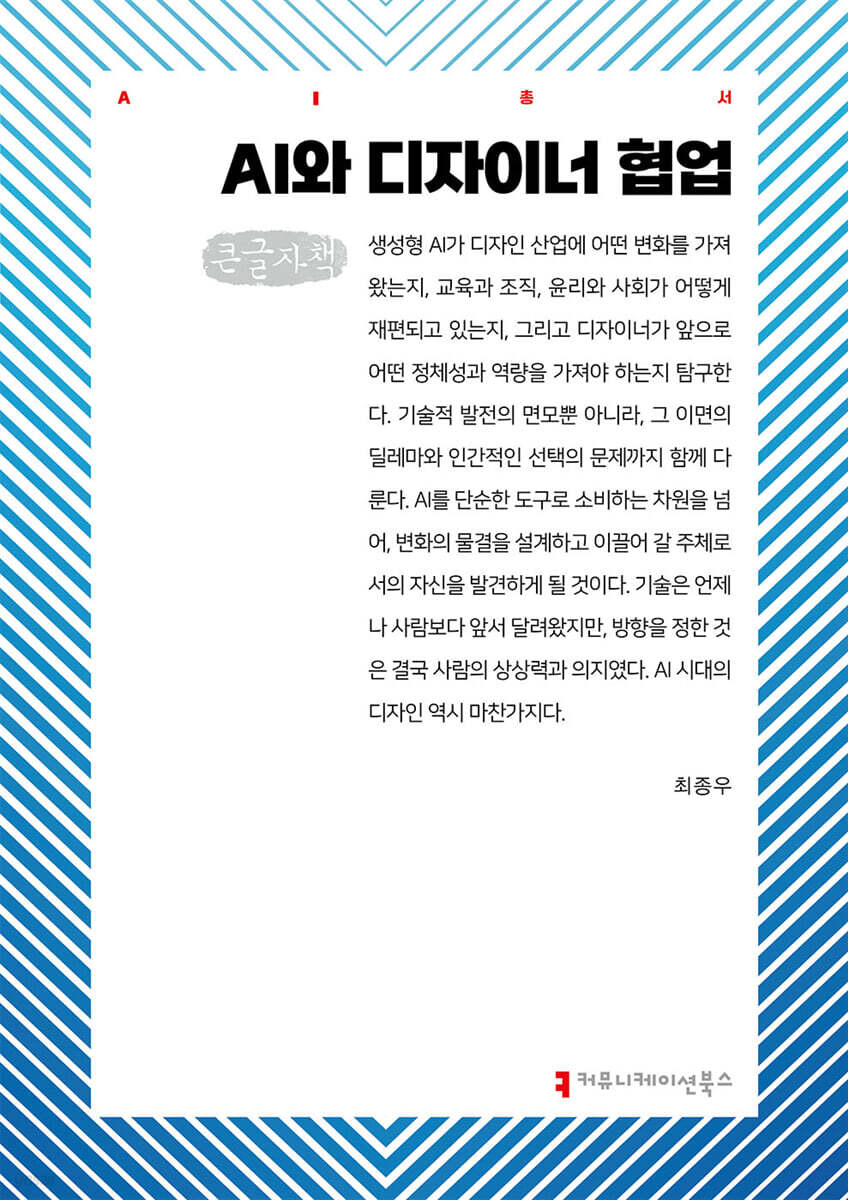
Explains how generative AI is transforming the practice of design and why designers must evolve into interpreters and facilitators.
It presents a new collaborative paradigm that connects technological speed with human contextual judgment, redefining the role of designers in leading creative work in the AI era. AI Series.
You can find the artificial intelligence knowledge you need at aiseries.oopy.io.
It presents a new collaborative paradigm that connects technological speed with human contextual judgment, redefining the role of designers in leading creative work in the AI era. AI Series.
You can find the artificial intelligence knowledge you need at aiseries.oopy.io.
- You can preview some of the book's contents.
Preview
Into the book
AI's calculations are fast, but humans are faster at weaving the results into meaning.
Designers find inspiration in the subtle imbalances and accidental distortions that algorithms miss.
Even when a result appears perfectly smooth, the human eye detects slight imperfections in it and gives it life.
At this time, sensory intuition becomes a compass that distinguishes which direction among the countless possibilities created by AI is reaching the human world.
Ultimately, the collaboration between generative AI and designers is not a division of labor for efficiency, but a coexistence that takes place at the intersection of senses.
Creation is completed when machines integrate data to create logic and humans attach emotions to that logic.
--- From “01_“Generative AI as a Collaborative Tool””
Designers in the AI era are no longer mere creators; they are evolving into strategic leaders who define problems, engage with technology, and infuse context and value into their outcomes.
Designers leverage the speed and efficiency of AI, but combine it with the empathy, ethical judgment, and cultural meaning that only humans can provide to complete their final creations.
This new leadership model will become a core competency that will change the paradigm of the future design industry.
--- From “03_“The Expanded Role of Designers””
The ethical issues surrounding collaboration with AI extend beyond the realm of simple legal compliance and connect to the fundamental nature of creative activity.
The moment a designer ponders 'what to make,' he or she must simultaneously decide 'what not to make.'
This balance is not a discipline, but a process of reasoning.
Ethical thinking does not slow down the pace of creation, but rather refines its direction.
In deciding which images to select and which data to include in training, designers are already acting as social interpreters.
--- From “06_“Ethics and Responsibility of Collaboration””
Ultimately, future designers must position themselves not simply as tool technicians, but as creative designers and social interpreters who balance creativity, technology, ethics, and sustainability. AI is merely a tool for change, but the direction in which that change is steered remains a matter of human choice and responsibility.
The new mission of future designers is to first design a future in which technology and humanity are in harmony.
But preparing for the future isn't simply a matter of mastering new technologies. In an era where collaboration with AI becomes routine, designers are increasingly forced to redesign their thinking.
Technological advancement offers endless speed, but that speed always requires direction.
It is human thought, not code, that sets the direction.
Designers find inspiration in the subtle imbalances and accidental distortions that algorithms miss.
Even when a result appears perfectly smooth, the human eye detects slight imperfections in it and gives it life.
At this time, sensory intuition becomes a compass that distinguishes which direction among the countless possibilities created by AI is reaching the human world.
Ultimately, the collaboration between generative AI and designers is not a division of labor for efficiency, but a coexistence that takes place at the intersection of senses.
Creation is completed when machines integrate data to create logic and humans attach emotions to that logic.
--- From “01_“Generative AI as a Collaborative Tool””
Designers in the AI era are no longer mere creators; they are evolving into strategic leaders who define problems, engage with technology, and infuse context and value into their outcomes.
Designers leverage the speed and efficiency of AI, but combine it with the empathy, ethical judgment, and cultural meaning that only humans can provide to complete their final creations.
This new leadership model will become a core competency that will change the paradigm of the future design industry.
--- From “03_“The Expanded Role of Designers””
The ethical issues surrounding collaboration with AI extend beyond the realm of simple legal compliance and connect to the fundamental nature of creative activity.
The moment a designer ponders 'what to make,' he or she must simultaneously decide 'what not to make.'
This balance is not a discipline, but a process of reasoning.
Ethical thinking does not slow down the pace of creation, but rather refines its direction.
In deciding which images to select and which data to include in training, designers are already acting as social interpreters.
--- From “06_“Ethics and Responsibility of Collaboration””
Ultimately, future designers must position themselves not simply as tool technicians, but as creative designers and social interpreters who balance creativity, technology, ethics, and sustainability. AI is merely a tool for change, but the direction in which that change is steered remains a matter of human choice and responsibility.
The new mission of future designers is to first design a future in which technology and humanity are in harmony.
But preparing for the future isn't simply a matter of mastering new technologies. In an era where collaboration with AI becomes routine, designers are increasingly forced to redesign their thinking.
Technological advancement offers endless speed, but that speed always requires direction.
It is human thought, not code, that sets the direction.
--- From “09_“Designers Preparing for the Future””
Publisher's Review
The moment when the essence of design is rewritten: A new way for AI and humans to collaborate.
The emergence of generative AI has brought the design industry to a completely new turning point. AI is no longer a mere assistant tool; it has become a co-creator, intervening in the entire design process, from ideation to visualization, prototyping, and usability testing.
This book deeply analyzes how AI is redefining the very act of design, and what new roles and capabilities designers must acquire within this transformation.
Designers must now evolve from being artisans who create forms to strategic interpreters who read context, design meaning, and balance technology and human values. More important than the dozens of images generated by AI is the human judgment that interprets the meaning of the resulting images and provides direction.
It covers a wide range of topics, from the nonlinearity of processes brought about by generative AI, to changes in team structure, the importance of prompt design skills, and even ethical responsibilities and copyright issues, and suggests how designers should lead in future collaborative environments.
Through real-world examples from industries such as fashion, architecture, gaming, and interfaces, it vividly demonstrates how collaboration with AI is transforming the very essence of design.
Ultimately, this is not a book about learning tools, but a guide that presents new standards and sensibilities that designers who will lead creation in the AI era must possess.
The emergence of generative AI has brought the design industry to a completely new turning point. AI is no longer a mere assistant tool; it has become a co-creator, intervening in the entire design process, from ideation to visualization, prototyping, and usability testing.
This book deeply analyzes how AI is redefining the very act of design, and what new roles and capabilities designers must acquire within this transformation.
Designers must now evolve from being artisans who create forms to strategic interpreters who read context, design meaning, and balance technology and human values. More important than the dozens of images generated by AI is the human judgment that interprets the meaning of the resulting images and provides direction.
It covers a wide range of topics, from the nonlinearity of processes brought about by generative AI, to changes in team structure, the importance of prompt design skills, and even ethical responsibilities and copyright issues, and suggests how designers should lead in future collaborative environments.
Through real-world examples from industries such as fashion, architecture, gaming, and interfaces, it vividly demonstrates how collaboration with AI is transforming the very essence of design.
Ultimately, this is not a book about learning tools, but a guide that presents new standards and sensibilities that designers who will lead creation in the AI era must possess.
GOODS SPECIFICS
- Date of issue: November 25, 2025
- Page count, weight, size: 103 pages | 210*290*7mm
- ISBN13: 9791143012685
You may also like
카테고리
korean


korean

![GQ KOREA Mark (Monthly): December [2025]](http://librairie.coreenne.fr/cdn/shop/files/8ef265dbbfbf186523ed75ba7319009d.jpg?v=1765340328&width=3840)


