

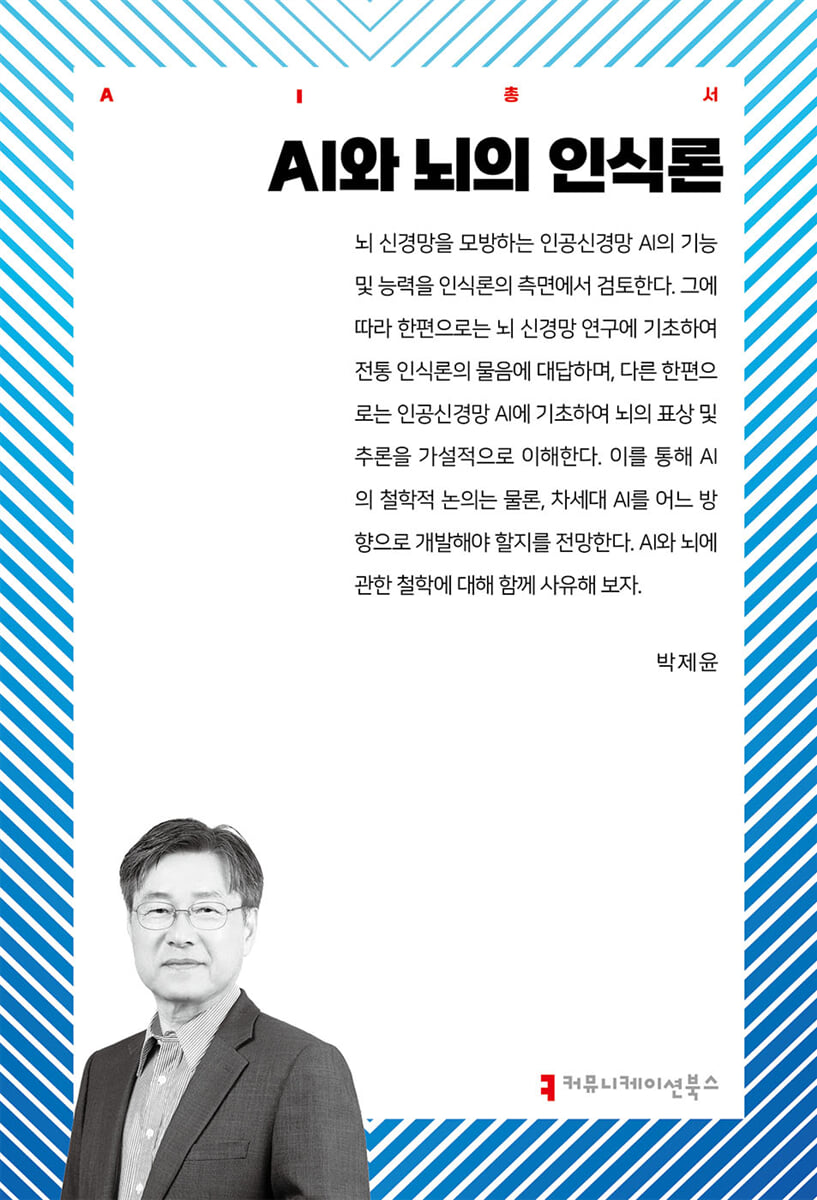
AI and the Epistemology of the Brain
 |
Description
Book Introduction
It explores the structure of knowledge and consciousness, encompassing artificial intelligence, brain science, and philosophy.
Reinterpreting the thought processes of humans and AI from a neurocognitive perspective, this book redefines the nature of intelligence. AI Series.
You can find the artificial intelligence knowledge you need at aiseries.oopy.io.
Reinterpreting the thought processes of humans and AI from a neurocognitive perspective, this book redefines the nature of intelligence. AI Series.
You can find the artificial intelligence knowledge you need at aiseries.oopy.io.
- You can preview some of the book's contents.
Preview
index
Science Research and Philosophy, AI Research and Philosophy
01 The Father of AI
02 Language Computational Logic
03 Brain computational processing
04 Parallel Processing and Learning
05 Brain Knowledge
06 Representation and Reduction
07 Creativity of the Brain and AI
08 Consciousness of the Brain and AI
09 Language of the Brain and AI
10 Next-Generation AI
01 The Father of AI
02 Language Computational Logic
03 Brain computational processing
04 Parallel Processing and Learning
05 Brain Knowledge
06 Representation and Reduction
07 Creativity of the Brain and AI
08 Consciousness of the Brain and AI
09 Language of the Brain and AI
10 Next-Generation AI
Into the book
Turing's model of a computer considers arithmetic calculations as the simplest human intellectual activity, but he envisions that in the future it will be able to perform all human intellectual activities.
So his ultimate question was, of course, this:
What is "intelligence"? Can machines think? What does it mean to think? He answered these questions in his 1950 paper, "Computing Machinery and Intelligence."
He published this paper in the philosophy journal, Mind.
He was a philosopher.
--- From "01_“Father of AI”"
According to von Neumann, a digital computer operates according to a sequence of instructions in a program.
To do so, the instruction must contain complex details such as where to retrieve the information stored, how to perform the operation, and where to send the result to memory for storage or output.
To perform such complex functions, a digital computer must be composed of complex devices, all of which must have special connection rules and limitations.
--- From “03_“Brain’s Computational Processing””
Long-held intuitive beliefs may turn out to be wrong.
I think now is the perfect time.
In relation to the recent existence of AI, the debate over whether AI will “be conscious” also needs to be viewed with this skeptical eye.
From a traditional perspective, scholars who speak of or are concerned about category errors draw boundaries in their research.
Such an attitude makes you and your colleagues hesitate to move forward.
The Churchlands' new reductionism allows AI researchers to get down to business.
(The discussion regarding the risks of AI is a separate topic.)
--- From “06_“Representation and Reduction””
Some cognitive scientists and philosophers say that in the evolutionary sequence, 'language' could have come first, and then 'thought' could have emerged.
According to them, we think through language.
In other words, thinking is linguistic.
Thinking in language leads us to assume that thinking itself is impossible without language.
From this perspective, studying the evolutionary origins of language seems important and highly valuable.
Because it is believed that this was the point at which mankind achieved high knowledge and wisdom.
So his ultimate question was, of course, this:
What is "intelligence"? Can machines think? What does it mean to think? He answered these questions in his 1950 paper, "Computing Machinery and Intelligence."
He published this paper in the philosophy journal, Mind.
He was a philosopher.
--- From "01_“Father of AI”"
According to von Neumann, a digital computer operates according to a sequence of instructions in a program.
To do so, the instruction must contain complex details such as where to retrieve the information stored, how to perform the operation, and where to send the result to memory for storage or output.
To perform such complex functions, a digital computer must be composed of complex devices, all of which must have special connection rules and limitations.
--- From “03_“Brain’s Computational Processing””
Long-held intuitive beliefs may turn out to be wrong.
I think now is the perfect time.
In relation to the recent existence of AI, the debate over whether AI will “be conscious” also needs to be viewed with this skeptical eye.
From a traditional perspective, scholars who speak of or are concerned about category errors draw boundaries in their research.
Such an attitude makes you and your colleagues hesitate to move forward.
The Churchlands' new reductionism allows AI researchers to get down to business.
(The discussion regarding the risks of AI is a separate topic.)
--- From “06_“Representation and Reduction””
Some cognitive scientists and philosophers say that in the evolutionary sequence, 'language' could have come first, and then 'thought' could have emerged.
According to them, we think through language.
In other words, thinking is linguistic.
Thinking in language leads us to assume that thinking itself is impossible without language.
From this perspective, studying the evolutionary origins of language seems important and highly valuable.
Because it is believed that this was the point at which mankind achieved high knowledge and wisdom.
--- From "09_“The Language of the Brain and AI”"
Publisher's Review
Neural exploration of knowledge and cognition
This is an exploratory book that organically connects artificial intelligence, brain research, and philosophical epistemology.
The author illuminates the close connections between science and philosophy, AI and epistemology, leading readers to the fundamental question, "What is knowledge?"
By comparing the neural network structure of deep learning to the parallel processing of the human brain and analyzing it from the perspective of neurocognition, we elucidate 'how machines can think.'
Following the intellectual lineage from Turing to von Neumann and Hinton, it comprehensively addresses issues such as computational logic, parallel learning, creativity, consciousness, and language.
In particular, it interprets consciousness as a recursive computational process and presents the view that critical thinking and doubt are the sources of creativity.
Extending philosophy's traditional epistemology to neuroscience and AI research, this book provides scientists with a framework for philosophical reflection and philosophers with a guide to empirical thinking.
Ultimately, this book, which questions the nature of intelligence and knowledge, is an attempt to redraw the boundary between 'thinking machines' and 'thinking humans.'
This is an exploratory book that organically connects artificial intelligence, brain research, and philosophical epistemology.
The author illuminates the close connections between science and philosophy, AI and epistemology, leading readers to the fundamental question, "What is knowledge?"
By comparing the neural network structure of deep learning to the parallel processing of the human brain and analyzing it from the perspective of neurocognition, we elucidate 'how machines can think.'
Following the intellectual lineage from Turing to von Neumann and Hinton, it comprehensively addresses issues such as computational logic, parallel learning, creativity, consciousness, and language.
In particular, it interprets consciousness as a recursive computational process and presents the view that critical thinking and doubt are the sources of creativity.
Extending philosophy's traditional epistemology to neuroscience and AI research, this book provides scientists with a framework for philosophical reflection and philosophers with a guide to empirical thinking.
Ultimately, this book, which questions the nature of intelligence and knowledge, is an attempt to redraw the boundary between 'thinking machines' and 'thinking humans.'
GOODS SPECIFICS
- Date of issue: November 17, 2025
- Page count, weight, size: 133 pages | 128*188*7mm
- ISBN13: 9791143014481
You may also like
카테고리
korean


korean

![GQ KOREA Mark (Monthly): December [2025]](http://librairie.coreenne.fr/cdn/shop/files/8ef265dbbfbf186523ed75ba7319009d.jpg?v=1765340328&width=3840)


