

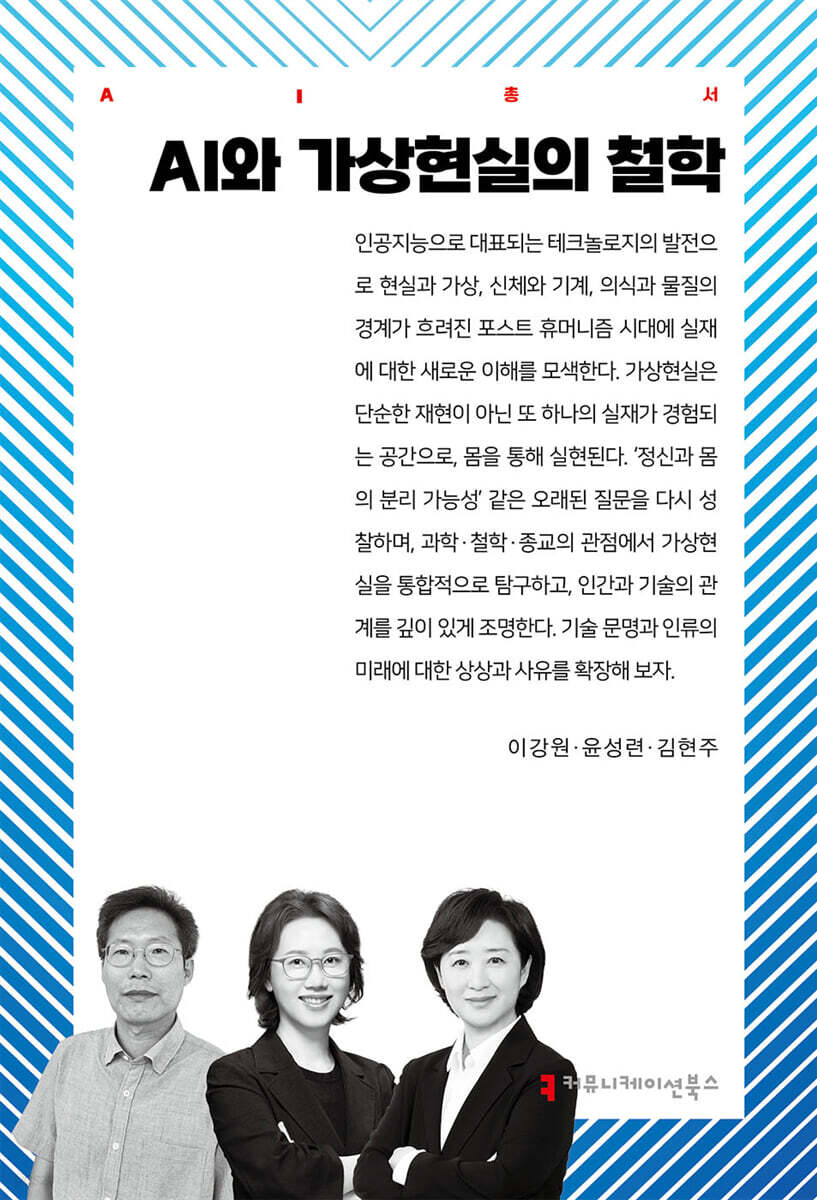
The Philosophy of AI and Virtual Reality
 |
Description
Book Introduction
In an age where the boundaries between reality and the virtual are blurring, we are asked again about the meaning of human existence.
At the intersection of science, philosophy, and theology, the virtual emerges as another reality, not fiction, redefining the relationship between humans and machines. AI Series.
You can find the artificial intelligence knowledge you need at aiseries.oopy.io.
At the intersection of science, philosophy, and theology, the virtual emerges as another reality, not fiction, redefining the relationship between humans and machines. AI Series.
You can find the artificial intelligence knowledge you need at aiseries.oopy.io.
- You can preview some of the book's contents.
Preview
index
Virtual Reality and the Future Ahead
01 The Reality of Virtual Reality
02 Virtual Walton Fictionalism: Material-Discursive Causality
03 The Reality of Agent Realism
04 Ethical Implications of Virtual Reality
05 Etymology and meaning of virtual
06 Space and Body in the Virtual World
07 Mutual Incarnation and Virtual Body
08 Altered Carbon and the Virtual Future
09 Mental Upload and Eternal Life Project
10 Old, But Still Valid Debates: What Is Human?
01 The Reality of Virtual Reality
02 Virtual Walton Fictionalism: Material-Discursive Causality
03 The Reality of Agent Realism
04 Ethical Implications of Virtual Reality
05 Etymology and meaning of virtual
06 Space and Body in the Virtual World
07 Mutual Incarnation and Virtual Body
08 Altered Carbon and the Virtual Future
09 Mental Upload and Eternal Life Project
10 Old, But Still Valid Debates: What Is Human?
Into the book
This contradiction, that experiences in virtual reality can be real on the one hand and fictional on the other, is the result of the dichotomous opposition between digital simulation and the human psychological and conscious dimension.
This dichotomous understanding, which sees digital simulation and the human psychological dimension as separate, fails to properly grasp the immersive experiences we experience through virtual reality and the resulting changes in our identity and their causality.
If we understand virtual reality as being created through the mutually constitutive interaction between digital simulation and our perception and consciousness, the causality of virtual reality and, furthermore, the reality of experience can be explained more persuasively.
--- From “01_“The Problem of Virtual Reality’s Reality””
Actor-realism, based on the quantum phenomenon of quantum entanglement, understands reality not as the interaction between independent entities, but as a phenomenon created through internal interaction before individuation or objectification, that is, before the distinction between subject and object occurs. By doing so, it emphasizes that things previously understood as dichotomies, such as subject-object, matter-spirit, and matter-meaning, are internally mutually constitutive and inseparably interconnected.
Barad's onto-epistemological agent realism, based on quantum entanglement, seeks to overcome the limitations of the modern Cartesian dualism of observer and observed, mind and matter, subject and object, human and non-human, etc.
--- From “03_“The Reality of Agent Realism””
One of the important concepts in virtual reality is immersion, which allows users to focus on the virtual world and block out the real world.
But what maximizes this immersion is interactivity.
This is because the virtual world becomes more realistic depending on how much the images appearing in the virtual space interact with the user.
And if these interactions lead to reality, the sensations and feelings embodied in the body will also lead to reality, and compatibility between the virtual world and the real world will occur.
I, the subject, become a place where the virtual and real worlds are compatible.
--- From “06_“Space and Body in the Virtual World””
But in the matter of eternal life, a more fundamental question than technology is: what is 'I' or 'the self'?
Perhaps philosophical and anthropological questions that transcend the level of technical questions, such as whether the data downloaded and preserved from the brain are identical to me, and whether the information from the brain combined with a machine can be defined as human, should take priority.
This dichotomous understanding, which sees digital simulation and the human psychological dimension as separate, fails to properly grasp the immersive experiences we experience through virtual reality and the resulting changes in our identity and their causality.
If we understand virtual reality as being created through the mutually constitutive interaction between digital simulation and our perception and consciousness, the causality of virtual reality and, furthermore, the reality of experience can be explained more persuasively.
--- From “01_“The Problem of Virtual Reality’s Reality””
Actor-realism, based on the quantum phenomenon of quantum entanglement, understands reality not as the interaction between independent entities, but as a phenomenon created through internal interaction before individuation or objectification, that is, before the distinction between subject and object occurs. By doing so, it emphasizes that things previously understood as dichotomies, such as subject-object, matter-spirit, and matter-meaning, are internally mutually constitutive and inseparably interconnected.
Barad's onto-epistemological agent realism, based on quantum entanglement, seeks to overcome the limitations of the modern Cartesian dualism of observer and observed, mind and matter, subject and object, human and non-human, etc.
--- From “03_“The Reality of Agent Realism””
One of the important concepts in virtual reality is immersion, which allows users to focus on the virtual world and block out the real world.
But what maximizes this immersion is interactivity.
This is because the virtual world becomes more realistic depending on how much the images appearing in the virtual space interact with the user.
And if these interactions lead to reality, the sensations and feelings embodied in the body will also lead to reality, and compatibility between the virtual world and the real world will occur.
I, the subject, become a place where the virtual and real worlds are compatible.
--- From “06_“Space and Body in the Virtual World””
But in the matter of eternal life, a more fundamental question than technology is: what is 'I' or 'the self'?
Perhaps philosophical and anthropological questions that transcend the level of technical questions, such as whether the data downloaded and preserved from the brain are identical to me, and whether the information from the brain combined with a machine can be defined as human, should take priority.
--- From "09_“Mental Upload and Eternal Life Project”"
Publisher's Review
In the AI era, virtuality is the new reality.
We explore the new world of reality created by artificial intelligence and technology through the three axes of science, philosophy, and theology.
In an era where the boundaries between reality and the virtual are disappearing, and human bodies and machines, consciousness and matter are intertwined, it poses the fundamental question, "Is the virtual a fiction, or another reality?"
Part 1 elucidates the principles of causality and immersion in virtual reality based on quantum mechanics and agent realism, and presents new conditions for reality in which humans and machines co-construct reality.
Part 2 explores how bodily experiences in virtual space reconstruct human existence through the phenomenology of the body, and Part 3 revisits the relationship between mind and body, human identity, and eternal life from a theological perspective.
By crossing science fiction imagination and philosophical thought, such as in Ghost in the Shell, X, and Ex Machina, it traces to the end what it means to be a 'human' in the age of technological civilization.
We explore the new world of reality created by artificial intelligence and technology through the three axes of science, philosophy, and theology.
In an era where the boundaries between reality and the virtual are disappearing, and human bodies and machines, consciousness and matter are intertwined, it poses the fundamental question, "Is the virtual a fiction, or another reality?"
Part 1 elucidates the principles of causality and immersion in virtual reality based on quantum mechanics and agent realism, and presents new conditions for reality in which humans and machines co-construct reality.
Part 2 explores how bodily experiences in virtual space reconstruct human existence through the phenomenology of the body, and Part 3 revisits the relationship between mind and body, human identity, and eternal life from a theological perspective.
By crossing science fiction imagination and philosophical thought, such as in Ghost in the Shell, X, and Ex Machina, it traces to the end what it means to be a 'human' in the age of technological civilization.
GOODS SPECIFICS
- Date of issue: November 13, 2025
- Page count, weight, size: 134 pages | 128*188*7mm
- ISBN13: 9791143013897
You may also like
카테고리
korean


korean

![GQ KOREA Mark (Monthly): December [2025]](http://librairie.coreenne.fr/cdn/shop/files/8ef265dbbfbf186523ed75ba7319009d.jpg?v=1765340328&width=3840)


