

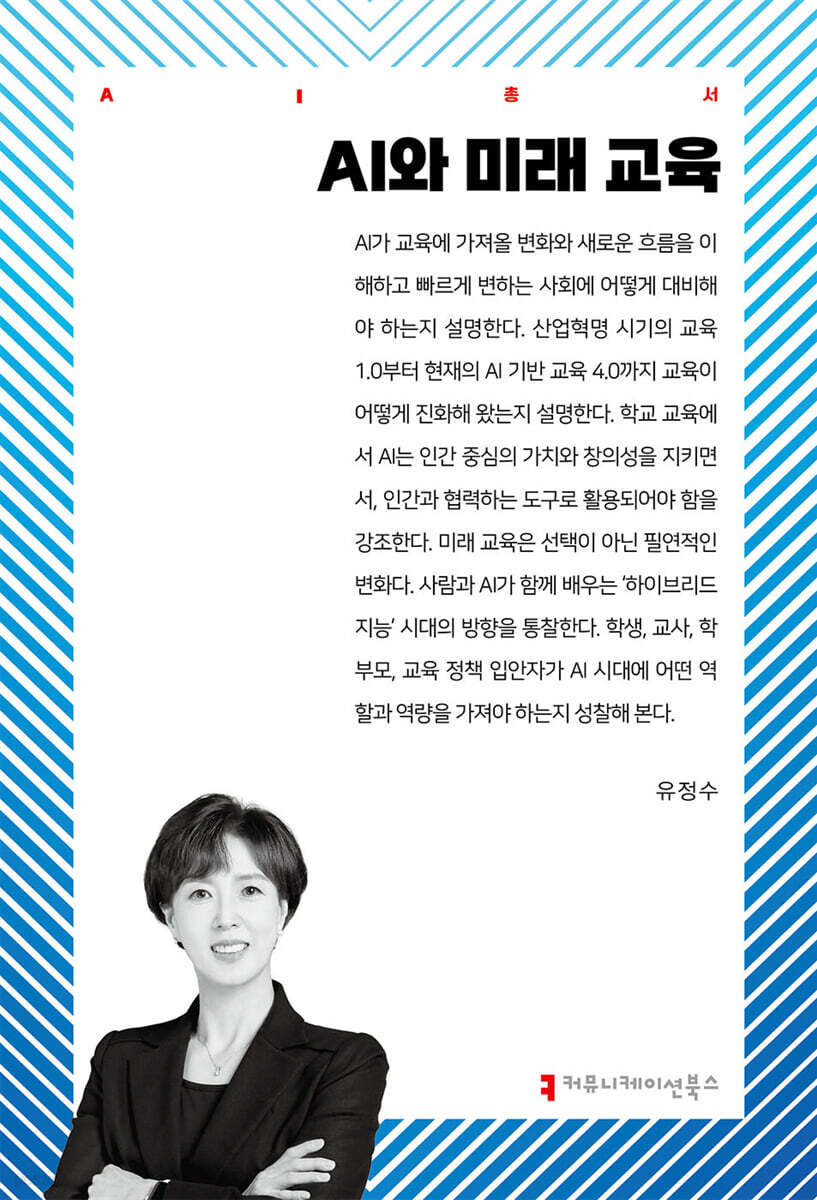
AI and the Future of Education
 |
Description
Book Introduction
This book presents a direction for education that goes beyond industrial efficiency and pursues human growth and harmony. It views AI not as a learning aid but as a partner that fosters inner growth, and envisions an era of personalized learning and autonomous exploration through intelligent textbooks and AI tutors. AI Encyclopedia.
You can find the artificial intelligence knowledge you need at aiseries.oopy.io.
You can find the artificial intelligence knowledge you need at aiseries.oopy.io.
- You can preview some of the book's contents.
Preview
index
The Evolution of Education Through AI
01 The Face of Education 4.0
02 Digital Platform-Based Education
03 Getting to Know AI with AI
04 Change in thinking style
05 Understanding Personalized Learning for Students
06 Combining AI and human teaching
07 AI is part of the curriculum
08 Activating the Digital Ecosystem in Education
09 AI Governance for Education
10 Future-Oriented Education Policy Directions
01 The Face of Education 4.0
02 Digital Platform-Based Education
03 Getting to Know AI with AI
04 Change in thinking style
05 Understanding Personalized Learning for Students
06 Combining AI and human teaching
07 AI is part of the curriculum
08 Activating the Digital Ecosystem in Education
09 AI Governance for Education
10 Future-Oriented Education Policy Directions
Into the book
Education 4.0 essentially includes features and principles to provide a learner-centered, lifelong, competency-based, interdisciplinary, inclusive, innovative, comprehensive and holistic learning approach to provide a versatile learning experience.
And we use new technologies and teaching methods to improve and transform the learning process.
These include e-learning, gamification, and AI.
Through these technologies, Education 4.0 is ushering in a new era in which humanist ideas are integrated into the digital world.
--- From “01_“The Face of Education 4.0””
We need to have the knowledge to correct AI-generated mistakes, improve solutions, and integrate AI-generated code into consistent, high-quality products.
Generative AI reinforces the need for information education rather than diminishing its value.
Understanding how and why code works is crucial to responsibly leveraging powerful AI tools.
We need to properly learn how AI works, how to use AI tools, etc.
That's because it's one of the most powerful skills you can develop yourself.
--- From “03_“Getting to Know AI with AI””
To leverage AI as a teaching improvement tool, teachers must always be at the center.
Putting teachers at the center and using AI as a tool for improving teaching means prioritizing a humanistic perspective on teaching.
This means that AI will not replace teachers.
This isn't just about making teachers' jobs easier; it's about enabling most teachers to do what they want to do.
For example, this includes giving you more time to creatively respond to moments when you can understand and teach your students more deeply.
--- From “06_“Combining AI and Human Teacher Teaching””
AI-powered education governance breaks down traditional boundaries of time and space, bringing unprecedented uncertainty and challenges to governance.
However, these uncertainties have led to the digitalization and comprehensive integration of educational governance elements, shifting from a supply-oriented to a demand-oriented approach. The introduction of AI technology contributes to the optimization of educational service processes, improving efficiency and quality, and realizing a shift from standardization to personalization, providing more convenient, efficient, and personalized learning support.
And we use new technologies and teaching methods to improve and transform the learning process.
These include e-learning, gamification, and AI.
Through these technologies, Education 4.0 is ushering in a new era in which humanist ideas are integrated into the digital world.
--- From “01_“The Face of Education 4.0””
We need to have the knowledge to correct AI-generated mistakes, improve solutions, and integrate AI-generated code into consistent, high-quality products.
Generative AI reinforces the need for information education rather than diminishing its value.
Understanding how and why code works is crucial to responsibly leveraging powerful AI tools.
We need to properly learn how AI works, how to use AI tools, etc.
That's because it's one of the most powerful skills you can develop yourself.
--- From “03_“Getting to Know AI with AI””
To leverage AI as a teaching improvement tool, teachers must always be at the center.
Putting teachers at the center and using AI as a tool for improving teaching means prioritizing a humanistic perspective on teaching.
This means that AI will not replace teachers.
This isn't just about making teachers' jobs easier; it's about enabling most teachers to do what they want to do.
For example, this includes giving you more time to creatively respond to moments when you can understand and teach your students more deeply.
--- From “06_“Combining AI and Human Teacher Teaching””
AI-powered education governance breaks down traditional boundaries of time and space, bringing unprecedented uncertainty and challenges to governance.
However, these uncertainties have led to the digitalization and comprehensive integration of educational governance elements, shifting from a supply-oriented to a demand-oriented approach. The introduction of AI technology contributes to the optimization of educational service processes, improving efficiency and quality, and realizing a shift from standardization to personalization, providing more convenient, efficient, and personalized learning support.
--- From “09_“AI Governance for Education””
Publisher's Review
AI Reinvents Education
In the age of artificial intelligence, we consider how education should return from 'industry' to 'agriculture'.
Drawing on Ye Shaojun's "Education as Agriculture" and John Dewey's "Education as Growth," the author proposes a new learning ecosystem that respects students' inner growth. AI is positioned not as a tool for efficiency, but as a "growth companion" that understands learners' potential and emotions. The emergence of AI tutors and intelligent textbooks simultaneously achieves the dual goals of personalized learning, accessibility, and the restoration of human-centered education.
This book outlines a blueprint for future education, focusing on a shift from push-based knowledge delivery to pull-based, self-directed learning, student-centered instruction, collaborative learning, and innovative assessment. It argues that even in an AI-driven era, the essence of education is growth, and technology must serve as a fertile ground for that growth.
Ultimately, collaboration between AI and humans goes beyond simple learning efficiency; it's a journey that redefines what it means for humans to "learn."
In the age of artificial intelligence, we consider how education should return from 'industry' to 'agriculture'.
Drawing on Ye Shaojun's "Education as Agriculture" and John Dewey's "Education as Growth," the author proposes a new learning ecosystem that respects students' inner growth. AI is positioned not as a tool for efficiency, but as a "growth companion" that understands learners' potential and emotions. The emergence of AI tutors and intelligent textbooks simultaneously achieves the dual goals of personalized learning, accessibility, and the restoration of human-centered education.
This book outlines a blueprint for future education, focusing on a shift from push-based knowledge delivery to pull-based, self-directed learning, student-centered instruction, collaborative learning, and innovative assessment. It argues that even in an AI-driven era, the essence of education is growth, and technology must serve as a fertile ground for that growth.
Ultimately, collaboration between AI and humans goes beyond simple learning efficiency; it's a journey that redefines what it means for humans to "learn."
GOODS SPECIFICS
- Date of issue: November 14, 2025
- Page count, weight, size: 125 pages | 128*188*7mm
- ISBN13: 9791143012340
You may also like
카테고리
korean


korean

![GQ KOREA Mark (Monthly): December [2025]](http://librairie.coreenne.fr/cdn/shop/files/8ef265dbbfbf186523ed75ba7319009d.jpg?v=1765340328&width=3840)


