

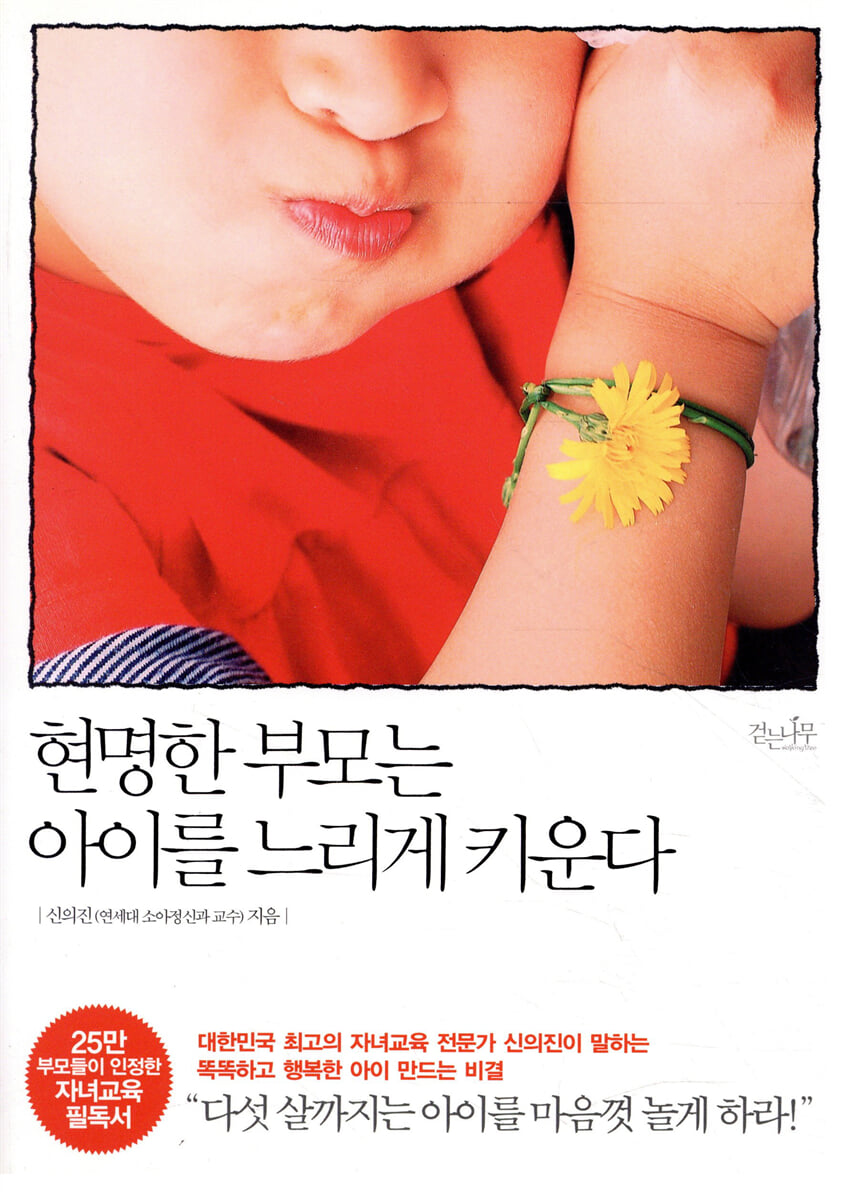
Wise parents raise their children slowly.
 |
Description
Book Introduction
Shin Eui-jin, Korea's leading expert on child education, reveals how today's early childhood education is ruining children and offers the secret to raising smart, happy children.
Indiscriminate early education makes children's minds sick.
To raise smart and happy children, parents are advised to help their children live happily and enjoyably, so that they can develop confidence, which is the foundation for navigating the world.
The author, who is convinced that the reason her two children were able to grow up well was because she did not provide them with early education, shows mothers who worry, "What if my child falls behind while everyone else does it?" a way to break free from the mold of "doing what everyone else does" and find a way for both children and mothers to be truly happy.
Additionally, based on brain development, it discusses why we should not trust IQ, why children should be allowed to play freely until the age of five, and suggests specific practical methods for raising children slowly based on various clinical cases.
Indiscriminate early education makes children's minds sick.
To raise smart and happy children, parents are advised to help their children live happily and enjoyably, so that they can develop confidence, which is the foundation for navigating the world.
The author, who is convinced that the reason her two children were able to grow up well was because she did not provide them with early education, shows mothers who worry, "What if my child falls behind while everyone else does it?" a way to break free from the mold of "doing what everyone else does" and find a way for both children and mothers to be truly happy.
Additionally, based on brain development, it discusses why we should not trust IQ, why children should be allowed to play freely until the age of five, and suggests specific practical methods for raising children slowly based on various clinical cases.
- You can preview some of the book's contents.
Preview
index
Prologue
Chapter 1.
Wise parents raise their children slowly.
In the future, children like this will succeed.
Diagnose yourself to see if you are fit to be a parent.
Slowing down when raising children is not an option, it's a necessity.
What We Can Learn from Ladakhi Parenting
Misconceptions about 'slow growing'
The Real Meaning of Slow Growing: One Step Behind, One Step Ahead
Why Children's Stress Is More Dangerous
Four Essential Virtues of Parents Who Raise Their Children Slowly
Chapter 2.
Let your child play to his heart's content until he is five years old.
4 Common Mistakes Parents Make
Never trust IQ
The Amazing Secrets Hidden in Children's Brains
Why I didn't send Jeongmo to a gifted academy
Your child might be a late bloomer.
Chapter 3.
Each child has a different learning method.
What are you teaching your child now?
Each child has a different learning method.
Find the right learning method for your child
The answer lies in what the child likes best.
Still, the reason to send Gyeongmo to school
Four Rules Working Mothers Should Follow
Why Dads Are Absolutely Essential for Children's Learning
Chapter 4.
Things I've Learned While Raising Two Children
There is no such thing as an impossible dream.
Why I Chose Child Psychiatry
Learning to be a parent from your husband
Even between brothers, a river flows.
What It Means to Be a Parent 1
What It Means to Be a Parent Part 2
The greatness of being together
charter 5.
10 Principles for Raising Children Slowly
Think of emotional regulation like underwear.
Don't scold your child if he or she lies.
Do your child's homework for him or her.
Try to negotiate with your child before scolding him.
Make them make mistakes on purpose
When you don't know the reason for a problem behavior, just endure it for now.
There is no better education than experience.
When you want to teach 'a little more', that's when you stop.
The child imitates everything you do.
Stay together but keep your distance
Chapter 1.
Wise parents raise their children slowly.
In the future, children like this will succeed.
Diagnose yourself to see if you are fit to be a parent.
Slowing down when raising children is not an option, it's a necessity.
What We Can Learn from Ladakhi Parenting
Misconceptions about 'slow growing'
The Real Meaning of Slow Growing: One Step Behind, One Step Ahead
Why Children's Stress Is More Dangerous
Four Essential Virtues of Parents Who Raise Their Children Slowly
Chapter 2.
Let your child play to his heart's content until he is five years old.
4 Common Mistakes Parents Make
Never trust IQ
The Amazing Secrets Hidden in Children's Brains
Why I didn't send Jeongmo to a gifted academy
Your child might be a late bloomer.
Chapter 3.
Each child has a different learning method.
What are you teaching your child now?
Each child has a different learning method.
Find the right learning method for your child
The answer lies in what the child likes best.
Still, the reason to send Gyeongmo to school
Four Rules Working Mothers Should Follow
Why Dads Are Absolutely Essential for Children's Learning
Chapter 4.
Things I've Learned While Raising Two Children
There is no such thing as an impossible dream.
Why I Chose Child Psychiatry
Learning to be a parent from your husband
Even between brothers, a river flows.
What It Means to Be a Parent 1
What It Means to Be a Parent Part 2
The greatness of being together
charter 5.
10 Principles for Raising Children Slowly
Think of emotional regulation like underwear.
Don't scold your child if he or she lies.
Do your child's homework for him or her.
Try to negotiate with your child before scolding him.
Make them make mistakes on purpose
When you don't know the reason for a problem behavior, just endure it for now.
There is no better education than experience.
When you want to teach 'a little more', that's when you stop.
The child imitates everything you do.
Stay together but keep your distance
Into the book
‘If I just try to make them do it, it will work out somehow. I guess I’ll get something out of it rather than not doing it… …’ While doing this, mothers try to shake off their anxiety and find comfort in their hearts.
But unfortunately, when it comes to children's learning, the old-fashioned, "it'll work out somehow" method never works.
A learning method that is 100 percent effective for 99 people may have fatal side effects for one person.
And that one person could be our child.
--- pp.81~82 From '4 Mistakes Parents Are Easily Making'
The more educated a mother is, the more likely she is to mistakenly believe that her role is to direct and monitor her child's learning from start to finish.
They don't believe that children learn and acquire many things on their own without any effort to teach them.
The child naturally thinks that he is the one who must educate, take care of, and hold onto the child.
--- p.87 From '4 Mistakes Parents Are Easily Making'
Australian parents deliberately keep quiet and hide the fact that their children are developing faster than others or are exceptional in some area.
Because they are afraid that the child will feel burdened or hurt because of it.
But our parents, who brag about their children's intelligence, don't seem to think at all about how that might affect the child.
--- p.89 From 'The child advertises that he is smart'
The reason I am concerned about the gifted syndrome is because the number of patients coming to me with its side effects continues to increase.
And what's even scarier is that they are so blinded by 'giftedness' that they don't even know if their child has a problem, and they even mistake mental illness for giftedness.
--- p.107 From 'Why I didn't send Jeongmo to a gifted academy'
There is no law that says a working mother cannot send her child to school.
Conversely, there is no rule that says that a stay-at-home mother will make her child study well.
--- p.177 From '4 Principles that Working Mothers Must Follow'
Not all fathers in the world are the same, but there seems to be at least one principle.
At least one person, whether mother or father, must have a counterproductive attitude toward the child's learning.
It's like playing tug-of-war. While one side pushes the child toward learning, the other side needs to create some breathing room for the child.
--- p.186 From 'Why a father is absolutely necessary for a child's learning'
If there's one thing I've done best since I was born, it would be giving birth to a child.
--- p.219 From 'The Meaning of Being a Parent 1'
What I overlooked was the 'certain amount of time' that a child needs.
Rather than trying to teach something, it is a time to play with the child without any greed and give the child unconditional love.
As I go through the first and second things in turn, I feel:
Just being together as a parent and child is such a great education for a child… … .
--- pp.226~227 From 'The Greatness of Being Together'
"Never scold your child when you're in a bad mood." When my emotional traffic light turns red, I leave them alone, whether they haven't done their homework or broken a promise to their mom.
At that time, no matter how good you try to look at the child, your inner emotions will show on your face.
Then, when your mood improves to a certain extent and your emotional score is at least 7 or 8 out of 10, only then do you say what you want to say to your child.
--- p.235 From 'Think of emotional regulation as underwear'
Often, children lie when they are in a situation that is too difficult for them to handle, as another way of saying that it is difficult.
In times like these, before blaming the lie itself, you need to find the underlying motive and address it first.
--- p.244 From 'Don't scold your child if he or she lies'
It seems that mistakes are not something that can be fixed by just correcting them.
Rather than correcting it, leaving it alone often produces unexpected effects.
That's the feedback effect through mistakes.
--- p.263 From 'Make mistakes on purpose'
Thanks to not having to receive early education, Gyeongmo is now good at studying.
I really think it's because I didn't ask.
But unfortunately, when it comes to children's learning, the old-fashioned, "it'll work out somehow" method never works.
A learning method that is 100 percent effective for 99 people may have fatal side effects for one person.
And that one person could be our child.
--- pp.81~82 From '4 Mistakes Parents Are Easily Making'
The more educated a mother is, the more likely she is to mistakenly believe that her role is to direct and monitor her child's learning from start to finish.
They don't believe that children learn and acquire many things on their own without any effort to teach them.
The child naturally thinks that he is the one who must educate, take care of, and hold onto the child.
--- p.87 From '4 Mistakes Parents Are Easily Making'
Australian parents deliberately keep quiet and hide the fact that their children are developing faster than others or are exceptional in some area.
Because they are afraid that the child will feel burdened or hurt because of it.
But our parents, who brag about their children's intelligence, don't seem to think at all about how that might affect the child.
--- p.89 From 'The child advertises that he is smart'
The reason I am concerned about the gifted syndrome is because the number of patients coming to me with its side effects continues to increase.
And what's even scarier is that they are so blinded by 'giftedness' that they don't even know if their child has a problem, and they even mistake mental illness for giftedness.
--- p.107 From 'Why I didn't send Jeongmo to a gifted academy'
There is no law that says a working mother cannot send her child to school.
Conversely, there is no rule that says that a stay-at-home mother will make her child study well.
--- p.177 From '4 Principles that Working Mothers Must Follow'
Not all fathers in the world are the same, but there seems to be at least one principle.
At least one person, whether mother or father, must have a counterproductive attitude toward the child's learning.
It's like playing tug-of-war. While one side pushes the child toward learning, the other side needs to create some breathing room for the child.
--- p.186 From 'Why a father is absolutely necessary for a child's learning'
If there's one thing I've done best since I was born, it would be giving birth to a child.
--- p.219 From 'The Meaning of Being a Parent 1'
What I overlooked was the 'certain amount of time' that a child needs.
Rather than trying to teach something, it is a time to play with the child without any greed and give the child unconditional love.
As I go through the first and second things in turn, I feel:
Just being together as a parent and child is such a great education for a child… … .
--- pp.226~227 From 'The Greatness of Being Together'
"Never scold your child when you're in a bad mood." When my emotional traffic light turns red, I leave them alone, whether they haven't done their homework or broken a promise to their mom.
At that time, no matter how good you try to look at the child, your inner emotions will show on your face.
Then, when your mood improves to a certain extent and your emotional score is at least 7 or 8 out of 10, only then do you say what you want to say to your child.
--- p.235 From 'Think of emotional regulation as underwear'
Often, children lie when they are in a situation that is too difficult for them to handle, as another way of saying that it is difficult.
In times like these, before blaming the lie itself, you need to find the underlying motive and address it first.
--- p.244 From 'Don't scold your child if he or she lies'
It seems that mistakes are not something that can be fixed by just correcting them.
Rather than correcting it, leaving it alone often produces unexpected effects.
That's the feedback effect through mistakes.
--- p.263 From 'Make mistakes on purpose'
Thanks to not having to receive early education, Gyeongmo is now good at studying.
I really think it's because I didn't ask.
--- p.277 From 'When you want to teach a little more, that's when you stop'
Publisher's Review
1) Let your child play to his or her heart's content until the age of five.
Most mothers believe that their child's growth is a so-called diagonal line ( / ), in which the child develops steadily and continuously in proportion to the effort put in.
However, in reality, the child shows a development in a step-like pattern ( ) that suddenly changes at some point through continuous waiting and stimulation.
The human brain continues to change and develop until adolescence, so depending on a child's temperament, it is impossible to know when that potential will be realized.
Therefore, what parents can do is to trust their child's 'Time table' and remove any distractions.
In other words, we must protect the child so that his or her positive self-image is not violated, his or her self-confidence is not lost, and his or her trust in the world is not lost.
However, if you are impatient and force your child to do this and that when they are young, thinking, "What if my child falls behind while everyone else is doing it?", this can cause problems in the child's growth.
Forced early education not only has little learning effect on children aged 0-6, but can actually ruin them.
For example, a third-grade girl who had been stressed from an early age due to excessive studying casually remarked that there was nothing interesting in the world.
For that child, studying was annoying and difficult, but he had to do it because his mother told him to, and the stress eventually made him hate thinking itself.
Another child, who had been attending an English kindergarten since the age of four due to his mother's pressure, later began to exhibit strange behaviors, such as lying down in front of the kindergarten gate, and even unconsciously refused to take unusual tests, such as IQ tests.
The reason this situation occurs is because we do not understand the child's developmental process.
According to the brain development process, until around the age of three, a child's brain develops evenly and vigorously in all areas without focusing on any one area, and above all, the emotional aspect develops greatly, so we must help the child live a happy and enjoyable life.
Only then can you have a positive image of yourself and the world, which in turn leads to self-confidence, the foundation for living in the world.
Also, because the frontal lobe, which is responsible for thinking, develops until around the age of 5, children should be given many opportunities to think so that they can use their imagination and interpret the world in their own way.
This way, when you enter elementary school and begin to study in earnest, you will be able to digest what you have learned in your own way.
Therefore, it is truly in the best interest of children to let them play to their heart's content until they are five years old.
This book explains how indiscriminate early education can make children's minds sick, and tells parents what they should really teach their children aged 0-6 to help them grow up to be smart and happy.
2) The true meaning of growing slowly - One step behind, one step ahead
The greatest virtue that parents who want to raise their children properly must possess is the 'wisdom of slowness', which is knowing how to wait without rushing.
However, this does not mean that children should be left to be lazy and careless.
There is a time for any development, and appropriate stimulation must be provided at that time.
If you miss the right time, the brain will have already matured, so even if you give the same stimulation, you cannot expect the same level of development as if you gave it at the right time.
So what is the real education children need? The most striking characteristic of infancy and early childhood is their instinctive drive to explore.
Children are thrilled to see something new and fun, and the act of exploring itself is a tremendous learning experience.
This book presents two educational methods based on the characteristics of infants and toddlers.
The first is 'One step behind', which literally means responding one beat late.
The mother simply watches the child as he or she does something, and when he or she shows curiosity about something, she gives him or her a gentle push.
Another is 'One step ahead', which means being one beat ahead of the child.
For example, when a child is eating rice and says “babababa~”, the mother clearly says “rice!” from the side.
Only through this type of education that provides appropriate stimulation at the appropriate time can a child's potential be brought out.
Potential is an ability whose expression is completely unpredictable.
The human brain does not develop from childhood due to any external stimuli, but rather seeks out the learning stimuli it needs on its own. If you just leave it alone and remove any distractions, it will eventually realize its potential.
3) Never Trust IQ - The Amazing Secrets Hidden in Children's Brains
Intelligence tests were originally developed to distinguish between retarded and normal children.
What's interesting is that when you take an intelligence test, the score goes up and down by about 10 depending on the child's mood, and if you take the test regularly every six months or so, the score goes up nine times out of ten.
What do these facts tell us?
The IQ we know is nothing more than an illusion.
Since intelligence tests are originally designed to distinguish between normal and retarded children, a score of around 100 is considered to be a basic requirement for studying well.
So, there is no reason to brag about your child's high IQ or worry about their low IQ.
So how should we determine the criteria for assessing a person's intelligence? The author argues that we should consider all three aspects: analytical IQ, practical IQ, and creative IQ.
Analytical IQ is the ability to categorize, memorize, and digest new stimuli when received, while practical IQ is the ability to apply learned knowledge to real life.
Lastly, creative IQ refers to the ability to see things in a new way every moment, rather than viewing them within the existing framework.
4) As a child psychiatrist for 17 years, I have treated children with mental illness.
Experiential parenting methods learned while raising two sons as a mother
These days, it's reminiscent of a race to learn kindergarten at age two, fourth grade in first grade, and middle school in fourth grade. Even if you decide not to force yourself to learn, it's not easy to keep that resolution.
The same was true for the author, who is raising two sons.
This book contains the core of child education methods that I have realized through countless trials and errors as a child psychiatrist who treats children with emotional problems and as a mother raising two sons.
The eldest son, Gyeongmo, suffered from attention deficit disorder and tic disorder, so he was very reluctant to interact with the world and was confined to his own world.
Not being able to socialize with my friends in kindergarten and playing trains alone wasn't even a problem.
There was even a time when I didn't touch the sand in the kindergarten yard for a whole year because I said, "It's dirty and I don't like it."
Even in the sweltering heat of summer, I would leave home wearing underwear under my shorts, and during class, I would walk around the classroom holding a large globe.
On the other hand, the youngest son, Jeongmo, was considered gifted enough to be judged to be at least a year ahead of his peers.
Raising two very different children wasn't easy, but what was even harder was fighting against the greed that comes with being a mother.
I thought that all I had to do was teach my older child how to interact with the world, but I was impatient and tried to force him to sit down and teach him.
I was greedy and wanted to teach the little child, who knew ten things if I taught him one, to do this and that.
Eventually, Gyeongmo closed his heart, and Jeongmo started lying due to the stress of studying.
After much trial and error, the author decided to apply a learning method that took into account the characteristics and developmental stages of the two children, rather than providing them with early education.
As a result, he says his two sons, now in their third year of high school and second year of middle school, are doing well in their studies and, above all, are happy.
Watching my two sons carve out their own paths in life, I became even more convinced that early education was not the answer.
Most mothers believe that their child's growth is a so-called diagonal line ( / ), in which the child develops steadily and continuously in proportion to the effort put in.
However, in reality, the child shows a development in a step-like pattern ( ) that suddenly changes at some point through continuous waiting and stimulation.
The human brain continues to change and develop until adolescence, so depending on a child's temperament, it is impossible to know when that potential will be realized.
Therefore, what parents can do is to trust their child's 'Time table' and remove any distractions.
In other words, we must protect the child so that his or her positive self-image is not violated, his or her self-confidence is not lost, and his or her trust in the world is not lost.
However, if you are impatient and force your child to do this and that when they are young, thinking, "What if my child falls behind while everyone else is doing it?", this can cause problems in the child's growth.
Forced early education not only has little learning effect on children aged 0-6, but can actually ruin them.
For example, a third-grade girl who had been stressed from an early age due to excessive studying casually remarked that there was nothing interesting in the world.
For that child, studying was annoying and difficult, but he had to do it because his mother told him to, and the stress eventually made him hate thinking itself.
Another child, who had been attending an English kindergarten since the age of four due to his mother's pressure, later began to exhibit strange behaviors, such as lying down in front of the kindergarten gate, and even unconsciously refused to take unusual tests, such as IQ tests.
The reason this situation occurs is because we do not understand the child's developmental process.
According to the brain development process, until around the age of three, a child's brain develops evenly and vigorously in all areas without focusing on any one area, and above all, the emotional aspect develops greatly, so we must help the child live a happy and enjoyable life.
Only then can you have a positive image of yourself and the world, which in turn leads to self-confidence, the foundation for living in the world.
Also, because the frontal lobe, which is responsible for thinking, develops until around the age of 5, children should be given many opportunities to think so that they can use their imagination and interpret the world in their own way.
This way, when you enter elementary school and begin to study in earnest, you will be able to digest what you have learned in your own way.
Therefore, it is truly in the best interest of children to let them play to their heart's content until they are five years old.
This book explains how indiscriminate early education can make children's minds sick, and tells parents what they should really teach their children aged 0-6 to help them grow up to be smart and happy.
2) The true meaning of growing slowly - One step behind, one step ahead
The greatest virtue that parents who want to raise their children properly must possess is the 'wisdom of slowness', which is knowing how to wait without rushing.
However, this does not mean that children should be left to be lazy and careless.
There is a time for any development, and appropriate stimulation must be provided at that time.
If you miss the right time, the brain will have already matured, so even if you give the same stimulation, you cannot expect the same level of development as if you gave it at the right time.
So what is the real education children need? The most striking characteristic of infancy and early childhood is their instinctive drive to explore.
Children are thrilled to see something new and fun, and the act of exploring itself is a tremendous learning experience.
This book presents two educational methods based on the characteristics of infants and toddlers.
The first is 'One step behind', which literally means responding one beat late.
The mother simply watches the child as he or she does something, and when he or she shows curiosity about something, she gives him or her a gentle push.
Another is 'One step ahead', which means being one beat ahead of the child.
For example, when a child is eating rice and says “babababa~”, the mother clearly says “rice!” from the side.
Only through this type of education that provides appropriate stimulation at the appropriate time can a child's potential be brought out.
Potential is an ability whose expression is completely unpredictable.
The human brain does not develop from childhood due to any external stimuli, but rather seeks out the learning stimuli it needs on its own. If you just leave it alone and remove any distractions, it will eventually realize its potential.
3) Never Trust IQ - The Amazing Secrets Hidden in Children's Brains
Intelligence tests were originally developed to distinguish between retarded and normal children.
What's interesting is that when you take an intelligence test, the score goes up and down by about 10 depending on the child's mood, and if you take the test regularly every six months or so, the score goes up nine times out of ten.
What do these facts tell us?
The IQ we know is nothing more than an illusion.
Since intelligence tests are originally designed to distinguish between normal and retarded children, a score of around 100 is considered to be a basic requirement for studying well.
So, there is no reason to brag about your child's high IQ or worry about their low IQ.
So how should we determine the criteria for assessing a person's intelligence? The author argues that we should consider all three aspects: analytical IQ, practical IQ, and creative IQ.
Analytical IQ is the ability to categorize, memorize, and digest new stimuli when received, while practical IQ is the ability to apply learned knowledge to real life.
Lastly, creative IQ refers to the ability to see things in a new way every moment, rather than viewing them within the existing framework.
4) As a child psychiatrist for 17 years, I have treated children with mental illness.
Experiential parenting methods learned while raising two sons as a mother
These days, it's reminiscent of a race to learn kindergarten at age two, fourth grade in first grade, and middle school in fourth grade. Even if you decide not to force yourself to learn, it's not easy to keep that resolution.
The same was true for the author, who is raising two sons.
This book contains the core of child education methods that I have realized through countless trials and errors as a child psychiatrist who treats children with emotional problems and as a mother raising two sons.
The eldest son, Gyeongmo, suffered from attention deficit disorder and tic disorder, so he was very reluctant to interact with the world and was confined to his own world.
Not being able to socialize with my friends in kindergarten and playing trains alone wasn't even a problem.
There was even a time when I didn't touch the sand in the kindergarten yard for a whole year because I said, "It's dirty and I don't like it."
Even in the sweltering heat of summer, I would leave home wearing underwear under my shorts, and during class, I would walk around the classroom holding a large globe.
On the other hand, the youngest son, Jeongmo, was considered gifted enough to be judged to be at least a year ahead of his peers.
Raising two very different children wasn't easy, but what was even harder was fighting against the greed that comes with being a mother.
I thought that all I had to do was teach my older child how to interact with the world, but I was impatient and tried to force him to sit down and teach him.
I was greedy and wanted to teach the little child, who knew ten things if I taught him one, to do this and that.
Eventually, Gyeongmo closed his heart, and Jeongmo started lying due to the stress of studying.
After much trial and error, the author decided to apply a learning method that took into account the characteristics and developmental stages of the two children, rather than providing them with early education.
As a result, he says his two sons, now in their third year of high school and second year of middle school, are doing well in their studies and, above all, are happy.
Watching my two sons carve out their own paths in life, I became even more convinced that early education was not the answer.
GOODS SPECIFICS
- Date of issue: June 11, 2010
- Page count, weight, size: 288 pages | 548g | 152*213*20mm
- ISBN13: 9788901109206
- ISBN10: 8901109204
You may also like
카테고리
korean


korean

![ELLE 엘르 스페셜 에디션 A형 : 12월 [2025]](http://librairie.coreenne.fr/cdn/shop/files/b8e27a3de6c9538896439686c6b0e8fb.jpg?v=1766436872&width=3840)


