

About what we believe
 |
Description
Book Introduction
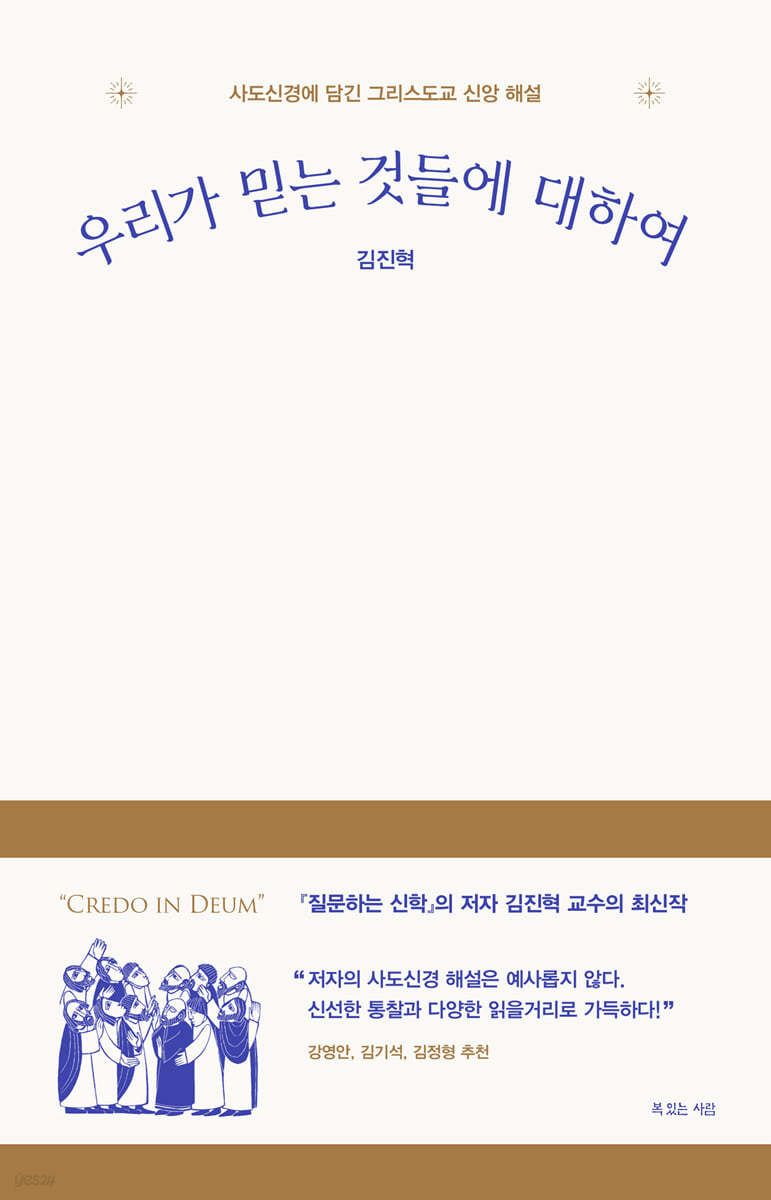
Professor Jinhyeok Kim, author of "Questioning Theology," has published his latest work, "On What We Believe," which explains the Christian faith in the form of a commentary on the Apostles' Creed.
This book, which highlights Professor Kim Jin-hyeok's characteristically flavorful narrative style and sharp theological reflection, interprets the ancient creed with a modern sensibility, using the teachings of early Christianity before the schism as a premise for its interpretation.
It is written in language that can be easily understood by any believer who accepts the Apostles' Creed as their confession of faith, and contains the core teachings of Christianity in a level and volume suitable for use in church settings.
This book, which highlights Professor Kim Jin-hyeok's characteristically flavorful narrative style and sharp theological reflection, interprets the ancient creed with a modern sensibility, using the teachings of early Christianity before the schism as a premise for its interpretation.
It is written in language that can be easily understood by any believer who accepts the Apostles' Creed as their confession of faith, and contains the core teachings of Christianity in a level and volume suitable for use in church settings.
- You can preview some of the book's contents.
Preview
index
introduction
introduction.
About faith
Chapter 1.
father
Chapter 2.
Jesus Christ
Chapter 3.
person
Chapter 4.
The Holy Spirit and the Church
Chapter 5.
forgiveness of sins
Chapter 6.
end
conclusion.
Amen, and again about 'faith'
supplement
main
Search
introduction.
About faith
Chapter 1.
father
Chapter 2.
Jesus Christ
Chapter 3.
person
Chapter 4.
The Holy Spirit and the Church
Chapter 5.
forgiveness of sins
Chapter 6.
end
conclusion.
Amen, and again about 'faith'
supplement
main
Search
Into the book
To profess the Apostles' Creed, "I believe," within a community means to be grafted into something greater, greater, and older than myself.
In keeping with the comprehensiveness of God's grace, the Lord of all creation, we transcend the limitations of time and space and form the body of Christ together with saints from all over the world.
This is an act that boldly challenges the egocentrism of humans who retreat into their private world and try to defend their own world with various logics.
This is a declaration to join an expedition that sets out on a journey of faith, leaving behind the differences in language, culture, race, gender, historical memory, ideology, and class that separate us, and staking everything on the grace of God who has reconciled the world.
---"introduction.
From “On Faith”
If we overlap Augustine's analogy of love with the words, "This is my beloved Son," we obtain a very interesting grammar for expressing the mystery of the Triune God.
It is God the Father as the one who ‘loves’ the Son, God the Son as the one who is ‘loved’ by the Father, and God the Holy Spirit as the ‘bond or fruit of love’ who shares the joy that flows between the Father and the Son and enriches their relationship.
From this perspective of love, the Christian God is a relational being who has been in a communion of love since eternity.
---「Chapter 1.
From "God"
The cross was a decisive event that gave humanity new possibilities by reconciling God and humanity.
He conquered death three days after his death on the cross as the 'first fruits of the future resurrection.'
With the resurrection, a new humanity emerged into history that did not belong to the old order of creation.
The true God, the Son, became human not only to forgive the sins of mankind, but also to perform the miracle of enabling us to become “true humans” like Him.
---「Chapter 2.
From "Jesus Christ"
The Spirit of Jesus Christ, who rose from the dead, raises those who were in the darkness of history and gives them new life as a community.
Through the worship of the church, we confess the one Jesus called Father as Father, are baptized in the water in which he was immersed, participate in the meal he shared with his disciples, pray together with the prayer he taught, and embrace together the dream of the kingdom of God he proclaimed, and thus we become Christians 'together.'
---「Chapter 4.
From “The Holy Spirit and the Church”
Although we are still sinners, the God of grace has justified us in Jesus Christ, and having received that grace through faith, we embark on the adventure of a righteous life as free people with the spark of love in our hearts in the Spirit of Christ.
This is possible because on the cross an 'exchange of fate' took place between the Son of God and sinful human beings.
As the representative of humanity, Jesus takes upon himself the cursed fate of humanity on our behalf, and at the same time, as the Son of God, he gives us the gift of true life.
---「Chapter 5.
From "Forgiveness of Sins"
The English word end (Greek telos) also means 'purpose'.
In other words, we must understand the end not simply as a prophecy about the end of history, but as a doctrine about the ultimate 'purpose' of history that the triune God will accomplish.
The humble confession that God, not man, is the master of history frees us from the devilish power of optimism that man can determine or achieve the ultimate purpose of history.
The God of the Bible is the one who made promises to Israel and is faithful to those promises.
In this way, God's promise becomes the 'purpose' of history, and God's activities to fulfill the promise become the 'driving force' of history.
---「Chapter 6.
From "The End"
The Apostles' Creed is an ancient document that tells us that human beings are such wonderful beings, loved by the triune God.
As we recite each article of the Apostles' Creed, we reconstruct our thoughts and actions according to the grammar of the grace of the triune God.
As we conclude the Apostles' Creed with 'Amen,' we boldly declare that we will look to today's world and live truthfully in it, longing for the future that God will perfect.
That is why the Apostles' Creed, in its archaic language, contains a radical message that could be called a declaration of the revolution of humanity.
In keeping with the comprehensiveness of God's grace, the Lord of all creation, we transcend the limitations of time and space and form the body of Christ together with saints from all over the world.
This is an act that boldly challenges the egocentrism of humans who retreat into their private world and try to defend their own world with various logics.
This is a declaration to join an expedition that sets out on a journey of faith, leaving behind the differences in language, culture, race, gender, historical memory, ideology, and class that separate us, and staking everything on the grace of God who has reconciled the world.
---"introduction.
From “On Faith”
If we overlap Augustine's analogy of love with the words, "This is my beloved Son," we obtain a very interesting grammar for expressing the mystery of the Triune God.
It is God the Father as the one who ‘loves’ the Son, God the Son as the one who is ‘loved’ by the Father, and God the Holy Spirit as the ‘bond or fruit of love’ who shares the joy that flows between the Father and the Son and enriches their relationship.
From this perspective of love, the Christian God is a relational being who has been in a communion of love since eternity.
---「Chapter 1.
From "God"
The cross was a decisive event that gave humanity new possibilities by reconciling God and humanity.
He conquered death three days after his death on the cross as the 'first fruits of the future resurrection.'
With the resurrection, a new humanity emerged into history that did not belong to the old order of creation.
The true God, the Son, became human not only to forgive the sins of mankind, but also to perform the miracle of enabling us to become “true humans” like Him.
---「Chapter 2.
From "Jesus Christ"
The Spirit of Jesus Christ, who rose from the dead, raises those who were in the darkness of history and gives them new life as a community.
Through the worship of the church, we confess the one Jesus called Father as Father, are baptized in the water in which he was immersed, participate in the meal he shared with his disciples, pray together with the prayer he taught, and embrace together the dream of the kingdom of God he proclaimed, and thus we become Christians 'together.'
---「Chapter 4.
From “The Holy Spirit and the Church”
Although we are still sinners, the God of grace has justified us in Jesus Christ, and having received that grace through faith, we embark on the adventure of a righteous life as free people with the spark of love in our hearts in the Spirit of Christ.
This is possible because on the cross an 'exchange of fate' took place between the Son of God and sinful human beings.
As the representative of humanity, Jesus takes upon himself the cursed fate of humanity on our behalf, and at the same time, as the Son of God, he gives us the gift of true life.
---「Chapter 5.
From "Forgiveness of Sins"
The English word end (Greek telos) also means 'purpose'.
In other words, we must understand the end not simply as a prophecy about the end of history, but as a doctrine about the ultimate 'purpose' of history that the triune God will accomplish.
The humble confession that God, not man, is the master of history frees us from the devilish power of optimism that man can determine or achieve the ultimate purpose of history.
The God of the Bible is the one who made promises to Israel and is faithful to those promises.
In this way, God's promise becomes the 'purpose' of history, and God's activities to fulfill the promise become the 'driving force' of history.
---「Chapter 6.
From "The End"
The Apostles' Creed is an ancient document that tells us that human beings are such wonderful beings, loved by the triune God.
As we recite each article of the Apostles' Creed, we reconstruct our thoughts and actions according to the grammar of the grace of the triune God.
As we conclude the Apostles' Creed with 'Amen,' we boldly declare that we will look to today's world and live truthfully in it, longing for the future that God will perfect.
That is why the Apostles' Creed, in its archaic language, contains a radical message that could be called a declaration of the revolution of humanity.
---"conclusion.
Amen, and again from “On Faith”
Amen, and again from “On Faith”
Publisher's Review
The latest work by Professor Jinhyeok Kim, author of "Questioning Theology"
“The author’s commentary on the Apostles’ Creed is extraordinary.
“Full of fresh insights and a variety of reading material!”
Recommended by Kang Young-an, Kim Ki-seok, and Kim Jeong-hyeong
This book, which explains the Christian faith in the form of a commentary on the Apostles' Creed,
A guide to faith for all Christians.
'What do Christians believe?' This is a question that has persisted since the first century.
The reason so many people have asked this question for over two thousand years is not simply because they have not found a satisfactory answer, but because the process of finding the answer has shaped the unique thinking, actions, and language of Christians.
Even when people could not yet read the Bible, when the religious community was persecuted, when the gospel spread to other languages and cultures, when the church was in turmoil due to various controversies, when the world was turned upside down by political or scientific revolutions, when wars and disasters made people doubt the existence of God, and even when ordinary days continued without incident, the church has repeatedly confirmed "what we believe" through the Apostles' Creed.
For this reason, many famous theologians from the past to the present have used the language and logic of the Apostles' Creed to explain the Christian faith.
This book, "What We Believe," also takes the approach of explaining the doctrine contained in each article of the Apostles' Creed.
In particular, we will make the most of the insights of the Church Fathers who greatly contributed to the formation of the theology of the Catholic Church to read the ancient creed with a modern sensibility.
Through this method, we seek to rediscover the wisdom of ancient Christians, who understood themselves as followers of Christ in a polytheistic culture, in the multicultural society of the 21st century.
This book is a compilation of lectures delivered at the Woodbury Institute in 2021. As it targets missionaries working in various countries, it focuses on the essence of faith itself rather than theological specifics, and while addressing doctrine, it does not lose sight of the practical horizon of faith.
Above all, by making the Trinitarian faith, which Christians in the Mediterranean region professed before the schism of the Church, the core perspective for interpreting the Apostles' Creed, it clearly shows the comprehensive horizon of the Christian faith that worships the Creator of the universe and the Savior of humanity.
characteristic
- The latest work by Professor Jinhyeok Kim, author of "Questioning Theology"
- Explanation of the core teachings of the Christian faith using the language and logic of the Apostles' Creed.
- Reinterprets the doctrine in a new way following the Trinitarian concerns of early Christianity.
- Each chapter includes questions for application and discussion.
Target audience
- Those who want to reflect on their faith in theological language
- Those preparing to study doctrine with the community
- Those who want to know Christianity in depth
“The author’s commentary on the Apostles’ Creed is extraordinary.
“Full of fresh insights and a variety of reading material!”
Recommended by Kang Young-an, Kim Ki-seok, and Kim Jeong-hyeong
This book, which explains the Christian faith in the form of a commentary on the Apostles' Creed,
A guide to faith for all Christians.
'What do Christians believe?' This is a question that has persisted since the first century.
The reason so many people have asked this question for over two thousand years is not simply because they have not found a satisfactory answer, but because the process of finding the answer has shaped the unique thinking, actions, and language of Christians.
Even when people could not yet read the Bible, when the religious community was persecuted, when the gospel spread to other languages and cultures, when the church was in turmoil due to various controversies, when the world was turned upside down by political or scientific revolutions, when wars and disasters made people doubt the existence of God, and even when ordinary days continued without incident, the church has repeatedly confirmed "what we believe" through the Apostles' Creed.
For this reason, many famous theologians from the past to the present have used the language and logic of the Apostles' Creed to explain the Christian faith.
This book, "What We Believe," also takes the approach of explaining the doctrine contained in each article of the Apostles' Creed.
In particular, we will make the most of the insights of the Church Fathers who greatly contributed to the formation of the theology of the Catholic Church to read the ancient creed with a modern sensibility.
Through this method, we seek to rediscover the wisdom of ancient Christians, who understood themselves as followers of Christ in a polytheistic culture, in the multicultural society of the 21st century.
This book is a compilation of lectures delivered at the Woodbury Institute in 2021. As it targets missionaries working in various countries, it focuses on the essence of faith itself rather than theological specifics, and while addressing doctrine, it does not lose sight of the practical horizon of faith.
Above all, by making the Trinitarian faith, which Christians in the Mediterranean region professed before the schism of the Church, the core perspective for interpreting the Apostles' Creed, it clearly shows the comprehensive horizon of the Christian faith that worships the Creator of the universe and the Savior of humanity.
characteristic
- The latest work by Professor Jinhyeok Kim, author of "Questioning Theology"
- Explanation of the core teachings of the Christian faith using the language and logic of the Apostles' Creed.
- Reinterprets the doctrine in a new way following the Trinitarian concerns of early Christianity.
- Each chapter includes questions for application and discussion.
Target audience
- Those who want to reflect on their faith in theological language
- Those preparing to study doctrine with the community
- Those who want to know Christianity in depth
GOODS SPECIFICS
- Publication date: July 22, 2022
- Page count, weight, size: 312 pages | 406g | 135*210*20mm
- ISBN13: 9791191987843
- ISBN10: 1191987841
You may also like
카테고리
korean


korean

![ELLE 엘르 스페셜 에디션 A형 : 12월 [2025]](http://librairie.coreenne.fr/cdn/shop/files/b8e27a3de6c9538896439686c6b0e8fb.jpg?v=1766436872&width=3840)


