

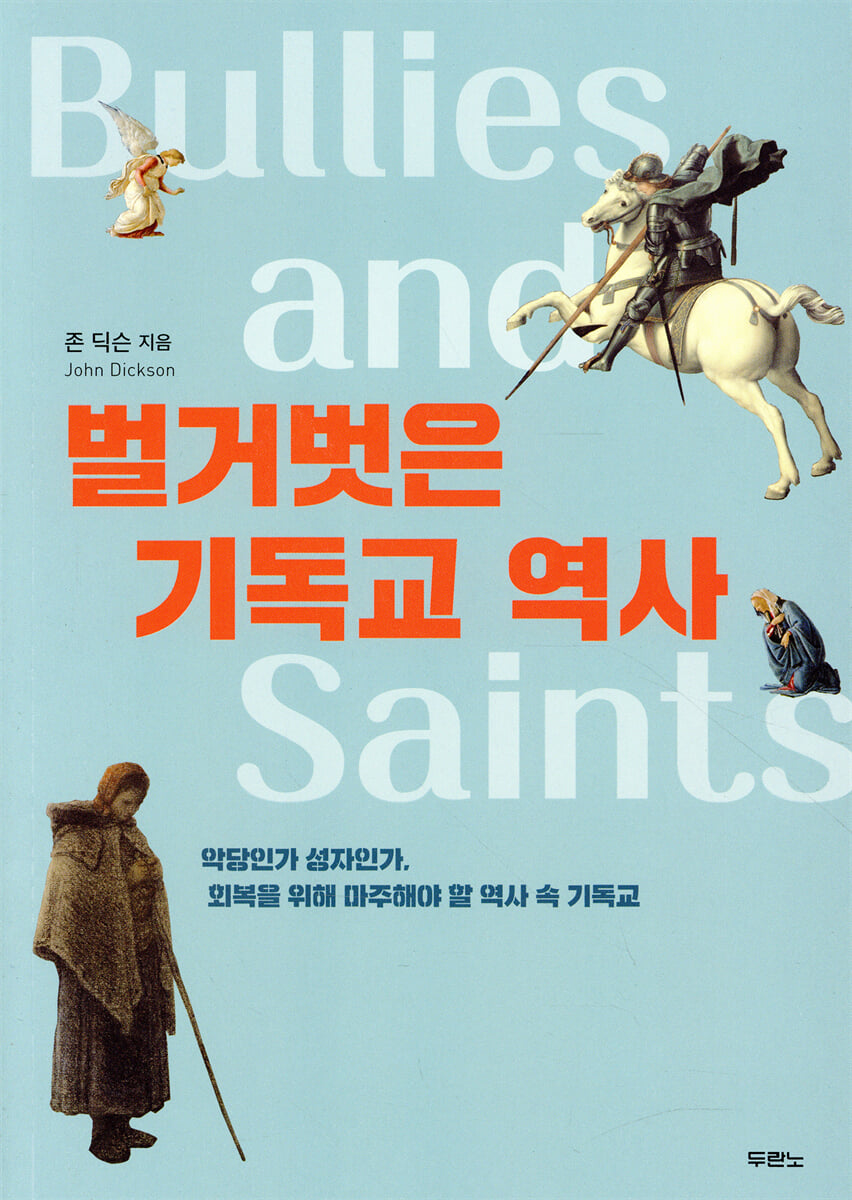
The Naked History of Christianity
 |
Description
Book Introduction
The labyrinthine two thousand year history of Christianity,
Let's just be honest and talk about it!
Facing the "Yesterday of Christianity" for a Healthy Faith
With the COVID-19 pandemic at the forefront, unpredictable days are unfolding.
Where are this generation, and the next, headed? In this post-Christian era, where the divide between church and society is rapidly deepening, if we don't understand the path we've taken and where we are now at this critical juncture, we risk continuing to err on the wrong path.
A book has been published that honestly confronts the path Christianity has taken over the past two thousand years and seeks a way forward.
Armed with meticulous historical data, keen scholarly analysis, and a profoundly honest pastoral perspective, historian John Dickson's "Naked History of Christianity" is a book.
This is a book that every believer must know and ponder, and it will also be a ray of light for non-believers who are skeptical of Christianity, the church, and Christians.
Let's just be honest and talk about it!
Facing the "Yesterday of Christianity" for a Healthy Faith
With the COVID-19 pandemic at the forefront, unpredictable days are unfolding.
Where are this generation, and the next, headed? In this post-Christian era, where the divide between church and society is rapidly deepening, if we don't understand the path we've taken and where we are now at this critical juncture, we risk continuing to err on the wrong path.
A book has been published that honestly confronts the path Christianity has taken over the past two thousand years and seeks a way forward.
Armed with meticulous historical data, keen scholarly analysis, and a profoundly honest pastoral perspective, historian John Dickson's "Naked History of Christianity" is a book.
This is a book that every believer must know and ponder, and it will also be a ray of light for non-believers who are skeptical of Christianity, the church, and Christians.
- You can preview some of the book's contents.
Preview
index
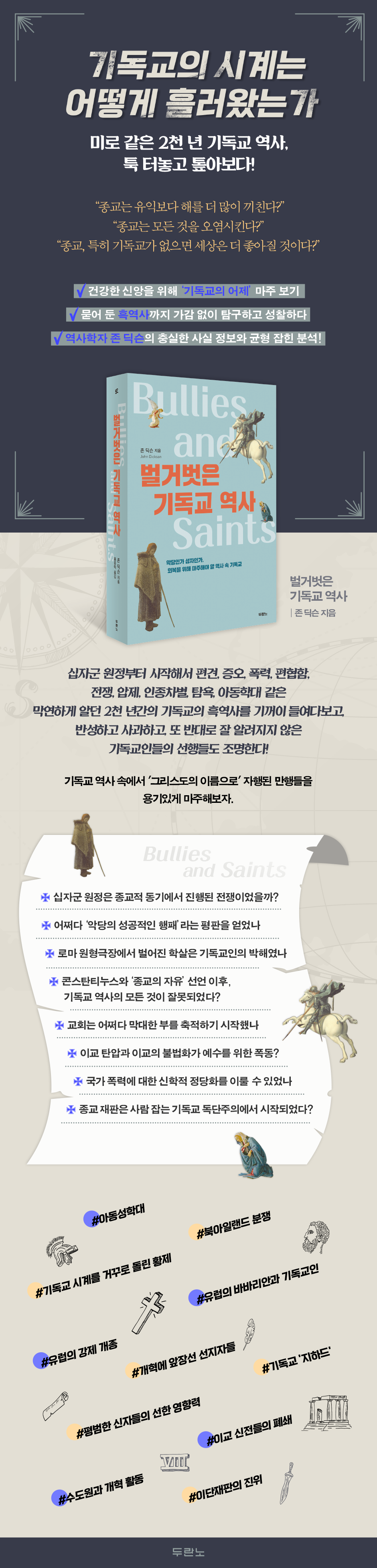
A Prelude.
An honest exploration of the path we have walked for two thousand years.
1.
The day when the confession of faith called “Holy Church” became meaningless
# 1099 # Massacre committed 'in the name of Christ'
2.
A brief overview of the context before and after the Crusades
# 1000-1200s # A successful holy war?
3.
The most perfect and beautiful original melody of Christ
# 1st century # Christian ethics
4.
Churches that are indifferent to the beam in their own eye
# 1st century # Christian view of humanity
5.
Early Christianity: Moments of Fierce and Brilliant Defeat
# 64-312 # Persecutions of the Church
6.
Constantine and the Declaration of 'Freedom of Religion'
# Early 300s # First Christian Emperor
7.
The first step toward Christian charity permeating the world
# Early 300s # Financial changes in Roman law
8.
The anti-Christian policy of Julian the Apostate
# 360s # The Emperor Who Turned Back the Christian Clock
9.
The rise of a powerful, muscular Christianity
# Late 300s # 'Senator' who became a bishop
10.
The Practical Gospel of the Three Cappadocian Church Fathers
# Late 300s # First hospital # Slavery
11.
Violent suppression of paganism and its outlawing
# 380-415 # Christian riots # Closure of pagan temples
12.
A theological justification for state violence?
# Early 400s # Christian War Theory
13.
The Fall of the Western Roman Empire and the Growth of the Church
# 400-1100 # European Barbarians and Christians
14.
Outrageous Coercion and Violence: Christian Jihad
# Late 700s # Forced conversion in Europe
15.
The intellectual medieval church that brought about the Renaissance
# In the midst of the Dark Ages # Educator Alcuin of York
16.
The Church Transformed into a 'Knight of Christ'
# Preparation period leading up to 1100 # Prelude to the 'Holy War'
17.
Prophets who rebuked hypocrites and led reform
# Middle Ages # Monasteries and Reformation Activities
18.
The Legacy of Byzantium, the Eternal Empire of the East
# 500-1400s # People of the Eastern Roman Empire forgotten in the West
19.
The Full Story of the Dark Ages Narrative
# 500-1200s # A slogan given by secular storytelling
20.
The Inquisition, Christian dogmatism that catches people?
# 1100-1500s # The truth of the heresy trials
21.
The Thirty Years' War, tainted by religious myths
# 1600s # Bloody battles during the Reformation
22.
Northern Ireland conflict: another tragic religious war?
# 1700s-1998 # Was the conflict between Catholic and Protestant religions the cause?
23.
A moral reckoning with the unexplainable evils within the church.
# Modern Church # Child Sex Abuse
24.
The fruits that come from fully internalizing and practicing faith
# Modern Church # The Good Influence of Ordinary Believers
25.
The beam in our own eye
# Hypocrisy that runs rampant in every age
A Coda.
Christianity, it's time to return to the original melody of life.
Acknowledgements
main
An honest exploration of the path we have walked for two thousand years.
1.
The day when the confession of faith called “Holy Church” became meaningless
# 1099 # Massacre committed 'in the name of Christ'
2.
A brief overview of the context before and after the Crusades
# 1000-1200s # A successful holy war?
3.
The most perfect and beautiful original melody of Christ
# 1st century # Christian ethics
4.
Churches that are indifferent to the beam in their own eye
# 1st century # Christian view of humanity
5.
Early Christianity: Moments of Fierce and Brilliant Defeat
# 64-312 # Persecutions of the Church
6.
Constantine and the Declaration of 'Freedom of Religion'
# Early 300s # First Christian Emperor
7.
The first step toward Christian charity permeating the world
# Early 300s # Financial changes in Roman law
8.
The anti-Christian policy of Julian the Apostate
# 360s # The Emperor Who Turned Back the Christian Clock
9.
The rise of a powerful, muscular Christianity
# Late 300s # 'Senator' who became a bishop
10.
The Practical Gospel of the Three Cappadocian Church Fathers
# Late 300s # First hospital # Slavery
11.
Violent suppression of paganism and its outlawing
# 380-415 # Christian riots # Closure of pagan temples
12.
A theological justification for state violence?
# Early 400s # Christian War Theory
13.
The Fall of the Western Roman Empire and the Growth of the Church
# 400-1100 # European Barbarians and Christians
14.
Outrageous Coercion and Violence: Christian Jihad
# Late 700s # Forced conversion in Europe
15.
The intellectual medieval church that brought about the Renaissance
# In the midst of the Dark Ages # Educator Alcuin of York
16.
The Church Transformed into a 'Knight of Christ'
# Preparation period leading up to 1100 # Prelude to the 'Holy War'
17.
Prophets who rebuked hypocrites and led reform
# Middle Ages # Monasteries and Reformation Activities
18.
The Legacy of Byzantium, the Eternal Empire of the East
# 500-1400s # People of the Eastern Roman Empire forgotten in the West
19.
The Full Story of the Dark Ages Narrative
# 500-1200s # A slogan given by secular storytelling
20.
The Inquisition, Christian dogmatism that catches people?
# 1100-1500s # The truth of the heresy trials
21.
The Thirty Years' War, tainted by religious myths
# 1600s # Bloody battles during the Reformation
22.
Northern Ireland conflict: another tragic religious war?
# 1700s-1998 # Was the conflict between Catholic and Protestant religions the cause?
23.
A moral reckoning with the unexplainable evils within the church.
# Modern Church # Child Sex Abuse
24.
The fruits that come from fully internalizing and practicing faith
# Modern Church # The Good Influence of Ordinary Believers
25.
The beam in our own eye
# Hypocrisy that runs rampant in every age
A Coda.
Christianity, it's time to return to the original melody of life.
Acknowledgements
main
Detailed image
Into the book
I am in a dilemma.
The official Christian creed, known as the Nicene Creed, requires believers to declare their faith in “the holy, catholic ('catholic' here does not mean Roman Catholic, but simply 'universal') and apostolic Church.”
So, in a very practical sense, Christians must have some kind of faith or spiritual conviction about the institution established by Christ.
Christ himself said:
“I will build my church.
The gates of Hades will not prevail against it” (Matthew 16:18, NIV).
But anyone familiar with the centuries of Christian history knows that the church has consistently been far from “holy.”
Sometimes, isn't the church an ally of "death"? Having studied history for a long time and attended church even longer, I feel conflicted.
I know where the bodies are buried in the tomb of church history, and I am also in a position to confess the words of the Nicene Creed somehow.
--- p.27
All of these situations raise related issues.
Were the Crusades a war waged for religious reasons? It's tempting to hide behind the alternative explanations that are occasionally offered.
The Crusades were either a land grab by Europeans disguised as religion, a search for new resources, or a ploy to provide work for tens of thousands of unemployed people.
… (omitted) … When reading primary sources about the Crusades, one is confronted with the powerful religious motivations and goals expressed therein.
“The importance of protecting fellow Christians, defending the honor of the Holy Land, and glorifying Jesus Christ against the incoming ‘paganism’ of Islam.” Raymond of Aguiller, quoted earlier, was a chaplain in the First Crusade.
He had a specific mission: to awaken the spiritual mission inherent in these acts of violence.
Regarding the massacre of 1099, he declared:
“This is the day when the truth of Christianity was revealed, paganism was humiliated, and our faith was renewed.” … (omitted) … Whether it was to unify a divided and fighting Europe, or to unite Western and Eastern Christendom, Pope Urban’s political ambitions were either one or the other, his ‘theology’ supported his thinking.
Urban wanted to restore what he considered to be the purity of the earlier church in matters of doctrine and morals.
He believed that only through a great moment of repentance and unity could the church experience God's renewing grace.
He thought that the moment had come when he received a request for help from the Christian emperor Alexius I Comnenus of the distant Eastern Roman Empire.
--- pp.31-32
Only those who have a healthy awareness of the human tendency to ruin things are in a position to properly lament the immorality of the outside world.
This is what is meant by “Blessed are those who mourn, for they will be comforted.”
… (omitted) … The reaction that Christ expected his followers to show when they saw the immorality of others was ‘sadness.’
This is not the 'judgmental attitude' that the church has sometimes been notorious for.
It is a humble sorrow that sees first one's own moral poverty and only then mourns the "theft and all the evil deeds" of others.
… (omitted) … The basic attitude of a Christian in the world should be one of humble sorrow, acknowledging that he is a full member of the “gathering of sinners.”
We must first see the evil within ourselves and then mourn the evil in the world.
--- pp.89~92
On July 3, 321, a small but significant financial change occurred.
On that day, Constantine decreed that “everyone, upon his death, is free to transfer whatever property he wishes to the Catholic Church, that most holy and venerable institution.”31 Here, “Catholic” simply refers to the entire Church.
In any case, this law, which allowed churches to make tax-free gifts that were already permitted to other groups, ultimately had a profound impact on the church's ability to amass wealth beyond self-sufficiency! Over time, the church's holdings grew immeasurably.
By the summer of 321, what had seemed like a small tax benefit had become the church's main source of income and a major source of justifiable criticism.
… (omitted) … A decree dated June 1, 329, fifteen years after the emperor’s conversion, sanctioned the prohibition of the rich from becoming priests.
By doing so, the ordinance clearly distinguishes between the roles of the wealthy and the church.
“The rich should bear their worldly responsibilities [through taxes and public works], and the poor should be supported by the wealth of the church.” In other words, wealthy citizens should take care of the affairs of the nation, and Christians should continue to help the poor.
The reason the church received tax-exempt status was because it was effectively responsible for the empire's charitable work.
This was a completely new phenomenon that had never been seen before.
--- pp.148~150
Fabiola sold all her vast possessions and gave the money to the poor.
Some of them were used to build what Jerome called an “infirmary.”
The establishment had all the hallmarks of the one Basil had founded twenty years earlier, including the importance of washing wounds by hand (an unimaginable task for a Roman woman of noble birth).
According to Jerome's account, Fabiola "gathered the suffering people from the streets into her infirmary and cared for the bodies of the poor, who were sick and hungry, with damaged noses, blind eyes, leprous arms, and bloated bellies.
"I carried countless poor, filthy people suffering from epilepsy! I personally washed countless pus from wounds that others dared not look at! I fed the sick with my own hands, and I even moistened the lips of those who were barely breathing, like corpses."
The fame of Fabiola's establishment spread from Italy to Britain.
Over time, many hospitals emerged in the West, just like in the Eastern Roman Empire, and records of these still remain.
The founders of the hospital were all local bishops, priests, and monks.
We owe Basil and Fabiola our gratitude for the hospital facilities we now take for granted.
--- pp.200~201
Most of the events that have occurred in church history, whether good or bad, can be traced back to events and ideas that occurred during the first 500 years of Christianity.
The subsequent abuses of the Church can already be glimpsed in the muscular vision of the relationship between Church and State, exemplified by Ambrose.
The Church's notorious intolerance towards 'sinners' was foreshadowed by the monks' riots that attacked pagan shrines.
The wealth that flooded into the coffers of the medieval church (and the great churches of the modern era) can be traced back to the patronage, land donations, and tax breaks that successive emperors granted to the church in the fourth century.
And the large-scale crusades against Muslims and heretics in the 11th-15th centuries were justified by adding a little imagination to Augustine's canonical doctrine.
Yet throughout all this time, the Church has been the sole source of charity, the true protector of the weak, and the deepest wellspring of periodic reform and renewal following the example of Jesus Christ.
Augustine was a figure who revealed the paradox of the church.
He is the one who theologically justified state violence and at the same time tried to free slaves.
In fact, this phenomenon has appeared in every era.
--- p.243
The absence of fixed social patterns within Christianity becomes a major vulnerability when combined with its missionary zeal.
Christians tend to accept local norms and adapt to local circumstances.
Because they have both the ability and the will to fit into the mainstream culture, they are easily tempted to sacrifice some of their own ideals in the effort to win friends and influence others (though it cannot be denied that Christians have sometimes defined their own version of Christianity as universal and imposed it on Christians in other parts of the world, much like colonizers).
… (omitted) … Christianity’s cultural flexibility creates the possibility of easy transformation.
Christianity may compromise its own moral logic in its attempts to adapt to local circumstances.
Something like this happened on a large scale in the Middle Ages.
The Church, in its efforts to bring the pagan warrior cultures of France, Germany, and Scandinavia to faith, ended up turning Jesus into the ultimate 'warlord' and his Church into 'knights of Christ.'
--- pp.292~293
Exaggerated and selective storytelling about the past took place on a large scale during the Renaissance (14th and 15th centuries) and the Age of Enlightenment (late 17th and 18th centuries).
It was at this time that artists, intellectuals, and even clergy popularized the term Dark Ages to describe the period following the collapse of the Western Roman Empire in 476.
“At that time, the Church emerged as a major power in Europe, and a period of ignorance, superstition, cultural stagnation, and cruelty began.
Fortunately, however, humanity was saved from this great tragedy by the revival of classical learning in the 14th century (this is the meaning of the Renaissance) and the Enlightenment in the 18th century (the word meaning light or illuminated by light says it all).”
This narrative is neat and artificial.
In the early 20th century, two scholars, one European and one American, conducted a brilliant historical detective investigation, and now we know that the very term "Dark Ages" was developed as a propaganda piece, completely disconnected from any fair assessment of the centuries more politely called "the Middle Ages."
The contrast between dark and light was intentional and very effective.
But it was also an exercise in self-praise and historical slander.
--- pp.360~361
“Myths about this war were created in the 19th century,” says Ulinka Rublac, professor of early modern European history at Cambridge University.
True to the Enlightenment practice of aversion to religion, intellectuals of the time began to view the Thirty Years' War as a conflict about religion rather than one involving it.
But the consensus among scholars of the past generation is quite different.
Professor Rublac said:
“We no longer believe that religious division was the primary motive for the Thirty Years’ War.
Rather, I see it primarily as a clash over the nature of governance on German soil and the balance of power in Europe,” Oxford’s Peter Wilson agreed.
“The various armies appeared not as Protestant or Catholic armies, but as Swedish, Bohemian, Bavarian, and Imperial armies.”
None of this is to say that religious differences played no role in the Thirty Years' War.
In this context, David Bentley Hart writes:
“Catholics and Protestants often hated each other with genuine ferocity.” And religious fervor became an effective tool in the hands of rulers.
Here, Heart adds:
“But there is something inherently absurd about persistently calling this conflict, which was at once a Habsburg War, a nationalist War, and a War of Succession, a ‘Religious War.’”
The official Christian creed, known as the Nicene Creed, requires believers to declare their faith in “the holy, catholic ('catholic' here does not mean Roman Catholic, but simply 'universal') and apostolic Church.”
So, in a very practical sense, Christians must have some kind of faith or spiritual conviction about the institution established by Christ.
Christ himself said:
“I will build my church.
The gates of Hades will not prevail against it” (Matthew 16:18, NIV).
But anyone familiar with the centuries of Christian history knows that the church has consistently been far from “holy.”
Sometimes, isn't the church an ally of "death"? Having studied history for a long time and attended church even longer, I feel conflicted.
I know where the bodies are buried in the tomb of church history, and I am also in a position to confess the words of the Nicene Creed somehow.
--- p.27
All of these situations raise related issues.
Were the Crusades a war waged for religious reasons? It's tempting to hide behind the alternative explanations that are occasionally offered.
The Crusades were either a land grab by Europeans disguised as religion, a search for new resources, or a ploy to provide work for tens of thousands of unemployed people.
… (omitted) … When reading primary sources about the Crusades, one is confronted with the powerful religious motivations and goals expressed therein.
“The importance of protecting fellow Christians, defending the honor of the Holy Land, and glorifying Jesus Christ against the incoming ‘paganism’ of Islam.” Raymond of Aguiller, quoted earlier, was a chaplain in the First Crusade.
He had a specific mission: to awaken the spiritual mission inherent in these acts of violence.
Regarding the massacre of 1099, he declared:
“This is the day when the truth of Christianity was revealed, paganism was humiliated, and our faith was renewed.” … (omitted) … Whether it was to unify a divided and fighting Europe, or to unite Western and Eastern Christendom, Pope Urban’s political ambitions were either one or the other, his ‘theology’ supported his thinking.
Urban wanted to restore what he considered to be the purity of the earlier church in matters of doctrine and morals.
He believed that only through a great moment of repentance and unity could the church experience God's renewing grace.
He thought that the moment had come when he received a request for help from the Christian emperor Alexius I Comnenus of the distant Eastern Roman Empire.
--- pp.31-32
Only those who have a healthy awareness of the human tendency to ruin things are in a position to properly lament the immorality of the outside world.
This is what is meant by “Blessed are those who mourn, for they will be comforted.”
… (omitted) … The reaction that Christ expected his followers to show when they saw the immorality of others was ‘sadness.’
This is not the 'judgmental attitude' that the church has sometimes been notorious for.
It is a humble sorrow that sees first one's own moral poverty and only then mourns the "theft and all the evil deeds" of others.
… (omitted) … The basic attitude of a Christian in the world should be one of humble sorrow, acknowledging that he is a full member of the “gathering of sinners.”
We must first see the evil within ourselves and then mourn the evil in the world.
--- pp.89~92
On July 3, 321, a small but significant financial change occurred.
On that day, Constantine decreed that “everyone, upon his death, is free to transfer whatever property he wishes to the Catholic Church, that most holy and venerable institution.”31 Here, “Catholic” simply refers to the entire Church.
In any case, this law, which allowed churches to make tax-free gifts that were already permitted to other groups, ultimately had a profound impact on the church's ability to amass wealth beyond self-sufficiency! Over time, the church's holdings grew immeasurably.
By the summer of 321, what had seemed like a small tax benefit had become the church's main source of income and a major source of justifiable criticism.
… (omitted) … A decree dated June 1, 329, fifteen years after the emperor’s conversion, sanctioned the prohibition of the rich from becoming priests.
By doing so, the ordinance clearly distinguishes between the roles of the wealthy and the church.
“The rich should bear their worldly responsibilities [through taxes and public works], and the poor should be supported by the wealth of the church.” In other words, wealthy citizens should take care of the affairs of the nation, and Christians should continue to help the poor.
The reason the church received tax-exempt status was because it was effectively responsible for the empire's charitable work.
This was a completely new phenomenon that had never been seen before.
--- pp.148~150
Fabiola sold all her vast possessions and gave the money to the poor.
Some of them were used to build what Jerome called an “infirmary.”
The establishment had all the hallmarks of the one Basil had founded twenty years earlier, including the importance of washing wounds by hand (an unimaginable task for a Roman woman of noble birth).
According to Jerome's account, Fabiola "gathered the suffering people from the streets into her infirmary and cared for the bodies of the poor, who were sick and hungry, with damaged noses, blind eyes, leprous arms, and bloated bellies.
"I carried countless poor, filthy people suffering from epilepsy! I personally washed countless pus from wounds that others dared not look at! I fed the sick with my own hands, and I even moistened the lips of those who were barely breathing, like corpses."
The fame of Fabiola's establishment spread from Italy to Britain.
Over time, many hospitals emerged in the West, just like in the Eastern Roman Empire, and records of these still remain.
The founders of the hospital were all local bishops, priests, and monks.
We owe Basil and Fabiola our gratitude for the hospital facilities we now take for granted.
--- pp.200~201
Most of the events that have occurred in church history, whether good or bad, can be traced back to events and ideas that occurred during the first 500 years of Christianity.
The subsequent abuses of the Church can already be glimpsed in the muscular vision of the relationship between Church and State, exemplified by Ambrose.
The Church's notorious intolerance towards 'sinners' was foreshadowed by the monks' riots that attacked pagan shrines.
The wealth that flooded into the coffers of the medieval church (and the great churches of the modern era) can be traced back to the patronage, land donations, and tax breaks that successive emperors granted to the church in the fourth century.
And the large-scale crusades against Muslims and heretics in the 11th-15th centuries were justified by adding a little imagination to Augustine's canonical doctrine.
Yet throughout all this time, the Church has been the sole source of charity, the true protector of the weak, and the deepest wellspring of periodic reform and renewal following the example of Jesus Christ.
Augustine was a figure who revealed the paradox of the church.
He is the one who theologically justified state violence and at the same time tried to free slaves.
In fact, this phenomenon has appeared in every era.
--- p.243
The absence of fixed social patterns within Christianity becomes a major vulnerability when combined with its missionary zeal.
Christians tend to accept local norms and adapt to local circumstances.
Because they have both the ability and the will to fit into the mainstream culture, they are easily tempted to sacrifice some of their own ideals in the effort to win friends and influence others (though it cannot be denied that Christians have sometimes defined their own version of Christianity as universal and imposed it on Christians in other parts of the world, much like colonizers).
… (omitted) … Christianity’s cultural flexibility creates the possibility of easy transformation.
Christianity may compromise its own moral logic in its attempts to adapt to local circumstances.
Something like this happened on a large scale in the Middle Ages.
The Church, in its efforts to bring the pagan warrior cultures of France, Germany, and Scandinavia to faith, ended up turning Jesus into the ultimate 'warlord' and his Church into 'knights of Christ.'
--- pp.292~293
Exaggerated and selective storytelling about the past took place on a large scale during the Renaissance (14th and 15th centuries) and the Age of Enlightenment (late 17th and 18th centuries).
It was at this time that artists, intellectuals, and even clergy popularized the term Dark Ages to describe the period following the collapse of the Western Roman Empire in 476.
“At that time, the Church emerged as a major power in Europe, and a period of ignorance, superstition, cultural stagnation, and cruelty began.
Fortunately, however, humanity was saved from this great tragedy by the revival of classical learning in the 14th century (this is the meaning of the Renaissance) and the Enlightenment in the 18th century (the word meaning light or illuminated by light says it all).”
This narrative is neat and artificial.
In the early 20th century, two scholars, one European and one American, conducted a brilliant historical detective investigation, and now we know that the very term "Dark Ages" was developed as a propaganda piece, completely disconnected from any fair assessment of the centuries more politely called "the Middle Ages."
The contrast between dark and light was intentional and very effective.
But it was also an exercise in self-praise and historical slander.
--- pp.360~361
“Myths about this war were created in the 19th century,” says Ulinka Rublac, professor of early modern European history at Cambridge University.
True to the Enlightenment practice of aversion to religion, intellectuals of the time began to view the Thirty Years' War as a conflict about religion rather than one involving it.
But the consensus among scholars of the past generation is quite different.
Professor Rublac said:
“We no longer believe that religious division was the primary motive for the Thirty Years’ War.
Rather, I see it primarily as a clash over the nature of governance on German soil and the balance of power in Europe,” Oxford’s Peter Wilson agreed.
“The various armies appeared not as Protestant or Catholic armies, but as Swedish, Bohemian, Bavarian, and Imperial armies.”
None of this is to say that religious differences played no role in the Thirty Years' War.
In this context, David Bentley Hart writes:
“Catholics and Protestants often hated each other with genuine ferocity.” And religious fervor became an effective tool in the hands of rulers.
Here, Heart adds:
“But there is something inherently absurd about persistently calling this conflict, which was at once a Habsburg War, a nationalist War, and a War of Succession, a ‘Religious War.’”
--- pp.417~418
Publisher's Review
Explore and reflect on even the buried dark history without reservation!
Historian John Dickson's faithful factual information and balanced analysis
“Does religion do more harm than good?” “Does religion corrupt everything?” “Would the world be better off without religion, especially Christianity?” Historian John Dickson has spent the past decade pondering these difficult questions.
He deeply sympathizes with the skeptics' arguments.
Even a cursory glance at Christian history reveals dark sides: prejudice, hatred, violence, bigotry, war, oppression, racism, greed, and child sexual abuse.
Throughout history, Christianity has been a so-called 'ruffian, a villain.'
Even today, countless Christians continue to engage in immorality, violence, and hatred.
However, the words of those who criticize Christianity are only 'partially' correct.
This is because this is neither the original nor the best form of Christianity.
Jesus of Nazareth gave the world a beautiful melody of love, humility, and human dignity.
Among those who followed him, there were many who were tone-deaf, but there were also many 'saints' who sang the song properly and changed the world.
This book honestly documents the complexities and awkward contexts of this mixed history of Christianity.
While it is true that too many believers have created dissonance, we invite skeptics to listen again to the original tune of Christ.
It also calls on Christians to seriously reflect on their own participation in the tragic and contradictory behavior of the Christian world and to live according to the leadership of Christ.
Historian John Dickson's faithful factual information and balanced analysis
“Does religion do more harm than good?” “Does religion corrupt everything?” “Would the world be better off without religion, especially Christianity?” Historian John Dickson has spent the past decade pondering these difficult questions.
He deeply sympathizes with the skeptics' arguments.
Even a cursory glance at Christian history reveals dark sides: prejudice, hatred, violence, bigotry, war, oppression, racism, greed, and child sexual abuse.
Throughout history, Christianity has been a so-called 'ruffian, a villain.'
Even today, countless Christians continue to engage in immorality, violence, and hatred.
However, the words of those who criticize Christianity are only 'partially' correct.
This is because this is neither the original nor the best form of Christianity.
Jesus of Nazareth gave the world a beautiful melody of love, humility, and human dignity.
Among those who followed him, there were many who were tone-deaf, but there were also many 'saints' who sang the song properly and changed the world.
This book honestly documents the complexities and awkward contexts of this mixed history of Christianity.
While it is true that too many believers have created dissonance, we invite skeptics to listen again to the original tune of Christ.
It also calls on Christians to seriously reflect on their own participation in the tragic and contradictory behavior of the Christian world and to live according to the leadership of Christ.
GOODS SPECIFICS
- Publication date: June 29, 2022
- Page count, weight, size: 532 pages | 726g | 150*210*30mm
- ISBN13: 9788953142282
- ISBN10: 8953142288
You may also like
카테고리
korean


korean

![ELLE 엘르 스페셜 에디션 A형 : 12월 [2025]](http://librairie.coreenne.fr/cdn/shop/files/b8e27a3de6c9538896439686c6b0e8fb.jpg?v=1766436872&width=3840)


