

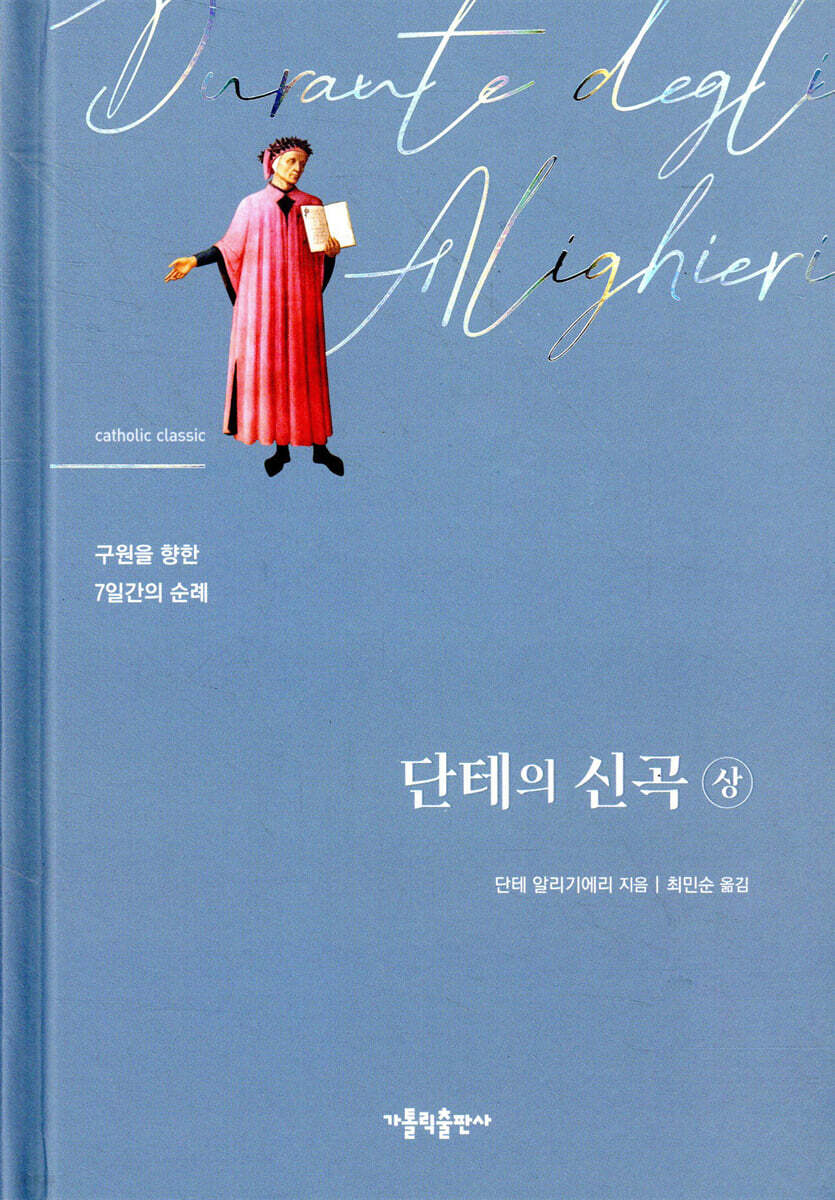
Dante's Divine Comedy (Part 1)
 |
Description
Book Introduction
The greatest masterpiece in medieval literature, Dante's Divine Comedy
There are few people who do not know Dante's Divine Comedy, which contains the pilgrimage journey from hell to heaven.
But not many people have actually read it.
Because it is so long and profound, it seems difficult to read at first.
However, this work is T.
Even world-renowned authors such as S. Eliot and Borges confessed that they had a hard time putting down Dante's Divine Comedy, as it is so captivating.
Dante's Divine Comedy, the greatest masterpiece in medieval literature, encompassing the culture, scholarship, and religion of the time, has been published as part of the Catholic Classics series.
We hope you will enjoy this book, translated by Father Choi Min-sun, who, with his knowledge of Christian theology and philosophy and literary talent, preserves the rhythm of the original text and adds abundant footnotes. It features a sophisticated and modern design, luxurious hardcover binding, and an accessible writing style.
There are few people who do not know Dante's Divine Comedy, which contains the pilgrimage journey from hell to heaven.
But not many people have actually read it.
Because it is so long and profound, it seems difficult to read at first.
However, this work is T.
Even world-renowned authors such as S. Eliot and Borges confessed that they had a hard time putting down Dante's Divine Comedy, as it is so captivating.
Dante's Divine Comedy, the greatest masterpiece in medieval literature, encompassing the culture, scholarship, and religion of the time, has been published as part of the Catholic Classics series.
We hope you will enjoy this book, translated by Father Choi Min-sun, who, with his knowledge of Christian theology and philosophy and literary talent, preserves the rhythm of the original text and adds abundant footnotes. It features a sophisticated and modern design, luxurious hardcover binding, and an accessible writing style.
- You can preview some of the book's contents.
Preview
index
Encyclical Letter - Pope Benedict XV, 5
Recommendation | Welcoming the Publication of the Catholic Classics Series · 22
Hell
Song 1, New Song Series, Preface·37
Dark forest.
Three beasts.
Guide.
Song 2: Prologue to Hell·51
The wandering poet.
Three women.
The road to hell.
Song 3: The Gates of Hell - The Prison of the Hwanoe·64
The writing above the door.
Coward.
Acheron River.
Song 4, Ring 1 - Limbo·77
Non-believers.
Old poets and philosophers.
Beautiful castle.
Song 5, 2nd Ring, 93
Minos.
Paolo and Francesca.
Song 6, 3rd Ring, 107
Cerberus.
Chaco.
Work in Florence.
Song 7, 4th Ring, 118
Pluto.
A soul that has sinned against wealth.
Theory of fate.
The Swamp of Styx, the Fifth Ring
Song 8, 5th Ring - February 130
The ship of Phlygias.
Filippo Argenti.
Under the castle of Dis.
Song 9: Outside the Door of Diss·142
Three Fouriers.
angel.
Fire tomb.
The 6th Ring Heretic
Song 10, 6th Ring - 2·155
Epicurus's pattern.
Farinata.
Cavalcanti.
Song 11, 6th Ring - March 168
The Pope's Tomb.
Three types of violence.
Sinners in hell.
Song 12, 7th Ring - 1st Circle·179
Minotaur.
River of blood.
Centaur's Bow.
Song 13, 7th Ring - 2nd Circle·193
The forest of suicides.
Harpieia.
Black dog.
Song 14, 7th Ring - 3rd Circle·206
Burning bee.
Single believers who curse God.
The flow of phlegethon.
Song 15, 7th Ring - 3rd Circle·220
Sad reunion.
Brunetto Latini.
A bleak outlook.
Song 16, 7th Ring - 3rd Circle·232
Three people from Florence.
The story of Florence.
The emergence of monsters.
Song 17, 7th Ring - 3rd Circle·245
Geryon.
Money business.
Above the abyss.
Song 18, 8th Ring - 1st Bag·258
The appearance of Malebolge.
fraud.
Tide.
8th Ring - 2nd Nang Alangsoe
Song 19, 8th Ring - 3rd Lang·271
Simon's sinners.
Nicholas III.
The sigh of the suffering one.
Song 20, 8th Ring - 4th Song·285
Fortune-telling magician.
The history of Mantua.
The rest of the prisoners.
Song 21, 8th Ring - 5th Lang·298
Boiling pitch.
Duck boat.
Malakoda's trick.
Song 22, 8th Ring - 5th Lang·310
The sad fate of Zampolo.
Song 23, 8th Ring - 6th Nang·323
dissembler.
Catalano and Roderingo.
Caiaphas.
Song 24, 8th Ring - 7th Nang·337
Snakes and thieves.
Banni Pucci and his bees.
Song 25, 8th Ring - 7th Nang·351
The fight between Chanpa and Agnoli.
The transformation of Florentine.
Song 26, 8th Ring - 8th Lang·365
Strategist.
Diomedes and Odysseus.
Odysseus telling his final story.
Song 27, 8th Ring - 8th Lang·379
Guido da Montefeltro.
Longing for home.
Punishment for conspiracy.
Song 28, 8th Ring - Song 9, 393
Those who sow the seeds of division.
prophet.
Headless man.
Song 29, 8th Ring - Song 10, 407
Jerry Del Bello.
fraud.
alchemist.
Song 30, 8th Ring - Song 10, 419
Gianni Schicchi.
The death of Maestro Adamo.
Song 31: Between the 8th and 9th Rings, 433
Giants.
The bosom of Antaeus.
Song 32, 9th Ring - 1st Circle·447
Kaina.
Kamichon de pachi.
9th Ring - 2nd Circle
Antenora.
A soul that betrayed its country and comrades.
Song 33, 9th Ring - 2nd Circle, 460
The death of Count Ugolino.
The castle of hunger.
9th Ring - 3rd Circle
Tolomea.
Alberigo.
Song 34, 9th Ring - 4th Circle·475
A soul that betrayed grace.
Lucifer.
Stars in the sky.
Purgatory
Song 1: Prologue to Purgatory·491
Narrative.
Southern sky.
Four stars.
Kato.
Song 2: The Shores of Purgatory·505
Angel's Ship.
The souls that disembark the ship.
Cassella.
Kato's admonition.
Song 3: Outside the Gates of Purgatory (518)
The poets' surprise.
The excommunicators.
The sad story of King Manfredi.
Song 4: Outside the Gates of Purgatory (533)
Excruciating fatigue.
Souls who sinned through laziness.
Bellaqua.
Song 5: Outside the Gates of Purgatory (546)
Those who died screaming.
Jacopo.
Buonconte.
Pia's sorrow.
Song 6: Outside the Gates of Purgatory (560)
Those who died screaming.
Suspicion and answer.
Sordello.
Song 7: Outside the Gates of Purgatory (575)
Virgil and Sordello.
Valley of the King.
Song 8: Outside the Gates of Purgatory (589)
Valley of the Kings.
Guardian angel.
snake.
Kurado.
Song 9: Outside the Gates of Purgatory.
Gates of Purgatory·603
Early morning sleep.
Lady of the Sky.
Angel of Repentance.
Song 10, Book 1: Punishment for Arrogance, 617
The door is open.
The prophecy of the birth of Jesus.
The soul of the proud.
Song 11, Volume 1, Chapter 631, Humility
Humble prayer.
A humble confession.
Humble love.
Song 12, Volume 1, The Road to Volume 2·645
God and pride.
Angel of Humility.
The first P was erased.
Song 13, Book 2, Punishment for Jealousy, 660
The emergency of the gods.
Jealousy and its punishment.
Safia's evil.
Song 14, Volume 2, Jealousy, 675
A conversation between great souls.
A sad prophecy.
Tuscany and Romagna.
Song 15, Book 2: Jealousy, Book 3: Anger·691
Angel of love.
Philosophy of love.
Video image.
Song 16, Volume 3, Anger·705
In the black clouds.
Marco of Lombardy.
The root of evil.
Recommendation | Welcoming the Publication of the Catholic Classics Series · 22
Hell
Song 1, New Song Series, Preface·37
Dark forest.
Three beasts.
Guide.
Song 2: Prologue to Hell·51
The wandering poet.
Three women.
The road to hell.
Song 3: The Gates of Hell - The Prison of the Hwanoe·64
The writing above the door.
Coward.
Acheron River.
Song 4, Ring 1 - Limbo·77
Non-believers.
Old poets and philosophers.
Beautiful castle.
Song 5, 2nd Ring, 93
Minos.
Paolo and Francesca.
Song 6, 3rd Ring, 107
Cerberus.
Chaco.
Work in Florence.
Song 7, 4th Ring, 118
Pluto.
A soul that has sinned against wealth.
Theory of fate.
The Swamp of Styx, the Fifth Ring
Song 8, 5th Ring - February 130
The ship of Phlygias.
Filippo Argenti.
Under the castle of Dis.
Song 9: Outside the Door of Diss·142
Three Fouriers.
angel.
Fire tomb.
The 6th Ring Heretic
Song 10, 6th Ring - 2·155
Epicurus's pattern.
Farinata.
Cavalcanti.
Song 11, 6th Ring - March 168
The Pope's Tomb.
Three types of violence.
Sinners in hell.
Song 12, 7th Ring - 1st Circle·179
Minotaur.
River of blood.
Centaur's Bow.
Song 13, 7th Ring - 2nd Circle·193
The forest of suicides.
Harpieia.
Black dog.
Song 14, 7th Ring - 3rd Circle·206
Burning bee.
Single believers who curse God.
The flow of phlegethon.
Song 15, 7th Ring - 3rd Circle·220
Sad reunion.
Brunetto Latini.
A bleak outlook.
Song 16, 7th Ring - 3rd Circle·232
Three people from Florence.
The story of Florence.
The emergence of monsters.
Song 17, 7th Ring - 3rd Circle·245
Geryon.
Money business.
Above the abyss.
Song 18, 8th Ring - 1st Bag·258
The appearance of Malebolge.
fraud.
Tide.
8th Ring - 2nd Nang Alangsoe
Song 19, 8th Ring - 3rd Lang·271
Simon's sinners.
Nicholas III.
The sigh of the suffering one.
Song 20, 8th Ring - 4th Song·285
Fortune-telling magician.
The history of Mantua.
The rest of the prisoners.
Song 21, 8th Ring - 5th Lang·298
Boiling pitch.
Duck boat.
Malakoda's trick.
Song 22, 8th Ring - 5th Lang·310
The sad fate of Zampolo.
Song 23, 8th Ring - 6th Nang·323
dissembler.
Catalano and Roderingo.
Caiaphas.
Song 24, 8th Ring - 7th Nang·337
Snakes and thieves.
Banni Pucci and his bees.
Song 25, 8th Ring - 7th Nang·351
The fight between Chanpa and Agnoli.
The transformation of Florentine.
Song 26, 8th Ring - 8th Lang·365
Strategist.
Diomedes and Odysseus.
Odysseus telling his final story.
Song 27, 8th Ring - 8th Lang·379
Guido da Montefeltro.
Longing for home.
Punishment for conspiracy.
Song 28, 8th Ring - Song 9, 393
Those who sow the seeds of division.
prophet.
Headless man.
Song 29, 8th Ring - Song 10, 407
Jerry Del Bello.
fraud.
alchemist.
Song 30, 8th Ring - Song 10, 419
Gianni Schicchi.
The death of Maestro Adamo.
Song 31: Between the 8th and 9th Rings, 433
Giants.
The bosom of Antaeus.
Song 32, 9th Ring - 1st Circle·447
Kaina.
Kamichon de pachi.
9th Ring - 2nd Circle
Antenora.
A soul that betrayed its country and comrades.
Song 33, 9th Ring - 2nd Circle, 460
The death of Count Ugolino.
The castle of hunger.
9th Ring - 3rd Circle
Tolomea.
Alberigo.
Song 34, 9th Ring - 4th Circle·475
A soul that betrayed grace.
Lucifer.
Stars in the sky.
Purgatory
Song 1: Prologue to Purgatory·491
Narrative.
Southern sky.
Four stars.
Kato.
Song 2: The Shores of Purgatory·505
Angel's Ship.
The souls that disembark the ship.
Cassella.
Kato's admonition.
Song 3: Outside the Gates of Purgatory (518)
The poets' surprise.
The excommunicators.
The sad story of King Manfredi.
Song 4: Outside the Gates of Purgatory (533)
Excruciating fatigue.
Souls who sinned through laziness.
Bellaqua.
Song 5: Outside the Gates of Purgatory (546)
Those who died screaming.
Jacopo.
Buonconte.
Pia's sorrow.
Song 6: Outside the Gates of Purgatory (560)
Those who died screaming.
Suspicion and answer.
Sordello.
Song 7: Outside the Gates of Purgatory (575)
Virgil and Sordello.
Valley of the King.
Song 8: Outside the Gates of Purgatory (589)
Valley of the Kings.
Guardian angel.
snake.
Kurado.
Song 9: Outside the Gates of Purgatory.
Gates of Purgatory·603
Early morning sleep.
Lady of the Sky.
Angel of Repentance.
Song 10, Book 1: Punishment for Arrogance, 617
The door is open.
The prophecy of the birth of Jesus.
The soul of the proud.
Song 11, Volume 1, Chapter 631, Humility
Humble prayer.
A humble confession.
Humble love.
Song 12, Volume 1, The Road to Volume 2·645
God and pride.
Angel of Humility.
The first P was erased.
Song 13, Book 2, Punishment for Jealousy, 660
The emergency of the gods.
Jealousy and its punishment.
Safia's evil.
Song 14, Volume 2, Jealousy, 675
A conversation between great souls.
A sad prophecy.
Tuscany and Romagna.
Song 15, Book 2: Jealousy, Book 3: Anger·691
Angel of love.
Philosophy of love.
Video image.
Song 16, Volume 3, Anger·705
In the black clouds.
Marco of Lombardy.
The root of evil.
Detailed image

Into the book
There have been many great and good poets who have led mankind from pleasure to virtue.
But no one has achieved the success of Dante.
Dante, with his unparalleled visionary expressions, the richness of his descriptions, and his majestic eloquence, led his readers directly to a life of devotion, and pierced their hearts with an arrow that ignited the love of Christian wisdom.
Dante achieved his goal.
---From the “Regulations”
Halfway through a lifetime of wandering
I was lost and wandering
I was standing in a dark forest.
Ah, this bush, so rough and tough
Even the thought of it makes me shudder
Oh, how wonderful it is to hear this!
---From "Hell Chapter 'Song 1'"
Dante descends to the second circle of the seventh circle, where those who have inflicted violence on their own bodies and property are punished.
Those who commit suicide are becoming trees and forming a forest, and those who commit violence against their property are being torn to pieces by packs of dogs.
---From "Hell Chapter 'Song 13'"
Rejoice, Florence, and be glad also.
Sea, land, and even hell
Your name flutters and shakes the wind.
Among the thieves, there are five of them
As a citizen, I am ashamed…
You guys have nothing to be proud of.
---From "Hell Chapter 'Song 26'"
Dante reaches the perimeter of the envious and sees souls there, with their eyes sewn shut with wire and dressed in ascetic attire.
Among them, Sapia, a woman from Siena, talks to the poet and confesses, “I used to be more pleased with others’ misfortunes than with my own.”
---From "Purgatory Chapter 'Song 13'"
Rome, which was always creating a good world,
We have two suns, one for the world
Another one taught me the way of God.
One kills another, and the sword is a shepherd's staff
After they were tied, both of them pulled each other with great force.
There was no choice but to go to evil.
But no one has achieved the success of Dante.
Dante, with his unparalleled visionary expressions, the richness of his descriptions, and his majestic eloquence, led his readers directly to a life of devotion, and pierced their hearts with an arrow that ignited the love of Christian wisdom.
Dante achieved his goal.
---From the “Regulations”
Halfway through a lifetime of wandering
I was lost and wandering
I was standing in a dark forest.
Ah, this bush, so rough and tough
Even the thought of it makes me shudder
Oh, how wonderful it is to hear this!
---From "Hell Chapter 'Song 1'"
Dante descends to the second circle of the seventh circle, where those who have inflicted violence on their own bodies and property are punished.
Those who commit suicide are becoming trees and forming a forest, and those who commit violence against their property are being torn to pieces by packs of dogs.
---From "Hell Chapter 'Song 13'"
Rejoice, Florence, and be glad also.
Sea, land, and even hell
Your name flutters and shakes the wind.
Among the thieves, there are five of them
As a citizen, I am ashamed…
You guys have nothing to be proud of.
---From "Hell Chapter 'Song 26'"
Dante reaches the perimeter of the envious and sees souls there, with their eyes sewn shut with wire and dressed in ascetic attire.
Among them, Sapia, a woman from Siena, talks to the poet and confesses, “I used to be more pleased with others’ misfortunes than with my own.”
---From "Purgatory Chapter 'Song 13'"
Rome, which was always creating a good world,
We have two suns, one for the world
Another one taught me the way of God.
One kills another, and the sword is a shepherd's staff
After they were tied, both of them pulled each other with great force.
There was no choice but to go to evil.
---From "Purgatory Chapter 'Song 16'"
Publisher's Review
The greatest masterpiece created by human hands
Dante's Divine Comedy is considered one of the greatest works in medieval literature and is still a classic praised as the "flower of Italian literature."
German poet Goethe even praised Dante's Divine Comedy as "the greatest masterpiece ever created by human hands."
However, not many people have actually read Dante's Divine Comedy.
It is true that the content is difficult for Korean readers because it has a Western poetry format that is unfamiliar to us and condenses the content of the Bible from Genesis to the Revelation of John.
Nevertheless, the reason why many people recommend reading Dante's Divine Comedy is because if you read it while savoring the content and imagining it, you can come into contact with the culture, scholarship, and religion of the medieval West all at once in this one book, and feel the essence of Christian literature.
In particular, since it is a literary work that weaves together the pilgrimage from hell to heaven with faith in God, Pope Benedict XV commented on this book as follows:
There have been many great and good poets who have led mankind from pleasure to virtue.
But no one has achieved the success of Dante.
Dante, with his unparalleled visionary expressions, the richness of his descriptions, and his majestic eloquence, led his readers directly to a life of devotion, and pierced their hearts with an arrow that ignited the love of Christian wisdom.
Dante achieved his goal.
- From Pope Benedict XV's 'Encyclical'
Our country's greatest religious poet
Translation by Father Choi Min-sun
“Father Choi Min-sun, who translated Don Quixote and Divine Comedy in the late 1950s, should be considered a miracle.
Of course, the translation is now sleeping in a library, but in terms of the love for the work and the pure desire to share it with readers, it is still unrivaled.”
- Translator Lee Se-wook (from a special interview celebrating the 3rd anniversary of 'Pressian Books')
The late Father Choi Min-sun (died 1975), who translated this book, is Korea's greatest religious poet, well-known for translating not only books such as St. Augustine's Confessions, Psalms and Songs, and Don Quixote, but also prayers we still use today, such as the 'Lord's Prayer' and 'Gloria in Excelsis.'
Even today, Father Choi Min-sun's translation of the Psalms is used to the fullest extent in hymns and liturgies, and his translation is melodious like a song, and it is delicious because it preserves the Korean language as much as possible.
Moreover, Father Choi Min-sun, while translating this book, left behind thousands of footnotes, making full use of his scholarly abilities. Reading the text along with these footnotes allows one to experience the essence of medieval literature even more deeply.
The footnotes in this book are so accurate that they have been referenced by other subsequent translations of the Divine Comedy. They are absolutely necessary footnotes, and because they cannot be left without an understanding of Christianity, their tone is different from that of the footnotes left by other translators.
Even a first-class translator who is fluent in the original language and Korean would not be able to translate properly without a thorough background knowledge of Christian theology and philosophy.
Because it is a footnote containing the Christian faith that Dante was trying to convey.
For this reason, the translation of Dante's Divine Comedy by Father Choi Min-sun, who won the 2nd Korean PEN Association Translation Literature Award in 1960, is still well known in academic circles as a faithful translation that preserves the beauty of the original text.
This can be said to be the result of his excellent re-creation of this work with his outstanding knowledge of Christian theology and philosophy, as well as his literary talent.
In an attempt to preserve the classic nature of this book, he even revived archaic expressions in our language and created a unique writing style.
A treasure trove of humanistic imagination
Dante's Divine Comedy is a work that comprehensively inherits the culture, religion, thought, and scholarship of the medieval West, and is still evaluated today as 'the pinnacle of all literature' and 'an immortal masterpiece in the history of human literature.'
The importance of humanities classics has been increasingly highlighted recently.
Bill Gates said, “Without the humanities, there would be no computers, and there would be no me.” Steve Jobs also said, “All of Apple’s products stand at the intersection of the humanities and technology.”
In fact, it is said that Google and Samsung Electronics have been actively hiring humanities majors recently.
Dante's Divine Comedy stands at the pinnacle of humanistic imagination.
Dante creates the worlds of the underworld, purgatory, and heaven in his imagination to visualize the topic of 'after death.'
And in this vast imagination, he synthesizes all the culture and history of the era in which he lived.
Dante's imagination has been a source of inspiration for countless artists.
It had a profound influence on Renaissance artists such as Giotto, Botticelli, and Michelangelo, as well as modern artists such as Delacroix, Rodin, Gustave Doré, and William Blake.
Milton even said that the reason he wrote Paradise Lost was because he had read Dante's Divine Comedy.
When we feel stuck and at a loss in our social lives, we often use our imagination to the fullest to solve the problem.
That is why imagination is considered a shortcut to becoming a genius.
But just because you want to imagine doesn't mean your imagination will flow.
It is important to train your imagination in everyday life and to be able to use your imagination to solve problems at any moment.
Dante's Divine Comedy has been known for centuries as a great book for training this imagination.
It is a proven book that has served as a treasure trove of humanistic imagination.
Knowing about these books and not reading them is like not being able to take the treasure even though it is right in front of you.
For this reason TS
Even world-renowned writers like Eliot and Borges confessed that it was difficult for them to put down Dante's Divine Comedy.
Dante's Divine Comedy is considered one of the greatest works in medieval literature and is still a classic praised as the "flower of Italian literature."
German poet Goethe even praised Dante's Divine Comedy as "the greatest masterpiece ever created by human hands."
However, not many people have actually read Dante's Divine Comedy.
It is true that the content is difficult for Korean readers because it has a Western poetry format that is unfamiliar to us and condenses the content of the Bible from Genesis to the Revelation of John.
Nevertheless, the reason why many people recommend reading Dante's Divine Comedy is because if you read it while savoring the content and imagining it, you can come into contact with the culture, scholarship, and religion of the medieval West all at once in this one book, and feel the essence of Christian literature.
In particular, since it is a literary work that weaves together the pilgrimage from hell to heaven with faith in God, Pope Benedict XV commented on this book as follows:
There have been many great and good poets who have led mankind from pleasure to virtue.
But no one has achieved the success of Dante.
Dante, with his unparalleled visionary expressions, the richness of his descriptions, and his majestic eloquence, led his readers directly to a life of devotion, and pierced their hearts with an arrow that ignited the love of Christian wisdom.
Dante achieved his goal.
- From Pope Benedict XV's 'Encyclical'
Our country's greatest religious poet
Translation by Father Choi Min-sun
“Father Choi Min-sun, who translated Don Quixote and Divine Comedy in the late 1950s, should be considered a miracle.
Of course, the translation is now sleeping in a library, but in terms of the love for the work and the pure desire to share it with readers, it is still unrivaled.”
- Translator Lee Se-wook (from a special interview celebrating the 3rd anniversary of 'Pressian Books')
The late Father Choi Min-sun (died 1975), who translated this book, is Korea's greatest religious poet, well-known for translating not only books such as St. Augustine's Confessions, Psalms and Songs, and Don Quixote, but also prayers we still use today, such as the 'Lord's Prayer' and 'Gloria in Excelsis.'
Even today, Father Choi Min-sun's translation of the Psalms is used to the fullest extent in hymns and liturgies, and his translation is melodious like a song, and it is delicious because it preserves the Korean language as much as possible.
Moreover, Father Choi Min-sun, while translating this book, left behind thousands of footnotes, making full use of his scholarly abilities. Reading the text along with these footnotes allows one to experience the essence of medieval literature even more deeply.
The footnotes in this book are so accurate that they have been referenced by other subsequent translations of the Divine Comedy. They are absolutely necessary footnotes, and because they cannot be left without an understanding of Christianity, their tone is different from that of the footnotes left by other translators.
Even a first-class translator who is fluent in the original language and Korean would not be able to translate properly without a thorough background knowledge of Christian theology and philosophy.
Because it is a footnote containing the Christian faith that Dante was trying to convey.
For this reason, the translation of Dante's Divine Comedy by Father Choi Min-sun, who won the 2nd Korean PEN Association Translation Literature Award in 1960, is still well known in academic circles as a faithful translation that preserves the beauty of the original text.
This can be said to be the result of his excellent re-creation of this work with his outstanding knowledge of Christian theology and philosophy, as well as his literary talent.
In an attempt to preserve the classic nature of this book, he even revived archaic expressions in our language and created a unique writing style.
A treasure trove of humanistic imagination
Dante's Divine Comedy is a work that comprehensively inherits the culture, religion, thought, and scholarship of the medieval West, and is still evaluated today as 'the pinnacle of all literature' and 'an immortal masterpiece in the history of human literature.'
The importance of humanities classics has been increasingly highlighted recently.
Bill Gates said, “Without the humanities, there would be no computers, and there would be no me.” Steve Jobs also said, “All of Apple’s products stand at the intersection of the humanities and technology.”
In fact, it is said that Google and Samsung Electronics have been actively hiring humanities majors recently.
Dante's Divine Comedy stands at the pinnacle of humanistic imagination.
Dante creates the worlds of the underworld, purgatory, and heaven in his imagination to visualize the topic of 'after death.'
And in this vast imagination, he synthesizes all the culture and history of the era in which he lived.
Dante's imagination has been a source of inspiration for countless artists.
It had a profound influence on Renaissance artists such as Giotto, Botticelli, and Michelangelo, as well as modern artists such as Delacroix, Rodin, Gustave Doré, and William Blake.
Milton even said that the reason he wrote Paradise Lost was because he had read Dante's Divine Comedy.
When we feel stuck and at a loss in our social lives, we often use our imagination to the fullest to solve the problem.
That is why imagination is considered a shortcut to becoming a genius.
But just because you want to imagine doesn't mean your imagination will flow.
It is important to train your imagination in everyday life and to be able to use your imagination to solve problems at any moment.
Dante's Divine Comedy has been known for centuries as a great book for training this imagination.
It is a proven book that has served as a treasure trove of humanistic imagination.
Knowing about these books and not reading them is like not being able to take the treasure even though it is right in front of you.
For this reason TS
Even world-renowned writers like Eliot and Borges confessed that it was difficult for them to put down Dante's Divine Comedy.
GOODS SPECIFICS
- Publication date: November 21, 2021
- Format: Hardcover book binding method guide
- Page count, weight, size: 720 pages | 710g | 128*188*40mm
- ISBN13: 9788932118024
- ISBN10: 8932118027
You may also like
카테고리
korean


korean

![ELLE 엘르 스페셜 에디션 A형 : 12월 [2025]](http://librairie.coreenne.fr/cdn/shop/files/b8e27a3de6c9538896439686c6b0e8fb.jpg?v=1766436872&width=3840)


