

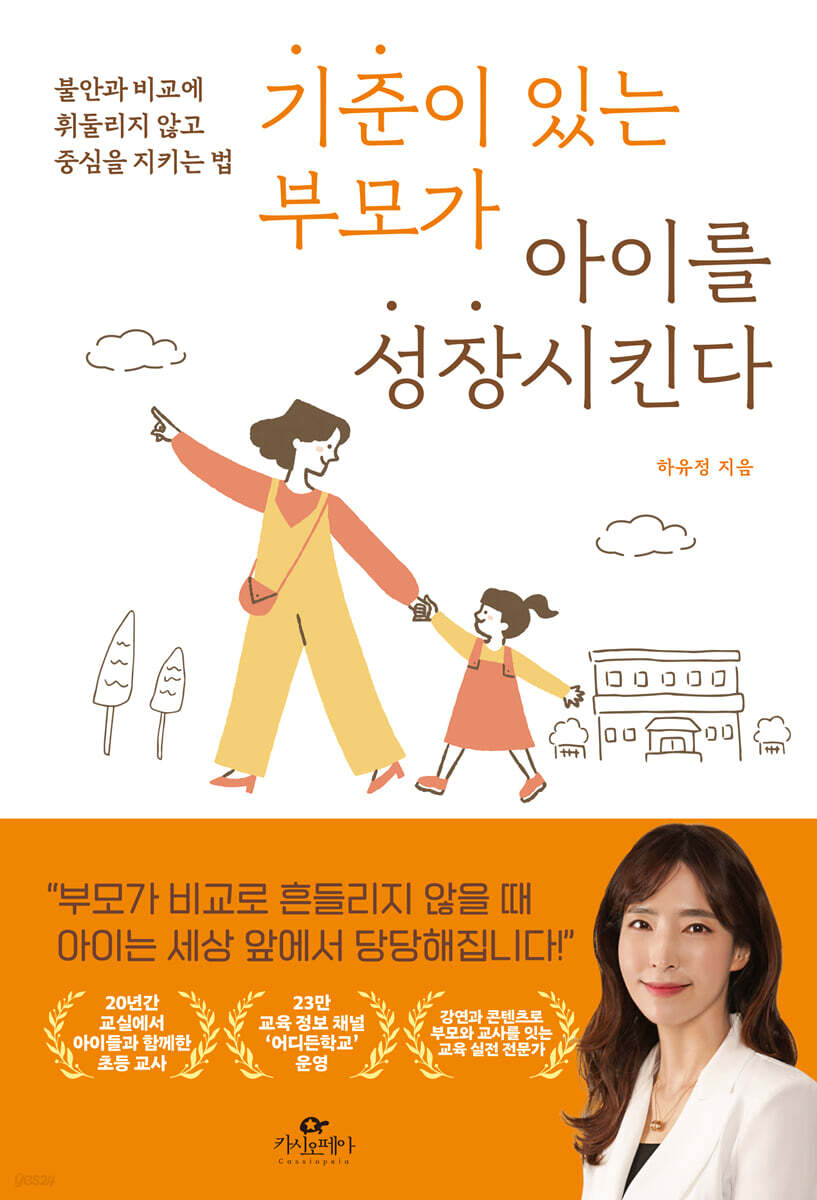
Parents with standards raise their children.
 |
Description
Book Introduction
From private education, pre-learning, to SNS content
What to believe in the flood of information
To parents who are at a loss as to what to follow
Solid advice from an elementary school teacher with 20 years of experience!
Unwavering in the midst of information overload
We teach you how to become a parent
From the private education craze to early English education to stories of "other people's children" on social media, parents are shaken by the daily influx of information and comparisons.
The anxiety of, "If I don't do this, will my child fall behind?" is immediately etched into the child's expression and self-esteem, and the parents' choices become increasingly confined to comparison and control.
But what children need is not the speed to catch up with others, but the unshakable standards set by their parents.
“Parents with Standards Raise Their Children” is a book that sets those very standards.
Author Ha Yu-jeong, an elementary school teacher with 20 years of experience and an educational channel operator with 230,000 subscribers, dissects the mechanisms of why parents are swayed by anxiety based on numerous cases she has encountered in classrooms and lecture halls (Part 1.
'unrest').
Next, we present specific principles and checklists for designing study methods, private education, conversation, and lifestyle habits that are tailored to the child's tendencies and developmental speed (Part 2).
'standard').
The greatest value of this book is ‘standards instead of comparisons.’
Private education should be provided without being excessive, studies should be tailored to the child's personality, conversations should be encouraged to move the child's heart, and parents should be encouraged to establish their own family standards through the small, daily choices they make.
Through this, parents can no longer be shaken and stand at the center of parenting with the confidence that “I know my child best.”
Ultimately, this book will be the most practical guide for parents to transform anxiety into confidence and enable their children to grow steadily at their own pace.
What to believe in the flood of information
To parents who are at a loss as to what to follow
Solid advice from an elementary school teacher with 20 years of experience!
Unwavering in the midst of information overload
We teach you how to become a parent
From the private education craze to early English education to stories of "other people's children" on social media, parents are shaken by the daily influx of information and comparisons.
The anxiety of, "If I don't do this, will my child fall behind?" is immediately etched into the child's expression and self-esteem, and the parents' choices become increasingly confined to comparison and control.
But what children need is not the speed to catch up with others, but the unshakable standards set by their parents.
“Parents with Standards Raise Their Children” is a book that sets those very standards.
Author Ha Yu-jeong, an elementary school teacher with 20 years of experience and an educational channel operator with 230,000 subscribers, dissects the mechanisms of why parents are swayed by anxiety based on numerous cases she has encountered in classrooms and lecture halls (Part 1.
'unrest').
Next, we present specific principles and checklists for designing study methods, private education, conversation, and lifestyle habits that are tailored to the child's tendencies and developmental speed (Part 2).
'standard').
The greatest value of this book is ‘standards instead of comparisons.’
Private education should be provided without being excessive, studies should be tailored to the child's personality, conversations should be encouraged to move the child's heart, and parents should be encouraged to establish their own family standards through the small, daily choices they make.
Through this, parents can no longer be shaken and stand at the center of parenting with the confidence that “I know my child best.”
Ultimately, this book will be the most practical guide for parents to transform anxiety into confidence and enable their children to grow steadily at their own pace.
- You can preview some of the book's contents.
Preview
index
Prologue_ Even in a wavering heart, standards are necessary.
Part 1.
Anxiety_Anxiety becomes the face of parents
1.
Parents without standards are bound to be shaken.
Why do we still feel inferior to academic achievement?
Why the IMF Generation Is Going All-In on Education
Early competition created by specialized high schools
The faster you learn English, the better?
Why do parents choose private education?
The weight of the name "school district"
The media doesn't pace competition.
Information power cannot be the standard for good education.
2.
When your desire to raise your child well makes it difficult for them
The moment when parents' expectations become a 'responsibility' for their children
Children who become good to be loved
Parents' attitudes toward raising children who study independently
When a conversation that touches your heart disappears
If private education is unavoidable, standards must be strict.
※4 Ways to Choose Private Education with Standards
A child's brain shaken by good deeds without foundation work
Why Kids These Days Have Lack of Social Skills
Children who grow up quickly fall apart during puberty.
Resilience comes from emotional memory, not knowledge.
3.
Reflecting on Parents' Anxiety
I think it's okay to be a good parent if you go ahead.
This is the academy that the child from that house goes to.
The bare face of educational anxiety revealed by the '7-year-old civil service exam'
Parents' emotions must be managed first.
My expression becomes like a child's
The popcorn of negative thoughts that anxiety causes
Parental depression begins with rumination.
Part 2.
Standard_Standard becomes a mirror for the child
4.
How is studying with standards possible?
What is standardized study?
Study methods vary depending on the child's personality and grade.
※ 3 essential studies elementary school students must do every day
Private education with principles is okay
※My child's private education summary with criteria
Time spent at rest helps children grow.
Is prior learning really the right answer?
Study leadership comes from 'trusting parents'
Metacognition: The power of children to design their own studies
Create a Career Profile for Your Child
An attitude toward life that prepares for opportunity
The home environment needs to be changed before studying.
※ Q&A to resolve concerns for deeper immersion
Just changing your words can improve your intrinsic motivation.
※ Q&A on Parents' Conversation Methods to Open Their Children's Hearts
5.
Establishing unwavering standards for our family
Break free from evaluation and comparison
Four criteria for selecting educational information
How to Practice an Information Diet in the Social Media Age
A house with standards welcomes failure.
Parenting standards established by parents together
6.
Caring for parents' emotional recovery
Five Types of Parents Who React to Education Anxiety
Breaking the Vicious Cycle of Emotions Created by Educational Anxiety
Don't mix your emotions into conversations with your child.
Comforting the hearts of parents who are blaming themselves
Epilogue: The standard is ultimately within us.
Part 1.
Anxiety_Anxiety becomes the face of parents
1.
Parents without standards are bound to be shaken.
Why do we still feel inferior to academic achievement?
Why the IMF Generation Is Going All-In on Education
Early competition created by specialized high schools
The faster you learn English, the better?
Why do parents choose private education?
The weight of the name "school district"
The media doesn't pace competition.
Information power cannot be the standard for good education.
2.
When your desire to raise your child well makes it difficult for them
The moment when parents' expectations become a 'responsibility' for their children
Children who become good to be loved
Parents' attitudes toward raising children who study independently
When a conversation that touches your heart disappears
If private education is unavoidable, standards must be strict.
※4 Ways to Choose Private Education with Standards
A child's brain shaken by good deeds without foundation work
Why Kids These Days Have Lack of Social Skills
Children who grow up quickly fall apart during puberty.
Resilience comes from emotional memory, not knowledge.
3.
Reflecting on Parents' Anxiety
I think it's okay to be a good parent if you go ahead.
This is the academy that the child from that house goes to.
The bare face of educational anxiety revealed by the '7-year-old civil service exam'
Parents' emotions must be managed first.
My expression becomes like a child's
The popcorn of negative thoughts that anxiety causes
Parental depression begins with rumination.
Part 2.
Standard_Standard becomes a mirror for the child
4.
How is studying with standards possible?
What is standardized study?
Study methods vary depending on the child's personality and grade.
※ 3 essential studies elementary school students must do every day
Private education with principles is okay
※My child's private education summary with criteria
Time spent at rest helps children grow.
Is prior learning really the right answer?
Study leadership comes from 'trusting parents'
Metacognition: The power of children to design their own studies
Create a Career Profile for Your Child
An attitude toward life that prepares for opportunity
The home environment needs to be changed before studying.
※ Q&A to resolve concerns for deeper immersion
Just changing your words can improve your intrinsic motivation.
※ Q&A on Parents' Conversation Methods to Open Their Children's Hearts
5.
Establishing unwavering standards for our family
Break free from evaluation and comparison
Four criteria for selecting educational information
How to Practice an Information Diet in the Social Media Age
A house with standards welcomes failure.
Parenting standards established by parents together
6.
Caring for parents' emotional recovery
Five Types of Parents Who React to Education Anxiety
Breaking the Vicious Cycle of Emotions Created by Educational Anxiety
Don't mix your emotions into conversations with your child.
Comforting the hearts of parents who are blaming themselves
Epilogue: The standard is ultimately within us.
Detailed image

Into the book
There's nothing easy in this world, but being a parent seems to be one of the hardest things.
That's understandable, because we all became parents without ever having been parents ourselves.
Still, you are already good enough parents.
Just thinking about a better way for my child is enough.
--- p.009
“I couldn’t do more than this due to my circumstances, but I want to make sure that my daughter does well.”
This is really strange.
Although it is called love, underneath it flows the emotion called ‘anxiety.’
The compulsion to start early, the impatience to not be later than others, the vague expectation that you should live at least better than me.
But it seems that that 'hard work' doesn't always have a positive effect on the child.
Sometimes, the child may quietly sense that the mother is anxious and keeps comparing herself to others.
--- p.025
Actually, we know.
There are only a very small number of videos of other people's children being interviewed in English.
Even the kid who passed the ○○ Academy level test probably doesn't always study with a smile on his face.
But the reason I feel anxious is because that scene doesn't seem like someone else's story, but because it keeps seeming like it's my child's story.
Then, suddenly, the thought, ‘I wish my child could do as much as that…’ quietly touches a part of my heart and passes by.
The sayings, "The sooner you learn, the better," and "You have to be ahead of others," aren't always true.
It doesn't give you time to think about whether it's right for your child.
Now is the time when ‘information discernment’ is more important than ‘information gathering.’
Rather than following what everyone else is doing, parents must first have the courage to keep what is essential for their children and filter out unnecessary information.
-pp.048~049
It's okay if it's a little slow.
It's okay if you don't know everything.
The standard by which you can judge for yourself 'the right path for your child' and that strong inner strength will give you strength as a parent.
Information is like a buoy floating on the sea.
They tell you where things are, but how you navigate the current ultimately depends on which way you row.
--- p.051
Yes, I will send you to an academy too.
Even I, who had only dug one well called education, could not help but knock on that door as my child grew up.
However, I would like to convey 'how it was sent' rather than 'where it was sent'.
I have one rule:
I never choose an instructor because others said they were good or because they were well-known by word of mouth.
The reason is simple.
There's no guarantee that it'll be good for my child.
--- pp.076~077
If you find yourself having recurring negative thoughts and don't know why, ask yourself these questions:
"Do I want my child to grow up right now? Or do I want to be recognized as a good parent?" Reflecting on where my inner desires stem from is the first step toward shifting my thinking.
--- p.135
In a fiercely competitive structure, a child who has been exposed to the content at least once in advance
It is an undeniable fact that it is relatively less embarrassing.
Good deeds themselves are not bad.
Rather, insisting that you "must go slowly" can make things more difficult for the child.
That doesn't mean that all good deeds are '
It is not right to say that we must return to 'more, faster, and more'.
In the end, isn't what matters the wisdom of parents who can accurately read their child's unique pace and needs?
--- p.177
“What a child needs is not a perfect mother, but a mother who is good enough.”
The 'good enough' mentioned here refers to a relationship that initially responds sensitively to the child's needs, but gradually reduces that response appropriately, helping the child face the world on his or her own.
child's homework
Rather than immediately helping or doing it for the child when they get annoyed and say they don't want to do something, wait for the child to think about it on their own and have a chance to start on their own.
When you tell a friend about an argument, rather than offering an immediate solution, say, “That’s right.
“Oh, I see!” It is a time to listen to the child’s feelings first.
That is the appropriate intervention that a 'good enough parent' would provide.
That 'appropriate distance' between waiting and intervention is 'good enough' parenting.
That's understandable, because we all became parents without ever having been parents ourselves.
Still, you are already good enough parents.
Just thinking about a better way for my child is enough.
--- p.009
“I couldn’t do more than this due to my circumstances, but I want to make sure that my daughter does well.”
This is really strange.
Although it is called love, underneath it flows the emotion called ‘anxiety.’
The compulsion to start early, the impatience to not be later than others, the vague expectation that you should live at least better than me.
But it seems that that 'hard work' doesn't always have a positive effect on the child.
Sometimes, the child may quietly sense that the mother is anxious and keeps comparing herself to others.
--- p.025
Actually, we know.
There are only a very small number of videos of other people's children being interviewed in English.
Even the kid who passed the ○○ Academy level test probably doesn't always study with a smile on his face.
But the reason I feel anxious is because that scene doesn't seem like someone else's story, but because it keeps seeming like it's my child's story.
Then, suddenly, the thought, ‘I wish my child could do as much as that…’ quietly touches a part of my heart and passes by.
The sayings, "The sooner you learn, the better," and "You have to be ahead of others," aren't always true.
It doesn't give you time to think about whether it's right for your child.
Now is the time when ‘information discernment’ is more important than ‘information gathering.’
Rather than following what everyone else is doing, parents must first have the courage to keep what is essential for their children and filter out unnecessary information.
-pp.048~049
It's okay if it's a little slow.
It's okay if you don't know everything.
The standard by which you can judge for yourself 'the right path for your child' and that strong inner strength will give you strength as a parent.
Information is like a buoy floating on the sea.
They tell you where things are, but how you navigate the current ultimately depends on which way you row.
--- p.051
Yes, I will send you to an academy too.
Even I, who had only dug one well called education, could not help but knock on that door as my child grew up.
However, I would like to convey 'how it was sent' rather than 'where it was sent'.
I have one rule:
I never choose an instructor because others said they were good or because they were well-known by word of mouth.
The reason is simple.
There's no guarantee that it'll be good for my child.
--- pp.076~077
If you find yourself having recurring negative thoughts and don't know why, ask yourself these questions:
"Do I want my child to grow up right now? Or do I want to be recognized as a good parent?" Reflecting on where my inner desires stem from is the first step toward shifting my thinking.
--- p.135
In a fiercely competitive structure, a child who has been exposed to the content at least once in advance
It is an undeniable fact that it is relatively less embarrassing.
Good deeds themselves are not bad.
Rather, insisting that you "must go slowly" can make things more difficult for the child.
That doesn't mean that all good deeds are '
It is not right to say that we must return to 'more, faster, and more'.
In the end, isn't what matters the wisdom of parents who can accurately read their child's unique pace and needs?
--- p.177
“What a child needs is not a perfect mother, but a mother who is good enough.”
The 'good enough' mentioned here refers to a relationship that initially responds sensitively to the child's needs, but gradually reduces that response appropriately, helping the child face the world on his or her own.
child's homework
Rather than immediately helping or doing it for the child when they get annoyed and say they don't want to do something, wait for the child to think about it on their own and have a chance to start on their own.
When you tell a friend about an argument, rather than offering an immediate solution, say, “That’s right.
“Oh, I see!” It is a time to listen to the child’s feelings first.
That is the appropriate intervention that a 'good enough parent' would provide.
That 'appropriate distance' between waiting and intervention is 'good enough' parenting.
--- p.314
Publisher's Review
Will you be shaken by looking at others through comparison?
Will you look after your child based on standards?
In the midst of the flood of information, what is ultimately more important to parents is ‘our own family’s standards.’
Rather than looking at the examples of successful people or learning methods floating around online, it's important to have the discernment to choose the study method that's right for your child.
The direction of study should vary depending on the child's personality and developmental rate, and parents should maintain a balanced approach to private education so that it is not excessive but not neglected.
This book provides key questions and checklists needed to establish such standards, and presents a practical framework that connects study, life, and conversation.
Especially in an age where it is easy to be swept away by educational information, the greatest value of this book is that it fosters an eye for looking at children through standards rather than comparisons.
After reading this book, parents will no longer be swayed by their surroundings, but will have the standards to make clear and confident choices that are right for their child right now.
The standard is not a grand philosophy.
It starts with small, repeated choices.
Standards don't start with grand philosophies.
Every word I say to my child today, every little habit I have of organizing our day together, every attitude I have toward failure, it all naturally becomes embedded in them.
The daily choices parents make without thinking accumulate to create their child's inner self, and the accumulated experiences ultimately lead to the child's self-esteem and resilience.
"Parents with Standards Raise Their Children" shows how parents can put these small, specific standards into practice in their lives.
It's packed with questions and examples you can apply today, from learning how to regulate your emotions, to a solid study routine, to conversations that open your child's heart, to principles for choosing private education.
This book is not just a simple educational guide, but also a guide that helps parents transform anxiety into 'confident action.'
If parents can regain their balance even when they are shaken, their children can safely take root and grow at their own pace.
It clearly proves that it is not perfect information that raises children, but rather the attitude of parents who return to the standard even when shaken that supports the child's growth.
From shaky anxiety to solid standards!
Parental growth frame completed with two axes
This book is composed of two axes: Part 1, ‘Anxiety’, and Part 2, ‘Standards’.
Part 1 reveals the true nature of the emotions that parents cannot help but feel.
It identifies the sources of anxiety that permeate our daily lives, such as private education, early learning, and social media comparisons, and shows through specific examples how these factors affect children's self-esteem and attitudes.
Through this, parents first come to realize 'why I am shaken'.
Part 2 presents the power to overcome anxiety, that is, how to establish unshakable standards for our own home.
It contains specific questions and checklists that can be applied directly to daily life, including study methods tailored to the child's personality and developmental pace, principles for selecting private education, emotional recovery routines, and living standards established together as a family.
Through this process, readers not only reduce their anxiety, but also grow into parents who look at their children with unwavering trust.
In other words, this book is not simply a book that provides educational information, but provides a practical framework that parents can establish themselves and guide their children's growth.
Ultimately, when the book is closed, parents will have acquired the most certain parenting asset: a center to which they can return even when they falter.
Will you look after your child based on standards?
In the midst of the flood of information, what is ultimately more important to parents is ‘our own family’s standards.’
Rather than looking at the examples of successful people or learning methods floating around online, it's important to have the discernment to choose the study method that's right for your child.
The direction of study should vary depending on the child's personality and developmental rate, and parents should maintain a balanced approach to private education so that it is not excessive but not neglected.
This book provides key questions and checklists needed to establish such standards, and presents a practical framework that connects study, life, and conversation.
Especially in an age where it is easy to be swept away by educational information, the greatest value of this book is that it fosters an eye for looking at children through standards rather than comparisons.
After reading this book, parents will no longer be swayed by their surroundings, but will have the standards to make clear and confident choices that are right for their child right now.
The standard is not a grand philosophy.
It starts with small, repeated choices.
Standards don't start with grand philosophies.
Every word I say to my child today, every little habit I have of organizing our day together, every attitude I have toward failure, it all naturally becomes embedded in them.
The daily choices parents make without thinking accumulate to create their child's inner self, and the accumulated experiences ultimately lead to the child's self-esteem and resilience.
"Parents with Standards Raise Their Children" shows how parents can put these small, specific standards into practice in their lives.
It's packed with questions and examples you can apply today, from learning how to regulate your emotions, to a solid study routine, to conversations that open your child's heart, to principles for choosing private education.
This book is not just a simple educational guide, but also a guide that helps parents transform anxiety into 'confident action.'
If parents can regain their balance even when they are shaken, their children can safely take root and grow at their own pace.
It clearly proves that it is not perfect information that raises children, but rather the attitude of parents who return to the standard even when shaken that supports the child's growth.
From shaky anxiety to solid standards!
Parental growth frame completed with two axes
This book is composed of two axes: Part 1, ‘Anxiety’, and Part 2, ‘Standards’.
Part 1 reveals the true nature of the emotions that parents cannot help but feel.
It identifies the sources of anxiety that permeate our daily lives, such as private education, early learning, and social media comparisons, and shows through specific examples how these factors affect children's self-esteem and attitudes.
Through this, parents first come to realize 'why I am shaken'.
Part 2 presents the power to overcome anxiety, that is, how to establish unshakable standards for our own home.
It contains specific questions and checklists that can be applied directly to daily life, including study methods tailored to the child's personality and developmental pace, principles for selecting private education, emotional recovery routines, and living standards established together as a family.
Through this process, readers not only reduce their anxiety, but also grow into parents who look at their children with unwavering trust.
In other words, this book is not simply a book that provides educational information, but provides a practical framework that parents can establish themselves and guide their children's growth.
Ultimately, when the book is closed, parents will have acquired the most certain parenting asset: a center to which they can return even when they falter.
GOODS SPECIFICS
- Date of issue: August 26, 2025
- Page count, weight, size: 324 pages | 150*220*30mm
- ISBN13: 9791168273375
- ISBN10: 1168273374
You may also like
카테고리
korean


korean

![GQ KOREA Mark (Monthly): December [2025]](http://librairie.coreenne.fr/cdn/shop/files/8ef265dbbfbf186523ed75ba7319009d.jpg?v=1765340328&width=3840)


