

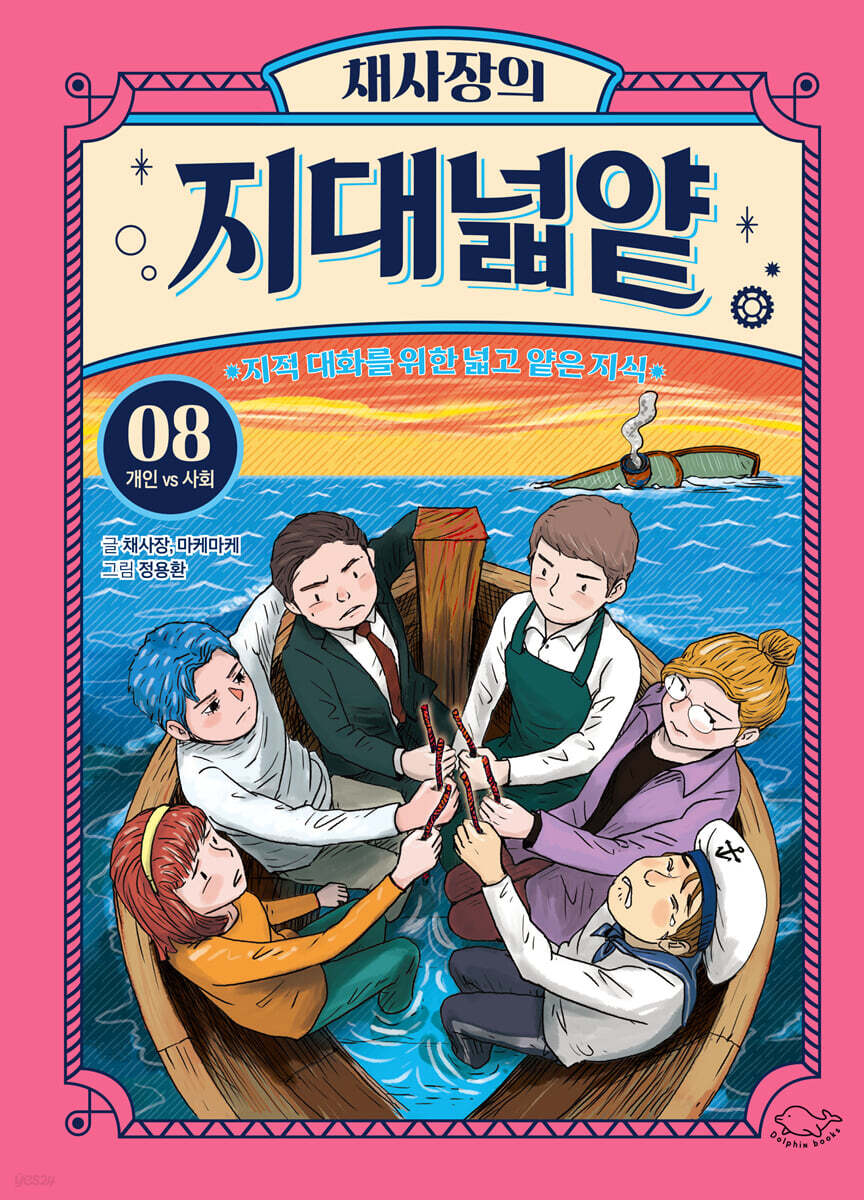
Cha Sa-jang's Broad and Shallow Land 8: Individual VS Society
 |
Description
Book Introduction
Following the adult bestseller, it became a children's bestseller.
The Reality Chapter of "The Broad and Shallow Land of the Chae Family" concludes.
History, economics, politics, society, ethics
A map of the real world culture drawn by CEO Chae in an easy and fun way
“You talk to your elementary school children about history, economics, and politics?
“It is possible if you read this book.”
A book that helps Korean children discover and enjoy the joy of intellectual conversation.
The humanities and liberal arts story comic series for children, "Cha Sa-jang's Wide and Shallow Land," received an enthusiastic response immediately after its release, and with each subsequent release, it has established itself as a must-read that satisfies both parents and children.
This book, which is beneficial for everyone from elementary school students to middle school students and adults, has become a 'recommended item' that people confidently recommend to their loved ones through word of mouth, and the joy of intellectual conversation is also spreading.
Culture is no longer a special and difficult culture, but rather an intellectual pastime enjoyed by all generations.
Studying for a test is boring, but acquiring knowledge for conversation is a pleasant experience.
Moreover, it was a thrilling joy to see those pieces of knowledge link together to form a simple, solid structure in my head.
The knowledge that a child acquires through 『Cha Sa-jang's Wide and Shallow Land』 will become a common denominator that will allow them to have enjoyable conversations with people from any country in the world someday in the future.
The journey of knowledge that began with the Alpha of Choreopsin passed through the areas of ‘history’, ‘economics’, and ‘politics’ and has now reached the areas of ‘society’ and ‘ethics’.
The 'Society' section of this book deals with conflicts between individuals and groups.
In particular, we will see how individualism and totalitarianism have conflicted in modern and contemporary history.
You can also learn how the two major pillars of 'ethical' philosophy, 'deontology' and 'teleology', are connected to issues of wealth gap and tax distribution in real society.
It may be a difficult and complex discourse, but as you encounter it through the characters' adventures, you will soon feel as if the knowledge has been embodied in your own body.
In particular, 『Cha Sa-jang's Broad and Shallow Knowledge 8: Individual VS Society』 is the final edition of the 'reality' section of Volume 1 of 『Broad and Shallow Knowledge for Intellectual Conversation』 written for adults.
Through the long storyline spanning from Volume 1 to Volume 8, readers learned about history, economics, politics, society, and ethics through the stories of Alpha and Chae, and came to realize that all of these areas are in fact closely connected.
This book structures a simple classification system that covers this vast area and summarizes it in a single, easy-to-understand diagram.
This structure is a minimal plot that summarizes the real world.
If young readers understand this plot, they will have a foundation for understanding themselves and others.
It is now up to each individual to draw the detailed branches.
Our children will be able to expand a vast forest of knowledge and wisdom based on strong roots.
The Reality Chapter of "The Broad and Shallow Land of the Chae Family" concludes.
History, economics, politics, society, ethics
A map of the real world culture drawn by CEO Chae in an easy and fun way
“You talk to your elementary school children about history, economics, and politics?
“It is possible if you read this book.”
A book that helps Korean children discover and enjoy the joy of intellectual conversation.
The humanities and liberal arts story comic series for children, "Cha Sa-jang's Wide and Shallow Land," received an enthusiastic response immediately after its release, and with each subsequent release, it has established itself as a must-read that satisfies both parents and children.
This book, which is beneficial for everyone from elementary school students to middle school students and adults, has become a 'recommended item' that people confidently recommend to their loved ones through word of mouth, and the joy of intellectual conversation is also spreading.
Culture is no longer a special and difficult culture, but rather an intellectual pastime enjoyed by all generations.
Studying for a test is boring, but acquiring knowledge for conversation is a pleasant experience.
Moreover, it was a thrilling joy to see those pieces of knowledge link together to form a simple, solid structure in my head.
The knowledge that a child acquires through 『Cha Sa-jang's Wide and Shallow Land』 will become a common denominator that will allow them to have enjoyable conversations with people from any country in the world someday in the future.
The journey of knowledge that began with the Alpha of Choreopsin passed through the areas of ‘history’, ‘economics’, and ‘politics’ and has now reached the areas of ‘society’ and ‘ethics’.
The 'Society' section of this book deals with conflicts between individuals and groups.
In particular, we will see how individualism and totalitarianism have conflicted in modern and contemporary history.
You can also learn how the two major pillars of 'ethical' philosophy, 'deontology' and 'teleology', are connected to issues of wealth gap and tax distribution in real society.
It may be a difficult and complex discourse, but as you encounter it through the characters' adventures, you will soon feel as if the knowledge has been embodied in your own body.
In particular, 『Cha Sa-jang's Broad and Shallow Knowledge 8: Individual VS Society』 is the final edition of the 'reality' section of Volume 1 of 『Broad and Shallow Knowledge for Intellectual Conversation』 written for adults.
Through the long storyline spanning from Volume 1 to Volume 8, readers learned about history, economics, politics, society, and ethics through the stories of Alpha and Chae, and came to realize that all of these areas are in fact closely connected.
This book structures a simple classification system that covers this vast area and summarizes it in a single, easy-to-understand diagram.
This structure is a minimal plot that summarizes the real world.
If young readers understand this plot, they will have a foundation for understanding themselves and others.
It is now up to each individual to draw the detailed branches.
Our children will be able to expand a vast forest of knowledge and wisdom based on strong roots.
- You can preview some of the book's contents.
Preview
index
Prologue: Old Friends
1.
Should we blow up that dam?
- Individual and Society
[Chairman Cha's Key Notes] When Individual and Social Interests Conflict
[Master's Report] Are Western and Eastern thinking different?
[Break time] Find Omega
2.
The village where patients live
- Egoism and totalitarianism
[Chairman Cha's Key Note] Totalitarianism Turns a Blind Eye to Individual Unethical Behavior
[Master's Report] The Tragedy of Totalitarianism
[Break time] Totalitarian leader
3.
For a fair society
- Ethical judgment
[Chairman Cha's Key Notes] What Kind of Society Is Ethical?
[Master's Report] The Veil of Ignorance
[Break time] The Rich Mouse and the Poor Mouse
4.
The lifeboat dilemma
- Deontology and teleology
[Chairman Cha's Key Notes] Ethical Situations That Put Us to the Test
[Master's Report] What is ethics?
[Break Time] Choice: Deontology vs. Teleology
5.
Return map
- Categorical imperative and utilitarianism
[Cha Sa-jang's Key Notes] Kant and Mill
[Master's Report] Utilitarianism
[Break time] Crossword puzzle
Epilogue: Secrets of the World
Final summary
A comprehensive summary of politics, society, and ethics
1.
Should we blow up that dam?
- Individual and Society
[Chairman Cha's Key Notes] When Individual and Social Interests Conflict
[Master's Report] Are Western and Eastern thinking different?
[Break time] Find Omega
2.
The village where patients live
- Egoism and totalitarianism
[Chairman Cha's Key Note] Totalitarianism Turns a Blind Eye to Individual Unethical Behavior
[Master's Report] The Tragedy of Totalitarianism
[Break time] Totalitarian leader
3.
For a fair society
- Ethical judgment
[Chairman Cha's Key Notes] What Kind of Society Is Ethical?
[Master's Report] The Veil of Ignorance
[Break time] The Rich Mouse and the Poor Mouse
4.
The lifeboat dilemma
- Deontology and teleology
[Chairman Cha's Key Notes] Ethical Situations That Put Us to the Test
[Master's Report] What is ethics?
[Break Time] Choice: Deontology vs. Teleology
5.
Return map
- Categorical imperative and utilitarianism
[Cha Sa-jang's Key Notes] Kant and Mill
[Master's Report] Utilitarianism
[Break time] Crossword puzzle
Epilogue: Secrets of the World
Final summary
A comprehensive summary of politics, society, and ethics
Detailed image

Publisher's Review
On a sinking lifeboat!
To save everyone, you have to throw one person into the sea?!
An amazing social experiment unfolds that will awaken our insight!
Humans are social animals.
An individual cannot live apart from society, and society cannot exist without individuals.
The two entities cannot help but coexist, but in specific situations they may come into conflict.
Cases where individual rights and societal interests come into conflict have occurred countless times throughout history, and they are still happening today.
In Volume 8, we will explore the dangers of egoism and totalitarianism that arise when individualism and collectivism become extreme through a hypothetical situation where individuals and groups are in conflict.
In particular, humanity has experienced violence and fear caused by totalitarianism throughout modern and contemporary history.
To avoid repeating this terrible history, we need to learn the value and preciousness of individual life, property, and freedom.
So how should we evaluate and judge the history, economy, politics, and society that unfold in the real world?
To learn this standard, we also explore the realm of ethics.
Learn the difference between deontology and teleology, represented by categorical imperatives and utilitarianism.
This is not the boring discourse of philosophers of the past.
It is the standard that determines the direction of real society.
This book provides a variety of questions about how to intervene in conflicts prevalent in society, such as the gap between the rich and the poor and tax issues, and what decisions should be made to create a fair society.
The social studies subjects “Ethics and Thought” and “Life and Ethics” are considered difficult subjects that torment students preparing for the CSAT.
Most students preparing for the college entrance exam studied by memorization, but this is closely related to real life and is a perspective we must understand.
Teleology, deontology, categorical imperatives, and utilitarianism, which are regular topics on the college entrance exam, are certainly unfamiliar concepts to elementary school students, but if you familiarize yourself with them in advance through stories based on famous thought experiments widely known in the history of philosophy, it will not be difficult.
You may even find yourself enjoying the discussion as if it were a game.
An instant bestseller
Boy's Korea's Best Children's Book Selection
The Best Children's Humanities Books, Proven by Reader Reviews
We live in an age where more learning materials than ever are available through books and media.
Today's children take in a lot of information, but they may not have the time or energy to synthesize that knowledge and digest it into their own thoughts.
What we need more than anything is to connect the flow of knowledge and make it our own.
Speaking 'my thoughts' is not something that can be studied by memorizing.
For children who need to understand hidden meanings and contexts and apply them to real life, this book will be an excellent teacher and discussion forum.
As important as knowledge is the power of thinking.
1.
Korea's first full-fledged humanities story comic for children!
By conveying only the core knowledge of history and economics in an easy and fun way, we can make the difficult and complex humanities easier to understand.
It's organized into one easy-to-understand line.
2.
Providing the 'real knowledge' needed to survive in the world.
The meaning of the market, government intervention, taxes and welfare, various economic systems, etc.
It contains the learning content learned in school, but also provides real knowledge that is not taught in school.
3.
A cultural comic format you've never seen before, 100% worth collecting!
With text and pictures that are different from previous educational cartoons
Rather than providing only fragmentary information, we cultivate the ability to think for oneself and develop a perspective on the world.
4.
Brain-stimulating stories + mind-stimulating knowledge
Through the story of the protagonist Alpha struggling to live with capitalism,
You can experience a unique reading experience with "stories that awaken the mind and knowledge that touches the heart."
5.
A knowledge series that explains everything about the world and life.
The important thing is to see the forest! Helping children broaden their understanding of the world.
It teaches wisdom beyond knowledge, how to live in the future.
How to read this book
1.
If you follow the life of the main character in the story, you can understand the flow of information.
2.
Think about how each character's position differs and where your thoughts are closer to.
3.
Find the key economic words in [Chairman Cha's Key Notes].
4.
Let's connect the knowledge that you are curious about by looking at [Master's Report].
5.
It's more fun to summarize a book briefly in [Final Summary] and discuss it with people around you.
# Appendix [Real World Summary Poster]
Check out how the history, economics, politics, society, and ethics you learned from Volumes 1 through 8 are organized into one.
To save everyone, you have to throw one person into the sea?!
An amazing social experiment unfolds that will awaken our insight!
Humans are social animals.
An individual cannot live apart from society, and society cannot exist without individuals.
The two entities cannot help but coexist, but in specific situations they may come into conflict.
Cases where individual rights and societal interests come into conflict have occurred countless times throughout history, and they are still happening today.
In Volume 8, we will explore the dangers of egoism and totalitarianism that arise when individualism and collectivism become extreme through a hypothetical situation where individuals and groups are in conflict.
In particular, humanity has experienced violence and fear caused by totalitarianism throughout modern and contemporary history.
To avoid repeating this terrible history, we need to learn the value and preciousness of individual life, property, and freedom.
So how should we evaluate and judge the history, economy, politics, and society that unfold in the real world?
To learn this standard, we also explore the realm of ethics.
Learn the difference between deontology and teleology, represented by categorical imperatives and utilitarianism.
This is not the boring discourse of philosophers of the past.
It is the standard that determines the direction of real society.
This book provides a variety of questions about how to intervene in conflicts prevalent in society, such as the gap between the rich and the poor and tax issues, and what decisions should be made to create a fair society.
The social studies subjects “Ethics and Thought” and “Life and Ethics” are considered difficult subjects that torment students preparing for the CSAT.
Most students preparing for the college entrance exam studied by memorization, but this is closely related to real life and is a perspective we must understand.
Teleology, deontology, categorical imperatives, and utilitarianism, which are regular topics on the college entrance exam, are certainly unfamiliar concepts to elementary school students, but if you familiarize yourself with them in advance through stories based on famous thought experiments widely known in the history of philosophy, it will not be difficult.
You may even find yourself enjoying the discussion as if it were a game.
An instant bestseller
Boy's Korea's Best Children's Book Selection
The Best Children's Humanities Books, Proven by Reader Reviews
We live in an age where more learning materials than ever are available through books and media.
Today's children take in a lot of information, but they may not have the time or energy to synthesize that knowledge and digest it into their own thoughts.
What we need more than anything is to connect the flow of knowledge and make it our own.
Speaking 'my thoughts' is not something that can be studied by memorizing.
For children who need to understand hidden meanings and contexts and apply them to real life, this book will be an excellent teacher and discussion forum.
As important as knowledge is the power of thinking.
1.
Korea's first full-fledged humanities story comic for children!
By conveying only the core knowledge of history and economics in an easy and fun way, we can make the difficult and complex humanities easier to understand.
It's organized into one easy-to-understand line.
2.
Providing the 'real knowledge' needed to survive in the world.
The meaning of the market, government intervention, taxes and welfare, various economic systems, etc.
It contains the learning content learned in school, but also provides real knowledge that is not taught in school.
3.
A cultural comic format you've never seen before, 100% worth collecting!
With text and pictures that are different from previous educational cartoons
Rather than providing only fragmentary information, we cultivate the ability to think for oneself and develop a perspective on the world.
4.
Brain-stimulating stories + mind-stimulating knowledge
Through the story of the protagonist Alpha struggling to live with capitalism,
You can experience a unique reading experience with "stories that awaken the mind and knowledge that touches the heart."
5.
A knowledge series that explains everything about the world and life.
The important thing is to see the forest! Helping children broaden their understanding of the world.
It teaches wisdom beyond knowledge, how to live in the future.
How to read this book
1.
If you follow the life of the main character in the story, you can understand the flow of information.
2.
Think about how each character's position differs and where your thoughts are closer to.
3.
Find the key economic words in [Chairman Cha's Key Notes].
4.
Let's connect the knowledge that you are curious about by looking at [Master's Report].
5.
It's more fun to summarize a book briefly in [Final Summary] and discuss it with people around you.
# Appendix [Real World Summary Poster]
Check out how the history, economics, politics, society, and ethics you learned from Volumes 1 through 8 are organized into one.
GOODS SPECIFICS
- Publication date: November 22, 2023
- Format: Hardcover book binding method guide
- Page count, weight, size: 164 pages | 454g | 158*217*16mm
- ISBN13: 9791193487006
- ISBN10: 1193487005
You may also like
카테고리
korean


korean

![GQ KOREA Mark (Monthly): December [2025]](http://librairie.coreenne.fr/cdn/shop/files/8ef265dbbfbf186523ed75ba7319009d.jpg?v=1765340328&width=3840)


