

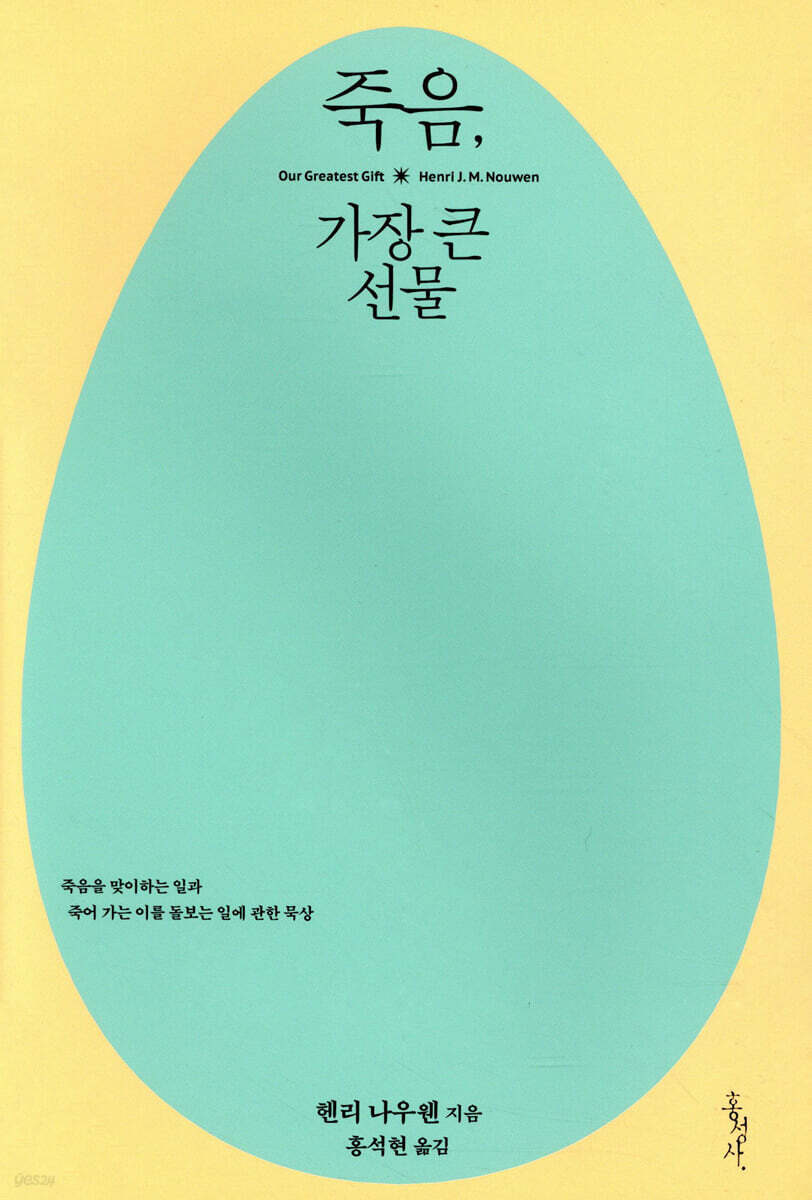
Death is the greatest gift
 |
Description
Book Introduction
A steady seller for over 20 years since the Korean version was published in 1998.
Henri Nouwen's masterpiece
Henri Nouwen in his old age
True Questions and Meditations in the Face of Death
Henri Nouwen experienced the deaths of loved ones in his old age and thought deeply about life and death.
And then he started asking.
How can death, like life, become ours? His thoughts on death continued, and he completed this book in a room of solitude, a temporary hideaway.
He wrote this meditation to discover for himself what it means to become familiar with his own death, and to help others become familiar with their own deaths.
When we look at the original title of this book, 'OUR GREATEST GIFT', and the Korean version's title, 'Death, the Greatest Gift', 'death' and 'gift' seem like an odd combination.
Can death truly be a gift to us? What is the source of our inner fear of death? His authentic interpretation of death, discovered through deep communion with God, earnestly reaches out to us who are misled by the truth, dispelling that fear.
And it takes out the greatest gift hidden in death and shows it to us.
Henri Nouwen's masterpiece
Henri Nouwen in his old age
True Questions and Meditations in the Face of Death
Henri Nouwen experienced the deaths of loved ones in his old age and thought deeply about life and death.
And then he started asking.
How can death, like life, become ours? His thoughts on death continued, and he completed this book in a room of solitude, a temporary hideaway.
He wrote this meditation to discover for himself what it means to become familiar with his own death, and to help others become familiar with their own deaths.
When we look at the original title of this book, 'OUR GREATEST GIFT', and the Korean version's title, 'Death, the Greatest Gift', 'death' and 'gift' seem like an odd combination.
Can death truly be a gift to us? What is the source of our inner fear of death? His authentic interpretation of death, discovered through deep communion with God, earnestly reaches out to us who are misled by the truth, dispelling that fear.
And it takes out the greatest gift hidden in death and shows it to us.
index
Acknowledgements
Before we go in_ Getting acquainted with death
Entering_ Grace Hidden in Helplessness
Part 1: Facing Death Well
- Close to my heart
We are God's little children
We are brothers and sisters
We are the parents of the coming generation
- A choice to face death well
Part 2: Caring for a Person Facing Death
- At the heart of human existence
You are God's little children
You are brothers and sisters
You are the parents of the next generation.
- A choice to take good care of yourself
Conclusion_ The Grace of Resurrection
Epilogue_ Death is both a loss and a gift.
Before we go in_ Getting acquainted with death
Entering_ Grace Hidden in Helplessness
Part 1: Facing Death Well
- Close to my heart
We are God's little children
We are brothers and sisters
We are the parents of the coming generation
- A choice to face death well
Part 2: Caring for a Person Facing Death
- At the heart of human existence
You are God's little children
You are brothers and sisters
You are the parents of the next generation.
- A choice to take good care of yourself
Conclusion_ The Grace of Resurrection
Epilogue_ Death is both a loss and a gift.
Into the book
Being old means that death is near.
In the past, I often calculated whether I could live as many years as I had lived.
When I was twenty, I was confident that I would live at least another twenty years.
Even when I turned thirty, I believed that I would be fine until I was sixty.
But when I turned forty, I began to doubt whether I would live to eighty.
And when I turned fifty, I realized that very few people live to be a hundred.
Now that I'm sixty, I know for sure that I'm very far from the halfway point of my life, and that I'm closer to death than I was when I was born.
--- p.31-32
Therefore, the real question we can ask ourselves as we face death is not, "How much can I still accomplish?" or, "How much influence can I still exert?"
The real, true question is, 'How can I live so that I can continue to bear fruit after I leave my family and friends?'
The question shifts our focus from doing to being.
Action produces success, but being produces fruit.
The great paradox of life is this.
We worry about what we should do and what we can do, but people remember us for who we were.
If the Holy Spirit, who gives love, joy, peace, gentleness, forgiveness, courage, patience, hope, and faith, guides our lives, the fruit of the Spirit will never die but will continue to grow from one generation to the next.
--- p.62-63
How often do we see the deathbed? How often do we see the dead? How often do we cover the coffin with dirt after it's been lowered into the grave? Standing, sitting, kneeling, or in any other position, how often do we visit the graves of our spouses, parents, siblings, aunts, uncles, and friends? Do we maintain contact with the dead, or do we treat those who came before us as if they never existed?
--- p.97
It takes a huge leap of faith to believe that our lives will move toward fulfillment within this dependence.
Everything we see and feel, everything society presents through its values and conventions, continually points in the opposite direction.
They say that success is important, but fruitfulness is not, and fruitfulness never comes from passivity.
But suffering is the way of God shown to us through the cross of Jesus.
We want to avoid this path at all costs, but it is the path to salvation.
This is why caring for the dying is so important.
This care is to help them make this difficult 'transition'.
It is about helping them move from action to suffering, from success to fruition, from 'how much can I achieve' to 'how can I make my life a gift to others?'
Caring for the dying means helping them see the power of God growing stronger as they become weaker.
In the past, I often calculated whether I could live as many years as I had lived.
When I was twenty, I was confident that I would live at least another twenty years.
Even when I turned thirty, I believed that I would be fine until I was sixty.
But when I turned forty, I began to doubt whether I would live to eighty.
And when I turned fifty, I realized that very few people live to be a hundred.
Now that I'm sixty, I know for sure that I'm very far from the halfway point of my life, and that I'm closer to death than I was when I was born.
--- p.31-32
Therefore, the real question we can ask ourselves as we face death is not, "How much can I still accomplish?" or, "How much influence can I still exert?"
The real, true question is, 'How can I live so that I can continue to bear fruit after I leave my family and friends?'
The question shifts our focus from doing to being.
Action produces success, but being produces fruit.
The great paradox of life is this.
We worry about what we should do and what we can do, but people remember us for who we were.
If the Holy Spirit, who gives love, joy, peace, gentleness, forgiveness, courage, patience, hope, and faith, guides our lives, the fruit of the Spirit will never die but will continue to grow from one generation to the next.
--- p.62-63
How often do we see the deathbed? How often do we see the dead? How often do we cover the coffin with dirt after it's been lowered into the grave? Standing, sitting, kneeling, or in any other position, how often do we visit the graves of our spouses, parents, siblings, aunts, uncles, and friends? Do we maintain contact with the dead, or do we treat those who came before us as if they never existed?
--- p.97
It takes a huge leap of faith to believe that our lives will move toward fulfillment within this dependence.
Everything we see and feel, everything society presents through its values and conventions, continually points in the opposite direction.
They say that success is important, but fruitfulness is not, and fruitfulness never comes from passivity.
But suffering is the way of God shown to us through the cross of Jesus.
We want to avoid this path at all costs, but it is the path to salvation.
This is why caring for the dying is so important.
This care is to help them make this difficult 'transition'.
It is about helping them move from action to suffering, from success to fruition, from 'how much can I achieve' to 'how can I make my life a gift to others?'
Caring for the dying means helping them see the power of God growing stronger as they become weaker.
--- p.121-122
Publisher's Review
Two Missions About Death
Facing death well, caring for the dying
The author suggests three beliefs we must have to become familiar with death.
It is believing that we are children of God, brothers and sisters of all people, and parents of future generations.
In doing so, death can be seen as a gateway to a new life rather than something to be rejected.
And we, under the three faiths, must be with the dying, helping them to cast off their fear and look beyond the borders of death.
This book carries out two missions: to welcome death well and to care for the dying, and leads us to a stage where we can spiritually understand death correctly.
It also conveys a message of great courage to those facing death and those who care for them.
Facing death well, caring for the dying
The author suggests three beliefs we must have to become familiar with death.
It is believing that we are children of God, brothers and sisters of all people, and parents of future generations.
In doing so, death can be seen as a gateway to a new life rather than something to be rejected.
And we, under the three faiths, must be with the dying, helping them to cast off their fear and look beyond the borders of death.
This book carries out two missions: to welcome death well and to care for the dying, and leads us to a stage where we can spiritually understand death correctly.
It also conveys a message of great courage to those facing death and those who care for them.
GOODS SPECIFICS
- Publication date: November 27, 2019
- Page count, weight, size: 152 pages | 198g | 128*188*20mm
- ISBN13: 9788936513955
- ISBN10: 8936513958
You may also like
카테고리
korean


korean

![ELLE 엘르 스페셜 에디션 A형 : 12월 [2025]](http://librairie.coreenne.fr/cdn/shop/files/b8e27a3de6c9538896439686c6b0e8fb.jpg?v=1766436872&width=3840)


