

Busy elementary school four-character idioms + copying
 |
Description
Book Introduction
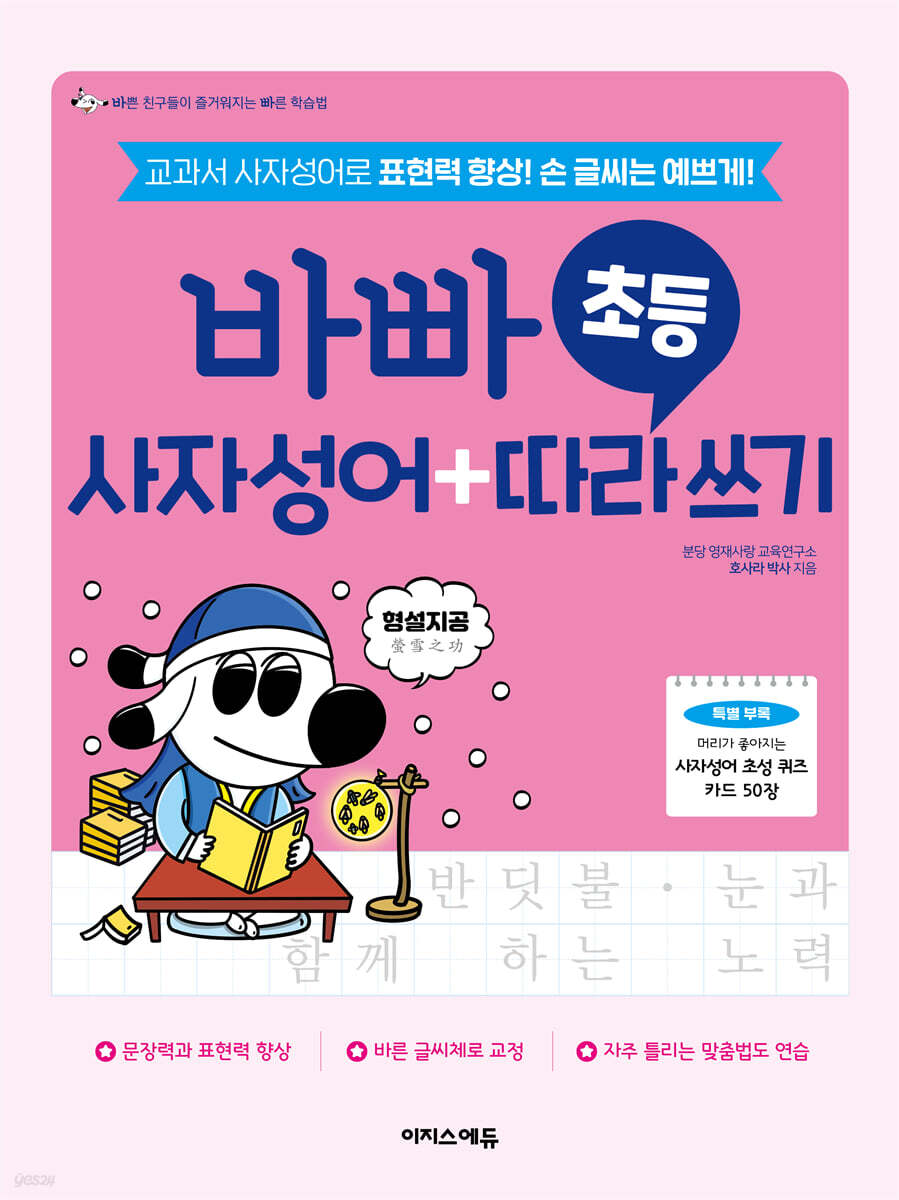
Improve your expressiveness with textbook idioms! Make your handwriting beautiful! A brain-stimulating four-character idiom book properly created by a doctor of gifted education. A doctorate in gifted education has released a book of four-character idioms, "Busy Elementary Four-Channel Idioms + Writing," designed specifically for elementary school students who struggle with expressive and writing skills. By memorizing only the four-character idioms found in elementary school textbooks and the CSAT, you'll improve your expressive skills. Also, by writing down the four-character idioms and their meanings in square boxes, you can correct crooked handwriting and even practice spelling, making this a book that kills three birds with one stone. First, the four-character idioms in this book were designed to be learned meaningfully by associating them with images that are easy to imagine, taking into account the characteristics of elementary school students, who are in the concrete operational stage of development. The interesting stories that show the actual use of idioms are organized into conversations, diaries, letters, and introductions, so that you can use them as they are when talking to friends or writing. Here, we have added a corner where elementary school students can practice frequently misspelled consonants and vowels, which can help them solidify their spelling skills. As a special appendix, we also provide 50 'Idiom Initial Consonant Quiz Cards' that will help you improve your brain, so you can enjoy reviewing like a game. After reading this book, which contains the teaching secrets of Dr. Hosara, who has closely taught children for 17 years, you will acquire expressive skills and proper handwriting that will make you exclaim, "Wow! Where did you learn those expressions?" |
- You can preview some of the book's contents.
Preview
index
Busy elementary school four-character idioms + copying
First Yard: Idioms Related to Animals
01 Killing Two Birds with One Stone
02 Dragon Head and Snake Tail
03 Tiger-watching Eyes
04 Dog and Monkey
05 Horse Ears East Wind
06 Crows Fly and Pear Fall
07 Hwaryongjeomjeong (畵龍點睛)
08 The sky is high and the horse is fat
09 Nine cows and one hair
10 A flock of chickens and one crane
★ First Yard Review
Second Yard: Idioms Related to Nature
11. Blue Mountain Flowing Water
12. Stones from other mountains
13 Adding Frost to the Snow
14. Five Li in the Fog
15 Wind-blown Lights
16 A bolt from the blue
17 Bamboo shoots after the rain
18 Cheongchuleoram (靑出於藍)
19. The Achievement of Snow
20 Golden Branches and Jade Leaves
★ Second Yard Review
Third Yard: Idioms Related to People
21 The Foolish Old Man Moves the Mountains
22 All-round beauty
23 East Question, West Answer
24 A sea of people
25 Three Days of Resolution
26. Insolent
27 Different people say the same thing
28 A blessing in disguise
29. The Thief Returns His Staff
30 Fisherman's Profit
★ Third Yard Review
Fourth yard: Idioms related to objects
31 There are bones in words
32 Childhood Friend
33 Daegi Manseong (大器晩成)
34 Carving a Boat and Seeking a Sword
35. Different Dreams in the Same Bed
36. The lights are not bright
37. The ink is black
38 Nangjungjichu
39 Gyeommunbalgeom (見蚊拔劍)
40 The icing on the cake
★ Fourth Yard Review
Fifth Yard: Idioms Related to Food
41 Chicken Egg Remains
Chapter 42
43. Three in the morning and four in the evening
44. Filial Piety in Reverse of Filial Piety
45 Cake in a Painting
46 Sweet talk
47 The Danger of Stacked Eggs
48 Ten spoonfuls of rice
49 Sweet and bitter spit out
50 Survival of the fittest
★ Fifth Yard Review
Special Appendix: 50 Idiom Initial Consonant Quiz Cards to Improve Your Brain
First Yard: Idioms Related to Animals
01 Killing Two Birds with One Stone
02 Dragon Head and Snake Tail
03 Tiger-watching Eyes
04 Dog and Monkey
05 Horse Ears East Wind
06 Crows Fly and Pear Fall
07 Hwaryongjeomjeong (畵龍點睛)
08 The sky is high and the horse is fat
09 Nine cows and one hair
10 A flock of chickens and one crane
★ First Yard Review
Second Yard: Idioms Related to Nature
11. Blue Mountain Flowing Water
12. Stones from other mountains
13 Adding Frost to the Snow
14. Five Li in the Fog
15 Wind-blown Lights
16 A bolt from the blue
17 Bamboo shoots after the rain
18 Cheongchuleoram (靑出於藍)
19. The Achievement of Snow
20 Golden Branches and Jade Leaves
★ Second Yard Review
Third Yard: Idioms Related to People
21 The Foolish Old Man Moves the Mountains
22 All-round beauty
23 East Question, West Answer
24 A sea of people
25 Three Days of Resolution
26. Insolent
27 Different people say the same thing
28 A blessing in disguise
29. The Thief Returns His Staff
30 Fisherman's Profit
★ Third Yard Review
Fourth yard: Idioms related to objects
31 There are bones in words
32 Childhood Friend
33 Daegi Manseong (大器晩成)
34 Carving a Boat and Seeking a Sword
35. Different Dreams in the Same Bed
36. The lights are not bright
37. The ink is black
38 Nangjungjichu
39 Gyeommunbalgeom (見蚊拔劍)
40 The icing on the cake
★ Fourth Yard Review
Fifth Yard: Idioms Related to Food
41 Chicken Egg Remains
Chapter 42
43. Three in the morning and four in the evening
44. Filial Piety in Reverse of Filial Piety
45 Cake in a Painting
46 Sweet talk
47 The Danger of Stacked Eggs
48 Ten spoonfuls of rice
49 Sweet and bitter spit out
50 Survival of the fittest
★ Fifth Yard Review
Special Appendix: 50 Idiom Initial Consonant Quiz Cards to Improve Your Brain
Detailed image

Publisher's Review
For elementary school students who lack expressive and writing skills
A brain-stimulating four-character idiom book properly created by a doctor of gifted education!
Busy Elementary Idioms + Writing Practice
The Korean language, a source of concern for the education sector
Recently, the decline in students' basic academic ability has become a major concern in the education world.
The subject of particular concern is ‘Korean’.
Elementary school students need to be constantly monitored by their teachers in their speaking, listening, writing, and reading skills, but these experiences have been severely lacking due to COVID-19.
I am even more concerned about children's writing skills.
In addition, after the Ministry of Education issued guidelines to use dictation cautiously as it could place a learning burden on first and second grade elementary school students, the implementation of the 'dictation test', which was the 'symbol' of writing education for first and second graders, was delayed and its frequency was also significantly reduced.
As a result, the number of students who frequently make mistakes in spacing and spelling and write crookedly is rapidly increasing, causing both parents and teachers to panic.
A good solution is to copy the four-character idiom!
Fortunately, there are many 'writing' books for elementary school students on the market.
I was especially happy to see a book on writing four-character idioms that helps with handwriting and literacy.
Idioms are excellent materials to help develop thinking and expressive skills.
There is also the benefit of building prior knowledge of the four-character idioms that appear in textbooks while practicing writing them.
For this reason, elementary school essay academies in famous school districts sometimes study only four-character idioms.
However, when I looked at the books on the market, I found many things to be disappointing.
A four-character idiom book perfectly suited to the developmental characteristics of elementary school students!
First, elementary school students who need this book are in the concrete operational stage of development.
That is, it is a time to learn through images that are easily imagined.
So, in this book, we carefully selected only the four-character idioms that appear in elementary school textbooks and the college entrance exam, and categorized them into those related to animals, nature, people, objects, and food, and encouraged students to associate them with easily imagined images and write them down.
Therefore, the scenes of the four-character idioms will be better remembered in the minds of children who study this book.
Fingerprints that can be used in everyday life!
Additionally, this book contains a variety of text formats, including not only stories and comics, but also conversations, diaries, and letters that children frequently use in their daily lives.
Reading interesting stories will improve your reading comprehension and literacy skills.
We've also added newspaper articles and introductory texts to provide a richer reading experience.
Children who study this book will actively use the four-character idioms they learn in the book when having conversations or writing diaries or letters.
Includes accurate examples that meet the standards of the Standard Korean Dictionary!
When I looked at books on the market, I found that many of them presented examples that were out of context.
Incorrect examples can give children misconceptions about the idiom, which can lead to incorrect answers when taking Korean language tests in middle school and high school.
So, this book is based on accurate examples from the Standard Korean Dictionary and contains the most appropriate situations.
Children who learn idioms from this book will be able to use them appropriately.
Sentence structure, spacing, and spelling are all taken care of at once!
In addition, this book does not stop at showing 'examples' of sentences using idioms, but is structured so that children can complete the sentences themselves.
Additionally, we have included a V-shaped mark to help children learn to correctly use spacing, and at the end, we have included a corner to double-check the consonants and vowels that elementary school students often make mistakes with, so that they can build up their spelling skills.
I hope that children will be able to refine their handwriting with the book 'Busy Elementary Idioms + Copywriting', and learn sentence structure, expressiveness, spacing, and spelling by being exposed to various writing styles.
Book Appendix: 50 Idiom Initial Consonant Quiz Cards to Improve Your Brain
The back of the book has a card shape printed on thick paper.
There is a quiz on the initial consonants of four-character idioms on the front, and a picture of the four-character idiom and the answer on the back. Cut along the dotted line and play the card game.
It is effective in training the brain by reviewing idioms in a fun way like a game.
Method 1|Look at the front page where the initial consonant quiz is written and try to guess the four-character idiom.
Method 2| Spread the four-character idiom cards on the floor and play a game where you quickly find the four-character idiom that someone else calls out.
It's more fun if you bet with your friends to see who can find it first.
Method 3|Spread out the cards so that the front side with the initial consonant quiz is visible.
The winner of rock-paper-scissors picks a card and says a Chinese idiom. If the answer is correct, the winner takes the card.
The person with the most four-character idiom cards wins!
How to Effectively Study "Busy Elementary Idioms + Writing"
Be sure to start reading this book out loud!
Reading out loud helps you understand the content more thoroughly and stores it in your head, increasing your learning effectiveness!
Step 1 | Let's start by understanding the meaning of the four-character idiom!
Read the meaning of the idiom first.
We've included the hidden meanings of the Chinese characters and idioms!
Step 2 | Read the text out loud!
Read a story that shows you in what situations idioms are used.
It contains texts that can be used directly in daily life, such as conversations, comics, diaries, letters, and newspaper articles!
Step 3 | Read and write the four-character idioms!
Read the four-character idioms out loud and write them in pretty handwriting.
Look at the marked part and learn the spacing as well.
Step 4 | Fill in the meaning of the four-character idiom and write it down!
Idioms are figurative expressions, so you need to know their exact meaning.
Fill in the meaning, write in pretty letters, and get used to proper handwriting.
Step 5 | Let's develop your writing skills!
Complete sentences from everyday life by adding four-character idioms.
If you use idioms in similar situations, you will receive a lot of compliments for your expressiveness.
Step 6 | Let's practice spelling too! Correct any misspelled consonants or vowels.
You'll feel more confident taking dictation tests too!
Parents and teachers who guide with this book, please help us like this!
★ It's more fun to read the text by dividing it into one line for the child, one line for the parent, or one line for the character!
★ Children can learn to write beautifully only when they hold their pencil correctly.
Please teach them to hold the pencil correctly and write, even if it means writing slowly.
★ Spelling can be difficult even for adults, so don't scold them if they make mistakes! For struggling children, encourage them to find hints in the text and then try to write it out!
Highly recommended as an after-school textbook for elementary school students!
Are you looking for an after-school resource for elementary school students struggling with literacy and writing skills? "Busy Elementary Idioms + Writing" is an effective way to improve sentence structure, expressive skills, proper handwriting, and spelling skills all at once by reading and writing the textbook's four-character idioms.
A brain-stimulating four-character idiom book properly created by a doctor of gifted education!
Busy Elementary Idioms + Writing Practice
The Korean language, a source of concern for the education sector
Recently, the decline in students' basic academic ability has become a major concern in the education world.
The subject of particular concern is ‘Korean’.
Elementary school students need to be constantly monitored by their teachers in their speaking, listening, writing, and reading skills, but these experiences have been severely lacking due to COVID-19.
I am even more concerned about children's writing skills.
In addition, after the Ministry of Education issued guidelines to use dictation cautiously as it could place a learning burden on first and second grade elementary school students, the implementation of the 'dictation test', which was the 'symbol' of writing education for first and second graders, was delayed and its frequency was also significantly reduced.
As a result, the number of students who frequently make mistakes in spacing and spelling and write crookedly is rapidly increasing, causing both parents and teachers to panic.
A good solution is to copy the four-character idiom!
Fortunately, there are many 'writing' books for elementary school students on the market.
I was especially happy to see a book on writing four-character idioms that helps with handwriting and literacy.
Idioms are excellent materials to help develop thinking and expressive skills.
There is also the benefit of building prior knowledge of the four-character idioms that appear in textbooks while practicing writing them.
For this reason, elementary school essay academies in famous school districts sometimes study only four-character idioms.
However, when I looked at the books on the market, I found many things to be disappointing.
A four-character idiom book perfectly suited to the developmental characteristics of elementary school students!
First, elementary school students who need this book are in the concrete operational stage of development.
That is, it is a time to learn through images that are easily imagined.
So, in this book, we carefully selected only the four-character idioms that appear in elementary school textbooks and the college entrance exam, and categorized them into those related to animals, nature, people, objects, and food, and encouraged students to associate them with easily imagined images and write them down.
Therefore, the scenes of the four-character idioms will be better remembered in the minds of children who study this book.
Fingerprints that can be used in everyday life!
Additionally, this book contains a variety of text formats, including not only stories and comics, but also conversations, diaries, and letters that children frequently use in their daily lives.
Reading interesting stories will improve your reading comprehension and literacy skills.
We've also added newspaper articles and introductory texts to provide a richer reading experience.
Children who study this book will actively use the four-character idioms they learn in the book when having conversations or writing diaries or letters.
Includes accurate examples that meet the standards of the Standard Korean Dictionary!
When I looked at books on the market, I found that many of them presented examples that were out of context.
Incorrect examples can give children misconceptions about the idiom, which can lead to incorrect answers when taking Korean language tests in middle school and high school.
So, this book is based on accurate examples from the Standard Korean Dictionary and contains the most appropriate situations.
Children who learn idioms from this book will be able to use them appropriately.
Sentence structure, spacing, and spelling are all taken care of at once!
In addition, this book does not stop at showing 'examples' of sentences using idioms, but is structured so that children can complete the sentences themselves.
Additionally, we have included a V-shaped mark to help children learn to correctly use spacing, and at the end, we have included a corner to double-check the consonants and vowels that elementary school students often make mistakes with, so that they can build up their spelling skills.
I hope that children will be able to refine their handwriting with the book 'Busy Elementary Idioms + Copywriting', and learn sentence structure, expressiveness, spacing, and spelling by being exposed to various writing styles.
Book Appendix: 50 Idiom Initial Consonant Quiz Cards to Improve Your Brain
The back of the book has a card shape printed on thick paper.
There is a quiz on the initial consonants of four-character idioms on the front, and a picture of the four-character idiom and the answer on the back. Cut along the dotted line and play the card game.
It is effective in training the brain by reviewing idioms in a fun way like a game.
Method 1|Look at the front page where the initial consonant quiz is written and try to guess the four-character idiom.
Method 2| Spread the four-character idiom cards on the floor and play a game where you quickly find the four-character idiom that someone else calls out.
It's more fun if you bet with your friends to see who can find it first.
Method 3|Spread out the cards so that the front side with the initial consonant quiz is visible.
The winner of rock-paper-scissors picks a card and says a Chinese idiom. If the answer is correct, the winner takes the card.
The person with the most four-character idiom cards wins!
How to Effectively Study "Busy Elementary Idioms + Writing"
Be sure to start reading this book out loud!
Reading out loud helps you understand the content more thoroughly and stores it in your head, increasing your learning effectiveness!
Step 1 | Let's start by understanding the meaning of the four-character idiom!
Read the meaning of the idiom first.
We've included the hidden meanings of the Chinese characters and idioms!
Step 2 | Read the text out loud!
Read a story that shows you in what situations idioms are used.
It contains texts that can be used directly in daily life, such as conversations, comics, diaries, letters, and newspaper articles!
Step 3 | Read and write the four-character idioms!
Read the four-character idioms out loud and write them in pretty handwriting.
Look at the marked part and learn the spacing as well.
Step 4 | Fill in the meaning of the four-character idiom and write it down!
Idioms are figurative expressions, so you need to know their exact meaning.
Fill in the meaning, write in pretty letters, and get used to proper handwriting.
Step 5 | Let's develop your writing skills!
Complete sentences from everyday life by adding four-character idioms.
If you use idioms in similar situations, you will receive a lot of compliments for your expressiveness.
Step 6 | Let's practice spelling too! Correct any misspelled consonants or vowels.
You'll feel more confident taking dictation tests too!
Parents and teachers who guide with this book, please help us like this!
★ It's more fun to read the text by dividing it into one line for the child, one line for the parent, or one line for the character!
★ Children can learn to write beautifully only when they hold their pencil correctly.
Please teach them to hold the pencil correctly and write, even if it means writing slowly.
★ Spelling can be difficult even for adults, so don't scold them if they make mistakes! For struggling children, encourage them to find hints in the text and then try to write it out!
Highly recommended as an after-school textbook for elementary school students!
Are you looking for an after-school resource for elementary school students struggling with literacy and writing skills? "Busy Elementary Idioms + Writing" is an effective way to improve sentence structure, expressive skills, proper handwriting, and spelling skills all at once by reading and writing the textbook's four-character idioms.
GOODS SPECIFICS
- Date of issue: March 10, 2023
- Page count, weight, size: 136 pages | 488g | 210*280*10mm
- ISBN13: 9791163034599
- ISBN10: 1163034592
- KC Certification: Certification Type: Conformity Confirmation
You may also like
카테고리
korean


korean

![GQ KOREA Mark (Monthly): December [2025]](http://librairie.coreenne.fr/cdn/shop/files/8ef265dbbfbf186523ed75ba7319009d.jpg?v=1765340328&width=3840)


