

AI and Nuclear Power (Large Print Book)
 |
Description
Book Introduction
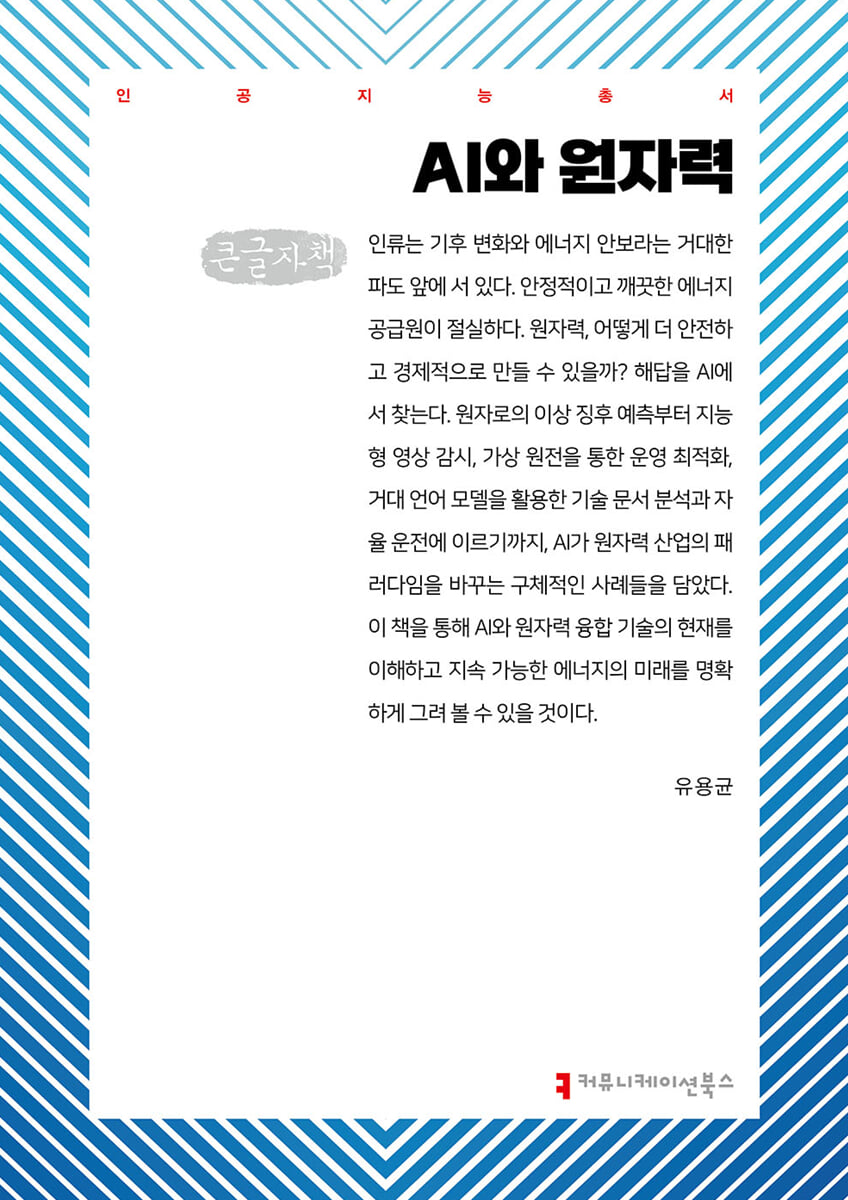
Faced with the enormous challenges of climate change and energy security, a stable and clean energy source is desperately needed.
How can nuclear power be made safer and more economical? The answer lies in AI.
From predicting abnormal signs in nuclear reactors to intelligent video surveillance, optimizing operations through virtual nuclear power plants, analyzing technical documents using large-scale language models, and even autonomous driving, this book contains specific examples of how AI is changing the paradigm of the nuclear power industry.
How can nuclear power be made safer and more economical? The answer lies in AI.
From predicting abnormal signs in nuclear reactors to intelligent video surveillance, optimizing operations through virtual nuclear power plants, analyzing technical documents using large-scale language models, and even autonomous driving, this book contains specific examples of how AI is changing the paradigm of the nuclear power industry.
- You can preview some of the book's contents.
Preview
index
Artificial Intelligence and Nuclear Power: The Dawn of a New Era xi
01 The Need for Next-Generation Nuclear Reactors and AI
02 Data Prediction for Reactor Maintenance
03 Video AI for Reactor Monitoring
04 Accelerating Nuclear Simulations Using AI
05 Virtual Nuclear Power Plant and AI
06 Giant Language Models for Nuclear Energy
07 AI-Powered Nuclear Research and Development and Regulatory Innovation
08 Document Management and AI for Reactor Operations
09 Intelligent Agent for Reactor Control
10 AI, Perfecting the Future of Nuclear Energy
01 The Need for Next-Generation Nuclear Reactors and AI
02 Data Prediction for Reactor Maintenance
03 Video AI for Reactor Monitoring
04 Accelerating Nuclear Simulations Using AI
05 Virtual Nuclear Power Plant and AI
06 Giant Language Models for Nuclear Energy
07 AI-Powered Nuclear Research and Development and Regulatory Innovation
08 Document Management and AI for Reactor Operations
09 Intelligent Agent for Reactor Control
10 AI, Perfecting the Future of Nuclear Energy
Into the book
Next-generation nuclear reactors, including small modular reactors (SMRs), are emerging as key solutions.
Small modular reactors can be built on small sites and provide stable, carbon-free power 24 hours a day, making them an ideal energy source for AI data centers.
In other words, AI is a key tool for enhancing the safety and economic feasibility of nuclear power, while nuclear power is also becoming a key infrastructure for making the AI revolution sustainable.
--- From "01_The Necessity of Next-Generation Nuclear Reactors and AI"
The AI-based 'surrogate model' emerged to overcome the fundamental limitations of traditional simulation.
A surrogate model, as the name suggests, is an AI model that predicts results quickly and accurately by ‘taking over’ complex and time-consuming physical simulations.
It's like an artificial intelligence that learns countless problems and answers and then intuitively finds the answer as soon as it sees a new problem, rather than solving difficult math problems from scratch every time.
--- From "04_Accelerating Nuclear Simulation Using AI"
Traditional machine learning and deep learning models are like 'experts' trained for a specific purpose.
For example, the predictive maintenance model introduced in Chapter 2 is trained to take specific numerical data, such as vibration or temperature, as input and output a specific output, namely the probability of failure.
The model that detects cracks in images is also specialized for crack image data.
These models perform their given tasks very well, but cannot solve other types of problems outside the domain in which they were trained.
In other words, there was a limitation that a new model had to be developed and trained from scratch each time to solve a different problem.
Small modular reactors can be built on small sites and provide stable, carbon-free power 24 hours a day, making them an ideal energy source for AI data centers.
In other words, AI is a key tool for enhancing the safety and economic feasibility of nuclear power, while nuclear power is also becoming a key infrastructure for making the AI revolution sustainable.
--- From "01_The Necessity of Next-Generation Nuclear Reactors and AI"
The AI-based 'surrogate model' emerged to overcome the fundamental limitations of traditional simulation.
A surrogate model, as the name suggests, is an AI model that predicts results quickly and accurately by ‘taking over’ complex and time-consuming physical simulations.
It's like an artificial intelligence that learns countless problems and answers and then intuitively finds the answer as soon as it sees a new problem, rather than solving difficult math problems from scratch every time.
--- From "04_Accelerating Nuclear Simulation Using AI"
Traditional machine learning and deep learning models are like 'experts' trained for a specific purpose.
For example, the predictive maintenance model introduced in Chapter 2 is trained to take specific numerical data, such as vibration or temperature, as input and output a specific output, namely the probability of failure.
The model that detects cracks in images is also specialized for crack image data.
These models perform their given tasks very well, but cannot solve other types of problems outside the domain in which they were trained.
In other words, there was a limitation that a new model had to be developed and trained from scratch each time to solve a different problem.
--- From "06_Giant Language Model for Nuclear Energy"
Publisher's Review
Artificial Intelligence and Nuclear Power: The Dawn of a New Era
Amidst the climate crisis and energy security, the combination of nuclear energy and artificial intelligence usher in a new era.
Now that the limits of fossil fuels have been revealed, the question is how the convergence of nuclear energy, a powerful energy source, and AI, the most powerful intellectual tool, will enhance safety and efficiency. AI has evolved from the 1956 Dartmouth Conference, the perceptron and expert systems, to ImageNet in 2012, AlphaGo in 2016, and ChatGPi in 2022, to large-scale language models, inference-time computing, and multiagents, approaching intelligent agents that "perceive and act on their environment."
The use of AI in nuclear power is two-pronged.
First, it proactively blocks risks and reduces costs through mathematical tools such as predictive maintenance, anomaly detection, and simulation acceleration.
Second, it combines document question-and-answer, knowledge graphs, and digital twins as an agent to implement autonomous driving and optimal control.
Humans are key as strategists and project managers who set goals, safety and ethical standards, and oversee the entire process.
This book covers next-generation nuclear power challenges, data and image-based preventive safety, simulation and digital twins, regulatory and knowledge intelligence, autonomous driving agents, and the future of industry and redefining the role of humans across ten chapters, offering practical insights for both nuclear power and AI experts and general readers.
The core driving forces are a vast amount of prior knowledge (base model), test-time calculations that enable logical thinking, and multi-agents that collaborate by sharing roles.
When these combine to close the chain of perception, reasoning, planning, and execution, nuclear power plants become more predictable and resilient systems.
The book also emphasizes governance and accountability, ensuring that AI-interpreted results are verifiable and explainable by humans.
Amidst the climate crisis and energy security, the combination of nuclear energy and artificial intelligence usher in a new era.
Now that the limits of fossil fuels have been revealed, the question is how the convergence of nuclear energy, a powerful energy source, and AI, the most powerful intellectual tool, will enhance safety and efficiency. AI has evolved from the 1956 Dartmouth Conference, the perceptron and expert systems, to ImageNet in 2012, AlphaGo in 2016, and ChatGPi in 2022, to large-scale language models, inference-time computing, and multiagents, approaching intelligent agents that "perceive and act on their environment."
The use of AI in nuclear power is two-pronged.
First, it proactively blocks risks and reduces costs through mathematical tools such as predictive maintenance, anomaly detection, and simulation acceleration.
Second, it combines document question-and-answer, knowledge graphs, and digital twins as an agent to implement autonomous driving and optimal control.
Humans are key as strategists and project managers who set goals, safety and ethical standards, and oversee the entire process.
This book covers next-generation nuclear power challenges, data and image-based preventive safety, simulation and digital twins, regulatory and knowledge intelligence, autonomous driving agents, and the future of industry and redefining the role of humans across ten chapters, offering practical insights for both nuclear power and AI experts and general readers.
The core driving forces are a vast amount of prior knowledge (base model), test-time calculations that enable logical thinking, and multi-agents that collaborate by sharing roles.
When these combine to close the chain of perception, reasoning, planning, and execution, nuclear power plants become more predictable and resilient systems.
The book also emphasizes governance and accountability, ensuring that AI-interpreted results are verifiable and explainable by humans.
GOODS SPECIFICS
- Date of issue: August 18, 2025
- Page count, weight, size: 131 pages | 210*290*7mm
- ISBN13: 9791143008626
You may also like
카테고리
korean


korean

![GQ KOREA Mark (Monthly): December [2025]](http://librairie.coreenne.fr/cdn/shop/files/8ef265dbbfbf186523ed75ba7319009d.jpg?v=1765340328&width=3840)


