

AI and psychological counseling
 |
Description
Book Introduction
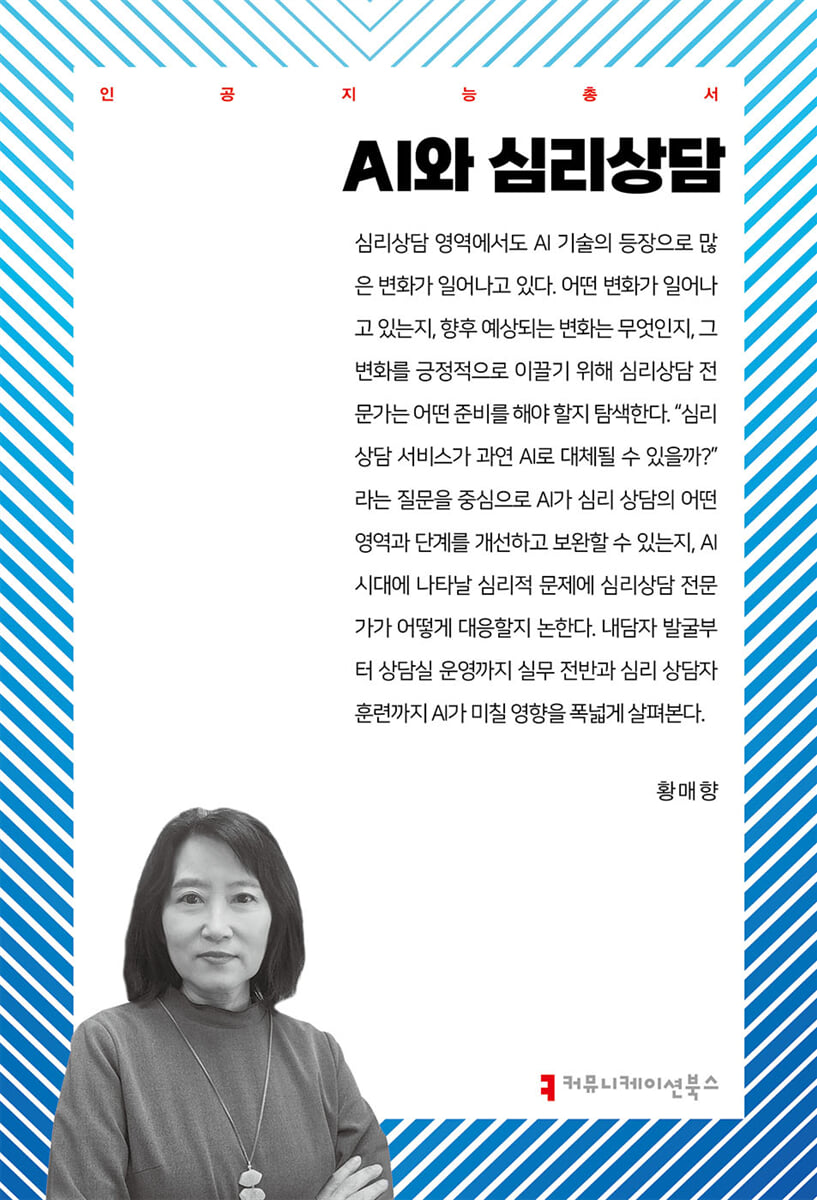
Can AI replace counseling? We analyze the impact of AI technology on psychological counseling and identify the competencies and challenges counseling professionals must possess.
Artificial Intelligence Encyclopedia.
You can find the artificial intelligence knowledge you need at aiseries.oopy.io.
Artificial Intelligence Encyclopedia.
You can find the artificial intelligence knowledge you need at aiseries.oopy.io.
- You can preview some of the book's contents.
Preview
index
Psychological Counseling in the AI Era
01 AI technology applicable to psychological counseling
02 AI that detects crises
03 Use of AI in the diagnosis stage
04 Mental Health Self-Help AI
05 Social Robots
06 Chatbot Counselor
07 Generative AI
08 AI-based counselor training
09 The AI Era: Changing Psychological Counseling
10 The Role of Psychological Counseling Professionals in the AI Era
01 AI technology applicable to psychological counseling
02 AI that detects crises
03 Use of AI in the diagnosis stage
04 Mental Health Self-Help AI
05 Social Robots
06 Chatbot Counselor
07 Generative AI
08 AI-based counselor training
09 The AI Era: Changing Psychological Counseling
10 The Role of Psychological Counseling Professionals in the AI Era
Into the book
The human aspiration to create machines capable of conversing with humans has long existed. This is also one of the visions pursued by AI technology.
AI, which can infer and execute what it should do on its own without being commanded, has developed into a technology called natural language processing in the area that enables conversations with humans.
The language used by humans is called natural language, and natural language processing technology that analyzes and understands what people say and creates machine-speak based on that analysis is steadily developing.
It learns a lot of data through machine learning and, furthermore, deep learning that incorporates human neural network models, and produces everyday conversations, answers, translations, summaries, etc. through inference based on this.
It also has a voice-to-text function, so you can have both voice and text support during conversations.
--- From "01_AI Technology Applicable to Psychological Counseling"
The intake interview is the process that begins after you apply for counseling and a counselor is assigned to you before the counseling session begins.
Even in places where multiple counselors work and counselor placement is not required, the intake interview stage will help determine what kind of support services are appropriate to provide.
Although the content and procedures of the admission interview may vary depending on the characteristics of the institution, there are some commonly covered topics, and each institution often conducts the interview according to relatively established procedures.
This is an area where AI technology can be applied to help operate an efficient consulting agency.
AI chatbots can perform the intake interview process according to procedures, and AI technology can be utilized in the process of detecting crises or summarizing the intake interview content to confirm the client's main complaint and information for case assignment.
--- From "03_Utilization of AI in the Diagnosis Stage"
With the rapid development of various language models and generative AI technologies, including natural language processing, chatbots are expected to evolve into services that can generate appropriate responses to users on their own.
The first goal is to apply a large language model (LLM) to the currently implemented rule-based chatbot response, thereby adding the ability for the chatbot to generate appropriate responses on its own, thereby better meeting the needs of users (clients).
Next, if we change the current text-based chatbot service to a voice-based one and include automatic translation, psychological counseling will become more convenient.
Finally, providing counseling in the form of an AI human that embodies the counselor through video, and processing nonverbal signals such as facial expressions and gestures as well as the client's voice as client responses, will bring counseling closer to real counseling.
These attempts are being made little by little, but they are still at the research stage.
--- From "06_Chatbot Counselor"
First, there may be clients who come to the counseling room feeling hurt after receiving counseling from AI.
It is a reality that recently expanded generative AI, including self-help apps, is replacing psychological counseling.
Instead of seeking out a counseling professional, it's easier to seek help from an AI chatbot.
However, while immediate comfort and empathy may be available, it's difficult to obtain professional help beyond that, and in many cases, it can actually be detrimental. Some youths have even committed suicide after conversing with AI chatbots, demonstrating the dangers of indiscriminate conversations with AI.
If clients who have been hurt by conversations with AI come to the counseling room, they will likely be complaining of different issues than those who have been hurt by interpersonal relationships that counseling professionals have previously encountered, and a different approach may be required.
AI, which can infer and execute what it should do on its own without being commanded, has developed into a technology called natural language processing in the area that enables conversations with humans.
The language used by humans is called natural language, and natural language processing technology that analyzes and understands what people say and creates machine-speak based on that analysis is steadily developing.
It learns a lot of data through machine learning and, furthermore, deep learning that incorporates human neural network models, and produces everyday conversations, answers, translations, summaries, etc. through inference based on this.
It also has a voice-to-text function, so you can have both voice and text support during conversations.
--- From "01_AI Technology Applicable to Psychological Counseling"
The intake interview is the process that begins after you apply for counseling and a counselor is assigned to you before the counseling session begins.
Even in places where multiple counselors work and counselor placement is not required, the intake interview stage will help determine what kind of support services are appropriate to provide.
Although the content and procedures of the admission interview may vary depending on the characteristics of the institution, there are some commonly covered topics, and each institution often conducts the interview according to relatively established procedures.
This is an area where AI technology can be applied to help operate an efficient consulting agency.
AI chatbots can perform the intake interview process according to procedures, and AI technology can be utilized in the process of detecting crises or summarizing the intake interview content to confirm the client's main complaint and information for case assignment.
--- From "03_Utilization of AI in the Diagnosis Stage"
With the rapid development of various language models and generative AI technologies, including natural language processing, chatbots are expected to evolve into services that can generate appropriate responses to users on their own.
The first goal is to apply a large language model (LLM) to the currently implemented rule-based chatbot response, thereby adding the ability for the chatbot to generate appropriate responses on its own, thereby better meeting the needs of users (clients).
Next, if we change the current text-based chatbot service to a voice-based one and include automatic translation, psychological counseling will become more convenient.
Finally, providing counseling in the form of an AI human that embodies the counselor through video, and processing nonverbal signals such as facial expressions and gestures as well as the client's voice as client responses, will bring counseling closer to real counseling.
These attempts are being made little by little, but they are still at the research stage.
--- From "06_Chatbot Counselor"
First, there may be clients who come to the counseling room feeling hurt after receiving counseling from AI.
It is a reality that recently expanded generative AI, including self-help apps, is replacing psychological counseling.
Instead of seeking out a counseling professional, it's easier to seek help from an AI chatbot.
However, while immediate comfort and empathy may be available, it's difficult to obtain professional help beyond that, and in many cases, it can actually be detrimental. Some youths have even committed suicide after conversing with AI chatbots, demonstrating the dangers of indiscriminate conversations with AI.
If clients who have been hurt by conversations with AI come to the counseling room, they will likely be complaining of different issues than those who have been hurt by interpersonal relationships that counseling professionals have previously encountered, and a different approach may be required.
--- From "09_The AI Era, Changing Psychological Counseling"
Publisher's Review
Can AI replace counselors?
In an era where AI technology can peer into the human psyche, how will the future of psychological counseling change? AI technology is being integrated into the field of psychological counseling.
We closely examine how this changes the relationship between counselors and clients. We comprehensively analyze various AI-based mental health services already in use, including AI chatbots, digital therapeutics, and social robots, as well as their effectiveness, limitations, and ethical issues.
It also provides a balanced view of the question of whether AI can replace counselors from both a technological and social context.
This book introduces the AI literacy, practical application, and international trends necessary for counselors, and suggests directions for professionals to proactively utilize AI tools. In an era where AI assists counseling, what preparations should counselors make? As the landscape of psychological counseling shifts, this book provides valuable knowledge for counseling professionals and aspiring counselors.
In an era where AI technology can peer into the human psyche, how will the future of psychological counseling change? AI technology is being integrated into the field of psychological counseling.
We closely examine how this changes the relationship between counselors and clients. We comprehensively analyze various AI-based mental health services already in use, including AI chatbots, digital therapeutics, and social robots, as well as their effectiveness, limitations, and ethical issues.
It also provides a balanced view of the question of whether AI can replace counselors from both a technological and social context.
This book introduces the AI literacy, practical application, and international trends necessary for counselors, and suggests directions for professionals to proactively utilize AI tools. In an era where AI assists counseling, what preparations should counselors make? As the landscape of psychological counseling shifts, this book provides valuable knowledge for counseling professionals and aspiring counselors.
GOODS SPECIFICS
- Date of issue: August 1, 2025
- Page count, weight, size: 142 pages | 128*188*8mm
- ISBN13: 9791143002952
You may also like
카테고리
korean


korean

![GQ KOREA Mark (Monthly): December [2025]](http://librairie.coreenne.fr/cdn/shop/files/8ef265dbbfbf186523ed75ba7319009d.jpg?v=1765340328&width=3840)


