

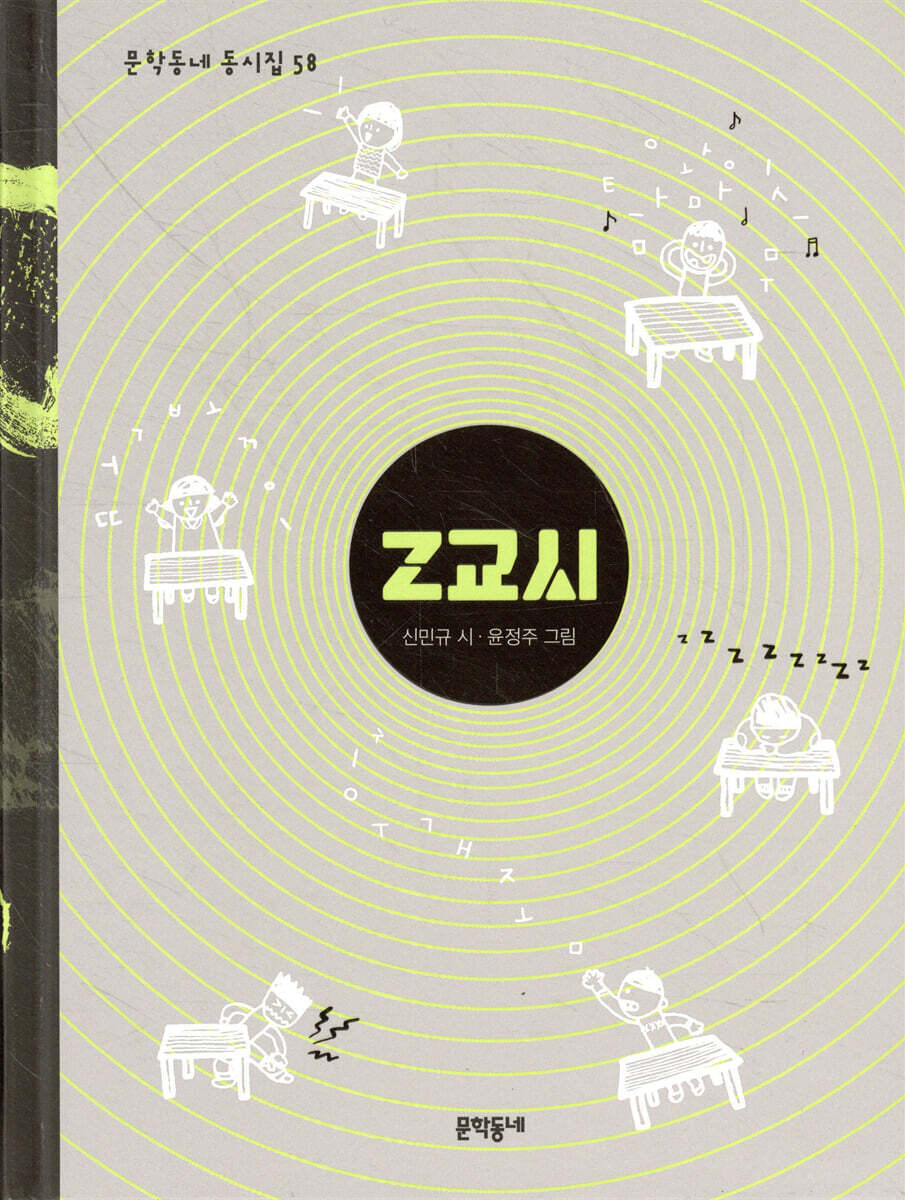
Z period
 |
Description
Book Introduction
Shin Min-gyu's "Z Period," a poetry collection unlike any you've ever seen before Plants are made up of roots, stems, leaves, flowers, and fruits. Roots support the plant and provide water and nutrients. The stem supports the sap and moves water and sap. The leaves are folded using a folded leaf. Nodding nodding and nodding nodding Nod, nod, nod, nod, Shin Min-gyu, get out of here! Flash! _「Z Period」 Full Text If you read it out loud, it will come to mind automatically. The teacher diligently explained the structure of plants, but no matter how hard I tried to keep my eyes open, my mind was helplessly consumed by nods. ZZZ... This is the scene from Z period. Shin Min-gyu's poetry collection, "Z Period," which has an unusual title, is filled with completely new poems. The word puzzle hidden in "Hidden Words" stimulates the desire for a challenge, and the verse of "Symphony of Fate" that begins with "Heogeogeogeogeok!/ This can't be happening!" comes to life vividly when set to Beethoven's melody. Rap songs including “Crossing the Line,” “Second Grade Syndrome,” and “Shoes Like This” show an incomparable level of perfection. The poet's revival explodes from the reading etiquette suggested in the 'Author's Note'. “Before you start reading, please set your cell phone to vibrate. / Don’t kick the seat in front of you. / Don’t shake your legs. / Don’t spit on more than two knuckles of your finger when turning the page. / Don’t get your nose on the book. / Use your imagination a lot while reading. / The poem will begin soon. / Please hold the lower right corner of the paper and turn the page.” |
- You can preview some of the book's contents.
Preview
index
Part 1) Find the hidden letters in the snow
Hidden Words 12
Light Flying 14
Rabbit and the Spring 15
Bibimmal 16
Z period 18
Becoming One 20
Bad Guy 22
Symphony of Fate 24
26 Lines to Cross and Lines to Avoid
Dad Age Showdown 28
Virus 30
Time Machine 31
Part 2) Yeah, I don't have a name, I'm not popular.
Letter to the Remote Control 34
36 Thoughts While Watching TV at 8 PM
Delicious Sound 38
Health Trial 40
42nd grade, 2nd year of high school
Meat Sense 44
Coke 45
Snoring Night 46
Window 48
Earphone Family 49
50 of these shoes
Trial 52
Part 3) Dark clouds over fresh peach pits
56
Playground 58
Electricity 60
New keyboard 61
Static electricity 62
Food Chain 63
Fence 64
Letter Man 66
Poetry Reading Process 68
Point 70
: 72
Poem 74 that makes you want to ride it
Part 4) Don't read me, don't forget me
Heaven and Earth 78
Edge of Sleep 80
Spring Stove 81
Do not read 82
Child 84
Ice Cream 86
Trumpet-Blowing Donkey 87
Watch out for me 88
Hula Hoop Star 90
I need to pee 92
I don't want to see 94
Dream User Manual 96
Commentary | Ian 99
Hidden Words 12
Light Flying 14
Rabbit and the Spring 15
Bibimmal 16
Z period 18
Becoming One 20
Bad Guy 22
Symphony of Fate 24
26 Lines to Cross and Lines to Avoid
Dad Age Showdown 28
Virus 30
Time Machine 31
Part 2) Yeah, I don't have a name, I'm not popular.
Letter to the Remote Control 34
36 Thoughts While Watching TV at 8 PM
Delicious Sound 38
Health Trial 40
42nd grade, 2nd year of high school
Meat Sense 44
Coke 45
Snoring Night 46
Window 48
Earphone Family 49
50 of these shoes
Trial 52
Part 3) Dark clouds over fresh peach pits
56
Playground 58
Electricity 60
New keyboard 61
Static electricity 62
Food Chain 63
Fence 64
Letter Man 66
Poetry Reading Process 68
Point 70
: 72
Poem 74 that makes you want to ride it
Part 4) Don't read me, don't forget me
Heaven and Earth 78
Edge of Sleep 80
Spring Stove 81
Do not read 82
Child 84
Ice Cream 86
Trumpet-Blowing Donkey 87
Watch out for me 88
Hula Hoop Star 90
I need to pee 92
I don't want to see 94
Dream User Manual 96
Commentary | Ian 99
Detailed image
Publisher's Review
Hardboiled, the first appearance of a new literary style generation
Poet Ian describes poet Shin Min-gyu’s “Z Period” as “hard-boiled.”
It was evaluated as “the first collection of poems that announced the emergence of a new generation of poets.”
First of all, this collection of poems does not contain ‘nature,’ which has been a regular feature in almost all collections of poems to date.
Even if it does appear, there is not a single case where it is treated as a central topic beyond the level of words.
What takes up that space are urban objects and spaces like TVs, PC rooms, zoos, and hospitals, as well as various devices of modern civilization and their related names, such as viruses, vaccines, remote controls, touchpads, search boxes, earphones, headphones, and USBs.
I'm so sleepy I could die
I need to pee
I don't want to get up
I need to pee
Put a needle in my lower abdomen
I want to pee
Plug the USB into your belly button
I want to transfer urine
Lying on the cold floor
I want to freeze my urine
I'm so sleepy I could die
I don't want to get up
The urine is getting
It becomes clearer
_「I need to pee」
In his commentary, poet Ian pointed out that this expression in “I need to pee” is “a perception and statement that would have been absolutely impossible for the previous generation.”
Recognizing the belly button, the place where the umbilical cord was cut and connected to the mother's body, as a USB port is a more unfamiliar and heterogeneous connection than the expression "fresh peach pit" ("split").
He calls Shin Min-gyu's writing style, which is based on the material aspect rather than the emotional, a writing style with almost no embellishments, dry endings, and a quick and easy read, "a writing style of bones that has stripped away all unnecessary embellishments, a hard-boiled style if you must call it that."
A devastating punchline that will elicit cheers and applause from contemporary children's readers.
pulsate
ankle
sprain
In fresh peach pits
Bitter dark clouds gather
There is thunder and lightning
It's raining heavily in my eyes.
unbearable
If you can endure 60 seconds of pain
The sun is shining
The bitter water is drained
The tears in my eyes stop flowing
A surprised ankle
Limp
Read it all
_「삠」professional
The children in Shin Min-gyu's poems are simple and unadorned.
“Let’s go eat tteokbokki after work / Did you watch TV yesterday? / I’m hungry, when will lunch time come / Can I borrow your eraser?” Regardless of what the teacher thinks, they boil up a pot of words (“Bibimmal”), and on the day they receive their report cards, they ride a time machine they accidentally find and go to the past to nag their mother about not scolding them for their grades when they have children in the future and come back (“Time Machine”).
I want to move the “Akdong Musician, Girl’s Day, EXO, Naul, Mamamoo” and “Twice” in my earphones to wider headphones (“Earphone Family”), and I summarize the day where my hair got stuck in my neck at the hair salon, I spilled cola while drinking it, my hair got stuck in the cola again, and I even stubbed my little toe on the bathroom doorstep by saying “This is the first ordeal like this in my 9 years of living” (“Ordeal”).
Even if you sprain your ankle while running, don't give up.
I know how to endure the agonizing 60 seconds of bitter dark clouds hanging over fresh peach pits and pouring rain from my eyes, and then comfort my startled ankles.
It is the image of children living their time in a cheerful and childlike manner, but more mature than adults.
I'm nine years old and in second grade.
I'm at an age where I know how to act innocent
Santa Claus's true identity is our father
My mother's cell phone password is 7537
I have a lot to know and a lot to learn.
I can't do anything, why are you doing this to me?
Whatever you do, you're still young, no no
I know the taste of Americano too
_「2nd grade disease」 part
It is impossible for a poet who has long since passed through childhood to write poetry with language and rhythm suited to today's children living in a time of tremendous change without great effort. The generational gap that exists between children and adults is fundamentally difficult to overcome, but poet Shin Min-gyu does it surprisingly well.
Readers cannot help but applaud his poetry, which is closely related to the sensibilities of contemporary children.
“I write in the hope that children will find it easy and fun to read.
It's the kind of poetry that you can read and get lost in in an instant, even if you just skim through it while flipping through the pages of a book.
“I want to write poems that make readers come to me, rather than poems that just come to me.” (Shin Min-gyu, 『Dongsi Majung』 March-April 2017 issue)
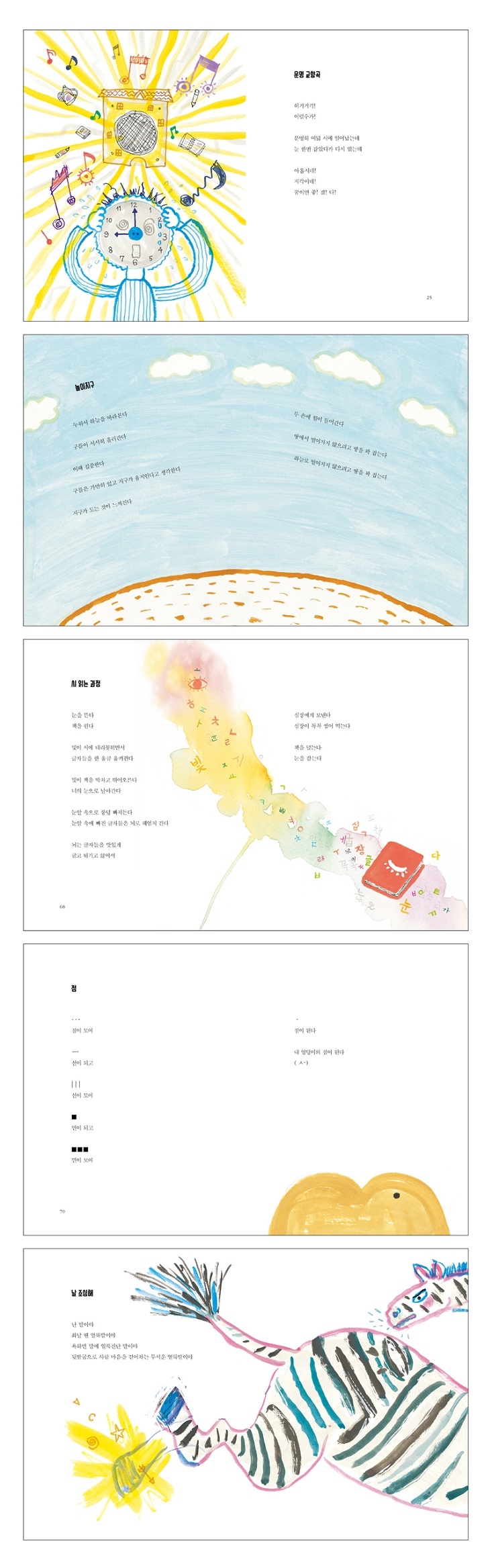
An illustration by Yoon Jeong-ju, jumping between the letters of a scrapbook.
The illustrations in 『Z Period』 were born from the brush of artist Jeongju Yoon.
His warm and humorous little people, animals, symbols, letters, numbers, shapes, and objects bounce between the letters on the paper and play with the hearts of children reading the poems.
The little things may not have been painted, but rather seemed to have just emerged from the artist's mind.
This painting conveys the image of our children, who are lively, natural, and upright beings.
Poet Ian describes poet Shin Min-gyu’s “Z Period” as “hard-boiled.”
It was evaluated as “the first collection of poems that announced the emergence of a new generation of poets.”
First of all, this collection of poems does not contain ‘nature,’ which has been a regular feature in almost all collections of poems to date.
Even if it does appear, there is not a single case where it is treated as a central topic beyond the level of words.
What takes up that space are urban objects and spaces like TVs, PC rooms, zoos, and hospitals, as well as various devices of modern civilization and their related names, such as viruses, vaccines, remote controls, touchpads, search boxes, earphones, headphones, and USBs.
I'm so sleepy I could die
I need to pee
I don't want to get up
I need to pee
Put a needle in my lower abdomen
I want to pee
Plug the USB into your belly button
I want to transfer urine
Lying on the cold floor
I want to freeze my urine
I'm so sleepy I could die
I don't want to get up
The urine is getting
It becomes clearer
_「I need to pee」
In his commentary, poet Ian pointed out that this expression in “I need to pee” is “a perception and statement that would have been absolutely impossible for the previous generation.”
Recognizing the belly button, the place where the umbilical cord was cut and connected to the mother's body, as a USB port is a more unfamiliar and heterogeneous connection than the expression "fresh peach pit" ("split").
He calls Shin Min-gyu's writing style, which is based on the material aspect rather than the emotional, a writing style with almost no embellishments, dry endings, and a quick and easy read, "a writing style of bones that has stripped away all unnecessary embellishments, a hard-boiled style if you must call it that."
A devastating punchline that will elicit cheers and applause from contemporary children's readers.
pulsate
ankle
sprain
In fresh peach pits
Bitter dark clouds gather
There is thunder and lightning
It's raining heavily in my eyes.
unbearable
If you can endure 60 seconds of pain
The sun is shining
The bitter water is drained
The tears in my eyes stop flowing
A surprised ankle
Limp
Read it all
_「삠」professional
The children in Shin Min-gyu's poems are simple and unadorned.
“Let’s go eat tteokbokki after work / Did you watch TV yesterday? / I’m hungry, when will lunch time come / Can I borrow your eraser?” Regardless of what the teacher thinks, they boil up a pot of words (“Bibimmal”), and on the day they receive their report cards, they ride a time machine they accidentally find and go to the past to nag their mother about not scolding them for their grades when they have children in the future and come back (“Time Machine”).
I want to move the “Akdong Musician, Girl’s Day, EXO, Naul, Mamamoo” and “Twice” in my earphones to wider headphones (“Earphone Family”), and I summarize the day where my hair got stuck in my neck at the hair salon, I spilled cola while drinking it, my hair got stuck in the cola again, and I even stubbed my little toe on the bathroom doorstep by saying “This is the first ordeal like this in my 9 years of living” (“Ordeal”).
Even if you sprain your ankle while running, don't give up.
I know how to endure the agonizing 60 seconds of bitter dark clouds hanging over fresh peach pits and pouring rain from my eyes, and then comfort my startled ankles.
It is the image of children living their time in a cheerful and childlike manner, but more mature than adults.
I'm nine years old and in second grade.
I'm at an age where I know how to act innocent
Santa Claus's true identity is our father
My mother's cell phone password is 7537
I have a lot to know and a lot to learn.
I can't do anything, why are you doing this to me?
Whatever you do, you're still young, no no
I know the taste of Americano too
_「2nd grade disease」 part
It is impossible for a poet who has long since passed through childhood to write poetry with language and rhythm suited to today's children living in a time of tremendous change without great effort. The generational gap that exists between children and adults is fundamentally difficult to overcome, but poet Shin Min-gyu does it surprisingly well.
Readers cannot help but applaud his poetry, which is closely related to the sensibilities of contemporary children.
“I write in the hope that children will find it easy and fun to read.
It's the kind of poetry that you can read and get lost in in an instant, even if you just skim through it while flipping through the pages of a book.
“I want to write poems that make readers come to me, rather than poems that just come to me.” (Shin Min-gyu, 『Dongsi Majung』 March-April 2017 issue)
An illustration by Yoon Jeong-ju, jumping between the letters of a scrapbook.
The illustrations in 『Z Period』 were born from the brush of artist Jeongju Yoon.
His warm and humorous little people, animals, symbols, letters, numbers, shapes, and objects bounce between the letters on the paper and play with the hearts of children reading the poems.
The little things may not have been painted, but rather seemed to have just emerged from the artist's mind.
This painting conveys the image of our children, who are lively, natural, and upright beings.
GOODS SPECIFICS
- Date of issue: October 31, 2017
- Page count, weight, size: 112 pages | 288g | 153*203*10mm
- ISBN13: 9788954648646
- ISBN10: 8954648649
- KC Certification: Certification Type: Conformity Confirmation
You may also like
카테고리
korean


korean

![GQ KOREA Mark (Monthly): December [2025]](http://librairie.coreenne.fr/cdn/shop/files/8ef265dbbfbf186523ed75ba7319009d.jpg?v=1765340328&width=3840)


