

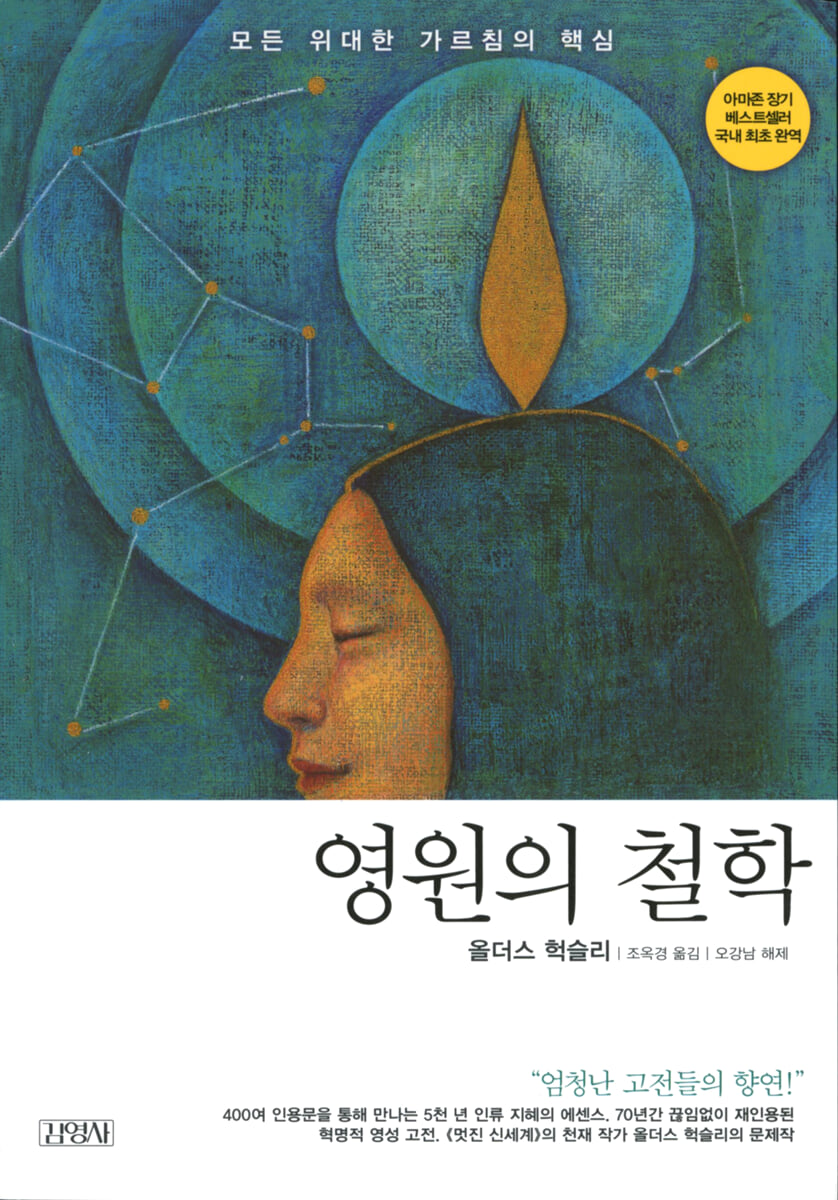
Philosophy of Eternity
 |
Description
Book Introduction
“The common core of all great religions, as Aldous Huxley of Brave New World has shown!”
A timeless classic of spirituality, a monumental work that changed the religious paradigm, is back!
'Eternal philosophy' refers to the 'essential and common core truth of all great religions' and the worldview, human view, and ethics shared by most religious traditions around the world.
In highly developed religions and philosophies, such concepts can be found for a long time, and the expression 'philosophia perennis' itself was first mentioned by the 16th-century Italian Old Testament scholar Agostino Steuco in his work Deperenni philosophia (1540).
It was first used by Leibniz to mean 'a fundamental metaphysical truth that transcends history', and it began to spread widely among the 19th-century transcendentalists. It was finally established as a proper noun in the 20th century when it became widely known to the general public through Aldous Huxley's book 'The Perennial Philosophy'.
Aldous Huxley examined a vast array of religious teachings, gleaning fragments of truth from humanity's diverse spiritual heritage—literature, history, philosophy, psychology, science, and art—and discovered a common core that runs through them all, creating a luminous mosaic.
Aldous Huxley's revolutionary spiritual classic, The Perennial Philosophy, has been translated into Korean and published for the first time by Kim Young Publishing.
This book has been referred to as a legend among those who seek unchanging, immortal values.
This book, which colorfully introduces the 'philosophy of eternity' through approximately 420 jewel-like quotations from the East and the West, has been constantly mentioned and re-quoted since its publication in 1945, and in modern times, Ken Wilber, a famous thinker who uniquely integrated Eastern and Western religions and psychology, often referred to it as 'a universal worldview adopted by the world's great spiritual teachers, philosophers, and thinkers' and used it as a basic premise of integrated thought, and its depth and value are still recognized in the 21st century.
Aldous Huxley's vast reading and exceptional insight are exquisitely revealed through the wonderful quotations arranged in 27 topics, and the depth of thought and experience evident in the commentary provides new intellectual stimulation and shock to readers who only knew him as the genius author of Brave New World.
Even if you just read the quotes individually, it is an interesting humanities report that will make you lose track of time, and it is also an excellent book of religion and meditation.
These precious "Teachings of Wisdom," introduced for the first time in Korea, still offer fresh inspiration and insight, leading one to guess why this book, published nearly 70 years ago, remains a long-time bestseller on Amazon.com.
Readers who thirst for something truly timeless, rather than a lighthearted, emotionally charged healing book, will not be disappointed.
A timeless classic of spirituality, a monumental work that changed the religious paradigm, is back!
'Eternal philosophy' refers to the 'essential and common core truth of all great religions' and the worldview, human view, and ethics shared by most religious traditions around the world.
In highly developed religions and philosophies, such concepts can be found for a long time, and the expression 'philosophia perennis' itself was first mentioned by the 16th-century Italian Old Testament scholar Agostino Steuco in his work Deperenni philosophia (1540).
It was first used by Leibniz to mean 'a fundamental metaphysical truth that transcends history', and it began to spread widely among the 19th-century transcendentalists. It was finally established as a proper noun in the 20th century when it became widely known to the general public through Aldous Huxley's book 'The Perennial Philosophy'.
Aldous Huxley examined a vast array of religious teachings, gleaning fragments of truth from humanity's diverse spiritual heritage—literature, history, philosophy, psychology, science, and art—and discovered a common core that runs through them all, creating a luminous mosaic.
Aldous Huxley's revolutionary spiritual classic, The Perennial Philosophy, has been translated into Korean and published for the first time by Kim Young Publishing.
This book has been referred to as a legend among those who seek unchanging, immortal values.
This book, which colorfully introduces the 'philosophy of eternity' through approximately 420 jewel-like quotations from the East and the West, has been constantly mentioned and re-quoted since its publication in 1945, and in modern times, Ken Wilber, a famous thinker who uniquely integrated Eastern and Western religions and psychology, often referred to it as 'a universal worldview adopted by the world's great spiritual teachers, philosophers, and thinkers' and used it as a basic premise of integrated thought, and its depth and value are still recognized in the 21st century.
Aldous Huxley's vast reading and exceptional insight are exquisitely revealed through the wonderful quotations arranged in 27 topics, and the depth of thought and experience evident in the commentary provides new intellectual stimulation and shock to readers who only knew him as the genius author of Brave New World.
Even if you just read the quotes individually, it is an interesting humanities report that will make you lose track of time, and it is also an excellent book of religion and meditation.
These precious "Teachings of Wisdom," introduced for the first time in Korea, still offer fresh inspiration and insight, leading one to guess why this book, published nearly 70 years ago, remains a long-time bestseller on Amazon.com.
Readers who thirst for something truly timeless, rather than a lighthearted, emotionally charged healing book, will not be disappointed.
- You can preview some of the book's contents.
Preview
index
Unpacking_ A deeper look into world religions through 'Eternal Philosophy'
Entering
01 You are it
Who else could be here besides him?
02 The nature of the fundamental basis
From nameless things came heaven and earth.
03 Character, Holiness, Divine Incarnation
Through identification, through grace
04 God in the World
However, certain conditions must be met.
05 The Best Love
All errors arise from a lack of love.
06 Asceticism, Non-Attachment, Right Livelihood
Accepting what happens in everyday life
07 Truth
A scroll with nothing written on it is the real scripture.
08 Religion and Temperament
The path may vary depending on one's constitution and temperament.
09 Self-understanding
Fools think they are awake
10 Grace and Free Will
You will never be abandoned unless you reject it.
11 Good and Evil
If you haven't seen the devil, look at your ego.
12 hours and eternity
How can temporal states coexist with atemporal states?
13 Salvation, Liberation, Enlightenment
He who would save his life must lose it.
14 Immortality and Survival
He who goes nowhere and comes from nowhere
15 Silence
Silencing the voices of longing and loathing
16 Prayers
Pray to yourself within me
17 Pain
Return to the fullness of eternal reality.
18 Faith
Faith leads to paradise, but Dharma leads to nirvana.
19 God is not mocked
Don't fool yourself
20 Sins Committed Because of Religion
The most fundamental causes of bondage are false beliefs and ignorance.
21 Idolatry
When truth and justice become new idols
22 Appeal to emotions
The idolatry of emotions and feelings takes its toll.
23 miracles
The obstacle between the soul and God
24 Rites, Symbols, and Eucharist
A gateway to eternity or a tool of bondage?
25 Spiritual Training
Use of drugs that may cause new diseases
26 Persistence and regularity
If you think you have enough, you lose everything.
27 Meditation, Action, and Social Usefulness
What sustains this world
Translator's Note
References
Search
Entering
01 You are it
Who else could be here besides him?
02 The nature of the fundamental basis
From nameless things came heaven and earth.
03 Character, Holiness, Divine Incarnation
Through identification, through grace
04 God in the World
However, certain conditions must be met.
05 The Best Love
All errors arise from a lack of love.
06 Asceticism, Non-Attachment, Right Livelihood
Accepting what happens in everyday life
07 Truth
A scroll with nothing written on it is the real scripture.
08 Religion and Temperament
The path may vary depending on one's constitution and temperament.
09 Self-understanding
Fools think they are awake
10 Grace and Free Will
You will never be abandoned unless you reject it.
11 Good and Evil
If you haven't seen the devil, look at your ego.
12 hours and eternity
How can temporal states coexist with atemporal states?
13 Salvation, Liberation, Enlightenment
He who would save his life must lose it.
14 Immortality and Survival
He who goes nowhere and comes from nowhere
15 Silence
Silencing the voices of longing and loathing
16 Prayers
Pray to yourself within me
17 Pain
Return to the fullness of eternal reality.
18 Faith
Faith leads to paradise, but Dharma leads to nirvana.
19 God is not mocked
Don't fool yourself
20 Sins Committed Because of Religion
The most fundamental causes of bondage are false beliefs and ignorance.
21 Idolatry
When truth and justice become new idols
22 Appeal to emotions
The idolatry of emotions and feelings takes its toll.
23 miracles
The obstacle between the soul and God
24 Rites, Symbols, and Eucharist
A gateway to eternity or a tool of bondage?
25 Spiritual Training
Use of drugs that may cause new diseases
26 Persistence and regularity
If you think you have enough, you lose everything.
27 Meditation, Action, and Social Usefulness
What sustains this world
Translator's Note
References
Search
Into the book
The ultimate goal of every human being is to discover who they really are.
(p.23)
Direct knowledge of the fundamental nature cannot be obtained except through union, and union can only be achieved by destroying the selfish ego, the barrier that separates 'you' from 'it'.
(p.76)
The idea that the self has been annihilated occurs to a person in pana (the no-mind state of Zen), but this is a fault.
The best state is when even extinction has disappeared.
At the inner peak of Atman-Brahman, there is ecstasy, the 'annihilation from annihilation'.
Another extinction from this more comprehensive extinction exists not only at the inner peak, but also in the world, through the world, in the full and waking daily knowledge of God.
(p.136)
Do what you are doing now, and suffer what you are suffering now.
Do all these things sacredly.
Nothing needs to change except your hearts.
There is divinity in willing what happens to us according to God's order.
- De Cossade
This is the same as following the supreme Way, avoiding selection in the "Shinsimmyeong", putting aside illusory views, opening one's eyes so that dreams disappear and the truth becomes clear on its own.
(p.140)
Love is certain.
There is no error there.
Because all errors arise from a lack of love.
- William Law (p.150)
Sell your cleverness and buy embarrassment.
Cleverness is just an opinion, but bewilderment is insight.
- Jalaluddin Rumi (p.244)
Fools feel that they are awake in the present.
Zhuangzi (p.277)
Understanding ourselves tells us where we came from, where we are, and where we are going.
We come from God and are in exile.
Because the power of our love tends towards God, we are conscious of this state of exile.
- Roysburg (p.278)
If you haven't seen the devil, look at your own ego.
- Jalaluddin Rumi (p.303)
Like a bee gathering honey from various flowers, a wise person accepts the essence of various scriptures and sees only the good in all religions.
《Srimad Bhagavatam》 (p.334)
Can you walk on water? You are no better than a rag.
Can you fly? You're no better than a fly.
Conquer your heart.
Then you can become a great person.
- Ansari of Herat (p.434)
If you say, “Enough is enough.
If you say, “I have reached perfection,” you lose everything.
Because it is the function of perfection to make one aware of one's own imperfections.
(p.23)
Direct knowledge of the fundamental nature cannot be obtained except through union, and union can only be achieved by destroying the selfish ego, the barrier that separates 'you' from 'it'.
(p.76)
The idea that the self has been annihilated occurs to a person in pana (the no-mind state of Zen), but this is a fault.
The best state is when even extinction has disappeared.
At the inner peak of Atman-Brahman, there is ecstasy, the 'annihilation from annihilation'.
Another extinction from this more comprehensive extinction exists not only at the inner peak, but also in the world, through the world, in the full and waking daily knowledge of God.
(p.136)
Do what you are doing now, and suffer what you are suffering now.
Do all these things sacredly.
Nothing needs to change except your hearts.
There is divinity in willing what happens to us according to God's order.
- De Cossade
This is the same as following the supreme Way, avoiding selection in the "Shinsimmyeong", putting aside illusory views, opening one's eyes so that dreams disappear and the truth becomes clear on its own.
(p.140)
Love is certain.
There is no error there.
Because all errors arise from a lack of love.
- William Law (p.150)
Sell your cleverness and buy embarrassment.
Cleverness is just an opinion, but bewilderment is insight.
- Jalaluddin Rumi (p.244)
Fools feel that they are awake in the present.
Zhuangzi (p.277)
Understanding ourselves tells us where we came from, where we are, and where we are going.
We come from God and are in exile.
Because the power of our love tends towards God, we are conscious of this state of exile.
- Roysburg (p.278)
If you haven't seen the devil, look at your own ego.
- Jalaluddin Rumi (p.303)
Like a bee gathering honey from various flowers, a wise person accepts the essence of various scriptures and sees only the good in all religions.
《Srimad Bhagavatam》 (p.334)
Can you walk on water? You are no better than a rag.
Can you fly? You're no better than a fly.
Conquer your heart.
Then you can become a great person.
- Ansari of Herat (p.434)
If you say, “Enough is enough.
If you say, “I have reached perfection,” you lose everything.
Because it is the function of perfection to make one aware of one's own imperfections.
- St. Augustine (p.485)
Publisher's Review
A book written by Aldous Huxley, author of Brave New World, and recommended by Kim Yeon-su!
Aldous Huxley, the genius author of Brave New World, colorfully introduces the "Eternal Philosophy," meaning "the common core of all great religions," with over 420 gem-like quotes from across the East and the West. Why is the world filled with suffering and desire? Where is God? Why do each person's path to enlightenment differ? Ken Wilber, the thinker who integrated Eastern and Western religions and psychology, calls the Eternal Philosophy "the common worldview chosen by the great spiritual masters" and the fundamental premise of his unified thought. A feast of fascinating classics, even if you only read the quotes, this is the ultimate exploration of consciousness that revolutionized our understanding of 20th-century culture, religion, and spirituality!
“Brave New World” by Aldous Huxley
“The common core of all great religions!”
A timeless classic of spirituality, a monumental work that changed the religious paradigm, is back!
No book better demonstrates that there is only one peak, but innumerable paths to it.
The language of silence left behind by mystics from the East and the West, past and present, including Rumi, Zhuangzi, Eckhart, and St. John of the Cross, is gathered together.
It may seem to be a discussion of religion, but it is in fact a description of the only way to bring life, art, and truth to a single peak: the art of burning the self with the kindling of awareness of one's own ignorance, boundless humility, and unconditional obedience.
The virtue of this book lies in its ability to share that spark with anyone who desires it, regardless of religion or race.
Kim Yeon-su (novelist)
'Eternal philosophy' refers to the 'essential and common core truth of all great religions' and the worldview, human view, and ethics shared by most religious traditions around the world.
In highly developed religions and philosophies, such concepts can be found for a long time, and the expression 'philosophia perennis' itself was first mentioned by the 16th-century Italian Old Testament scholar Agostino Steuco in his work Deperenni philosophia (1540).
It was first used by Leibniz to mean 'a fundamental metaphysical truth that transcends history', and it began to spread widely among the 19th-century transcendentalists. It was finally established as a proper noun in the 20th century when it became widely known to the general public through Aldous Huxley's book 'The Perennial Philosophy'.
Aldous Huxley examined a vast array of religious teachings, gleaning fragments of truth from humanity's diverse spiritual heritage—literature, history, philosophy, psychology, science, and art—and discovered a common core that runs through them all, creating a luminous mosaic.
Aldous Huxley's revolutionary spiritual classic, The Perennial Philosophy, has been translated into Korean and published for the first time by Kim Young Publishing.
This book has been referred to as a legend among those who seek unchanging, immortal values.
This book, which colorfully introduces the 'philosophy of eternity' through approximately 420 jewel-like quotations from the East and the West, has been constantly mentioned and re-quoted since its publication in 1945, and in modern times, Ken Wilber, a famous thinker who uniquely integrated Eastern and Western religions and psychology, often referred to it as 'a universal worldview adopted by the world's great spiritual teachers, philosophers, and thinkers' and used it as a basic premise of integrated thought, and its depth and value are still recognized in the 21st century.
Aldous Huxley's vast reading and exceptional insight are exquisitely revealed through the wonderful quotations arranged in 27 topics, and the depth of thought and experience evident in the commentary provides new intellectual stimulation and shock to readers who only knew him as the genius author of Brave New World.
Even if you just read the quotes individually, it is an interesting humanities report that will make you lose track of time, and it is also an excellent book of religion and meditation.
These precious "Teachings of Wisdom," introduced for the first time in Korea, still offer fresh inspiration and insight, leading one to guess why this book, published nearly 70 years ago, remains a long-time bestseller on Amazon.com.
Readers who thirst for something truly timeless, rather than a lighthearted, emotionally charged healing book, will not be disappointed.
Aldous Huxley, a 20th-century genius writer who pursued spirituality beyond intellect
Huxley, widely known as the author of Brave New World, was a writer, poet, and thinker who was born in England in 1894 and died in the United States in 1963.
He was born into the famous 'Huxley family', which produced outstanding talents in the fields of science, medicine, art, and literature and is even listed in the Encyclopedia Britannica, and grew up receiving abundant intellectual stimulation and encouragement of creative talent from a young age.
His grandfather was Thomas Henry Huxley, a renowned biologist who defended Darwin's theory of natural selection, strongly opposed religious traditions, and first coined the term 'agnosticism'; his father was Leonard Huxley, vice-head of the prestigious Charterhouse School and biographer; his older brother was Julian Huxley, a leading figure in modern evolutionary theory and the first Director-General of UNESCO who led the popularization of science; and his younger brother was Andrew Huxley, winner of the Nobel Prize in Physiology or Medicine.
My maternal side had outstanding talents in literature and religion.
His maternal great-grandfather was Thomas Arnold, an educator and religious figure who brought about educational reform in England; his mother studied English literature at Oxford; his maternal uncle was Matthew Arnold, a renowned meditative poet and literary critic; and his maternal aunt was Mrs. Humphrey Ward, who boldly depicted social and religious issues in her novels.
Huxley, considered the most influential writer in mid-20th century Britain, not only explored various literary genres, including poetry, comedy, novels, essays, and criticism, but also actively worked as a philosopher, mystic, and prophet of social phenomena.
In his early works, he established himself as a social critic through his sharp intellect and critical thinking, but in his later years, he became immersed in religious and spiritual themes, taking an interest in philosophical mysticism and parapsychology.
His interest in Eastern and Western mysticism deepened after he immigrated to the United States in 1937, and in his later years he lived mainly in California, interacting deeply with prominent spiritual figures such as Jiddu Krishnamurti and Swami Prabhavananda, and striving to harmonize practical issues such as war, politics, economics, ethics, education, religion, and technology with ultimate reality.
While actively participating in the peace movement, he also self-administered hallucinogens in addition to meditation and yoga to achieve the ultimate experience of consciousness. The contents of his explorations were published in “The Door to Perception” and “Heaven and Hell” and became a hot topic.
On November 22, 1963, John F.
He died at the age of 69 on the day President Kennedy was assassinated, and he argued that the crisis of modern civilization could be overcome when Eastern mysticism and the art of integrated living, and Western science, technology, and rational methodologies were in harmony.
Revealing the common core of the great religions of the East and the West!
As Huxley himself mentioned in the introduction, this book is a 'collection of eternal philosophy (a book that selects representative works)'.
Rather than being an academic or abstract philosophy, it is a collection of wisdom, with Huxley's commentary, of passages expressed across various times and places by truly "saintly men and women" who have directly discerned and become capable of "ultimate reality" through self-rebirth and enlightenment.
The divine reality, the basis of all existence, is a realm of 'direct spiritual knowledge' through experience that cannot be accessed through thought or language.
To reveal this point, Huxley meticulously studied various scriptures, including those of Buddhism, Hinduism, Taoism, Christianity, and Islamic mysticism, and then, based on his extensive knowledge, compared and analyzed them to find essential commonalities and synthesize them.
There are approximately 420 articles selected through quotations.
The Catholic mystics Meister Eckhart and William Law are cited most frequently, but St. John of the Cross, Jalaluddin Rumi, and St. Francis de Sales are also frequently cited.
Not only the writings of Protestants Denck and Frank, and George Fox, the founder of Quakerism, but also the writings of literary giants such as Shakespeare, Tolstoy, and Wordsworth appear frequently.
Among the sages of the East, the writings of Zhuangzi and Laozi were frequently quoted, and the famous Indian scriptures, the Upanishads and the Bhagavad Gita, were also quoted quite a few times.
It also cites various Buddhist scriptures, the most of which is the 《Neurijāgagyeong》 which is said to have been passed down by Bodhidharma to Hyega, and other scriptures that show the essence of Seon such as the 《Platform Sutra of the Sixth Patriarch》, 《Transmission of the Mind Beopyo》, 《Sinsimmyeong》, etc., as well as the 《Awakening of Faith in Mahayana》, 《Pure Purgatory Sutra》, 《Neurijāgagyeong》, 《Dhammapadagyeong》, 《Diamond Sutra》, etc. It evenly covers the core of Mahayana, Hinayana, Gyo, and Seon sects to the point that even Easterners who claim to know a fair bit about Buddhism are amazed.
These quotes, many of which are rare materials being introduced to Korea for the first time, continue to provide unexpected intellectual and spiritual surprises even after so many years, thanks to their breadth and depth, their discerning approach to material selection, and their complex composition that exquisitely fits the subject matter.
Huxley's vast reading volume, his horizons of thought, and the depth of experience evident in his commentary, which brought together the diverse voices of Eastern and Western spiritual geniuses, offer the joy of heightened consciousness along with the wonder of his genius.
● How can I find the way?
: The thrill of the moment when different pieces fit together into one picture!
Where is God? How can we realize the truth? Some seek it from a transcendental, external source, others examine their own hearts, and still others claim directly that they are the absolute and the truth.
Huxley begins his book by presenting the conclusion to this dilemma, which most religions reach after long exploration and adventure.
“You are it” “See only one thing in everything” God is within us and outside of us.
There is a path to absolute Reality within the soul and through the soul.
In the world, and through the world, there is a path to absolute reality.
It is doubtful whether the final destination can be reached by following only one of these paths to the exclusion of the others.
(p.111)
But accepting and putting this into practice is not easy.
No, is this even a valid fact? The reasons, logic, context, and methodology behind it are richly detailed in the other pages of this book.
This book delves into the nature of "divine reality" from various perspectives, exploring weighty topics such as the relationship between love and truth, what it means to understand oneself, free will and grace, the self, good and evil, time and eternity, salvation and liberation, faith and knowledge, silence and prayer, idolatry, spiritual training and the value of miracles, as well as the points at which these topics intersect with contemporary psychology, science, and political realities.
These contents, presented with numerous quotations, beautifully mosaic-likely form a vast system that is difficult to express in a single word: 'Eternal Philosophy.'
What is surprising about this book is that these explorations and quotations are not merely “nice words” or the superficial level of what is often found in meditation books.
Even if we look at the famous expression "Thou art that," which is the title of Chapter 1 and has been cited by saints of Christianity, Buddhism, and Hinduism, Huxley always goes a few steps further to consider the dangers of such insights or truths becoming "idols" again, and the subsequent social repercussions, thereby broadening our horizons of understanding.
The fact that Nirvana and Samsara are one is a fact about the nature of the universe.
However, only a soul with a very advanced spirituality can fully realize or directly experience this fact.
If ordinary, kind, but godless people accept these truths as hearsay and put them into practice, it will bring disaster.
All the dark tales of antinomianism warn us of what happens when people put into practice the purely intellectual, yet unenlightened, theory that everything is God and God is everything.
(p.131-132)
● Why is the path different for each person?
: The path of action, the path of knowledge, the path of devotion
Until we discover how nature transcends itself by nature, we are lost.
(p.267)
Why do some prioritize faith, others favor analytical explanations, and others prioritize ethical practice? In every era, people strive to persuade and impose their own way of thinking.
Behind the resurgent Israeli-Palestinian conflict, as well as large-scale genocide, abuse of women, war, murder, and violence, we can see that there is a value system that fails to respect each other's 'differences' and fails to understand the 'sameness' within them.
Aldous Huxley interestingly identifies common causes of these problems through the different approaches of scientific research and religious wisdom.
It explains, through various examples, how each person's physiological constitution (body type) of endoderm, mesoderm, and ectoderm differs, how it affects their way of life, and how it is related to the path of devotion, the path of action, and the path of knowledge discovered by ancient religions.
There have often been times in the course of history when some of the imperfect religions have been taken too seriously, as good and true in themselves, rather than as means to the ultimate end of all religions.
Such errors sometimes had dire consequences.
(Omitted) As Sheldon points out, violent conversion is usually a phenomenon limited to people with a high degree of mesomorphic personality.
These people are so extroverted that they are completely unaware of what is going on at a lower level of their minds.
When, for whatever reason, they turn their attention inward, the resulting self-knowledge reveals itself, by its very strangeness and unfamiliarity, as having the power and quality of revelation.
Therefore, repentance, or metanoia, or change of mind, is sudden and full of emotion.
(Omitted) For those who are naturally drawn to this kind of emotional upheaval, doctrines that make salvation dependent on conversion may be satisfying, but they are very detrimental to spiritual growth.
(p.266-267)
Although it begins with religious issues, it ultimately leads to a methodology of self-cultivation and the pursuit of truth, and the explanation comprehensively examines the history of war and violence that continues even in modern times. This explanation transcends the right and wrong of constitutionalism and presents a new perspective on the world.
● What is the meaning of this world filled with suffering and desire?
: Return to the fullness of eternal reality.
We all pursue happiness.
However, in the process of satisfying each person's desires, life becomes filled with suffering.
Great saints have taught us that God exists not in some distant heaven, but in this very world, and that the world itself is God. So why is our life so painful? Christianity has explained this with "original sin" and the "fall," but Huxley, in "The Philosophy of the Eternal," reveals that the essence of this is "the yearning for individualized existence."
Divinity does not feel pain.
Because where there is perfection and unity, there can be no suffering.
(Omitted) The purpose of creation is to free all living beings from the illusive drive and sense of separation that results in suffering, and to return to the wholeness of eternal reality through unitive knowledge.
(p.383)
The ultimate goal of every human being is to discover that fact for themselves and discover who they really are.
(p.23)
So what can we do with our lives now? Should we believe in something again? Asceticism? Prayer? Service? Indifference? Passion? Or perhaps another learning? The answers to these questions, as in life itself, are presented in this book through a variety of paths, often through unexpected characters.
Countless works of literature, poems, novels, plays, and aphorisms from both the East and the West sing of something in their own way.
Do what you are doing now, and suffer what you are suffering now.
Do all these things sacredly.
Nothing needs to change except your hearts.
There is divinity in willing what happens to us according to God's order.
_De Cossad (p.122)
"The thought that the self has been annihilated arises in a person in pana (the no-mind state of Zen), and this is a fault.
The highest state is the cessation of cessation." At the inner peak of Atman-Brahman, there is the cessation of cessation, the state of ecstasy.
Another extinction from this more comprehensive extinction exists not only at the inner peak, but also in the world, through the world, in the full and waking daily knowledge of God.
(p.136~137)
Religion originally contained the greatest intellectual reflection and concern of its time.
So, this is what is called the ‘prime teaching’.
This book, while mentioning the most core and essential common principles of such religions, does not speak deeply about 'religion' itself, but rather about the oldest wisdom of how to happily return to my 'now' self and my life 'here'.
A book that will serve as a compass for those seeking true enlightenment and spiritual integration!
There is some significance in the fact that a book published in English in 1945 has been translated and published in Korea after about 70 years.
As we enter the new millennium of the 21st century, a new era of integration is dawning, transcending the modern era, when reason and rationality dominated the zeitgeist, and the post-modern attempts to avoid the dominance of formal rationality that suppresses the irrational and unreasonable.
In contrast to the bright picture of scientific advancement and technological and industrial progress based on objective and rational thinking, humanity, having experienced the dark shadows of the commodification of life, the equalization of qualitative differences, the fragmentation of the living world, and shallow materialism, is gradually growing in its longing for universal values such as spirituality that go beyond intellect.
The topic of 'spirituality', which had been considered a religious subject, saw an explosive increase in interest in its meaning and value in the 2000s as the medical community began to consistently report its positive effects on mental health.
Furthermore, the recent resurgence of interest in Eastern classics among the general public demonstrates a growing moral and ethical desire to discover the meaning and value of life. This, in turn, can be directly linked to the ultimate morality of "spirituality," which demonstrates that we are all fundamentally one.
Considering this current of the times, "The Philosophy of Eternity," which synthesizes the diverse voices of Eastern and Western spiritual geniuses to demonstrate the existence of universal truths for humanity passed down from ancient times, is a must-read for the 21st century.
Especially in the information age, where the development of the Internet has made the world a vivid "global village," the ability to view the sophisticated wisdom of the East and the West in one place will serve as a starting point for opening up a higher horizon of consciousness.
Aldous Huxley, the genius author of Brave New World, colorfully introduces the "Eternal Philosophy," meaning "the common core of all great religions," with over 420 gem-like quotes from across the East and the West. Why is the world filled with suffering and desire? Where is God? Why do each person's path to enlightenment differ? Ken Wilber, the thinker who integrated Eastern and Western religions and psychology, calls the Eternal Philosophy "the common worldview chosen by the great spiritual masters" and the fundamental premise of his unified thought. A feast of fascinating classics, even if you only read the quotes, this is the ultimate exploration of consciousness that revolutionized our understanding of 20th-century culture, religion, and spirituality!
“Brave New World” by Aldous Huxley
“The common core of all great religions!”
A timeless classic of spirituality, a monumental work that changed the religious paradigm, is back!
No book better demonstrates that there is only one peak, but innumerable paths to it.
The language of silence left behind by mystics from the East and the West, past and present, including Rumi, Zhuangzi, Eckhart, and St. John of the Cross, is gathered together.
It may seem to be a discussion of religion, but it is in fact a description of the only way to bring life, art, and truth to a single peak: the art of burning the self with the kindling of awareness of one's own ignorance, boundless humility, and unconditional obedience.
The virtue of this book lies in its ability to share that spark with anyone who desires it, regardless of religion or race.
Kim Yeon-su (novelist)
'Eternal philosophy' refers to the 'essential and common core truth of all great religions' and the worldview, human view, and ethics shared by most religious traditions around the world.
In highly developed religions and philosophies, such concepts can be found for a long time, and the expression 'philosophia perennis' itself was first mentioned by the 16th-century Italian Old Testament scholar Agostino Steuco in his work Deperenni philosophia (1540).
It was first used by Leibniz to mean 'a fundamental metaphysical truth that transcends history', and it began to spread widely among the 19th-century transcendentalists. It was finally established as a proper noun in the 20th century when it became widely known to the general public through Aldous Huxley's book 'The Perennial Philosophy'.
Aldous Huxley examined a vast array of religious teachings, gleaning fragments of truth from humanity's diverse spiritual heritage—literature, history, philosophy, psychology, science, and art—and discovered a common core that runs through them all, creating a luminous mosaic.
Aldous Huxley's revolutionary spiritual classic, The Perennial Philosophy, has been translated into Korean and published for the first time by Kim Young Publishing.
This book has been referred to as a legend among those who seek unchanging, immortal values.
This book, which colorfully introduces the 'philosophy of eternity' through approximately 420 jewel-like quotations from the East and the West, has been constantly mentioned and re-quoted since its publication in 1945, and in modern times, Ken Wilber, a famous thinker who uniquely integrated Eastern and Western religions and psychology, often referred to it as 'a universal worldview adopted by the world's great spiritual teachers, philosophers, and thinkers' and used it as a basic premise of integrated thought, and its depth and value are still recognized in the 21st century.
Aldous Huxley's vast reading and exceptional insight are exquisitely revealed through the wonderful quotations arranged in 27 topics, and the depth of thought and experience evident in the commentary provides new intellectual stimulation and shock to readers who only knew him as the genius author of Brave New World.
Even if you just read the quotes individually, it is an interesting humanities report that will make you lose track of time, and it is also an excellent book of religion and meditation.
These precious "Teachings of Wisdom," introduced for the first time in Korea, still offer fresh inspiration and insight, leading one to guess why this book, published nearly 70 years ago, remains a long-time bestseller on Amazon.com.
Readers who thirst for something truly timeless, rather than a lighthearted, emotionally charged healing book, will not be disappointed.
Aldous Huxley, a 20th-century genius writer who pursued spirituality beyond intellect
Huxley, widely known as the author of Brave New World, was a writer, poet, and thinker who was born in England in 1894 and died in the United States in 1963.
He was born into the famous 'Huxley family', which produced outstanding talents in the fields of science, medicine, art, and literature and is even listed in the Encyclopedia Britannica, and grew up receiving abundant intellectual stimulation and encouragement of creative talent from a young age.
His grandfather was Thomas Henry Huxley, a renowned biologist who defended Darwin's theory of natural selection, strongly opposed religious traditions, and first coined the term 'agnosticism'; his father was Leonard Huxley, vice-head of the prestigious Charterhouse School and biographer; his older brother was Julian Huxley, a leading figure in modern evolutionary theory and the first Director-General of UNESCO who led the popularization of science; and his younger brother was Andrew Huxley, winner of the Nobel Prize in Physiology or Medicine.
My maternal side had outstanding talents in literature and religion.
His maternal great-grandfather was Thomas Arnold, an educator and religious figure who brought about educational reform in England; his mother studied English literature at Oxford; his maternal uncle was Matthew Arnold, a renowned meditative poet and literary critic; and his maternal aunt was Mrs. Humphrey Ward, who boldly depicted social and religious issues in her novels.
Huxley, considered the most influential writer in mid-20th century Britain, not only explored various literary genres, including poetry, comedy, novels, essays, and criticism, but also actively worked as a philosopher, mystic, and prophet of social phenomena.
In his early works, he established himself as a social critic through his sharp intellect and critical thinking, but in his later years, he became immersed in religious and spiritual themes, taking an interest in philosophical mysticism and parapsychology.
His interest in Eastern and Western mysticism deepened after he immigrated to the United States in 1937, and in his later years he lived mainly in California, interacting deeply with prominent spiritual figures such as Jiddu Krishnamurti and Swami Prabhavananda, and striving to harmonize practical issues such as war, politics, economics, ethics, education, religion, and technology with ultimate reality.
While actively participating in the peace movement, he also self-administered hallucinogens in addition to meditation and yoga to achieve the ultimate experience of consciousness. The contents of his explorations were published in “The Door to Perception” and “Heaven and Hell” and became a hot topic.
On November 22, 1963, John F.
He died at the age of 69 on the day President Kennedy was assassinated, and he argued that the crisis of modern civilization could be overcome when Eastern mysticism and the art of integrated living, and Western science, technology, and rational methodologies were in harmony.
Revealing the common core of the great religions of the East and the West!
As Huxley himself mentioned in the introduction, this book is a 'collection of eternal philosophy (a book that selects representative works)'.
Rather than being an academic or abstract philosophy, it is a collection of wisdom, with Huxley's commentary, of passages expressed across various times and places by truly "saintly men and women" who have directly discerned and become capable of "ultimate reality" through self-rebirth and enlightenment.
The divine reality, the basis of all existence, is a realm of 'direct spiritual knowledge' through experience that cannot be accessed through thought or language.
To reveal this point, Huxley meticulously studied various scriptures, including those of Buddhism, Hinduism, Taoism, Christianity, and Islamic mysticism, and then, based on his extensive knowledge, compared and analyzed them to find essential commonalities and synthesize them.
There are approximately 420 articles selected through quotations.
The Catholic mystics Meister Eckhart and William Law are cited most frequently, but St. John of the Cross, Jalaluddin Rumi, and St. Francis de Sales are also frequently cited.
Not only the writings of Protestants Denck and Frank, and George Fox, the founder of Quakerism, but also the writings of literary giants such as Shakespeare, Tolstoy, and Wordsworth appear frequently.
Among the sages of the East, the writings of Zhuangzi and Laozi were frequently quoted, and the famous Indian scriptures, the Upanishads and the Bhagavad Gita, were also quoted quite a few times.
It also cites various Buddhist scriptures, the most of which is the 《Neurijāgagyeong》 which is said to have been passed down by Bodhidharma to Hyega, and other scriptures that show the essence of Seon such as the 《Platform Sutra of the Sixth Patriarch》, 《Transmission of the Mind Beopyo》, 《Sinsimmyeong》, etc., as well as the 《Awakening of Faith in Mahayana》, 《Pure Purgatory Sutra》, 《Neurijāgagyeong》, 《Dhammapadagyeong》, 《Diamond Sutra》, etc. It evenly covers the core of Mahayana, Hinayana, Gyo, and Seon sects to the point that even Easterners who claim to know a fair bit about Buddhism are amazed.
These quotes, many of which are rare materials being introduced to Korea for the first time, continue to provide unexpected intellectual and spiritual surprises even after so many years, thanks to their breadth and depth, their discerning approach to material selection, and their complex composition that exquisitely fits the subject matter.
Huxley's vast reading volume, his horizons of thought, and the depth of experience evident in his commentary, which brought together the diverse voices of Eastern and Western spiritual geniuses, offer the joy of heightened consciousness along with the wonder of his genius.
● How can I find the way?
: The thrill of the moment when different pieces fit together into one picture!
Where is God? How can we realize the truth? Some seek it from a transcendental, external source, others examine their own hearts, and still others claim directly that they are the absolute and the truth.
Huxley begins his book by presenting the conclusion to this dilemma, which most religions reach after long exploration and adventure.
“You are it” “See only one thing in everything” God is within us and outside of us.
There is a path to absolute Reality within the soul and through the soul.
In the world, and through the world, there is a path to absolute reality.
It is doubtful whether the final destination can be reached by following only one of these paths to the exclusion of the others.
(p.111)
But accepting and putting this into practice is not easy.
No, is this even a valid fact? The reasons, logic, context, and methodology behind it are richly detailed in the other pages of this book.
This book delves into the nature of "divine reality" from various perspectives, exploring weighty topics such as the relationship between love and truth, what it means to understand oneself, free will and grace, the self, good and evil, time and eternity, salvation and liberation, faith and knowledge, silence and prayer, idolatry, spiritual training and the value of miracles, as well as the points at which these topics intersect with contemporary psychology, science, and political realities.
These contents, presented with numerous quotations, beautifully mosaic-likely form a vast system that is difficult to express in a single word: 'Eternal Philosophy.'
What is surprising about this book is that these explorations and quotations are not merely “nice words” or the superficial level of what is often found in meditation books.
Even if we look at the famous expression "Thou art that," which is the title of Chapter 1 and has been cited by saints of Christianity, Buddhism, and Hinduism, Huxley always goes a few steps further to consider the dangers of such insights or truths becoming "idols" again, and the subsequent social repercussions, thereby broadening our horizons of understanding.
The fact that Nirvana and Samsara are one is a fact about the nature of the universe.
However, only a soul with a very advanced spirituality can fully realize or directly experience this fact.
If ordinary, kind, but godless people accept these truths as hearsay and put them into practice, it will bring disaster.
All the dark tales of antinomianism warn us of what happens when people put into practice the purely intellectual, yet unenlightened, theory that everything is God and God is everything.
(p.131-132)
● Why is the path different for each person?
: The path of action, the path of knowledge, the path of devotion
Until we discover how nature transcends itself by nature, we are lost.
(p.267)
Why do some prioritize faith, others favor analytical explanations, and others prioritize ethical practice? In every era, people strive to persuade and impose their own way of thinking.
Behind the resurgent Israeli-Palestinian conflict, as well as large-scale genocide, abuse of women, war, murder, and violence, we can see that there is a value system that fails to respect each other's 'differences' and fails to understand the 'sameness' within them.
Aldous Huxley interestingly identifies common causes of these problems through the different approaches of scientific research and religious wisdom.
It explains, through various examples, how each person's physiological constitution (body type) of endoderm, mesoderm, and ectoderm differs, how it affects their way of life, and how it is related to the path of devotion, the path of action, and the path of knowledge discovered by ancient religions.
There have often been times in the course of history when some of the imperfect religions have been taken too seriously, as good and true in themselves, rather than as means to the ultimate end of all religions.
Such errors sometimes had dire consequences.
(Omitted) As Sheldon points out, violent conversion is usually a phenomenon limited to people with a high degree of mesomorphic personality.
These people are so extroverted that they are completely unaware of what is going on at a lower level of their minds.
When, for whatever reason, they turn their attention inward, the resulting self-knowledge reveals itself, by its very strangeness and unfamiliarity, as having the power and quality of revelation.
Therefore, repentance, or metanoia, or change of mind, is sudden and full of emotion.
(Omitted) For those who are naturally drawn to this kind of emotional upheaval, doctrines that make salvation dependent on conversion may be satisfying, but they are very detrimental to spiritual growth.
(p.266-267)
Although it begins with religious issues, it ultimately leads to a methodology of self-cultivation and the pursuit of truth, and the explanation comprehensively examines the history of war and violence that continues even in modern times. This explanation transcends the right and wrong of constitutionalism and presents a new perspective on the world.
● What is the meaning of this world filled with suffering and desire?
: Return to the fullness of eternal reality.
We all pursue happiness.
However, in the process of satisfying each person's desires, life becomes filled with suffering.
Great saints have taught us that God exists not in some distant heaven, but in this very world, and that the world itself is God. So why is our life so painful? Christianity has explained this with "original sin" and the "fall," but Huxley, in "The Philosophy of the Eternal," reveals that the essence of this is "the yearning for individualized existence."
Divinity does not feel pain.
Because where there is perfection and unity, there can be no suffering.
(Omitted) The purpose of creation is to free all living beings from the illusive drive and sense of separation that results in suffering, and to return to the wholeness of eternal reality through unitive knowledge.
(p.383)
The ultimate goal of every human being is to discover that fact for themselves and discover who they really are.
(p.23)
So what can we do with our lives now? Should we believe in something again? Asceticism? Prayer? Service? Indifference? Passion? Or perhaps another learning? The answers to these questions, as in life itself, are presented in this book through a variety of paths, often through unexpected characters.
Countless works of literature, poems, novels, plays, and aphorisms from both the East and the West sing of something in their own way.
Do what you are doing now, and suffer what you are suffering now.
Do all these things sacredly.
Nothing needs to change except your hearts.
There is divinity in willing what happens to us according to God's order.
_De Cossad (p.122)
"The thought that the self has been annihilated arises in a person in pana (the no-mind state of Zen), and this is a fault.
The highest state is the cessation of cessation." At the inner peak of Atman-Brahman, there is the cessation of cessation, the state of ecstasy.
Another extinction from this more comprehensive extinction exists not only at the inner peak, but also in the world, through the world, in the full and waking daily knowledge of God.
(p.136~137)
Religion originally contained the greatest intellectual reflection and concern of its time.
So, this is what is called the ‘prime teaching’.
This book, while mentioning the most core and essential common principles of such religions, does not speak deeply about 'religion' itself, but rather about the oldest wisdom of how to happily return to my 'now' self and my life 'here'.
A book that will serve as a compass for those seeking true enlightenment and spiritual integration!
There is some significance in the fact that a book published in English in 1945 has been translated and published in Korea after about 70 years.
As we enter the new millennium of the 21st century, a new era of integration is dawning, transcending the modern era, when reason and rationality dominated the zeitgeist, and the post-modern attempts to avoid the dominance of formal rationality that suppresses the irrational and unreasonable.
In contrast to the bright picture of scientific advancement and technological and industrial progress based on objective and rational thinking, humanity, having experienced the dark shadows of the commodification of life, the equalization of qualitative differences, the fragmentation of the living world, and shallow materialism, is gradually growing in its longing for universal values such as spirituality that go beyond intellect.
The topic of 'spirituality', which had been considered a religious subject, saw an explosive increase in interest in its meaning and value in the 2000s as the medical community began to consistently report its positive effects on mental health.
Furthermore, the recent resurgence of interest in Eastern classics among the general public demonstrates a growing moral and ethical desire to discover the meaning and value of life. This, in turn, can be directly linked to the ultimate morality of "spirituality," which demonstrates that we are all fundamentally one.
Considering this current of the times, "The Philosophy of Eternity," which synthesizes the diverse voices of Eastern and Western spiritual geniuses to demonstrate the existence of universal truths for humanity passed down from ancient times, is a must-read for the 21st century.
Especially in the information age, where the development of the Internet has made the world a vivid "global village," the ability to view the sophisticated wisdom of the East and the West in one place will serve as a starting point for opening up a higher horizon of consciousness.
GOODS SPECIFICS
- Date of issue: August 8, 2014
- Page count, weight, size: 528 pages | 747g | 166*224*35mm
- ISBN13: 9788934968627
- ISBN10: 8934968621
You may also like
카테고리
korean


korean

![GQ KOREA Mark (Monthly): December [2025]](http://librairie.coreenne.fr/cdn/shop/files/8ef265dbbfbf186523ed75ba7319009d.jpg?v=1765340328&width=3840)


