

Your Child's 5 Love Languages
 |
Description
Book Introduction
“My parents don’t love me.
“I am a useless child.”
“What are you talking about? Don’t you know how much I love you!”
Do you love your children?
And do your children feel that love enough?
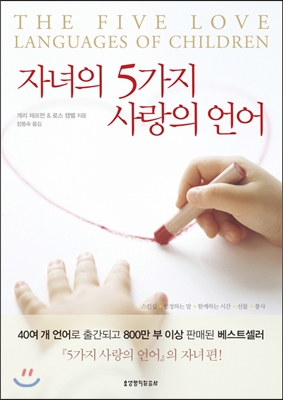
This is the children's version of "The 5 Love Languages," a worldwide bestseller that has changed the way many people love and express themselves.
Gary Chapman saw the explosive global success of his book, The 5 Love Languages, and its profound impact on the relationships and lives of many people. He realized that this same principle should apply to children, and so he wrote this book with pediatrician Ross Campbell.
All parents in the world love their children, but our children are sad, lost, and suffering because they do not know that they are loved.
Especially in today's world, where materialism and individualism are rampant, parents' ignorance and misunderstanding often fail to convey love to their children, but instead only cause them to feel alienated and hurt.
All children in this world deserve to receive enough love from their parents and many other people.
Only then can you grow into a mature adult and live your life positively and actively.
Therefore, in order to convey love more effectively and help children grow up to be warm-hearted people, parents need, above all, their full and wise love.
This book identifies the five love languages—skin contact, affirmation, time spent together, gifts, and service—that are most effective in communicating with our children, and helps parents and related ministry workers utilize them.
To this end, we cover the characteristics of each language, how to understand it, its effects, and behaviors to avoid. We also include cautions when disciplining, the relationship between love languages and learning, and advice to help single-parent families.
In addition, a plan to practice your child's five love languages, consisting of questions and group discussions, is included as an appendix to help you apply it more specifically and practically.
“I am a useless child.”
“What are you talking about? Don’t you know how much I love you!”
Do you love your children?
And do your children feel that love enough?
This is the children's version of "The 5 Love Languages," a worldwide bestseller that has changed the way many people love and express themselves.
Gary Chapman saw the explosive global success of his book, The 5 Love Languages, and its profound impact on the relationships and lives of many people. He realized that this same principle should apply to children, and so he wrote this book with pediatrician Ross Campbell.
All parents in the world love their children, but our children are sad, lost, and suffering because they do not know that they are loved.
Especially in today's world, where materialism and individualism are rampant, parents' ignorance and misunderstanding often fail to convey love to their children, but instead only cause them to feel alienated and hurt.
All children in this world deserve to receive enough love from their parents and many other people.
Only then can you grow into a mature adult and live your life positively and actively.
Therefore, in order to convey love more effectively and help children grow up to be warm-hearted people, parents need, above all, their full and wise love.
This book identifies the five love languages—skin contact, affirmation, time spent together, gifts, and service—that are most effective in communicating with our children, and helps parents and related ministry workers utilize them.
To this end, we cover the characteristics of each language, how to understand it, its effects, and behaviors to avoid. We also include cautions when disciplining, the relationship between love languages and learning, and advice to help single-parent families.
In addition, a plan to practice your child's five love languages, consisting of questions and group discussions, is included as an appendix to help you apply it more specifically and practically.
- You can preview some of the book's contents.
Preview
index
Translator's Preface
introduction
1.
Love is the foundation
2.
Love Language #1: Physical Intimacy
3.
Love Language #2: Words of Affirmation
4.
Love Language #3: Time Together
5.
Love Language #4: Gifts
6.
Love Language #5: Service
7.
How to Discover Your Child's Primary Love Language
8.
The Language of Discipline and Love
9.
The Language of Learning and Love
10.
Anger and Love
11.
Expressing the Language of Love in Single-Parent Families
12.
Expressing the Language of Love in Marriage
Epilogue
A Plan to Practice Your Child's Five Love Languages
introduction
1.
Love is the foundation
2.
Love Language #1: Physical Intimacy
3.
Love Language #2: Words of Affirmation
4.
Love Language #3: Time Together
5.
Love Language #4: Gifts
6.
Love Language #5: Service
7.
How to Discover Your Child's Primary Love Language
8.
The Language of Discipline and Love
9.
The Language of Learning and Love
10.
Anger and Love
11.
Expressing the Language of Love in Single-Parent Families
12.
Expressing the Language of Love in Marriage
Epilogue
A Plan to Practice Your Child's Five Love Languages
Into the book
This book corrects our parents' wrong thinking and teaches us the most practical way to love our children.
There are probably no parents who do not love their children.
They just don't know how to love their children effectively.
Good parents don't just happen.
There must be a deep understanding and constant effort toward children. ---p.6
All problems that arise while raising children depend on the love between parents and children.
If a child's need for love is not met, the child cannot do anything.
Only a child who feels truly loved and cared for can do his or her best.
But even if you love your children, if they don't feel it—if you don't use a love language they understand—they won't feel loved. ---p.18
Of course, it is necessary to educate and train children, but that too must be done after their emotional tanks are filled.
Their emotional tanks need to be filled with very good fuel.
That is unconditional love.
All children have an "emotional tank" that they long to fill (which needs to be replenished regularly because it is often depleted).
Only unconditional love can eliminate problems such as anger, feelings of not being loved, guilt, fear, and anxiety.
Only when we give our children unconditional love can we deeply understand them and deal with their behavior, whether good or bad.
There are probably no parents who do not love their children.
They just don't know how to love their children effectively.
Good parents don't just happen.
There must be a deep understanding and constant effort toward children. ---p.6
All problems that arise while raising children depend on the love between parents and children.
If a child's need for love is not met, the child cannot do anything.
Only a child who feels truly loved and cared for can do his or her best.
But even if you love your children, if they don't feel it—if you don't use a love language they understand—they won't feel loved. ---p.18
Of course, it is necessary to educate and train children, but that too must be done after their emotional tanks are filled.
Their emotional tanks need to be filled with very good fuel.
That is unconditional love.
All children have an "emotional tank" that they long to fill (which needs to be replenished regularly because it is often depleted).
Only unconditional love can eliminate problems such as anger, feelings of not being loved, guilt, fear, and anxiety.
Only when we give our children unconditional love can we deeply understand them and deal with their behavior, whether good or bad.
---p.20
GOODS SPECIFICS
- Date of publication: June 25, 2013
- Page count, weight, size: 256 pages | 367g | 148*210*20mm
- ISBN13: 9788904141319
- ISBN10: 8904141311
You may also like
카테고리
korean


korean

![ELLE 엘르 스페셜 에디션 A형 : 12월 [2025]](http://librairie.coreenne.fr/cdn/shop/files/b8e27a3de6c9538896439686c6b0e8fb.jpg?v=1766436872&width=3840)


