

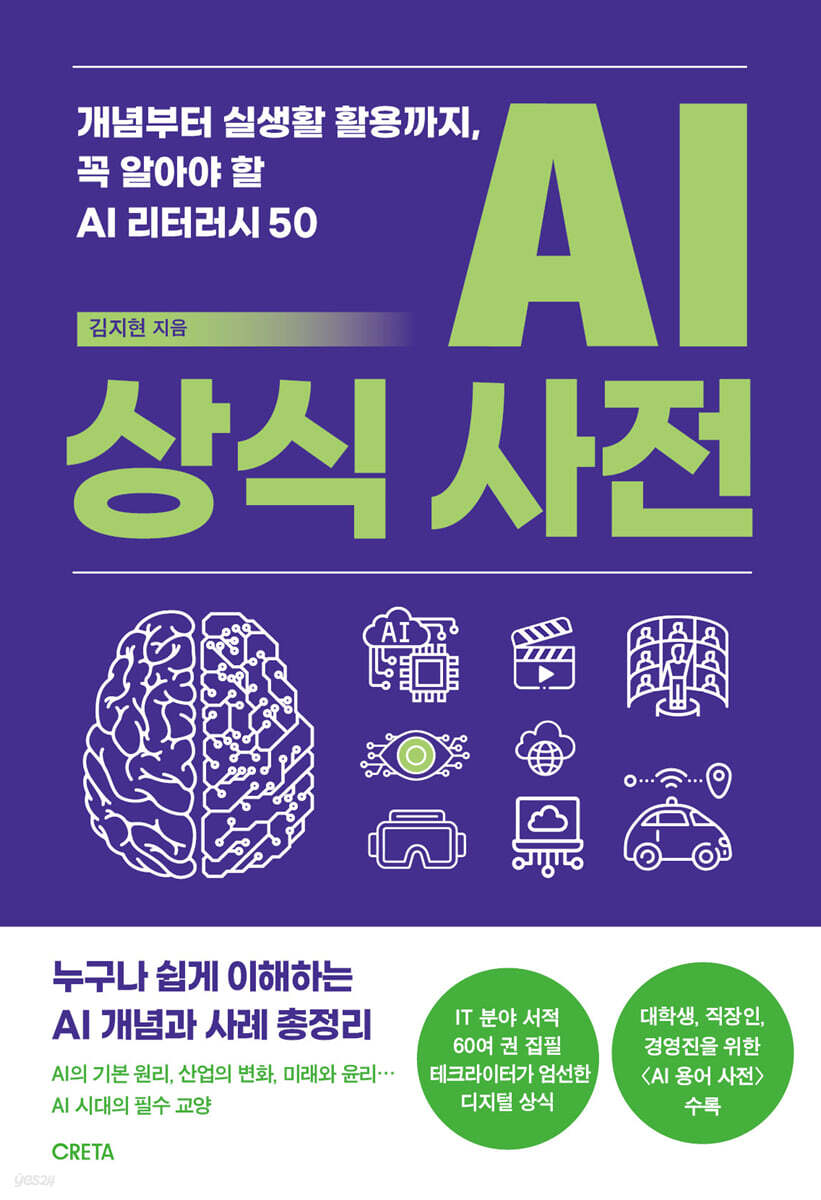
AI Common Sense Dictionary
 |
Description
Book Introduction
From Chat GPT to Physical AI,
Everything You Need to Know About AI Now
The AI era has already arrived, but how much do we know?
AI is no longer an optional subject, but a necessity.
AI is no longer the domain of select experts.
A new book, "AI Common Sense Dictionary," has been published, offering in-depth insights into the key trends and technologies of the rapidly changing AI era and future social changes.
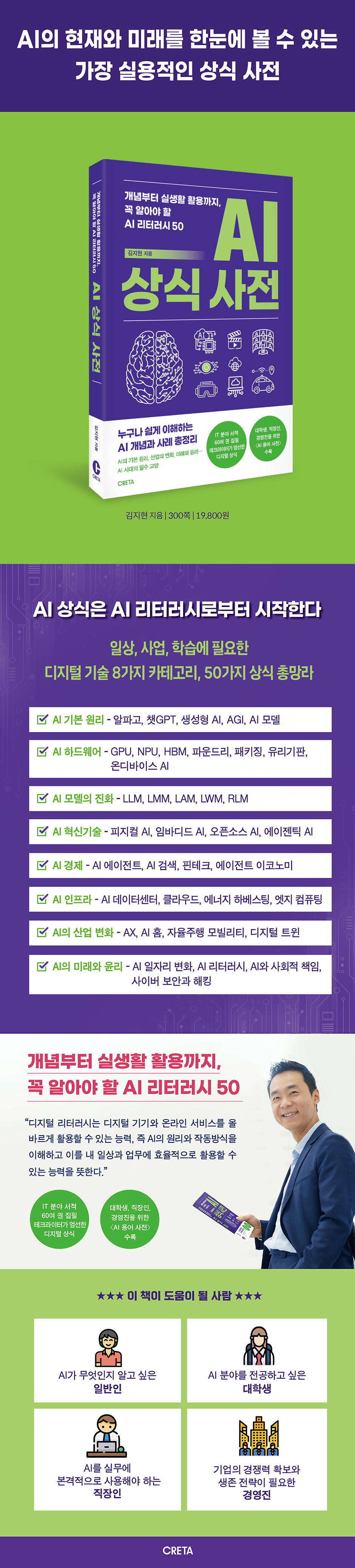
This book is the most practical guidebook available today, as artificial intelligence (AI) rapidly permeates our daily lives. It covers everything from basic concepts to the latest technological trends and their impact on individuals and society, all in 50 key words.
《AI Common Sense Dictionary》 covers a wide range of issues related to AI, starting with an explanation of the basic structure of AI hardware such as GPU, NPU, and QPU, everything about generative AI starting with ChatGPT, technologies such as AI inference, digital twins, AGI (Artificial Intelligence), AI jobs, and social discussions such as AI literacy.
Beyond a technology-focused AI guide, it provides insights into “Why do we need to understand AI now?”
The new book, "AI Common Sense Dictionary," carefully selects 50 essential AI facts we need to know in our daily lives and organizes them in a way that even those unfamiliar with technology can easily understand.
By making the AI field accessible in a fun and easy way, both non-specialists and experts can embrace AI as an area of life.
Everything You Need to Know About AI Now
The AI era has already arrived, but how much do we know?
AI is no longer an optional subject, but a necessity.
AI is no longer the domain of select experts.
A new book, "AI Common Sense Dictionary," has been published, offering in-depth insights into the key trends and technologies of the rapidly changing AI era and future social changes.
This book is the most practical guidebook available today, as artificial intelligence (AI) rapidly permeates our daily lives. It covers everything from basic concepts to the latest technological trends and their impact on individuals and society, all in 50 key words.
《AI Common Sense Dictionary》 covers a wide range of issues related to AI, starting with an explanation of the basic structure of AI hardware such as GPU, NPU, and QPU, everything about generative AI starting with ChatGPT, technologies such as AI inference, digital twins, AGI (Artificial Intelligence), AI jobs, and social discussions such as AI literacy.
Beyond a technology-focused AI guide, it provides insights into “Why do we need to understand AI now?”
The new book, "AI Common Sense Dictionary," carefully selects 50 essential AI facts we need to know in our daily lives and organizes them in a way that even those unfamiliar with technology can easily understand.
By making the AI field accessible in a fun and easy way, both non-specialists and experts can embrace AI as an area of life.
- You can preview some of the book's contents.
Preview
index
Author's Note
01 What does the AI brain look like? GPU and HBM
02 Quantum Computer QPU to Solve Humanity's Challenges
03 Machine Learning and Deep Learning: The Core of AI
04 Evolution of AI through Seeing and Hearing in Writing LLM and LWM
05 AI Thinks for Itself? Inference Model
06 Gas Station Data Center for AI
07 Cloud FM and On-Device AI in Smartphones
08 Edge computing is closer than the distant cloud.
09 AI Needs Teachers Too: RAG and Prompt Engineering
10 Generative AI Beyond the Web and Apps
The AI Agent Economy Following Platform 11
12 AI Home Next to Smartphones
13 Autonomous Driving and Computer Vision on the Road
14 Factory Digital Twins: Automatic and Smart
15 Open Source AI of All, by All, for All
16 Wearables and IoT: The Internet of Things: Everything We Wear, Use, and Learn
17. Multimodal Evolution into AI that Listens and Speaks
18 NEXT AXES OF DIGITAL TRANSFORMATION
19 Synthetic data that teaches smart AI
20 Fine-tuning, knowledge distillation, and prompt engineering for superior AI
21 New AI Training Methods: Meta-Learning, Few-Shot Learning, and Vibe Coding
22 AI Search to Replace Google and Naver
23 Another World: Metaverse and Virtual Reality
24 Blockchain to Help Drive Global Financial Innovation
25 The Beginning of New Financial Markets: DeFi and DAO
26 Can Fintech Go Further? Blockchain 2.0
27 Hybrid Edge Computing: A Key in the Distributed Data Era
28 AI-Driven Core Infrastructure: Edge AI Data Centers
29 Big Data Analysis and Business Innovation Data-Driven Decision Making (DDDM)
30 Money Revolution AI Fintech
31. Do AIs Have Countries? Sovereign AI
32 AI-created new digital humans
33 Cloud-Native Applications: A New Paradigm in Software Development
34 Hyper-personalized, hyper-automated, hyper-intelligent business AI agent BAA
35 Cybersecurity becomes even more important in the AI era
36 Enterprises' Work Automation RPA, LLM-Based Agents
37 AI Applications Permeating Apps
38 Now Think and Answer Deep Reasoning AI
39 Next-Generation Semiconductors: The Engine of the AI Industry
40 Physical AI Transcending Virtuality and Invading Reality
41 Transparent, innovative glass substrates that will change the fate of semiconductors
From 42 people to AI, insurance AI agent
43 The Day Robots Become Colleagues Humanoid Robots
44 Network's New Clothes: SDN and Virtualization
45 Electricity Evolves: The Smart Grid
46 Zero Trust in the Age of Hacking and Cyberwarfare
47 Crisis or Opportunity? AI Jobs
48 A Battery-Free World? Energy Harvesting and Ultra-Low-Power Technology
49 AI Literacy: Common Sense to Help You Use AI Effectively in Daily Life, Like Math
50 The Duality of AI AI and Xtopia
AI Glossary
01 What does the AI brain look like? GPU and HBM
02 Quantum Computer QPU to Solve Humanity's Challenges
03 Machine Learning and Deep Learning: The Core of AI
04 Evolution of AI through Seeing and Hearing in Writing LLM and LWM
05 AI Thinks for Itself? Inference Model
06 Gas Station Data Center for AI
07 Cloud FM and On-Device AI in Smartphones
08 Edge computing is closer than the distant cloud.
09 AI Needs Teachers Too: RAG and Prompt Engineering
10 Generative AI Beyond the Web and Apps
The AI Agent Economy Following Platform 11
12 AI Home Next to Smartphones
13 Autonomous Driving and Computer Vision on the Road
14 Factory Digital Twins: Automatic and Smart
15 Open Source AI of All, by All, for All
16 Wearables and IoT: The Internet of Things: Everything We Wear, Use, and Learn
17. Multimodal Evolution into AI that Listens and Speaks
18 NEXT AXES OF DIGITAL TRANSFORMATION
19 Synthetic data that teaches smart AI
20 Fine-tuning, knowledge distillation, and prompt engineering for superior AI
21 New AI Training Methods: Meta-Learning, Few-Shot Learning, and Vibe Coding
22 AI Search to Replace Google and Naver
23 Another World: Metaverse and Virtual Reality
24 Blockchain to Help Drive Global Financial Innovation
25 The Beginning of New Financial Markets: DeFi and DAO
26 Can Fintech Go Further? Blockchain 2.0
27 Hybrid Edge Computing: A Key in the Distributed Data Era
28 AI-Driven Core Infrastructure: Edge AI Data Centers
29 Big Data Analysis and Business Innovation Data-Driven Decision Making (DDDM)
30 Money Revolution AI Fintech
31. Do AIs Have Countries? Sovereign AI
32 AI-created new digital humans
33 Cloud-Native Applications: A New Paradigm in Software Development
34 Hyper-personalized, hyper-automated, hyper-intelligent business AI agent BAA
35 Cybersecurity becomes even more important in the AI era
36 Enterprises' Work Automation RPA, LLM-Based Agents
37 AI Applications Permeating Apps
38 Now Think and Answer Deep Reasoning AI
39 Next-Generation Semiconductors: The Engine of the AI Industry
40 Physical AI Transcending Virtuality and Invading Reality
41 Transparent, innovative glass substrates that will change the fate of semiconductors
From 42 people to AI, insurance AI agent
43 The Day Robots Become Colleagues Humanoid Robots
44 Network's New Clothes: SDN and Virtualization
45 Electricity Evolves: The Smart Grid
46 Zero Trust in the Age of Hacking and Cyberwarfare
47 Crisis or Opportunity? AI Jobs
48 A Battery-Free World? Energy Harvesting and Ultra-Low-Power Technology
49 AI Literacy: Common Sense to Help You Use AI Effectively in Daily Life, Like Math
50 The Duality of AI AI and Xtopia
AI Glossary
Detailed image
Into the book
Starting around 2020, new features were required for servers within these data centers.
As demand for computing infrastructure for artificial intelligence grows, the need for GPUs specifically designed to power AI has grown. GPUs are specialized for optimal performance of AI computations by connecting multiple GPUs in parallel.
In other words, GPUs, which were used for graphic screen processing, were ideal for developing artificial intelligence.
Thanks to this, new technologies such as self-driving cars, voice recognition, and image analysis have rapidly grown thanks to GPU-based computing power, and a new era of AI has begun with ChatGPT starting in 2023.
--- pp.15-16
On the other hand, ChatGPT, released in 2022, is an AI model based on language, unlike AlphaGo, and is a representative example of a large language model (LLM).
ChatGPT has the ability to appropriately answer questions or write creatively by learning the natural language used by humans through a large amount of data.
While AlphaGo is a specialized AI optimized for specific problems, ChatGPT is closer to a general-purpose AI capable of performing various conversations and tasks with humans through language.
In other words, AlphaGo excels at solving problems within set rules, while ChatGPT skillfully handles open conversations without set answers.
--- p.24
On-device AI operates directly within the device, without relying on the cloud. It can be applied broadly beyond PCs and smartphones to appliances like TVs, vacuum cleaners, and even automobiles.
Through this, AI will permeate every aspect of our living spaces, making all devices smarter and more convenient.
The latest smart TVs, such as Samsung Neo QLED TV and LG OLED AI TV, are equipped with NPU chipsets that can perform real-time image quality improvement and voice command processing immediately without a cloud connection.
Home appliances like robot vacuums and smart refrigerators can also learn users' lifestyle patterns through on-device AI and perform optimized operations.
Even in the automotive industry, autonomous driving and driving assistance systems are being equipped with on-device AI as standard to enable immediate situational assessment and response without connection to the cloud.
--- p.49
Edge computing works by processing user data immediately after it is generated on a nearby edge server or device.
In the traditional cloud model, all data is sent to a remote central data center for processing, but edge computing significantly reduces this step and quickly performs necessary calculations and processing on locally located edge servers.
For example, data collected from industrial robots and airplane movements at factories or airports is not sent to a central cloud for processing, but rather analyzed and judged in real time on a nearby small edge server for immediate use.
This significantly reduces processing time and increases immediate response speed.
--- p.52
Open source allows more people to contribute to the technology, experiment with it, and give feedback, accelerating the pace of improvement exponentially.
Companies may be afraid to share code with competitors, but open source has proven that sharing makes the market bigger, and when the market grows, the companies that lead the technology benefit more.
Especially in the AI field, where building a single model can cost hundreds of billions or even trillions of won, open collaboration is a smart strategy for reducing risk and accelerating innovation.
--- p.87
The demand for AI training data is rapidly increasing, but there is a shortage of data that can actually be used.
There are also cases where specific datasets required for training specific AI models are lacking, or data quality is poor, negatively impacting AI performance.
For AI models that learn image information that changes over time, such as car license plates, a lack of up-to-date data can lead to poor performance.
--- p.108
Therefore, for the metaverse to become a true future platform, it must go beyond replicating or replacing reality.
We must open up new realms of experience, such as experiences impossible in reality, expansion of the senses, and alterations of existence.
Rather than simply being a game-like social networking service, we need to provide a multidimensional ecosystem where work, learning, play, and consumption are organically linked.
To do this, we need a new device that implements MR, or mixed reality.
In the future, it will not be smartphones or PCs, but rather devices in the form of glasses worn on the face that will be at the center.
Examples include Vision Pro, Quest, and Orion. Only when the real world and the virtual world are connected through MR devices will the metaverse truly be complete.
Therefore, it is difficult to view the metaverse that was popular five years ago as a complete metaverse.
--- p.132
Data-driven decision making (DDDM) is a method of making decisions based on clear evidence such as numbers, statistics, and patterns rather than intuition or experience.
Global companies have been doing this for a long time.
Google uses data to inform every decision, from team composition to product launches and design elements, while Tesla and Meta also experiment and improve based on customer feedback data.
Now, even small and medium-sized businesses lacking technical capabilities are seeking to adopt the same culture through data analysis tools.
According to one survey, 57% of companies cited "improved decision-making quality" as the biggest benefit of data analytics.
This goes beyond simply securing technological superiority; it is also positioned as a strategy to reduce market risk and build rapid response capabilities.
--- pp.165-166
The most talked-about area in Korea's current global AI market is HBM (high-bandwidth memory).
Nvidia's GPUs require ultra-fast memory to operate, and SK Hynix makes the best memory in the world.
The presence of SK Hynix, responsible for supplying HBM, was crucial for NVIDIA's absolute dominance in the AI GPU market in 2023-2024.
But while Korea plays a crucial role in AI infrastructure, why hasn't it excelled in AI models themselves or in the services and platforms they support? AI model development requires enormous computing power and human resources, along with national policies and investment to support this ongoing development.
--- p.177
On-premises system operation, where a company owns and directly maintains and manages the system in its own facilities, requires the company to build and operate the physical resources directly.
While it may be expensive to initially build because you have 100% control over all systems, it has the advantage of providing greater security and operational freedom.
However, as the number of customers increases, especially as they expand to include global users, the costs of building, installing, and operating the system increase, and investment in the main business decreases, which can lead to a reversal of roles.
Cloud-native applications, on the other hand, can avoid this burden by flexibly leveraging the resources of clouds that have already been built and scaled around the world.
Additionally, the system can be operated near the physical locations where actual customers use it, enabling faster service.
In other words, by operating a faster system on a physically closer server, it reduces the loading time of websites or apps for users and increases overall satisfaction.
--- p.186
AI's deep reasoning capabilities are emerging as a revolutionary tool for both businesses and individuals.
Enterprises can leverage AI's hierarchical thinking structure for a variety of tasks, including complex business decision-making, automated generation of multi-layered reports, customer data analysis, and risk assessment.
In the financial sector, market risks are simulated using various scenarios, and in the legal field, contractual terms are analyzed clause by clause to examine the possibility of illegality.
In the medical field, the possibility of a diagnosis is inferred step by step based on patient records and symptom information, and additional information is requested when necessary.
This entire process is structured as if a human expert were thinking, making it ideal for assisting actual expert work.
--- pp.220-221
What really matters is the robot's intelligence.
In the past, robots only performed movements that were programmed in advance.
Driving and simple operations were possible, but exceptional situations or tasks requiring judgment were not possible.
However, recently, robots are evolving into beings that can make decisions and act on their own, as they are equipped with AI that simultaneously possesses language understanding ability based on LLM and environmental recognition ability based on LWM.
For example, they can cook in the kitchen, retrieve and move items in the warehouse, and perform tasks in place of humans in hazardous workplaces.
This is physical AI.
As AI that understands language (LLM) gains the ability to perceive the environment and situation (LWM), AI is no longer just a screen assistant, but a real-world collaborator.
In the future, it is highly likely that such intelligent robots will become common in most of the spaces where we live.
--- p.232
For human-robot coexistence, there is something as important as technology.
It's all about trust and interaction.
The ability of robots to understand human emotions, read social cues, and respond appropriately is becoming increasingly important.
To this end, we are actively developing HRI (human-robot interaction) technology.
Recently, emotional robots have appeared that can recognize human facial expressions, speech patterns, and gestures and respond appropriately.
Robots like Pepper and Nao are enabling emotion-based interactions in hospitals, schools, and stores.
In the future, there will come a time when robots and humans will form emotional bonds.
In addition to collaboration at work, its role can expand to include conversation partners at home, caregivers, and educational assistants.
The key to coexistence lies not in technology, but in our attitude and readiness to accept robots.
--- p.250
The biggest change brought about by the smart grid is maximizing energy efficiency.
Previously, it was difficult to predict demand, and production and facilities were always operated based on maximum power consumption, resulting in a lot of waste.
However, smart grids can produce only what is needed and supply only where it is needed through accurate demand forecasting and real-time feedback.
Businesses can reduce their energy costs, and governments and local governments can regulate citizens' energy use through peak hour tariffs or energy usage reports.
Especially in industrial settings, automated power analysis systems based on smart meters enable advanced management, such as optimizing machine operating times and eliminating energy waste points.
--- p.257
The emergence of battery-free devices doesn't just reduce the stress of charging.
Much greater value can be found in sustainability and environmental protection.
Today, batteries are the heart of almost every electronic device, but they are also a source of environmental problems.
Mining and processing rare metals like lithium, cobalt, and nickel causes environmental destruction, and used batteries also become hazardous waste.
Billions of batteries are discarded worldwide every year, and their disposal is becoming an increasingly serious problem.
If energy harvesting technology becomes commercialized and widespread, it could completely change this battery-centric energy structure.
As demand for computing infrastructure for artificial intelligence grows, the need for GPUs specifically designed to power AI has grown. GPUs are specialized for optimal performance of AI computations by connecting multiple GPUs in parallel.
In other words, GPUs, which were used for graphic screen processing, were ideal for developing artificial intelligence.
Thanks to this, new technologies such as self-driving cars, voice recognition, and image analysis have rapidly grown thanks to GPU-based computing power, and a new era of AI has begun with ChatGPT starting in 2023.
--- pp.15-16
On the other hand, ChatGPT, released in 2022, is an AI model based on language, unlike AlphaGo, and is a representative example of a large language model (LLM).
ChatGPT has the ability to appropriately answer questions or write creatively by learning the natural language used by humans through a large amount of data.
While AlphaGo is a specialized AI optimized for specific problems, ChatGPT is closer to a general-purpose AI capable of performing various conversations and tasks with humans through language.
In other words, AlphaGo excels at solving problems within set rules, while ChatGPT skillfully handles open conversations without set answers.
--- p.24
On-device AI operates directly within the device, without relying on the cloud. It can be applied broadly beyond PCs and smartphones to appliances like TVs, vacuum cleaners, and even automobiles.
Through this, AI will permeate every aspect of our living spaces, making all devices smarter and more convenient.
The latest smart TVs, such as Samsung Neo QLED TV and LG OLED AI TV, are equipped with NPU chipsets that can perform real-time image quality improvement and voice command processing immediately without a cloud connection.
Home appliances like robot vacuums and smart refrigerators can also learn users' lifestyle patterns through on-device AI and perform optimized operations.
Even in the automotive industry, autonomous driving and driving assistance systems are being equipped with on-device AI as standard to enable immediate situational assessment and response without connection to the cloud.
--- p.49
Edge computing works by processing user data immediately after it is generated on a nearby edge server or device.
In the traditional cloud model, all data is sent to a remote central data center for processing, but edge computing significantly reduces this step and quickly performs necessary calculations and processing on locally located edge servers.
For example, data collected from industrial robots and airplane movements at factories or airports is not sent to a central cloud for processing, but rather analyzed and judged in real time on a nearby small edge server for immediate use.
This significantly reduces processing time and increases immediate response speed.
--- p.52
Open source allows more people to contribute to the technology, experiment with it, and give feedback, accelerating the pace of improvement exponentially.
Companies may be afraid to share code with competitors, but open source has proven that sharing makes the market bigger, and when the market grows, the companies that lead the technology benefit more.
Especially in the AI field, where building a single model can cost hundreds of billions or even trillions of won, open collaboration is a smart strategy for reducing risk and accelerating innovation.
--- p.87
The demand for AI training data is rapidly increasing, but there is a shortage of data that can actually be used.
There are also cases where specific datasets required for training specific AI models are lacking, or data quality is poor, negatively impacting AI performance.
For AI models that learn image information that changes over time, such as car license plates, a lack of up-to-date data can lead to poor performance.
--- p.108
Therefore, for the metaverse to become a true future platform, it must go beyond replicating or replacing reality.
We must open up new realms of experience, such as experiences impossible in reality, expansion of the senses, and alterations of existence.
Rather than simply being a game-like social networking service, we need to provide a multidimensional ecosystem where work, learning, play, and consumption are organically linked.
To do this, we need a new device that implements MR, or mixed reality.
In the future, it will not be smartphones or PCs, but rather devices in the form of glasses worn on the face that will be at the center.
Examples include Vision Pro, Quest, and Orion. Only when the real world and the virtual world are connected through MR devices will the metaverse truly be complete.
Therefore, it is difficult to view the metaverse that was popular five years ago as a complete metaverse.
--- p.132
Data-driven decision making (DDDM) is a method of making decisions based on clear evidence such as numbers, statistics, and patterns rather than intuition or experience.
Global companies have been doing this for a long time.
Google uses data to inform every decision, from team composition to product launches and design elements, while Tesla and Meta also experiment and improve based on customer feedback data.
Now, even small and medium-sized businesses lacking technical capabilities are seeking to adopt the same culture through data analysis tools.
According to one survey, 57% of companies cited "improved decision-making quality" as the biggest benefit of data analytics.
This goes beyond simply securing technological superiority; it is also positioned as a strategy to reduce market risk and build rapid response capabilities.
--- pp.165-166
The most talked-about area in Korea's current global AI market is HBM (high-bandwidth memory).
Nvidia's GPUs require ultra-fast memory to operate, and SK Hynix makes the best memory in the world.
The presence of SK Hynix, responsible for supplying HBM, was crucial for NVIDIA's absolute dominance in the AI GPU market in 2023-2024.
But while Korea plays a crucial role in AI infrastructure, why hasn't it excelled in AI models themselves or in the services and platforms they support? AI model development requires enormous computing power and human resources, along with national policies and investment to support this ongoing development.
--- p.177
On-premises system operation, where a company owns and directly maintains and manages the system in its own facilities, requires the company to build and operate the physical resources directly.
While it may be expensive to initially build because you have 100% control over all systems, it has the advantage of providing greater security and operational freedom.
However, as the number of customers increases, especially as they expand to include global users, the costs of building, installing, and operating the system increase, and investment in the main business decreases, which can lead to a reversal of roles.
Cloud-native applications, on the other hand, can avoid this burden by flexibly leveraging the resources of clouds that have already been built and scaled around the world.
Additionally, the system can be operated near the physical locations where actual customers use it, enabling faster service.
In other words, by operating a faster system on a physically closer server, it reduces the loading time of websites or apps for users and increases overall satisfaction.
--- p.186
AI's deep reasoning capabilities are emerging as a revolutionary tool for both businesses and individuals.
Enterprises can leverage AI's hierarchical thinking structure for a variety of tasks, including complex business decision-making, automated generation of multi-layered reports, customer data analysis, and risk assessment.
In the financial sector, market risks are simulated using various scenarios, and in the legal field, contractual terms are analyzed clause by clause to examine the possibility of illegality.
In the medical field, the possibility of a diagnosis is inferred step by step based on patient records and symptom information, and additional information is requested when necessary.
This entire process is structured as if a human expert were thinking, making it ideal for assisting actual expert work.
--- pp.220-221
What really matters is the robot's intelligence.
In the past, robots only performed movements that were programmed in advance.
Driving and simple operations were possible, but exceptional situations or tasks requiring judgment were not possible.
However, recently, robots are evolving into beings that can make decisions and act on their own, as they are equipped with AI that simultaneously possesses language understanding ability based on LLM and environmental recognition ability based on LWM.
For example, they can cook in the kitchen, retrieve and move items in the warehouse, and perform tasks in place of humans in hazardous workplaces.
This is physical AI.
As AI that understands language (LLM) gains the ability to perceive the environment and situation (LWM), AI is no longer just a screen assistant, but a real-world collaborator.
In the future, it is highly likely that such intelligent robots will become common in most of the spaces where we live.
--- p.232
For human-robot coexistence, there is something as important as technology.
It's all about trust and interaction.
The ability of robots to understand human emotions, read social cues, and respond appropriately is becoming increasingly important.
To this end, we are actively developing HRI (human-robot interaction) technology.
Recently, emotional robots have appeared that can recognize human facial expressions, speech patterns, and gestures and respond appropriately.
Robots like Pepper and Nao are enabling emotion-based interactions in hospitals, schools, and stores.
In the future, there will come a time when robots and humans will form emotional bonds.
In addition to collaboration at work, its role can expand to include conversation partners at home, caregivers, and educational assistants.
The key to coexistence lies not in technology, but in our attitude and readiness to accept robots.
--- p.250
The biggest change brought about by the smart grid is maximizing energy efficiency.
Previously, it was difficult to predict demand, and production and facilities were always operated based on maximum power consumption, resulting in a lot of waste.
However, smart grids can produce only what is needed and supply only where it is needed through accurate demand forecasting and real-time feedback.
Businesses can reduce their energy costs, and governments and local governments can regulate citizens' energy use through peak hour tariffs or energy usage reports.
Especially in industrial settings, automated power analysis systems based on smart meters enable advanced management, such as optimizing machine operating times and eliminating energy waste points.
--- p.257
The emergence of battery-free devices doesn't just reduce the stress of charging.
Much greater value can be found in sustainability and environmental protection.
Today, batteries are the heart of almost every electronic device, but they are also a source of environmental problems.
Mining and processing rare metals like lithium, cobalt, and nickel causes environmental destruction, and used batteries also become hazardous waste.
Billions of batteries are discarded worldwide every year, and their disposal is becoming an increasingly serious problem.
If energy harvesting technology becomes commercialized and widespread, it could completely change this battery-centric energy structure.
--- pp.271-272
Publisher's Review
Understanding AI is now common sense.
The First Step to Understanding AI: AI Literacy
From AI assistants in smartphones to ChatGPT and AI smart homes, these have become a part of our daily lives and work, and the underlying technologies are also being replaced by AI.
In this way, our daily lives are already an environment that requires technological understanding.
In a world where not knowing the principles and workings of technology can be inconvenient, many people still feel unfamiliar with AI.
The author of this book, Jihyun Kim, emphasizes that we must build literacy in digital technology, or AI literacy, from the ground up.
AI literacy refers to the ability to correctly understand and utilize artificial intelligence devices and online services. In other words, it refers to the ability to understand their principles and operating methods and apply them effectively in daily life and work.
Instead of complex and difficult technical terms, this book explains the core principles of AI and IT with concrete examples and stories anyone can encounter in their daily lives. It helps make daily life easier, work more productive, and learning and education more profound and enriching.
Through this book, I hope that teenagers, students in their 20s, office workers in their 30s, leaders in their 40s, and executives in their 50s will all be able to shake off their vague fears about AI and IT, gain a more comfortable understanding of AI technology, and live and work more efficiently and confidently.
AI hardware such as GPU, NPU, and QPU,
Data centers, the AI economy, AI security…
A glance at the present and future of AI
The most practical common sense dictionary
▷ AI Basics - AlphaGo, ChatGPT, Generative AI, AGI, AI Models
▷ AI hardware - GPU, NPU, HBM, foundry, packaging, glass substrate, on-device AI
▷ Evolution of AI models - LLM, LMM, LAM, LWM, RLM
▷ AI Innovation Technologies - Physical AI, Embedded AI, Open Source AI, Agentic AI
▷ AI Economy - AI Agents, AI Search, Fintech, Agent Economy
▷ AI Infrastructure - AI Data Centers, Cloud, Energy Harvesting, Edge Computing
▷ AI's Industrial Transformation - AX, AI Home, Autonomous Mobility, Digital Twin
The Future and Ethics of AI - AI Job Transformation, AI Literacy, AI and Social Responsibility, Cybersecurity and Hacking
■ The first step to properly understanding technology
Have you ever thought, “What is the brain that drives AI?”, “Are self-driving cars actually AI technology?”, or “How can I make money with AI?”
In her new book, "AI Common Sense Dictionary," Jihyun Kim, a tech writer with 30 years of experience, she easily explains the core knowledge needed to understand the AI era, including the differences between CPUs, GPUs, and NPUs, how ChatGPT and AlphaGo work, and why physical AI and AI data centers are attracting attention.
It also explains the technological trends behind products, such as AI technologies that have turned the world upside down, such as ChatGPT and humanoid robots, the competition for semiconductor supremacy, the spread of on-device AI, and the emergence of deep inference models, with various examples, helping readers naturally understand the context of technology and industry.
The era of 100 trillion won in AI investment is coming.
Beyond an IT Powerhouse, the Path to AI Sovereignty and Technology Powerhouse
■ Where technology, society, and business meet
Beyond technological advancement, AI is bringing about overall changes to industrial structures and society.
It is also a time when we need to discuss the changes brought about by technologies such as evolving generative AI, humanoid robots, data centers, digital twins, and the semiconductor industry, as well as the social discussions surrounding them.
This book provides an accessible overview of the core technologies and structures that comprise artificial intelligence, while also exploring how AI is permeating society, business, and industry through 50 key keywords. It covers machine learning and deep learning, the foundations of AI advancement in this era of evolving AI, as well as the inference technology that powers the AI brain, AI agents that transcend limitations, infrastructure like data centers and the cloud, the societal changes brought about by AI homes, autonomous driving, and smart factories, and the AI economy, including fintech and blockchain. It also explores the global landscape, ethics, and jobs that will be transformed by these changes.
■ The great wave of artificial intelligence
This book aims to serve as a compass for the future, offering clear explanations in the face of the enormous wave of artificial intelligence that humanity is facing.
It goes beyond simply explaining technology, but shows how society, industry, and life itself are changing.
We are currently using ChatGPT and autonomous driving technology, but we will also encounter home robots that read Braille and smart factories that operate without humans.
Here, we take an in-depth look at 'why technology develops and how it helps our lives.'
Technology is a tool, but ultimately, it is up to humans to understand and use that tool.
The new book, "AI Common Sense Dictionary," will serve as an "interesting introductory book" for non-specialists and beginners, and a "map to the future" for practitioners and executives. It will be an interesting guide to AI and a reliable compass for living with AI in this era.
The First Step to Understanding AI: AI Literacy
From AI assistants in smartphones to ChatGPT and AI smart homes, these have become a part of our daily lives and work, and the underlying technologies are also being replaced by AI.
In this way, our daily lives are already an environment that requires technological understanding.
In a world where not knowing the principles and workings of technology can be inconvenient, many people still feel unfamiliar with AI.
The author of this book, Jihyun Kim, emphasizes that we must build literacy in digital technology, or AI literacy, from the ground up.
AI literacy refers to the ability to correctly understand and utilize artificial intelligence devices and online services. In other words, it refers to the ability to understand their principles and operating methods and apply them effectively in daily life and work.
Instead of complex and difficult technical terms, this book explains the core principles of AI and IT with concrete examples and stories anyone can encounter in their daily lives. It helps make daily life easier, work more productive, and learning and education more profound and enriching.
Through this book, I hope that teenagers, students in their 20s, office workers in their 30s, leaders in their 40s, and executives in their 50s will all be able to shake off their vague fears about AI and IT, gain a more comfortable understanding of AI technology, and live and work more efficiently and confidently.
AI hardware such as GPU, NPU, and QPU,
Data centers, the AI economy, AI security…
A glance at the present and future of AI
The most practical common sense dictionary
▷ AI Basics - AlphaGo, ChatGPT, Generative AI, AGI, AI Models
▷ AI hardware - GPU, NPU, HBM, foundry, packaging, glass substrate, on-device AI
▷ Evolution of AI models - LLM, LMM, LAM, LWM, RLM
▷ AI Innovation Technologies - Physical AI, Embedded AI, Open Source AI, Agentic AI
▷ AI Economy - AI Agents, AI Search, Fintech, Agent Economy
▷ AI Infrastructure - AI Data Centers, Cloud, Energy Harvesting, Edge Computing
▷ AI's Industrial Transformation - AX, AI Home, Autonomous Mobility, Digital Twin
The Future and Ethics of AI - AI Job Transformation, AI Literacy, AI and Social Responsibility, Cybersecurity and Hacking
■ The first step to properly understanding technology
Have you ever thought, “What is the brain that drives AI?”, “Are self-driving cars actually AI technology?”, or “How can I make money with AI?”
In her new book, "AI Common Sense Dictionary," Jihyun Kim, a tech writer with 30 years of experience, she easily explains the core knowledge needed to understand the AI era, including the differences between CPUs, GPUs, and NPUs, how ChatGPT and AlphaGo work, and why physical AI and AI data centers are attracting attention.
It also explains the technological trends behind products, such as AI technologies that have turned the world upside down, such as ChatGPT and humanoid robots, the competition for semiconductor supremacy, the spread of on-device AI, and the emergence of deep inference models, with various examples, helping readers naturally understand the context of technology and industry.
The era of 100 trillion won in AI investment is coming.
Beyond an IT Powerhouse, the Path to AI Sovereignty and Technology Powerhouse
■ Where technology, society, and business meet
Beyond technological advancement, AI is bringing about overall changes to industrial structures and society.
It is also a time when we need to discuss the changes brought about by technologies such as evolving generative AI, humanoid robots, data centers, digital twins, and the semiconductor industry, as well as the social discussions surrounding them.
This book provides an accessible overview of the core technologies and structures that comprise artificial intelligence, while also exploring how AI is permeating society, business, and industry through 50 key keywords. It covers machine learning and deep learning, the foundations of AI advancement in this era of evolving AI, as well as the inference technology that powers the AI brain, AI agents that transcend limitations, infrastructure like data centers and the cloud, the societal changes brought about by AI homes, autonomous driving, and smart factories, and the AI economy, including fintech and blockchain. It also explores the global landscape, ethics, and jobs that will be transformed by these changes.
■ The great wave of artificial intelligence
This book aims to serve as a compass for the future, offering clear explanations in the face of the enormous wave of artificial intelligence that humanity is facing.
It goes beyond simply explaining technology, but shows how society, industry, and life itself are changing.
We are currently using ChatGPT and autonomous driving technology, but we will also encounter home robots that read Braille and smart factories that operate without humans.
Here, we take an in-depth look at 'why technology develops and how it helps our lives.'
Technology is a tool, but ultimately, it is up to humans to understand and use that tool.
The new book, "AI Common Sense Dictionary," will serve as an "interesting introductory book" for non-specialists and beginners, and a "map to the future" for practitioners and executives. It will be an interesting guide to AI and a reliable compass for living with AI in this era.
GOODS SPECIFICS
- Date of issue: June 27, 2025
- Page count, weight, size: 300 pages | 410g | 145*212*20mm
- ISBN13: 9791192742502
- ISBN10: 1192742508
You may also like
카테고리
korean


korean

![GQ KOREA Mark (Monthly): December [2025]](http://librairie.coreenne.fr/cdn/shop/files/8ef265dbbfbf186523ed75ba7319009d.jpg?v=1765340328&width=3840)


