

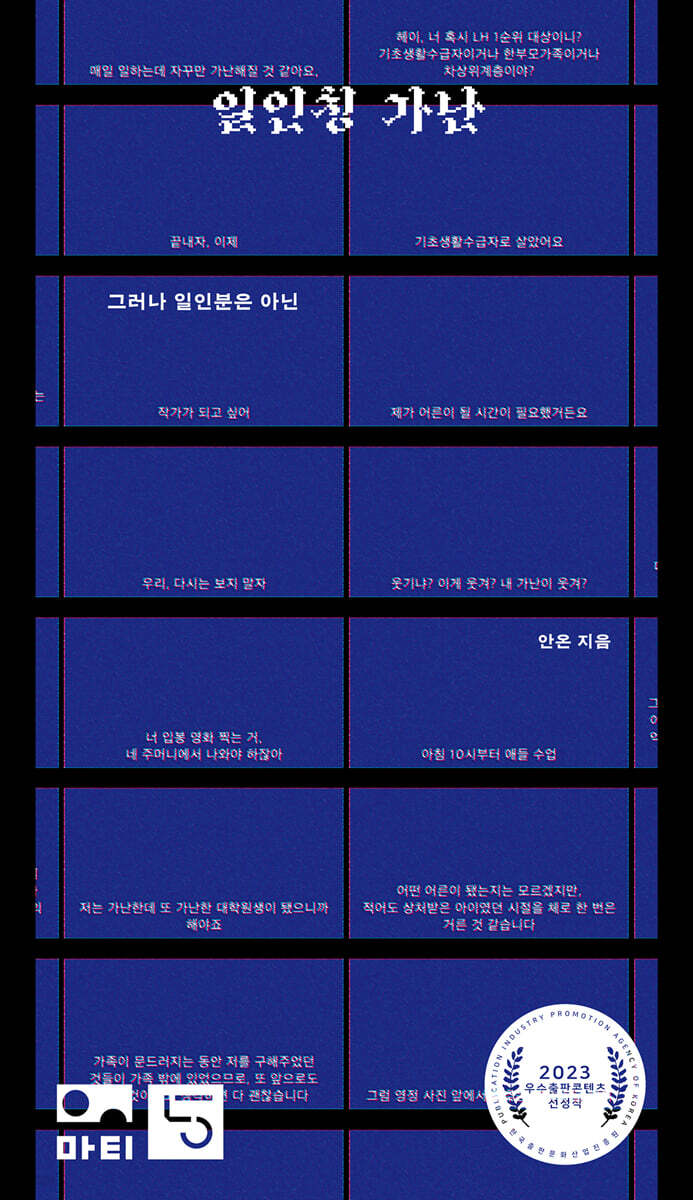
First-person poverty
 |
Description
Book Introduction
The author, who is 26 years old this year, has been living as a recipient of basic livelihood security for about 20 years until 2019.
But I know that I cannot represent the poverty of Korea.
It's not that they're less poor, but because poverty takes many different forms.
So this book is written entirely in the first person.
But I know that I cannot represent the poverty of Korea.
It's not that they're less poor, but because poverty takes many different forms.
So this book is written entirely in the first person.
- You can preview some of the book's contents.
Preview
index
prolog
sterilized milk
Real and fake
Princess of the Week 1: At Hwamyeong Apartment
The Princess and the Matchmaker 2: At Geumgok Public Housing Apartment
Open stream dragon
Killing Fields
Minimum cost, maximum effect
Hard-earned money and easy-earned money
A fragmentary summary of part-time workers
H Building Horror
G Hill Share
Changes to Master's degree (completion)
performance
Prayer
Lee So-ho appeals
The happening of traveling abroad
Taste of Cebu
Only we know ourselves
scar
piano
Because I'm poor, I don't have these
80% or 90% of poverty
Leave dad
Relatives 1: Maternal grandfather and maternal uncle
Relatives 2: Grandfather and Aunt
suicide survivor
The resource called time
Constant overwork
It's leaking
Eating
Sushi Omakase
The family I chose
Cat 480
Epilogue
Appendix: Link to Welfare Application
main
sterilized milk
Real and fake
Princess of the Week 1: At Hwamyeong Apartment
The Princess and the Matchmaker 2: At Geumgok Public Housing Apartment
Open stream dragon
Killing Fields
Minimum cost, maximum effect
Hard-earned money and easy-earned money
A fragmentary summary of part-time workers
H Building Horror
G Hill Share
Changes to Master's degree (completion)
performance
Prayer
Lee So-ho appeals
The happening of traveling abroad
Taste of Cebu
Only we know ourselves
scar
piano
Because I'm poor, I don't have these
80% or 90% of poverty
Leave dad
Relatives 1: Maternal grandfather and maternal uncle
Relatives 2: Grandfather and Aunt
suicide survivor
The resource called time
Constant overwork
It's leaking
Eating
Sushi Omakase
The family I chose
Cat 480
Epilogue
Appendix: Link to Welfare Application
main
Into the book
I have seen and heard from afar what poverty is like outside the supply chain, but I am not fully aware of its circumstances.
So, I hesitated a lot when writing a sentence with 'poverty' as the subject, but I wrote it anyway.
Because someone else will write about poverty in the first person.
The world needs compelling first-person voices that aren't captured by poverty measurement models.
--- p.10
When the thing I received from the teachers' office was not sterilized milk but a college entrance exam textbook, I was still heavy, but I wasn't annoyed.
At the same time, a suspicion began to creep in that perhaps I had become resigned to poverty and had accepted these “small gifts.”
--- p.15
I know some people will argue that if you buy books or go to school, you are not truly poor.
I also know that there is poverty where it is difficult to make ends meet.
However, that does not mean that the fact that 'education' was still the way out of poverty in the 2000s when I went to private academies, eating up my mother's wages, body, and time, is 'fake'.
--- p.30
I developed chronic inflammation in the ligaments in both arms from washing breadboards at a bakery.
I just stuck on a patch and held on, but my elbows started to hurt.
Some areas such as muscle injections and physical therapy are not covered by medical insurance, so treatment was rarely received.
The problem of 'unmet medical needs' for medical aid recipients occurs on a daily basis.
--- p.47
My acting didn't seem to end.
I made up words and gestures to avoid being intimidated, not even knowing what was holding me back.
…I was ashamed of my poverty, but I was also ashamed of myself for trying so hard.
--- p.66
There was a shop near the Golden Gate Bridge that sold clam chowder soup in pancakes, and if you let your guard down, a seagull bigger than a man's calf will snatch the bread away.
Did other people already know that having their meal stolen by a bird would become an unforgettable memory?
Are we all living a life where we are both genuinely upset and happy about these kinds of happenings?
--- p.78
We reported our survival, showing off our scars, and strengthened our sense of solidarity.
Look here, I'm here too.
The scars left behind by not being able to report the perpetrator even though I knew him/her have become scars.
Still, I am living well and will continue to do so, and I made a silent promise to live on.
--- p.89
When I talk about poverty, I put family last.
I don't want to hear things like, "It's because that's how my family is."
I'm tired of the clichés that treat unhappy families and poverty as a set.
My poverty wasn't caused by my family, but by car accidents, alcoholism, career interruptions for women, low wages, gender-based violence, and domestic violence.
--- p.116
Poor people want to escape their current reality more strongly than anyone else, but they are more strongly bound to it than anyone else.
…there is no time to continue worrying about what to do in the future or what kind of person to be.
Because there is no one to pay me for the time I spend worrying about the future.
--- p.123
Putting aside the work environment and intensity, if you look at the annual salary alone, I was a 6th-year academy instructor who was earning quite well.
…Once you taste it, you will never forget the taste of poverty.
Even though people around me say that I have that much income and that it's quite comfortable, I don't feel comfortable at all.
--- p.137
The Welfare website has four menus: welfare services, service application, welfare guidance, welfare assistance, and welfare reporting. It is significant that alongside the four items demonstrating the will to provide welfare, there is also a ‘welfare reporting’ item that advertises and encourages reporting of ‘illegal receipt.’
So, I hesitated a lot when writing a sentence with 'poverty' as the subject, but I wrote it anyway.
Because someone else will write about poverty in the first person.
The world needs compelling first-person voices that aren't captured by poverty measurement models.
--- p.10
When the thing I received from the teachers' office was not sterilized milk but a college entrance exam textbook, I was still heavy, but I wasn't annoyed.
At the same time, a suspicion began to creep in that perhaps I had become resigned to poverty and had accepted these “small gifts.”
--- p.15
I know some people will argue that if you buy books or go to school, you are not truly poor.
I also know that there is poverty where it is difficult to make ends meet.
However, that does not mean that the fact that 'education' was still the way out of poverty in the 2000s when I went to private academies, eating up my mother's wages, body, and time, is 'fake'.
--- p.30
I developed chronic inflammation in the ligaments in both arms from washing breadboards at a bakery.
I just stuck on a patch and held on, but my elbows started to hurt.
Some areas such as muscle injections and physical therapy are not covered by medical insurance, so treatment was rarely received.
The problem of 'unmet medical needs' for medical aid recipients occurs on a daily basis.
--- p.47
My acting didn't seem to end.
I made up words and gestures to avoid being intimidated, not even knowing what was holding me back.
…I was ashamed of my poverty, but I was also ashamed of myself for trying so hard.
--- p.66
There was a shop near the Golden Gate Bridge that sold clam chowder soup in pancakes, and if you let your guard down, a seagull bigger than a man's calf will snatch the bread away.
Did other people already know that having their meal stolen by a bird would become an unforgettable memory?
Are we all living a life where we are both genuinely upset and happy about these kinds of happenings?
--- p.78
We reported our survival, showing off our scars, and strengthened our sense of solidarity.
Look here, I'm here too.
The scars left behind by not being able to report the perpetrator even though I knew him/her have become scars.
Still, I am living well and will continue to do so, and I made a silent promise to live on.
--- p.89
When I talk about poverty, I put family last.
I don't want to hear things like, "It's because that's how my family is."
I'm tired of the clichés that treat unhappy families and poverty as a set.
My poverty wasn't caused by my family, but by car accidents, alcoholism, career interruptions for women, low wages, gender-based violence, and domestic violence.
--- p.116
Poor people want to escape their current reality more strongly than anyone else, but they are more strongly bound to it than anyone else.
…there is no time to continue worrying about what to do in the future or what kind of person to be.
Because there is no one to pay me for the time I spend worrying about the future.
--- p.123
Putting aside the work environment and intensity, if you look at the annual salary alone, I was a 6th-year academy instructor who was earning quite well.
…Once you taste it, you will never forget the taste of poverty.
Even though people around me say that I have that much income and that it's quite comfortable, I don't feel comfortable at all.
--- p.137
The Welfare website has four menus: welfare services, service application, welfare guidance, welfare assistance, and welfare reporting. It is significant that alongside the four items demonstrating the will to provide welfare, there is also a ‘welfare reporting’ item that advertises and encourages reporting of ‘illegal receipt.’
--- p.149
Publisher's Review
Marty's On Series Volume 5
Thinking and Writing about Poverty
Young poverty born in 1997
The author, who is 26 years old this year, has been living as a recipient of basic livelihood security for about 20 years until 2019.
But I know that I cannot represent the poverty of Korea.
It's not that they're less poor, but because poverty takes many different forms.
Based on the living wage, this is on par with the 2.45 million people earning less than 30% of the median income. However, the author knows firsthand that there are factors that income levels cannot explain, such as working conditions, health status, education level, family characteristics, and housing issues.
That's why this book is written entirely in the first person.
But it's not for one person.
His poverty is intertwined with social welfare, including the National Basic Livelihood Security System, EBS textbook support, milk provision during vacations, and activities of private scholarship associations, and it vibrates in the relationships with police officers, community center staff, school teachers, and peers.
The author, who believes that poverty should not be confined to personal narratives, connects and overlaps his own poverty with that of others through novels, poems, articles, papers, and books.
The power of real
The author realistically portrays the details of poverty that only those involved can accurately understand.
No, it creates a scene that was there but no one noticed.
By doing so, it vividly proves that poverty exists in reality, not in a drama.
The author's mother poured any income she had beyond the minimum living expenses of welfare benefits into private tutoring (p. 29). It may seem strange that families receiving welfare invested their income in their children's private education rather than in food, clothing, and shelter.
This is what the author wishes for.
Breaking the cliché of 'poor people' or 'poverty' that we have in our heads.
This book vividly demonstrates how powerful an autobiographical essay, in which the author and narrator are in sync, can be when it speaks of "reality."
What poverty brings
It is difficult to find any description of emotions in this book, which revolves around actions, choices, and events brought about by poverty.
The author calmly recalls when he went on a trip to the United States with the support of the Green Umbrella Children's Foundation ("The Happening of Overseas Travel," p. 76), when he spent the winter bare-legged instead of wearing stockings that were likely to go out ("Smoke," p. 64), and when he stopped his master's program at the completion stage ("A Defense of the Master's Degree (Completion)" p. 58).
But the feelings of those around him about his poverty were all over the place.
“The attitude and temperature of adults towards poor and young people fluctuated like this.
He canceled, then apologized, then looked down on me, then brought me up.
“He was businesslike, then affectionate, then cold, then seething.” However, the author quickly realized that “he was only intoxicated by his own boiling self, and in fact had no interest in poor and young people” (p. 88).
The emotions of sadness, joy, regret, disappointment, pity, compassion, and support that readers will feel as they watch the author go through his or her struggles due to poverty are left to the reader's own imagination.
This book hopes that these emotions, easily triggered and then extinguished by the "spectacle" of poverty, will serve as a driving force for social change.
Individual poverty is the poverty of society.
Poverty cannot be personal.
This is because it is inseparable from unemployment, disability, career breaks for married women, the social atmosphere that leaves welfare to families and businesses, the selective welfare system, thorough welfare application-based system, and the entrenched meritocracy.
The author writes that when talking about poverty, family is mentioned last.
When talking about my visually impaired father who was an alcoholic and my mother who had difficulty finding a job due to the aftereffects of a car accident, the cause of poverty is often lumped together as 'family'.
Once you remove the 'unhappy family history' from poverty, the situation becomes clearer.
The author states, "My poverty was a combination of car accidents, alcoholism, career interruptions for women, low wages, gender-based violence, and domestic violence." (p. 116)
The appendix, “Shortcut to Welfare Application” (page 147), shows that Korea’s welfare system cannot function without “applicants.”
Even while working tirelessly at tutoring, academies, meat restaurants, and bakeries throughout college and graduate school, the author constantly checked for scholarship extensions and wrestled with government officials to resolve housing issues.
This book asks whether the desperation to avoid being excluded from selective welfare is not taking away even sleep from poor young people who do not have the time and resources to think about what they want to do tomorrow or what kind of job they want to have in a few years.
Because poverty doesn't end even after the book ends
This book, which consists of 33 anecdotes, is not very long.
It won't take too long to finish the book.
But the author has experienced and is experiencing these days over and over again.
This is the key.
Even if the book ends, the author's poverty will not end, and even if the author's poverty becomes a thing of the past, the poverty of our society is still ongoing.
This book calls for ongoing attention to poverty.
The author does not offer analyses or alternatives for which he cannot take responsibility.
He doesn't even try to find meaning in the poverty he has experienced.
I'll just write it as it is.
It is now up to society to contextualize and cherish these fragments.
Thinking and Writing about Poverty
Young poverty born in 1997
The author, who is 26 years old this year, has been living as a recipient of basic livelihood security for about 20 years until 2019.
But I know that I cannot represent the poverty of Korea.
It's not that they're less poor, but because poverty takes many different forms.
Based on the living wage, this is on par with the 2.45 million people earning less than 30% of the median income. However, the author knows firsthand that there are factors that income levels cannot explain, such as working conditions, health status, education level, family characteristics, and housing issues.
That's why this book is written entirely in the first person.
But it's not for one person.
His poverty is intertwined with social welfare, including the National Basic Livelihood Security System, EBS textbook support, milk provision during vacations, and activities of private scholarship associations, and it vibrates in the relationships with police officers, community center staff, school teachers, and peers.
The author, who believes that poverty should not be confined to personal narratives, connects and overlaps his own poverty with that of others through novels, poems, articles, papers, and books.
The power of real
The author realistically portrays the details of poverty that only those involved can accurately understand.
No, it creates a scene that was there but no one noticed.
By doing so, it vividly proves that poverty exists in reality, not in a drama.
The author's mother poured any income she had beyond the minimum living expenses of welfare benefits into private tutoring (p. 29). It may seem strange that families receiving welfare invested their income in their children's private education rather than in food, clothing, and shelter.
This is what the author wishes for.
Breaking the cliché of 'poor people' or 'poverty' that we have in our heads.
This book vividly demonstrates how powerful an autobiographical essay, in which the author and narrator are in sync, can be when it speaks of "reality."
What poverty brings
It is difficult to find any description of emotions in this book, which revolves around actions, choices, and events brought about by poverty.
The author calmly recalls when he went on a trip to the United States with the support of the Green Umbrella Children's Foundation ("The Happening of Overseas Travel," p. 76), when he spent the winter bare-legged instead of wearing stockings that were likely to go out ("Smoke," p. 64), and when he stopped his master's program at the completion stage ("A Defense of the Master's Degree (Completion)" p. 58).
But the feelings of those around him about his poverty were all over the place.
“The attitude and temperature of adults towards poor and young people fluctuated like this.
He canceled, then apologized, then looked down on me, then brought me up.
“He was businesslike, then affectionate, then cold, then seething.” However, the author quickly realized that “he was only intoxicated by his own boiling self, and in fact had no interest in poor and young people” (p. 88).
The emotions of sadness, joy, regret, disappointment, pity, compassion, and support that readers will feel as they watch the author go through his or her struggles due to poverty are left to the reader's own imagination.
This book hopes that these emotions, easily triggered and then extinguished by the "spectacle" of poverty, will serve as a driving force for social change.
Individual poverty is the poverty of society.
Poverty cannot be personal.
This is because it is inseparable from unemployment, disability, career breaks for married women, the social atmosphere that leaves welfare to families and businesses, the selective welfare system, thorough welfare application-based system, and the entrenched meritocracy.
The author writes that when talking about poverty, family is mentioned last.
When talking about my visually impaired father who was an alcoholic and my mother who had difficulty finding a job due to the aftereffects of a car accident, the cause of poverty is often lumped together as 'family'.
Once you remove the 'unhappy family history' from poverty, the situation becomes clearer.
The author states, "My poverty was a combination of car accidents, alcoholism, career interruptions for women, low wages, gender-based violence, and domestic violence." (p. 116)
The appendix, “Shortcut to Welfare Application” (page 147), shows that Korea’s welfare system cannot function without “applicants.”
Even while working tirelessly at tutoring, academies, meat restaurants, and bakeries throughout college and graduate school, the author constantly checked for scholarship extensions and wrestled with government officials to resolve housing issues.
This book asks whether the desperation to avoid being excluded from selective welfare is not taking away even sleep from poor young people who do not have the time and resources to think about what they want to do tomorrow or what kind of job they want to have in a few years.
Because poverty doesn't end even after the book ends
This book, which consists of 33 anecdotes, is not very long.
It won't take too long to finish the book.
But the author has experienced and is experiencing these days over and over again.
This is the key.
Even if the book ends, the author's poverty will not end, and even if the author's poverty becomes a thing of the past, the poverty of our society is still ongoing.
This book calls for ongoing attention to poverty.
The author does not offer analyses or alternatives for which he cannot take responsibility.
He doesn't even try to find meaning in the poverty he has experienced.
I'll just write it as it is.
It is now up to society to contextualize and cherish these fragments.
GOODS SPECIFICS
- Publication date: November 24, 2023
- Page count, weight, size: 168 pages | 224g | 130*225*10mm
- ISBN13: 9791190853514
- ISBN10: 1190853515
You may also like
카테고리
korean


korean

![GQ KOREA Mark (Monthly): December [2025]](http://librairie.coreenne.fr/cdn/shop/files/8ef265dbbfbf186523ed75ba7319009d.jpg?v=1765340328&width=3840)


