

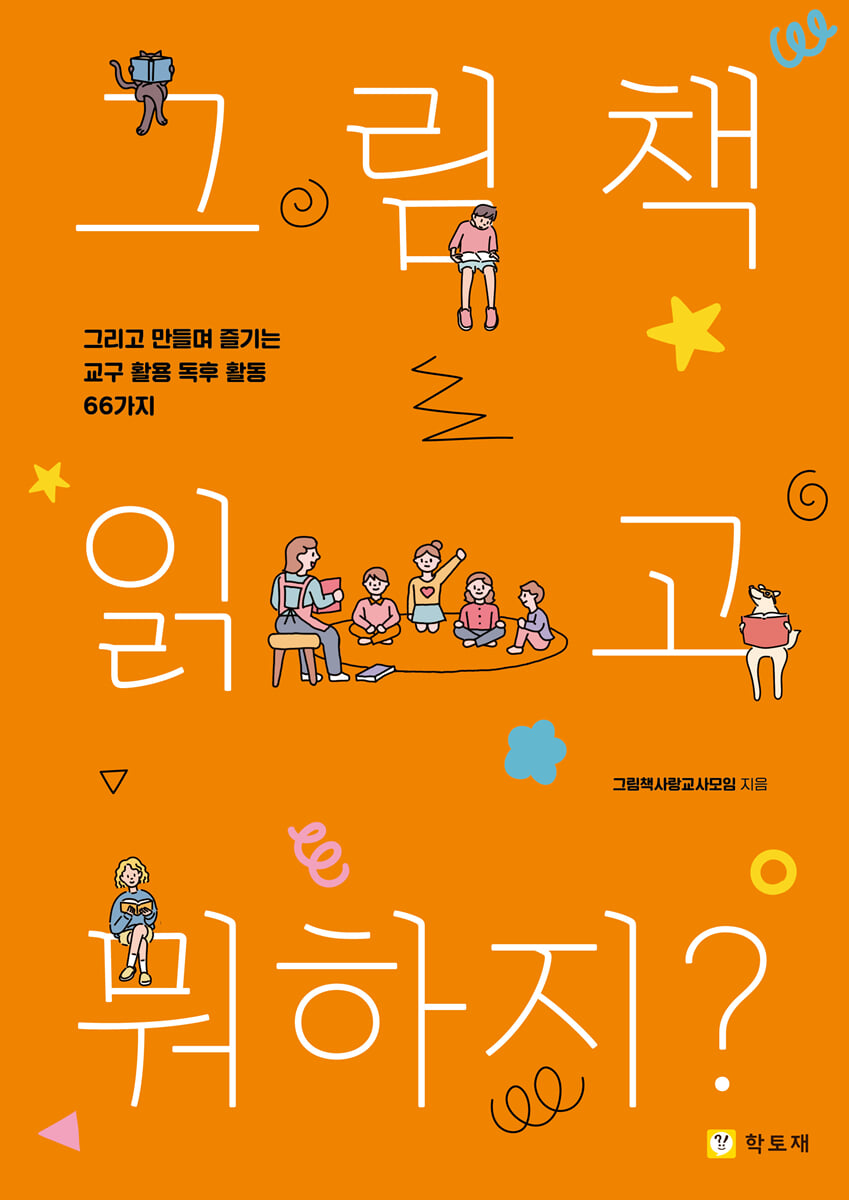
What do you do after reading a picture book?
 |
Description
Book Introduction
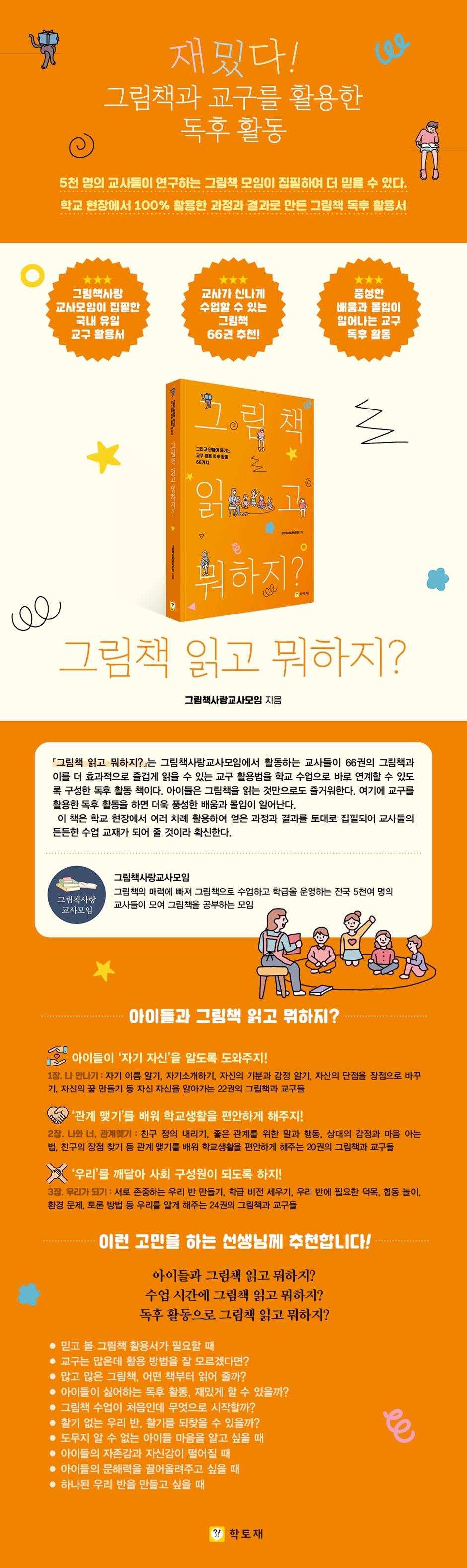
It's more trustworthy because it was written by a group of 5,000 teachers who studied picture books!
A picture book review book created with 100% utilization of the process and results in the school setting.
The only textbook in Korea written by the Picture Book Lovers Teachers Association
66 recommended picture books that will make classes more exciting for teachers!
Parish reading activities that provide rich learning and immersion
"What do you do after reading a picture book?" is a post-reading activity book organized by teachers from the Picture Book Lovers Teachers Association to help them directly connect 66 picture books and how to use teaching aids to make reading them more effective and enjoyable to school classes.
Children enjoy just reading picture books.
Using the parish here for post-reading activities will lead to richer learning and greater immersion.
This book is based on the process and results obtained through repeated use in school settings, and we are confident that it will serve as a solid teaching material for teachers.
“Picture books ultimately connect with people.
“I truly feel in the field that when children read picture books and engage in various activities, the books seep into their lives.” _From a teacher’s words
A picture book review book created with 100% utilization of the process and results in the school setting.
The only textbook in Korea written by the Picture Book Lovers Teachers Association
66 recommended picture books that will make classes more exciting for teachers!
Parish reading activities that provide rich learning and immersion
"What do you do after reading a picture book?" is a post-reading activity book organized by teachers from the Picture Book Lovers Teachers Association to help them directly connect 66 picture books and how to use teaching aids to make reading them more effective and enjoyable to school classes.
Children enjoy just reading picture books.
Using the parish here for post-reading activities will lead to richer learning and greater immersion.
This book is based on the process and results obtained through repeated use in school settings, and we are confident that it will serve as a solid teaching material for teachers.
“Picture books ultimately connect with people.
“I truly feel in the field that when children read picture books and engage in various activities, the books seep into their lives.” _From a teacher’s words
- You can preview some of the book's contents.
Preview
index
Fun as you go! Post-reading activities using picture books and teaching aids
Chapter 1: Meeting Me
Make my own sparkly name tag_Name pin
Writing a self-introduction sentence_Story Chubby Sticker
Expressing my feelings in various ways_Emotion Weather Board
Setting up my dream nameplate_Name Tent
Making a Dreaming Whale_Dream in Dream Card
Riding a hot air balloon filled with dreams_Hot Air Balloon & I
What to Pack in Your Happy Bag_Baek & I
Create your own storybook_Book & I
Creating a Self-Declaration_Self-Declaration Card
Turning Weaknesses into Strengths_Stick & I
What do you think about me?_Feeling Card
Mistakes are beautiful, failures are cool_Centering the Star Ladder
I have human rights_Human rights Yutnori
What to put in the imagination box? _Learning Pocket
Speech bubbles that encourage heated discussions_Kokomu activity sheet
Things My Hands Can Do_Hand & I
Writing sentences with word tags_Come out, sentence game
Vote for My Heart_Feeling Voting Board
Interviewing Characters_Animal Talking Stick
Develop your thinking skills with questions!_Reading Question Stick
Chapter 2: Building a Relationship Between You and Me
If you say 'friend' in one word_One word card
What words and actions make a good friend? _Inseong Miracle Curling
Give the gift of words_Mind Up Sticker
If you could choose one virtue_Seed Virtue Sticker
Express your emotions with your body!_Feeling Magnet Cards
Looking into Emotions_Emotion One Grain Card
Find the Hidden Emotions!_Emotion Detection Game
Write a letter to spring in autumn_Film & I
Find Virtue!_Virtue Gem Marvel
Hello Break: A Board Game with Questions and Missions
Developing the Power of Thinking Through Questions_Thought Sharing Parking Lot Board
Finding the Strengths of Myself and My Friends_Together Tail-Catching Vest
Sharing Thoughts While Playing_Havruta Reading Board Game
Thinking and Empathizing with Brain Structure_Brain & I
What's your motto?_Quote Card
Writing in a snap with literacy cards! _7 Keyword Rainbow Reading Literacy Cards
Adding Friends is Fun_Together Letter Writing
Creating a Backstory_Havruta Dice
Let's fly the balloon of hope_Balloon & I
Strengthening the Mind through Values Discussion_Values Vertical Line Discussion Kit
Chapter 3: Becoming Us
Creating a Respectful Class_UNI
Making a Friendship Tree in Our Class_Tree & I
Creating a Class Vision_Seed Virtues Magnet Cards
Me expressed in words, us gathered together_Word Prism
The Value of "Together": Discovering Through Play_Together Family Collaborative Band Package
Harmonious Life Together_Together Bojagi Badminton
Reading Board Game_Reading Marble
The Seeds of the Heart We Must Cultivate_Seed Virtues Stick
Reading Havruta_7 Keyword Rainbow Reading Discussion Cards
What Virtues Do We Need in Our Class?_36 Virtues Thank You Card
Supporting each other's wishes_Together Pipe Package
Experience a variety of post-reading activities_Reading Dice Pang Pang
Making a Number Picture Book_Targeting
Encouragement Circle Activities_3-Pack Restorative Life Education
Questions and Answers with Topic Keywords_Children's Havruta Discussion Stick
Object Transformation Play_Kkobuli
Writing a Short Poem Using Thinking Skills_Thinking Gear Cards
Are We Really Disappearing?_Climate Crisis Solver Card and More
Parents' Shining Moments_All-Stargram
Shining Words! Memory Game_Together Bingo
Save the Forest Animals: A Precarious Balance (Animal Edition)
Developing Thoughts While Playing_Together Hole-in
When opinions differ, we debate_Acorns Pros and Cons Debate Board
Creating Our Class Forest_Together Family Egg Carton Play Kit
Appendix Picture Book Activity Materials List
Chapter 1: Meeting Me
Make my own sparkly name tag_Name pin
Writing a self-introduction sentence_Story Chubby Sticker
Expressing my feelings in various ways_Emotion Weather Board
Setting up my dream nameplate_Name Tent
Making a Dreaming Whale_Dream in Dream Card
Riding a hot air balloon filled with dreams_Hot Air Balloon & I
What to Pack in Your Happy Bag_Baek & I
Create your own storybook_Book & I
Creating a Self-Declaration_Self-Declaration Card
Turning Weaknesses into Strengths_Stick & I
What do you think about me?_Feeling Card
Mistakes are beautiful, failures are cool_Centering the Star Ladder
I have human rights_Human rights Yutnori
What to put in the imagination box? _Learning Pocket
Speech bubbles that encourage heated discussions_Kokomu activity sheet
Things My Hands Can Do_Hand & I
Writing sentences with word tags_Come out, sentence game
Vote for My Heart_Feeling Voting Board
Interviewing Characters_Animal Talking Stick
Develop your thinking skills with questions!_Reading Question Stick
Chapter 2: Building a Relationship Between You and Me
If you say 'friend' in one word_One word card
What words and actions make a good friend? _Inseong Miracle Curling
Give the gift of words_Mind Up Sticker
If you could choose one virtue_Seed Virtue Sticker
Express your emotions with your body!_Feeling Magnet Cards
Looking into Emotions_Emotion One Grain Card
Find the Hidden Emotions!_Emotion Detection Game
Write a letter to spring in autumn_Film & I
Find Virtue!_Virtue Gem Marvel
Hello Break: A Board Game with Questions and Missions
Developing the Power of Thinking Through Questions_Thought Sharing Parking Lot Board
Finding the Strengths of Myself and My Friends_Together Tail-Catching Vest
Sharing Thoughts While Playing_Havruta Reading Board Game
Thinking and Empathizing with Brain Structure_Brain & I
What's your motto?_Quote Card
Writing in a snap with literacy cards! _7 Keyword Rainbow Reading Literacy Cards
Adding Friends is Fun_Together Letter Writing
Creating a Backstory_Havruta Dice
Let's fly the balloon of hope_Balloon & I
Strengthening the Mind through Values Discussion_Values Vertical Line Discussion Kit
Chapter 3: Becoming Us
Creating a Respectful Class_UNI
Making a Friendship Tree in Our Class_Tree & I
Creating a Class Vision_Seed Virtues Magnet Cards
Me expressed in words, us gathered together_Word Prism
The Value of "Together": Discovering Through Play_Together Family Collaborative Band Package
Harmonious Life Together_Together Bojagi Badminton
Reading Board Game_Reading Marble
The Seeds of the Heart We Must Cultivate_Seed Virtues Stick
Reading Havruta_7 Keyword Rainbow Reading Discussion Cards
What Virtues Do We Need in Our Class?_36 Virtues Thank You Card
Supporting each other's wishes_Together Pipe Package
Experience a variety of post-reading activities_Reading Dice Pang Pang
Making a Number Picture Book_Targeting
Encouragement Circle Activities_3-Pack Restorative Life Education
Questions and Answers with Topic Keywords_Children's Havruta Discussion Stick
Object Transformation Play_Kkobuli
Writing a Short Poem Using Thinking Skills_Thinking Gear Cards
Are We Really Disappearing?_Climate Crisis Solver Card and More
Parents' Shining Moments_All-Stargram
Shining Words! Memory Game_Together Bingo
Save the Forest Animals: A Precarious Balance (Animal Edition)
Developing Thoughts While Playing_Together Hole-in
When opinions differ, we debate_Acorns Pros and Cons Debate Board
Creating Our Class Forest_Together Family Egg Carton Play Kit
Appendix Picture Book Activity Materials List
Detailed image
Into the book
Reading picture books alone can provide students with a variety of enjoyment, but adding post-reading activities can enrich their learning even more.
Through post-reading activities, students share their thoughts and feelings from the book, express their own thoughts, and experience the process of empathizing with each other and understanding each other.
As the saying goes, picture books ultimately connect with people, by reading picture books and engaging in various post-reading activities, you can feel the emotion of books connecting and permeating your life.
Psychologist Piaget identified four stages of cognitive development in his theory of cognitive development.
Among them, in the concrete operational stage, one can learn intuitively through activities such as touching and making things, and expand one's thinking through relationships with objects.
The tools used to concretize, intuit, and effectively guide learning are teaching aids.
The teaching aids used in learning have the characteristic of providing students with experiences that allow them to actively construct and explore knowledge through direct touching and manipulation, and through activities with friends.
A curriculum is a tool used to enhance learning effectiveness in the curriculum and help students achieve class objectives.
It is to help students solve problems by acting as a learning assistant.
Because the parish has the effect of focusing on achieving educational goals, the concentration that arises from manipulating the parish has a positive effect on forming a learning attitude.
Therefore, teachers must clearly understand what educational effects the teaching aids are designed to achieve and know when and how to effectively utilize them.
But the parish has more than just instrumental value.
The parish goes beyond mere tools to embody the values of educators who effectively support children's dreams, learning, and relationships.
This has something in common with picture books in that they provide readers with food for thought, as they contain various values beyond simply being reading materials for children.
--- p.4
###Reading picture books
"Beautiful Mistakes" is a wordless picture book that shows how a seemingly small mistake can become a source of ideas and turn into a wonderful work of art.
It tells us that it is our choice whether the dot on the canvas will remain as a mistake or become the starting point for another beginning.
In other words, it contains content about growing through mistakes.
Children in an environment that demands perfection either won't even try if they don't have the confidence to do it, or won't tolerate even small mistakes in the pursuit of perfection.
In this day and age where perfection is demanded, let's read this book to children to learn that challenges are wonderful, mistakes are natural, and that success comes from repeating mistakes.
###Meet the Parish
'Star Ladder Centering' is a teaching aid that balances objects based on the center of gravity.
Because it's difficult to keep your focus, you experience numerous failures and then the thrill of success, gaining confidence and self-efficacy by saying, "I can do it too," and "I can do it."
###Enjoying the parish
What are the challenges and failures of Step 1?
After thinking about what challenges and failures are, share them.
A challenge is something you do to achieve what you want to do, something you try once with courage, and failure is something that you give up because you tried but couldn't, and something that makes you want to challenge more. These are somewhat different ideas.
He says that challenges and failures can be viewed differently, and shares challenges he has experienced so far.
Talk about an experience where you didn't try something because you were afraid of failure, or an experience where you were afraid of failure but tried something and succeeded.
(syncopation)
Step 2: Success through continued challenges
Let's look for examples of success through continuous challenges without fear of failure.
We learn from examples of failures that turned into wonderful successes that change doesn't happen without action.
At first, it may be difficult to find examples, so I tell them about the 'birth of Post-it' and instruct them to search using words like 'failure' and 'success'.
Present and report on a case study in which a failure found in the group turned into a success.
Post the report in the classroom and have friends write down messages of encouragement, thoughts, or lessons learned on post-it notes and attach them to the bottom of the report.
Step 3: Read the picture book and share your thoughts
Show the cover of "Beautiful Mistakes" and discuss what you can expect from it.
When reading a picture book, give your child ample time to look at the pictures and encourage them to think about the next scene.
After reading a picture book, share with your friends the scenes that impressed you, the reasons for them, and your feelings.
After mentioning that it's okay to make mistakes and that mistakes can help you grow, move on to the next activity.
When each person shares a mistake they made in a group activity, the remaining group members say, “It’s okay, that was a beautiful mistake.”
Have students who have changed their thinking about mistakes discuss with their group what attitude is needed to turn failure into success, and express this in a mind map.
(syncopation)
4-Step Star Ladder Centering Game Challenge
Children try something, but if they fail repeatedly, they quickly give up.
It is because they lack the experience of taking on challenges and achieving things without fear of failure.
The Star Ladder Balance Set is a balancing toy made up of ladders, stars, building sticks, and sticks. It provides a sense of fun and accomplishment when you balance yourself after failing multiple times.
(syncopation)
###Additional activity tips
It provides a mission where you have to use only the supplies in the set and find the center using one of your own school supplies.
You can change the centering object or add more objects using various school supplies or objects provided by the teacher.
You can also use the stacking blocks or Jenga blocks in your classroom.
The student who succeeds in centering in a shape that is not in the standard model will be selected as the 'Creative King of the Month'.
It teaches us that play activities that are achieved through challenges allow us to enjoy failures and that the joy of small successes accumulates to increase self-confidence.
###Picture books that are good to read together
The Ballerina Rabbit (written and illustrated by Makiko Toyofuku, translated by Soyeon Kim, Thousand Winds)
Failure Celebration Party (written by Eunhye Kwon, illustrated by Chloe, Children of the Royal Family)
Inventor Rosie's Brilliant Failure (written by Andrea Beatty, illustrated by David Roberts, translated by Kim Hye-jin, Thousand Winds)
Through post-reading activities, students share their thoughts and feelings from the book, express their own thoughts, and experience the process of empathizing with each other and understanding each other.
As the saying goes, picture books ultimately connect with people, by reading picture books and engaging in various post-reading activities, you can feel the emotion of books connecting and permeating your life.
Psychologist Piaget identified four stages of cognitive development in his theory of cognitive development.
Among them, in the concrete operational stage, one can learn intuitively through activities such as touching and making things, and expand one's thinking through relationships with objects.
The tools used to concretize, intuit, and effectively guide learning are teaching aids.
The teaching aids used in learning have the characteristic of providing students with experiences that allow them to actively construct and explore knowledge through direct touching and manipulation, and through activities with friends.
A curriculum is a tool used to enhance learning effectiveness in the curriculum and help students achieve class objectives.
It is to help students solve problems by acting as a learning assistant.
Because the parish has the effect of focusing on achieving educational goals, the concentration that arises from manipulating the parish has a positive effect on forming a learning attitude.
Therefore, teachers must clearly understand what educational effects the teaching aids are designed to achieve and know when and how to effectively utilize them.
But the parish has more than just instrumental value.
The parish goes beyond mere tools to embody the values of educators who effectively support children's dreams, learning, and relationships.
This has something in common with picture books in that they provide readers with food for thought, as they contain various values beyond simply being reading materials for children.
--- p.4
###Reading picture books
"Beautiful Mistakes" is a wordless picture book that shows how a seemingly small mistake can become a source of ideas and turn into a wonderful work of art.
It tells us that it is our choice whether the dot on the canvas will remain as a mistake or become the starting point for another beginning.
In other words, it contains content about growing through mistakes.
Children in an environment that demands perfection either won't even try if they don't have the confidence to do it, or won't tolerate even small mistakes in the pursuit of perfection.
In this day and age where perfection is demanded, let's read this book to children to learn that challenges are wonderful, mistakes are natural, and that success comes from repeating mistakes.
###Meet the Parish
'Star Ladder Centering' is a teaching aid that balances objects based on the center of gravity.
Because it's difficult to keep your focus, you experience numerous failures and then the thrill of success, gaining confidence and self-efficacy by saying, "I can do it too," and "I can do it."
###Enjoying the parish
What are the challenges and failures of Step 1?
After thinking about what challenges and failures are, share them.
A challenge is something you do to achieve what you want to do, something you try once with courage, and failure is something that you give up because you tried but couldn't, and something that makes you want to challenge more. These are somewhat different ideas.
He says that challenges and failures can be viewed differently, and shares challenges he has experienced so far.
Talk about an experience where you didn't try something because you were afraid of failure, or an experience where you were afraid of failure but tried something and succeeded.
(syncopation)
Step 2: Success through continued challenges
Let's look for examples of success through continuous challenges without fear of failure.
We learn from examples of failures that turned into wonderful successes that change doesn't happen without action.
At first, it may be difficult to find examples, so I tell them about the 'birth of Post-it' and instruct them to search using words like 'failure' and 'success'.
Present and report on a case study in which a failure found in the group turned into a success.
Post the report in the classroom and have friends write down messages of encouragement, thoughts, or lessons learned on post-it notes and attach them to the bottom of the report.
Step 3: Read the picture book and share your thoughts
Show the cover of "Beautiful Mistakes" and discuss what you can expect from it.
When reading a picture book, give your child ample time to look at the pictures and encourage them to think about the next scene.
After reading a picture book, share with your friends the scenes that impressed you, the reasons for them, and your feelings.
After mentioning that it's okay to make mistakes and that mistakes can help you grow, move on to the next activity.
When each person shares a mistake they made in a group activity, the remaining group members say, “It’s okay, that was a beautiful mistake.”
Have students who have changed their thinking about mistakes discuss with their group what attitude is needed to turn failure into success, and express this in a mind map.
(syncopation)
4-Step Star Ladder Centering Game Challenge
Children try something, but if they fail repeatedly, they quickly give up.
It is because they lack the experience of taking on challenges and achieving things without fear of failure.
The Star Ladder Balance Set is a balancing toy made up of ladders, stars, building sticks, and sticks. It provides a sense of fun and accomplishment when you balance yourself after failing multiple times.
(syncopation)
###Additional activity tips
It provides a mission where you have to use only the supplies in the set and find the center using one of your own school supplies.
You can change the centering object or add more objects using various school supplies or objects provided by the teacher.
You can also use the stacking blocks or Jenga blocks in your classroom.
The student who succeeds in centering in a shape that is not in the standard model will be selected as the 'Creative King of the Month'.
It teaches us that play activities that are achieved through challenges allow us to enjoy failures and that the joy of small successes accumulates to increase self-confidence.
###Picture books that are good to read together
The Ballerina Rabbit (written and illustrated by Makiko Toyofuku, translated by Soyeon Kim, Thousand Winds)
Failure Celebration Party (written by Eunhye Kwon, illustrated by Chloe, Children of the Royal Family)
Inventor Rosie's Brilliant Failure (written by Andrea Beatty, illustrated by David Roberts, translated by Kim Hye-jin, Thousand Winds)
--- p.62
Publisher's Review
Fun! Post-reading activities that integrate picture books and teaching aids.
Believe! A book written by teachers studying picture books.
Learn! 66 Great Picture Books to Read with Kids
Picture book classes where you learn with your head, feel with your heart, and practice with your hands and feet.
Learn the values covered in picture books through parish play and experiences!
"What do you do after reading a picture book?" is a post-reading activity book organized by teachers from the Picture Book Lovers Teachers Association to help them directly connect 66 picture books and how to use teaching aids to make reading them more effective and enjoyable to school classes.
Children enjoy just reading picture books.
Using the parish here for post-reading activities will lead to richer learning and greater immersion.
If you want to lead classes where students open their minds, broaden their horizons, and feel comfortable expressing their feelings and emotions, or if you want to create a classroom culture that fosters communication and cooperation, why not try reading picture books and using teaching aids to broaden their learning and thinking? Intellectual learning is possible without teaching aids.
However, education that allows one to learn with one's head, feel with one's heart, and practice with one's hands and feet is possible only with the parish.
[This book's content structure]
Chapter 1: Picture books and teaching aids to help children learn about themselves
22 picture books and teaching aids for self-discovery, including learning your name, introducing yourself, understanding your feelings and emotions, turning your weaknesses into strengths, and creating your own dreams.
Chapter 2: Picture books and teaching aids that make school life easier through 'building relationships'
20 picture books and teaching aids that will make school life easier by teaching children how to build relationships, such as defining friends, what words and actions create good relationships, understanding others' feelings and emotions, and finding friends' strengths.
Chapter 3: Picture books and teaching aids for understanding 'us' and growing as members of society
24 picture books and teaching aids that help us understand ourselves, including creating a class that respects one another, establishing a class vision, virtues necessary for our class, cooperative play, environmental issues, and discussion methods.
[Usage Structure of this Book]
① Reading picture books: Summary of picture book plots and core values
② Meet the Parish: Explanation of the Parish to be used with the picture book
③ Enjoying with the parish (Steps 1 to 4): From the basic use of picture books and parishes to the 4th level of use
④ Applying post-reading activities: Guide to deepening and applying methods
⑤ Reading picture books that are good to read together: Introduction to picture books related to the topic
[Why Use Picture Books and Teaching Materials?]
〈1〉 Effectively expresses the values pursued by educators and the intention of classes through picture books.
〈2〉 When picture books and teaching aids come together, classes that satisfy learners of various characteristics and ages become possible.
〈3〉 You can easily do various post-reading activities after reading picture books.
It saves educators who use picture books in their classes the time and effort required to create and develop teaching materials.
〈4〉 Parishes can connect the values covered in picture books to classes through play and experience.
〈5〉 Provides opportunities for diverse interaction and collaboration among students.
Students can use the parish to share ideas and collaborate with peers about various questions that arise in picture books.
〈6〉 Helps improve students’ creative thinking skills.
To solve situations or problems in picture books, students use their teaching materials to share their experiences and develop ideas to find creative solutions.
When are picture books and teaching aids necessary?
◇ When you need a picture book you can trust and use
◇ What if there are many parishes but you don't know how to use them?
◇ There are so many picture books, which one should I read first?
◇ Can we make the post-reading activities that children dislike fun?
◇ This is my first picture book class. What should I start with?
◇ Can we bring back some energy to our dull class?
◇ When you want to know the minds of children that you can't understand at all
◇ When children's self-esteem and confidence fall
◇ When you want to improve children's literacy
◇ When you want to create a unified class
Believe! A book written by teachers studying picture books.
Learn! 66 Great Picture Books to Read with Kids
Picture book classes where you learn with your head, feel with your heart, and practice with your hands and feet.
Learn the values covered in picture books through parish play and experiences!
"What do you do after reading a picture book?" is a post-reading activity book organized by teachers from the Picture Book Lovers Teachers Association to help them directly connect 66 picture books and how to use teaching aids to make reading them more effective and enjoyable to school classes.
Children enjoy just reading picture books.
Using the parish here for post-reading activities will lead to richer learning and greater immersion.
If you want to lead classes where students open their minds, broaden their horizons, and feel comfortable expressing their feelings and emotions, or if you want to create a classroom culture that fosters communication and cooperation, why not try reading picture books and using teaching aids to broaden their learning and thinking? Intellectual learning is possible without teaching aids.
However, education that allows one to learn with one's head, feel with one's heart, and practice with one's hands and feet is possible only with the parish.
[This book's content structure]
Chapter 1: Picture books and teaching aids to help children learn about themselves
22 picture books and teaching aids for self-discovery, including learning your name, introducing yourself, understanding your feelings and emotions, turning your weaknesses into strengths, and creating your own dreams.
Chapter 2: Picture books and teaching aids that make school life easier through 'building relationships'
20 picture books and teaching aids that will make school life easier by teaching children how to build relationships, such as defining friends, what words and actions create good relationships, understanding others' feelings and emotions, and finding friends' strengths.
Chapter 3: Picture books and teaching aids for understanding 'us' and growing as members of society
24 picture books and teaching aids that help us understand ourselves, including creating a class that respects one another, establishing a class vision, virtues necessary for our class, cooperative play, environmental issues, and discussion methods.
[Usage Structure of this Book]
① Reading picture books: Summary of picture book plots and core values
② Meet the Parish: Explanation of the Parish to be used with the picture book
③ Enjoying with the parish (Steps 1 to 4): From the basic use of picture books and parishes to the 4th level of use
④ Applying post-reading activities: Guide to deepening and applying methods
⑤ Reading picture books that are good to read together: Introduction to picture books related to the topic
[Why Use Picture Books and Teaching Materials?]
〈1〉 Effectively expresses the values pursued by educators and the intention of classes through picture books.
〈2〉 When picture books and teaching aids come together, classes that satisfy learners of various characteristics and ages become possible.
〈3〉 You can easily do various post-reading activities after reading picture books.
It saves educators who use picture books in their classes the time and effort required to create and develop teaching materials.
〈4〉 Parishes can connect the values covered in picture books to classes through play and experience.
〈5〉 Provides opportunities for diverse interaction and collaboration among students.
Students can use the parish to share ideas and collaborate with peers about various questions that arise in picture books.
〈6〉 Helps improve students’ creative thinking skills.
To solve situations or problems in picture books, students use their teaching materials to share their experiences and develop ideas to find creative solutions.
When are picture books and teaching aids necessary?
◇ When you need a picture book you can trust and use
◇ What if there are many parishes but you don't know how to use them?
◇ There are so many picture books, which one should I read first?
◇ Can we make the post-reading activities that children dislike fun?
◇ This is my first picture book class. What should I start with?
◇ Can we bring back some energy to our dull class?
◇ When you want to know the minds of children that you can't understand at all
◇ When children's self-esteem and confidence fall
◇ When you want to improve children's literacy
◇ When you want to create a unified class
GOODS SPECIFICS
- Date of issue: October 18, 2023
- Page count, weight, size: 336 pages | 718g | 170*240*30mm
- ISBN13: 9791185668970
- ISBN10: 1185668977
You may also like
카테고리
korean


korean

![GQ KOREA Mark (Monthly): December [2025]](http://librairie.coreenne.fr/cdn/shop/files/8ef265dbbfbf186523ed75ba7319009d.jpg?v=1765340328&width=3840)


