

AX Planning Theory
 |
Description
Book Introduction
AI is no longer a special technology.
It is now a key means of innovating services and businesses.
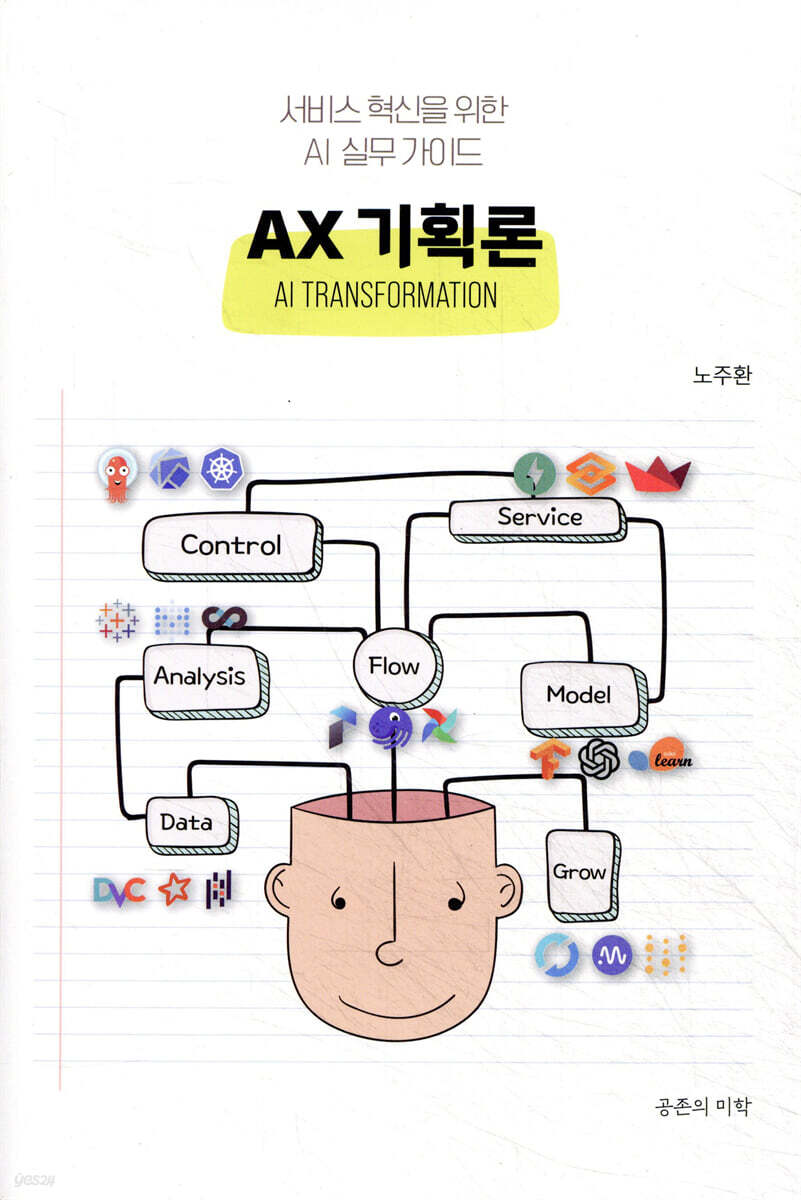
"AX Planning Theory: A Practical Guide to AI for Service Innovation" goes beyond simply explaining complex AI technologies. It focuses on understanding AI, planning for it, and applying it in practice.
This book is not intended for developers or engineers.
A practical guide for those who "need to understand and apply" AI, such as planners, marketers, and business leaders.
Focusing on 10 core service areas, including membership registration, customer analysis, search, recommendations, translation, chatbots, document analysis, voice interfaces, location-based services, and advertising, a total of 61 AI application techniques, including 'ID recommendation', 'password recommendation', 'customer segmentation', and 'retargeting advertising', were explained in detail.
We created diagrams (structural diagrams) for each function without exception, so that even complex flows can be intuitively understood.
This book does not introduce AI technology abstractly.
It helps readers understand and plan the flow of AX (AI Transformation) through practical applicability, an open-source-based approach, and a repetitive core structure.
Additionally, the basic principles of major models and technologies are explained with notes so that even those who do not know the technology can easily follow the flow.
"AX Planning Theory" is a practical guide for anyone who wants to go beyond the vague pressure to adopt AI and plan and implement "what to change with AI."
Now, let's explore the most realistic way to open the door to service innovation.
It is now a key means of innovating services and businesses.
"AX Planning Theory: A Practical Guide to AI for Service Innovation" goes beyond simply explaining complex AI technologies. It focuses on understanding AI, planning for it, and applying it in practice.
This book is not intended for developers or engineers.
A practical guide for those who "need to understand and apply" AI, such as planners, marketers, and business leaders.
Focusing on 10 core service areas, including membership registration, customer analysis, search, recommendations, translation, chatbots, document analysis, voice interfaces, location-based services, and advertising, a total of 61 AI application techniques, including 'ID recommendation', 'password recommendation', 'customer segmentation', and 'retargeting advertising', were explained in detail.
We created diagrams (structural diagrams) for each function without exception, so that even complex flows can be intuitively understood.
This book does not introduce AI technology abstractly.
It helps readers understand and plan the flow of AX (AI Transformation) through practical applicability, an open-source-based approach, and a repetitive core structure.
Additionally, the basic principles of major models and technologies are explained with notes so that even those who do not know the technology can easily follow the flow.
"AX Planning Theory" is a practical guide for anyone who wants to go beyond the vague pressure to adopt AI and plan and implement "what to change with AI."
Now, let's explore the most realistic way to open the door to service innovation.
index
1.
join the membership
ID recommendation
Password Recommendation
Credit card registration
ID verification
Fingerprint authentication
facial recognition
CAPTCHA authentication
AI avatar creation
2.
Customer Analysis
Customer profiling
Customer segmentation
Create a persona
Predicting Customer Lifetime Value
Customer Journey Analysis
Customer Churn Prediction
Predicting Customer Retention Effectiveness
Predicting customer intent
sentiment analysis
VOC analysis
3.
Document Analysis
Create a document
Document structure analysis
Document structure analysis
Intelligent Document Processing
Document similarity analysis
Entity Management
4.
search
Keyword search
Natural language search
Generative search
Image Search
Color Search
Multimodal search
5.
suggestion
Demographic-based recommendations
Rule-based recommendations
Onboarding Personalization
Knowledge-based recommendations
Context-based recommendations
Content-based recommendations
collaborative filtering
Hybrid Recommendation
6.
Chatbot
FAQ Chatbot
Scenario Chatbot
RAG-based chatbot
Multimodal Chatbot
7.
translation
Neural Machine Translation
LLM-based translation
Hybrid translation
8.
voice interface
Intelligent Call Center
Intelligent Meeting
Audio narration
9.
Location and space
POI Analysis
Congestion analysis
Recommended places nearby
Geofencing
Route recommendation
Itinerary Planner
10.
advertisement
Cookieless user identification
Retargeting ads
Contextual advertising
Click prediction model
A/B testing automation
Measuring Brand Lift
Multi-channel attribution analysis
join the membership
ID recommendation
Password Recommendation
Credit card registration
ID verification
Fingerprint authentication
facial recognition
CAPTCHA authentication
AI avatar creation
2.
Customer Analysis
Customer profiling
Customer segmentation
Create a persona
Predicting Customer Lifetime Value
Customer Journey Analysis
Customer Churn Prediction
Predicting Customer Retention Effectiveness
Predicting customer intent
sentiment analysis
VOC analysis
3.
Document Analysis
Create a document
Document structure analysis
Document structure analysis
Intelligent Document Processing
Document similarity analysis
Entity Management
4.
search
Keyword search
Natural language search
Generative search
Image Search
Color Search
Multimodal search
5.
suggestion
Demographic-based recommendations
Rule-based recommendations
Onboarding Personalization
Knowledge-based recommendations
Context-based recommendations
Content-based recommendations
collaborative filtering
Hybrid Recommendation
6.
Chatbot
FAQ Chatbot
Scenario Chatbot
RAG-based chatbot
Multimodal Chatbot
7.
translation
Neural Machine Translation
LLM-based translation
Hybrid translation
8.
voice interface
Intelligent Call Center
Intelligent Meeting
Audio narration
9.
Location and space
POI Analysis
Congestion analysis
Recommended places nearby
Geofencing
Route recommendation
Itinerary Planner
10.
advertisement
Cookieless user identification
Retargeting ads
Contextual advertising
Click prediction model
A/B testing automation
Measuring Brand Lift
Multi-channel attribution analysis
Publisher's Review
AI is no longer a special technology.
Many companies and organizations are adopting AXAI Transformation, transforming their operations and services around AI. AX goes beyond simple technology adoption; it encompasses a complete transformation of business models and operational methods. It has become an essential strategy for securing competitive advantage and creating new value.
However, in reality, promoting AX is never easy.
AI technology is complex, changing rapidly, and explanations focused solely on algorithms or frameworks don't easily connect to practical planning.
This has left many planners and marketers feeling the pressure to "adopt AI," but unsure where to start or what to consider first.
There is a clear gap between technology and practice, and this is creating an invisible barrier that is hindering AX.
This book focuses on bridging this gap.
Rather than explaining AI as a complex, cutting-edge technology, we focused on how it solves problems in real-world services and how it operates within the context of those problems.
AI technology was explained through various practical examples, including membership registration, search, recommendations, translation, chatbots, voice interfaces, document analysis, advertising, location-based services, and customer analysis.
Additionally, we wanted to suggest what perspectives and questions planners should have.
AX puts design before technology.
You need to clearly define what you want to automate, what data you want to leverage, and what user experience you want to create.
Rather than covering how to implement AI, this book is for those who are concerned about what AI will change.
AI technology may seem vast and complex at first, but when you actually look into it, the concepts and structures used across services are surprisingly similar.
The repetition of the same models and software across multiple chapters is intentional, allowing readers to naturally grasp the technologies and software that are crucial for practical use.
Through repeated processes, you will be able to experience that AI is not a technology that is difficult to overcome, but rather a technology that can be sufficiently understood and planned.
Most of the service cases introduced in this book were selected based on a clear awareness of the need for AI during the design and planning stages.
It was organized around why AI was needed and what role it should play amidst various practical concerns.
This helped me gain a sense of the practical problem awareness and the potential application of AI.
This book is not for developers or engineers.
While understanding the code isn't essential, some key concepts and workflows are accompanied by code examples to aid practical application. Anyone planning AI needs to understand the fundamental principles and characteristics of solutions, even if they don't implement the technology themselves.
Accordingly, descriptions of major models and software are also included.
The book's structure is centered around open source, making it as accessible as possible to everyone.
While various commercial solutions are utilized in real-world projects, this book focuses on understanding the fundamental principles and applicability. AI technology is rapidly evolving, so some aspects may not reflect the latest trends.
Any concepts or terms not fully explained in the text have been supplemented through footnotes. Please note that even if they are not explained on the current page, they may be covered later.
As the content was composed with overseas publication in mind, it is regrettable that it did not include in-depth Korean situations or specific examples.
I would like to express my deepest gratitude to Senior Editor Bae Ian, who provided meticulous research, code examples, and annotations to complete this book.
Finally,
We hope this book will serve as a practical guide to starting your AX journey for anyone who collaborates with engineers to lead AI projects, considers data-driven decision-making, and seeks to innovate products and services through AI.
Many companies and organizations are adopting AXAI Transformation, transforming their operations and services around AI. AX goes beyond simple technology adoption; it encompasses a complete transformation of business models and operational methods. It has become an essential strategy for securing competitive advantage and creating new value.
However, in reality, promoting AX is never easy.
AI technology is complex, changing rapidly, and explanations focused solely on algorithms or frameworks don't easily connect to practical planning.
This has left many planners and marketers feeling the pressure to "adopt AI," but unsure where to start or what to consider first.
There is a clear gap between technology and practice, and this is creating an invisible barrier that is hindering AX.
This book focuses on bridging this gap.
Rather than explaining AI as a complex, cutting-edge technology, we focused on how it solves problems in real-world services and how it operates within the context of those problems.
AI technology was explained through various practical examples, including membership registration, search, recommendations, translation, chatbots, voice interfaces, document analysis, advertising, location-based services, and customer analysis.
Additionally, we wanted to suggest what perspectives and questions planners should have.
AX puts design before technology.
You need to clearly define what you want to automate, what data you want to leverage, and what user experience you want to create.
Rather than covering how to implement AI, this book is for those who are concerned about what AI will change.
AI technology may seem vast and complex at first, but when you actually look into it, the concepts and structures used across services are surprisingly similar.
The repetition of the same models and software across multiple chapters is intentional, allowing readers to naturally grasp the technologies and software that are crucial for practical use.
Through repeated processes, you will be able to experience that AI is not a technology that is difficult to overcome, but rather a technology that can be sufficiently understood and planned.
Most of the service cases introduced in this book were selected based on a clear awareness of the need for AI during the design and planning stages.
It was organized around why AI was needed and what role it should play amidst various practical concerns.
This helped me gain a sense of the practical problem awareness and the potential application of AI.
This book is not for developers or engineers.
While understanding the code isn't essential, some key concepts and workflows are accompanied by code examples to aid practical application. Anyone planning AI needs to understand the fundamental principles and characteristics of solutions, even if they don't implement the technology themselves.
Accordingly, descriptions of major models and software are also included.
The book's structure is centered around open source, making it as accessible as possible to everyone.
While various commercial solutions are utilized in real-world projects, this book focuses on understanding the fundamental principles and applicability. AI technology is rapidly evolving, so some aspects may not reflect the latest trends.
Any concepts or terms not fully explained in the text have been supplemented through footnotes. Please note that even if they are not explained on the current page, they may be covered later.
As the content was composed with overseas publication in mind, it is regrettable that it did not include in-depth Korean situations or specific examples.
I would like to express my deepest gratitude to Senior Editor Bae Ian, who provided meticulous research, code examples, and annotations to complete this book.
Finally,
We hope this book will serve as a practical guide to starting your AX journey for anyone who collaborates with engineers to lead AI projects, considers data-driven decision-making, and seeks to innovate products and services through AI.
GOODS SPECIFICS
- Date of issue: May 22, 2025
- Page count, weight, size: 536 pages | 152*223*35mm
- ISBN13: 9791195072682
You may also like
카테고리
korean


korean

![GQ KOREA Mark (Monthly): December [2025]](http://librairie.coreenne.fr/cdn/shop/files/8ef265dbbfbf186523ed75ba7319009d.jpg?v=1765340328&width=3840)


