

AI and smart farms
 |
Description
Book Introduction
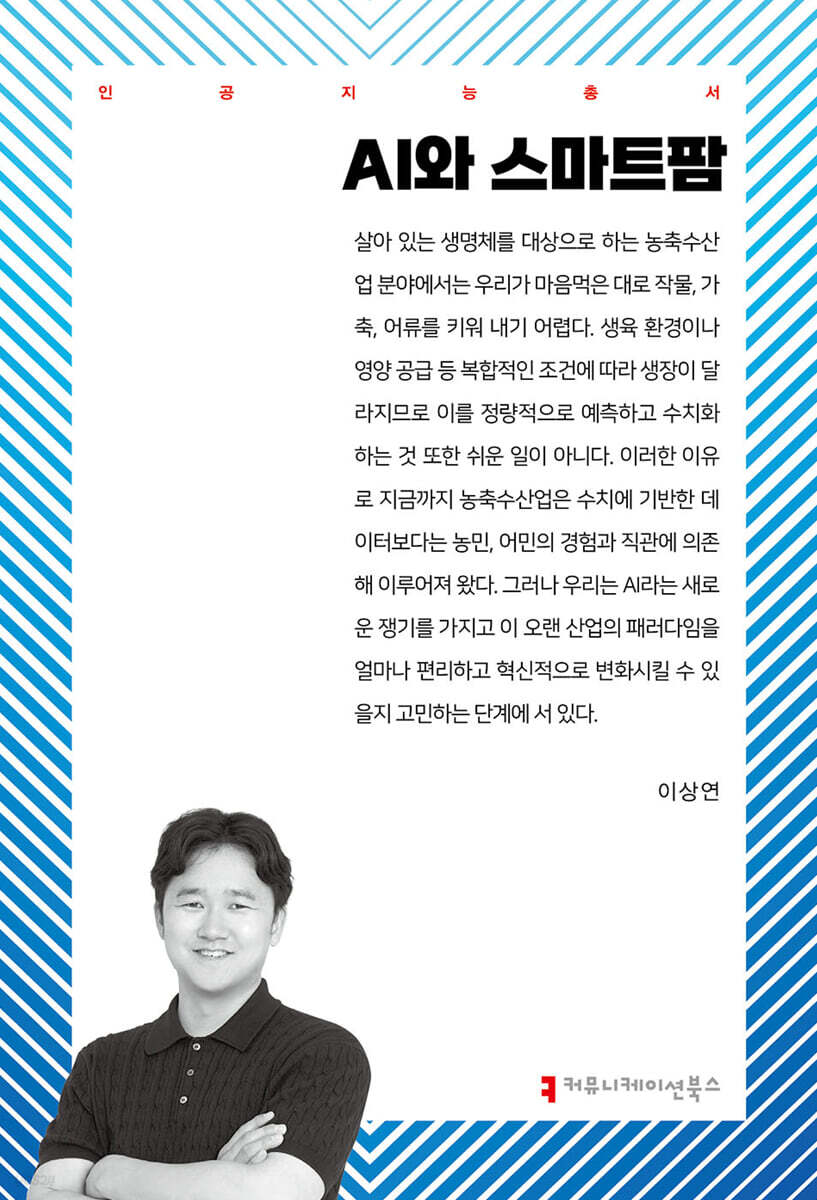
As AI technology is fully applied to the agricultural, livestock, and fisheries industries, experience-based management is shifting to data-driven management.
This book examines the characteristics of agriculture, livestock, and fisheries, as well as examples of AI utilization, and suggests directions for driving future changes in the agricultural, livestock, and fisheries industries.
It opens up new possibilities for those who dream of better food and a better future, even in the midst of uncertainty.
This book examines the characteristics of agriculture, livestock, and fisheries, as well as examples of AI utilization, and suggests directions for driving future changes in the agricultural, livestock, and fisheries industries.
It opens up new possibilities for those who dream of better food and a better future, even in the midst of uncertainty.
- You can preview some of the book's contents.
Preview
index
Paradigm shifts in the agricultural, livestock, and fisheries industries driven by AI
01 AI and Agriculture
02 AI and Livestock Industry
03 AI and the Fisheries Industry
04 AI and Agricultural Data
05 AI and Disease Detection
06 AI and Agricultural Robots
07 AI and Production Optimization
08 AI and Climate Change Response
09 AI and Food Security
10 AI and Space Farming
01 AI and Agriculture
02 AI and Livestock Industry
03 AI and the Fisheries Industry
04 AI and Agricultural Data
05 AI and Disease Detection
06 AI and Agricultural Robots
07 AI and Production Optimization
08 AI and Climate Change Response
09 AI and Food Security
10 AI and Space Farming
Into the book
How is AI technology being used in open-field farming?
In the dictionary of agricultural terms, 'open field' is defined as land without a roof, or outside natural conditions.
It is a form of growing crops in the natural environment itself, and is greatly affected by external factors such as weather.
Recently, AI technology has been utilized to solve the difficulties of open-field farming.
Farming efficiency is being improved with technologies such as self-driving tractors for leveling the ground, drones for pesticide spraying, and automatic weeding for weed detection. AI is also being used to analyze soil conditions using satellite data and optimize fertilizer and water supplies.
--- From "01_AI and Agriculture"
The most important topic in the smartening of the fisheries industry is the diversity of fish species.
Each fish species has different environmental requirements and is consumed in different regions.
The fact that both physiological characteristics and growth conditions are different makes it difficult to predict the growth environment and hinders systematic data collection.
Therefore, it is necessary to develop environmental control technologies and aquaculture optimization technologies suitable for each fish species, and even develop logistics and distribution channels.
It is also necessary to re-optimize existing technologies to suit the characteristics of each fish species.
Fish farms handling a variety of fish species will be able to utilize AI technology to analyze environmental data and model growth conditions for each species, enabling more efficient operations.
--- From "03_AI and Fisheries"
AI and digital twin technologies are essential for conducting research on primary agriculture.
A 'digital twin' refers to a system that digitalizes the real-world environment and implements it identically in a virtual world within a computer.
It is called a digital 'twin' because it represents something in the real world in the digital world like a twin.
Because it is based on real-world data, simulations can be conducted in a virtual environment, and the information obtained here can be used to apply the optimal environment back to the real world.
Simply put, there is the real world and a virtual world that replicates it, and first, in the virtual world, you change the environmental conditions and experiment with various situations.
In the dictionary of agricultural terms, 'open field' is defined as land without a roof, or outside natural conditions.
It is a form of growing crops in the natural environment itself, and is greatly affected by external factors such as weather.
Recently, AI technology has been utilized to solve the difficulties of open-field farming.
Farming efficiency is being improved with technologies such as self-driving tractors for leveling the ground, drones for pesticide spraying, and automatic weeding for weed detection. AI is also being used to analyze soil conditions using satellite data and optimize fertilizer and water supplies.
--- From "01_AI and Agriculture"
The most important topic in the smartening of the fisheries industry is the diversity of fish species.
Each fish species has different environmental requirements and is consumed in different regions.
The fact that both physiological characteristics and growth conditions are different makes it difficult to predict the growth environment and hinders systematic data collection.
Therefore, it is necessary to develop environmental control technologies and aquaculture optimization technologies suitable for each fish species, and even develop logistics and distribution channels.
It is also necessary to re-optimize existing technologies to suit the characteristics of each fish species.
Fish farms handling a variety of fish species will be able to utilize AI technology to analyze environmental data and model growth conditions for each species, enabling more efficient operations.
--- From "03_AI and Fisheries"
AI and digital twin technologies are essential for conducting research on primary agriculture.
A 'digital twin' refers to a system that digitalizes the real-world environment and implements it identically in a virtual world within a computer.
It is called a digital 'twin' because it represents something in the real world in the digital world like a twin.
Because it is based on real-world data, simulations can be conducted in a virtual environment, and the information obtained here can be used to apply the optimal environment back to the real world.
Simply put, there is the real world and a virtual world that replicates it, and first, in the virtual world, you change the environmental conditions and experiment with various situations.
--- From "10_AI and Space Agriculture"
Publisher's Review
Changes in the agricultural, livestock, and fisheries industries
Changes through AI are also beginning to take hold in the agricultural, livestock, and fisheries industries.
It is now possible to detect crop growth environments in real time and precisely adjust temperature, humidity, and nutrient conditions. It is also possible to continuously monitor the health of livestock and fish and predict the possibility of disease outbreaks.
Management methods that relied on experience and intuition are gradually shifting to data-driven, scientific management, which is leading to tangible results such as increased productivity, improved quality, and reduced costs.
AI technology reflecting industry-specific characteristics
This book meticulously examines the unique characteristics of each of the different sectors—agriculture, livestock farming, and fisheries—and introduces examples of AI technology applications suited to each.
We will examine data collection and analysis techniques tailored to the characteristics of target organisms, such as crops that are sensitive to soil and light, livestock that respond immediately to environmental changes, and fish that are sensitive to changes in water quality.
It also broadly covers the changes AI is bringing across the agricultural, livestock, and fisheries industries, including disease detection, the use of agricultural robots, production optimization, climate change response, and food security enhancement.
Preparing for the Future of the Agricultural, Livestock and Fisheries Industry
We have now entered an era where even rural areas must actively adopt cutting-edge technologies.
Beyond simple automation, smart decision-making and precise cultivation environments powered by AI are becoming key to competitiveness.
It provides valuable insights not only to those working in the agricultural, livestock, and fisheries industries, but also to readers seeking to explore new opportunities in the industry and prepare for the future.
Changes through AI are also beginning to take hold in the agricultural, livestock, and fisheries industries.
It is now possible to detect crop growth environments in real time and precisely adjust temperature, humidity, and nutrient conditions. It is also possible to continuously monitor the health of livestock and fish and predict the possibility of disease outbreaks.
Management methods that relied on experience and intuition are gradually shifting to data-driven, scientific management, which is leading to tangible results such as increased productivity, improved quality, and reduced costs.
AI technology reflecting industry-specific characteristics
This book meticulously examines the unique characteristics of each of the different sectors—agriculture, livestock farming, and fisheries—and introduces examples of AI technology applications suited to each.
We will examine data collection and analysis techniques tailored to the characteristics of target organisms, such as crops that are sensitive to soil and light, livestock that respond immediately to environmental changes, and fish that are sensitive to changes in water quality.
It also broadly covers the changes AI is bringing across the agricultural, livestock, and fisheries industries, including disease detection, the use of agricultural robots, production optimization, climate change response, and food security enhancement.
Preparing for the Future of the Agricultural, Livestock and Fisheries Industry
We have now entered an era where even rural areas must actively adopt cutting-edge technologies.
Beyond simple automation, smart decision-making and precise cultivation environments powered by AI are becoming key to competitiveness.
It provides valuable insights not only to those working in the agricultural, livestock, and fisheries industries, but also to readers seeking to explore new opportunities in the industry and prepare for the future.
GOODS SPECIFICS
- Date of issue: May 9, 2025
- Page count, weight, size: 108 pages | 128*188*6mm
- ISBN13: 9791143000033
You may also like
카테고리
korean


korean

![GQ KOREA Mark (Monthly): December [2025]](http://librairie.coreenne.fr/cdn/shop/files/8ef265dbbfbf186523ed75ba7319009d.jpg?v=1765340328&width=3840)


