

Classroom Positive Discipline Method
 |
Description
Book Introduction
Excellent and respected teachers are kind yet firm.
When dealing with students, be kind to their personalities and emotions as human beings, but be firm about the promises and responsibilities that a human being must fulfill as a member of a community.
Thus, students can develop self-esteem, a sense of self-worth, a sense of belonging, and a sense of responsibility for themselves and their community, based on a connection with their teachers, rather than a sense of indulgence, rejection, or fear. PDC, or Positive Classroom Discipline, makes this possible.
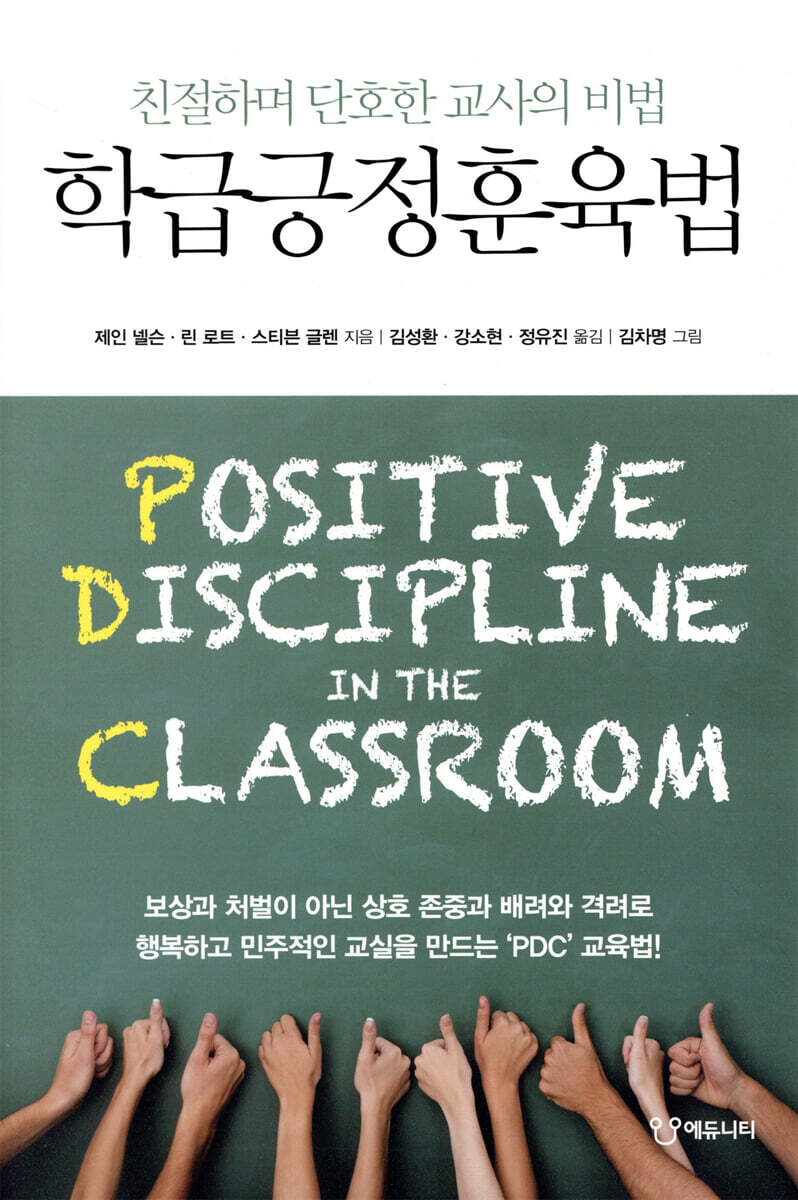
This book is about the 'PDC' educational method that creates a happy and democratic classroom through mutual respect, consideration, and encouragement rather than rewards and punishments.
Part 1 introduces the 'Principles of a Kind and Firm Teacher'.
We explore what teachers should teach, what type of teacher I am, why children get into trouble, and why children don't change easily.
Part 2 introduces ‘Technology for a Happy and Democratic Classroom.’
This course introduces skills for communicating respectfully and assertively, resolving issues related to school violence and homework, and PDC class meetings. By mastering the philosophy and principles of PDC through various practical examples and activities, teachers will be able to create a classroom environment that fosters academic growth, utilize encouragement rather than rewards and punishments, help students develop social skills and foster positive behavior through class meetings, resolve problems through collaboration rather than punishment, and understand the underlying motivations behind behaviors, not just the surface reasons for them.
When dealing with students, be kind to their personalities and emotions as human beings, but be firm about the promises and responsibilities that a human being must fulfill as a member of a community.
Thus, students can develop self-esteem, a sense of self-worth, a sense of belonging, and a sense of responsibility for themselves and their community, based on a connection with their teachers, rather than a sense of indulgence, rejection, or fear. PDC, or Positive Classroom Discipline, makes this possible.
This book is about the 'PDC' educational method that creates a happy and democratic classroom through mutual respect, consideration, and encouragement rather than rewards and punishments.
Part 1 introduces the 'Principles of a Kind and Firm Teacher'.
We explore what teachers should teach, what type of teacher I am, why children get into trouble, and why children don't change easily.
Part 2 introduces ‘Technology for a Happy and Democratic Classroom.’
This course introduces skills for communicating respectfully and assertively, resolving issues related to school violence and homework, and PDC class meetings. By mastering the philosophy and principles of PDC through various practical examples and activities, teachers will be able to create a classroom environment that fosters academic growth, utilize encouragement rather than rewards and punishments, help students develop social skills and foster positive behavior through class meetings, resolve problems through collaboration rather than punishment, and understand the underlying motivations behind behaviors, not just the surface reasons for them.
- You can preview some of the book's contents.
Preview
index
Translator's Note - To you who opened this book
Author's Preface
Recommended Preface
Part 1: The Principles of a Kind and Firm Teacher
Chapter 1: A New Discipline for Shaken Teachers
Two Necessary and Sufficient Conditions for Learning | PDC Will Transform Your Life and Class | PDC's 7 Beliefs | A New Discipline for Faltering Teachers
Chapter 2: What and How Should Teachers Teach?
A shift in perception is needed | What do students want to learn? | The beliefs behind behavior | Belonging, self-esteem, and punishment | Beyond reward and punishment
Chapter 3: What Kind of Teacher Are You?
Teacher Types: Boss, Servant, and Ghost | Teacher Types: Chameleon, Turtle, Lion, and Eagle | The PDC Teacher's Basic Perspectives and Skills | 14 Steps to Teacher Problem Solving | 4 Levels of Awareness and Ability to Grow as a PDC Teacher
Chapter 4: Why Children Cause Problems
Four Student Stories | Misaligned Goal Behaviors | Teaching Students the Misaligned Goal Behavior Chart
Chapter 5: Why Children Have a Hard Time Changing
7 Keys to Building a Strong Student-School Relationship | Old Methods Won't Change | Relationship Building Comes First | The Power of Consideration | Attitudes and Skills for Relationship Building | Listen and Be Serious | Enjoy Field Trips and More | Everyone Has Their Own Unique Traits | A Sense of Humor is Key to Relationship Building | Respect Students' Interests | Encourage Growth, Not Perfection
Part 2: Technology for a Happy and Democratic Classroom
Chapter 6: Respectful Communication Skills
Turning Communication Barriers into Communication Skills | 4 Techniques to Empower Your Communication
Chapter 7: Friendly Problem Solving Skills
The 3Rs and 1H for Problem Solving | The 4 Steps to Problem Solving | The Problem Solving Card Box | The Choice Wheel | The Peace Table | Positive Timeout | Class Meeting
Chapter 8: Assertive Problem-Solving Skills
Limited Choices | Doing Instead of Talking | Asking What & How Questions | Asking Behavior Change Questions | Experiencing Natural Consequences | Deciding What to Do | Respectfully Saying No | Getting Everyone in the Same Boat
Chapter 9: School Violence Problem Solving Techniques
What is school violence? | Violence is learned | Everyone is exposed to school violence | Problems must be addressed | What adults should do | Precautions when intervening in school violence
Chapter 10 Homework Problem Solving Skills
Whose Responsibility Is Homework? | Avoiding Double Punishment
Chapter 11: Eight Skills for PDC Class Meetings
Sit in a circle | Give thanks and praise | Respect differences | Use respectful communication skills | Focus on solutions | Role-play and brainstorm | Use agendas and class meeting formats | Understand and use the four misaligned goals
Chapter 12 PDC Class Meeting Q&A
Frequently Asked Questions for Elementary School Teachers | Frequently Asked Questions for Middle and High School Teachers | Other Questions and Answers
Conclusion: What to do from now on
If you want to use PDC better
References
Author's Preface
Recommended Preface
Part 1: The Principles of a Kind and Firm Teacher
Chapter 1: A New Discipline for Shaken Teachers
Two Necessary and Sufficient Conditions for Learning | PDC Will Transform Your Life and Class | PDC's 7 Beliefs | A New Discipline for Faltering Teachers
Chapter 2: What and How Should Teachers Teach?
A shift in perception is needed | What do students want to learn? | The beliefs behind behavior | Belonging, self-esteem, and punishment | Beyond reward and punishment
Chapter 3: What Kind of Teacher Are You?
Teacher Types: Boss, Servant, and Ghost | Teacher Types: Chameleon, Turtle, Lion, and Eagle | The PDC Teacher's Basic Perspectives and Skills | 14 Steps to Teacher Problem Solving | 4 Levels of Awareness and Ability to Grow as a PDC Teacher
Chapter 4: Why Children Cause Problems
Four Student Stories | Misaligned Goal Behaviors | Teaching Students the Misaligned Goal Behavior Chart
Chapter 5: Why Children Have a Hard Time Changing
7 Keys to Building a Strong Student-School Relationship | Old Methods Won't Change | Relationship Building Comes First | The Power of Consideration | Attitudes and Skills for Relationship Building | Listen and Be Serious | Enjoy Field Trips and More | Everyone Has Their Own Unique Traits | A Sense of Humor is Key to Relationship Building | Respect Students' Interests | Encourage Growth, Not Perfection
Part 2: Technology for a Happy and Democratic Classroom
Chapter 6: Respectful Communication Skills
Turning Communication Barriers into Communication Skills | 4 Techniques to Empower Your Communication
Chapter 7: Friendly Problem Solving Skills
The 3Rs and 1H for Problem Solving | The 4 Steps to Problem Solving | The Problem Solving Card Box | The Choice Wheel | The Peace Table | Positive Timeout | Class Meeting
Chapter 8: Assertive Problem-Solving Skills
Limited Choices | Doing Instead of Talking | Asking What & How Questions | Asking Behavior Change Questions | Experiencing Natural Consequences | Deciding What to Do | Respectfully Saying No | Getting Everyone in the Same Boat
Chapter 9: School Violence Problem Solving Techniques
What is school violence? | Violence is learned | Everyone is exposed to school violence | Problems must be addressed | What adults should do | Precautions when intervening in school violence
Chapter 10 Homework Problem Solving Skills
Whose Responsibility Is Homework? | Avoiding Double Punishment
Chapter 11: Eight Skills for PDC Class Meetings
Sit in a circle | Give thanks and praise | Respect differences | Use respectful communication skills | Focus on solutions | Role-play and brainstorm | Use agendas and class meeting formats | Understand and use the four misaligned goals
Chapter 12 PDC Class Meeting Q&A
Frequently Asked Questions for Elementary School Teachers | Frequently Asked Questions for Middle and High School Teachers | Other Questions and Answers
Conclusion: What to do from now on
If you want to use PDC better
References
Publisher's Review
With mutual respect, consideration, and encouragement, not rewards and punishments.
The 'PDC' educational method that creates a happy and democratic classroom!
A Teacher's Confession: Can You Be Kind Yet Firm?
A teacher loves children and wants to be loved by children.
So I try to be kind to the children and not get angry.
At first, the children seem to like the teacher.
But as time goes by, children start to treat their teachers rudely.
Because of that, the teacher gets hurt.
I suppress my emotions and always endure, but the pain just keeps growing.
Eventually, the teacher's self-esteem hits rock bottom.
Another teacher wants to teach children well.
I believe that is an important responsibility of a teacher.
Especially, if you do something wrong, I will do my best to correct you.
But the children don't listen to the teacher and want to do whatever they want.
I want to teach my children well, but I feel like I am too distant from them, perhaps because of my assertiveness.
I'm always afraid that I'm not competent enough as a teacher.
Almost all teachers have probably experienced being hurt by being kind to children, or feeling distant by being firm.
Is it possible to be kind yet firm with children? This book offers the secret.
This is called 'Positive Discipline in the Classroom (PDC)'.
A New Discipline for Shaken Teachers
Excellent and respected teachers are kind yet firm.
When dealing with students, be kind to their personalities and emotions as human beings, but be firm about the promises and responsibilities that a human being must fulfill as a member of a community.
So, students can develop self-esteem, a sense of belonging and responsibility for themselves and their community, based on a sense of connection with their teachers rather than self-indulgence, rejection, or fear.
PDC, or Positive Discipline in the Classroom, makes this possible.
In fact, ‘positive discipline’ is nothing new.
It is actually a method that has been proven over a long period of time.
For over 30 years, millions of parents and teachers have used positive discipline to restore order and respect in their homes and classrooms, and they have seen amazingly effective results.
Many people, including teachers, believe that the purpose of school is to acquire knowledge, and that rewards and punishments are effective ways to achieve this.
However, this is not the right approach. Numerous studies have shown that when students don't develop social and emotional skills, they experience a variety of problems, both academic and disciplinary. PDC takes a different approach. It prioritizes social and emotional development alongside academic growth.
Additionally, students are viewed as proactive problem solvers, not as objects of reward and punishment.
So, student participation is also very important in PDC.
Students create their own class rules, set their own class schedules, and participate directly in class and school events.
When a problem arises, solutions are found through class meetings, etc.
For a happy and democratic classroom
Part 1 introduces the 'Principles of a Kind and Firm Teacher'.
We explore what teachers should teach, what type of teacher I am, why children get into trouble, and why children don't change easily.
Part 2 introduces ‘Technology for a Happy and Democratic Classroom.’
We introduce skills for communicating kindly and firmly with respect, resolving problems related to school violence or homework, and PDC class meeting skills.
By learning the philosophy and principles of PDC through various practical examples and activities, teachers will be able to create a classroom atmosphere that fosters academic growth, use encouragement rather than rewards and punishments, help students develop social skills and positive behavior through class meetings, resolve problem situations collaboratively rather than punishing, and understand the motivations behind behaviors, not just the superficial reasons for them.
The 10 Commandments of a PDC Teacher
1.
Be kind to your emotions and firm in your actions.
2.
Discipline with encouragement and rules rather than rewards and punishments.
3.
Decipher your child's hidden intentions rather than their overt problem behavior.
4.
Don't take sides or be the judge in your children's fights.
5.
Always be consistent with your children.
6.
Encourage attitude, effort, process, and creativity rather than praising results.
7.
Use questions and choices rather than instructions and explanations.
8.
Encourage your child's mistakes and use them as learning opportunities.
9.
Make it a daily routine to express gratitude and encouragement so your children become accustomed to positive words.
10.
Enforce the rules and principles that must be followed to the end.
The translators of this book, having worked at innovative schools, know firsthand what the greatest force is in transforming children's lives.
To change schools and children's lives, changes in the curriculum and school management system are necessary, but above all, the driving force is teachers' love for children.
We can grow through communication, cooperation, and encouragement based on love.
The content of this book is about how to love children and how to grow as a teacher.
It will also soon become a guidebook for fostering a happy life for teachers and children.
_ Lee Jung-hyun, principal of Joan Elementary School in Namyangju
How powerful can a single, insightful line be? I encountered "positive discipline" and held a class meeting to find ways to support children rather than punish them.
I was impressed by PDC's respect for students as proactive problem-solvers, guided by questions rather than explanations. I'm confident that PDC's respectful questions will unlock the sparkling 1% in each student.
_ Heo Seung-hwan, teacher at Seoul Film Elementary School
It introduces clear concepts and strategies that any teacher should have, and they can be put into practice without difficulty.
This book changed my life not only as a teacher and student, but also as a principal.
_ Bill Scott, Principal of Burnie Elementary School
This book can be said to be the standard for discipline.
I highly recommend it to anyone who wants to teach children.
_ Robert W.
Reasoner, President of the International Counseling Association
It changed the teacher's perspective on himself and his students.
By practicing the activities introduced in the book, it shows how the learning process from head to heart and the resulting positive changes take root.
_ Dina Emser, former elementary school principal and educational counselor
The 'PDC' educational method that creates a happy and democratic classroom!
A Teacher's Confession: Can You Be Kind Yet Firm?
A teacher loves children and wants to be loved by children.
So I try to be kind to the children and not get angry.
At first, the children seem to like the teacher.
But as time goes by, children start to treat their teachers rudely.
Because of that, the teacher gets hurt.
I suppress my emotions and always endure, but the pain just keeps growing.
Eventually, the teacher's self-esteem hits rock bottom.
Another teacher wants to teach children well.
I believe that is an important responsibility of a teacher.
Especially, if you do something wrong, I will do my best to correct you.
But the children don't listen to the teacher and want to do whatever they want.
I want to teach my children well, but I feel like I am too distant from them, perhaps because of my assertiveness.
I'm always afraid that I'm not competent enough as a teacher.
Almost all teachers have probably experienced being hurt by being kind to children, or feeling distant by being firm.
Is it possible to be kind yet firm with children? This book offers the secret.
This is called 'Positive Discipline in the Classroom (PDC)'.
A New Discipline for Shaken Teachers
Excellent and respected teachers are kind yet firm.
When dealing with students, be kind to their personalities and emotions as human beings, but be firm about the promises and responsibilities that a human being must fulfill as a member of a community.
So, students can develop self-esteem, a sense of belonging and responsibility for themselves and their community, based on a sense of connection with their teachers rather than self-indulgence, rejection, or fear.
PDC, or Positive Discipline in the Classroom, makes this possible.
In fact, ‘positive discipline’ is nothing new.
It is actually a method that has been proven over a long period of time.
For over 30 years, millions of parents and teachers have used positive discipline to restore order and respect in their homes and classrooms, and they have seen amazingly effective results.
Many people, including teachers, believe that the purpose of school is to acquire knowledge, and that rewards and punishments are effective ways to achieve this.
However, this is not the right approach. Numerous studies have shown that when students don't develop social and emotional skills, they experience a variety of problems, both academic and disciplinary. PDC takes a different approach. It prioritizes social and emotional development alongside academic growth.
Additionally, students are viewed as proactive problem solvers, not as objects of reward and punishment.
So, student participation is also very important in PDC.
Students create their own class rules, set their own class schedules, and participate directly in class and school events.
When a problem arises, solutions are found through class meetings, etc.
For a happy and democratic classroom
Part 1 introduces the 'Principles of a Kind and Firm Teacher'.
We explore what teachers should teach, what type of teacher I am, why children get into trouble, and why children don't change easily.
Part 2 introduces ‘Technology for a Happy and Democratic Classroom.’
We introduce skills for communicating kindly and firmly with respect, resolving problems related to school violence or homework, and PDC class meeting skills.
By learning the philosophy and principles of PDC through various practical examples and activities, teachers will be able to create a classroom atmosphere that fosters academic growth, use encouragement rather than rewards and punishments, help students develop social skills and positive behavior through class meetings, resolve problem situations collaboratively rather than punishing, and understand the motivations behind behaviors, not just the superficial reasons for them.
The 10 Commandments of a PDC Teacher
1.
Be kind to your emotions and firm in your actions.
2.
Discipline with encouragement and rules rather than rewards and punishments.
3.
Decipher your child's hidden intentions rather than their overt problem behavior.
4.
Don't take sides or be the judge in your children's fights.
5.
Always be consistent with your children.
6.
Encourage attitude, effort, process, and creativity rather than praising results.
7.
Use questions and choices rather than instructions and explanations.
8.
Encourage your child's mistakes and use them as learning opportunities.
9.
Make it a daily routine to express gratitude and encouragement so your children become accustomed to positive words.
10.
Enforce the rules and principles that must be followed to the end.
The translators of this book, having worked at innovative schools, know firsthand what the greatest force is in transforming children's lives.
To change schools and children's lives, changes in the curriculum and school management system are necessary, but above all, the driving force is teachers' love for children.
We can grow through communication, cooperation, and encouragement based on love.
The content of this book is about how to love children and how to grow as a teacher.
It will also soon become a guidebook for fostering a happy life for teachers and children.
_ Lee Jung-hyun, principal of Joan Elementary School in Namyangju
How powerful can a single, insightful line be? I encountered "positive discipline" and held a class meeting to find ways to support children rather than punish them.
I was impressed by PDC's respect for students as proactive problem-solvers, guided by questions rather than explanations. I'm confident that PDC's respectful questions will unlock the sparkling 1% in each student.
_ Heo Seung-hwan, teacher at Seoul Film Elementary School
It introduces clear concepts and strategies that any teacher should have, and they can be put into practice without difficulty.
This book changed my life not only as a teacher and student, but also as a principal.
_ Bill Scott, Principal of Burnie Elementary School
This book can be said to be the standard for discipline.
I highly recommend it to anyone who wants to teach children.
_ Robert W.
Reasoner, President of the International Counseling Association
It changed the teacher's perspective on himself and his students.
By practicing the activities introduced in the book, it shows how the learning process from head to heart and the resulting positive changes take root.
_ Dina Emser, former elementary school principal and educational counselor
GOODS SPECIFICS
- Date of issue: September 1, 2014
- Format: Hardcover book binding method guide
- Page count, weight, size: 304 pages | 660g | 153*224*24mm
- ISBN13: 9791185992006
- ISBN10: 1185992006
You may also like
카테고리
korean


korean

![GQ KOREA Mark (Monthly): December [2025]](http://librairie.coreenne.fr/cdn/shop/files/8ef265dbbfbf186523ed75ba7319009d.jpg?v=1765340328&width=3840)


