

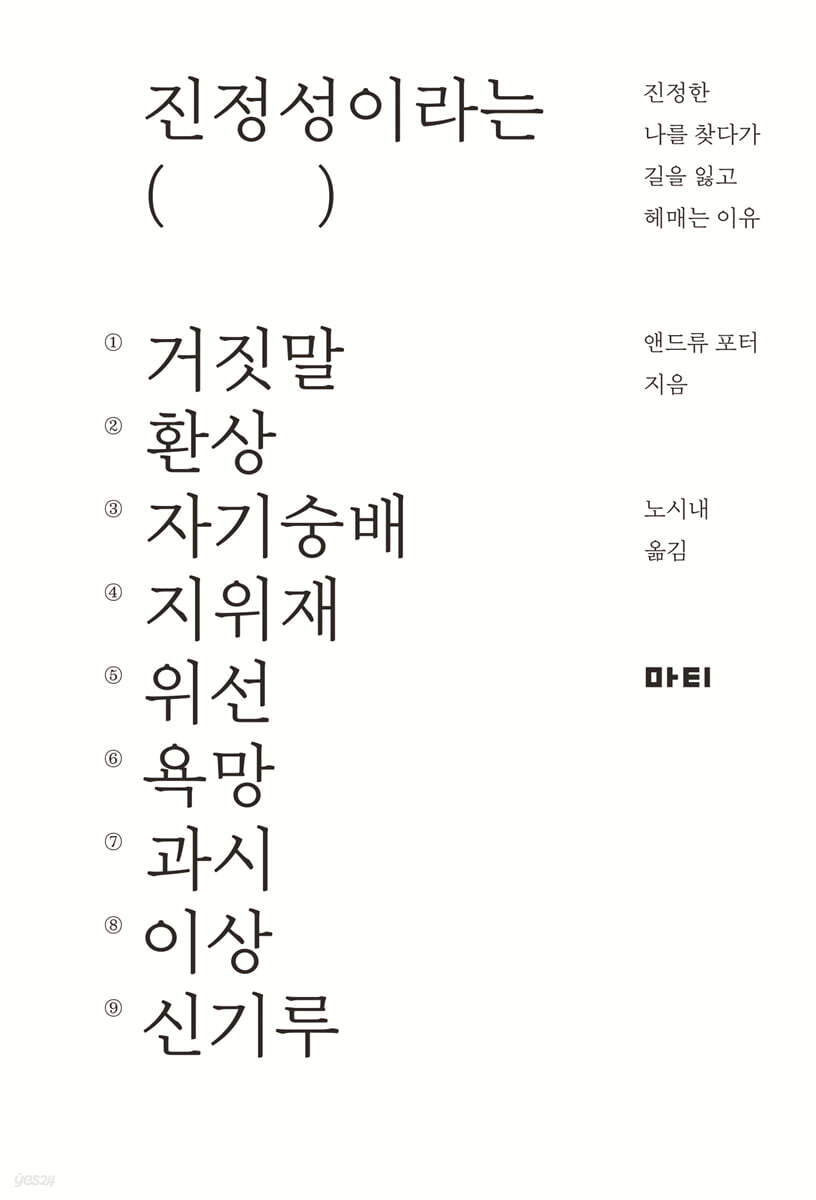
The lie of authenticity
 |
Description
Book Introduction
Andrew Porter, a young Canadian philosopher who mercilessly shakes what we consider 'right' with his sharp social criticism.
Following the previous work, "Selling Revolution," which exposed the dark side of the symbol of resistance, "counterculture," in "The Lie Called Authenticity," the true face of "authenticity," the last bastion of this era, is revealed.
Following the previous work, "Selling Revolution," which exposed the dark side of the symbol of resistance, "counterculture," in "The Lie Called Authenticity," the true face of "authenticity," the last bastion of this era, is revealed.
- You can preview some of the book's contents.
Preview
index
Entering the term authenticity
Chapter 1: The Disease of Modernity
Chapter 2: A Return to Naive Primitivism
Chapter 3: People Who Consume Artistic Aura
Chapter 4: Authenticity for Show
Chapter 5: The Perils of Transparency
Chapter 6: Give me a vote for sincerity
Chapter 7 Culture for Tourists
Chapter 8: The End of History
In conclusion, again, progress
Acknowledgements
Translator's Note: Part 3 of the "Debunking Fiction" trilogy. This time, authenticity is at stake.
main
Search
Chapter 1: The Disease of Modernity
Chapter 2: A Return to Naive Primitivism
Chapter 3: People Who Consume Artistic Aura
Chapter 4: Authenticity for Show
Chapter 5: The Perils of Transparency
Chapter 6: Give me a vote for sincerity
Chapter 7 Culture for Tourists
Chapter 8: The End of History
In conclusion, again, progress
Acknowledgements
Translator's Note: Part 3 of the "Debunking Fiction" trilogy. This time, authenticity is at stake.
main
Search
Publisher's Review
A sharp social critique that shakes what we consider to be 'right' without mercy.
Andrew Porter, a young Canadian philosopher
Following the previous work, "Selling Revolution," which revealed the dark side of the symbol of resistance, "counterculture,"
In "The Lie of Authenticity," the true face of authenticity, the last bastion of this era, is revealed!
If you type "authenticity" into Google, you'll get 3,150,000 news searches.
"Insincere electioneering"
“Authenticity of the 80s”
"Musical authenticity that even surprised teenagers"
The comfort women issue hinges on Japan's sincere apology.
What is authenticity?
A subtle term that must be understood from the outset, not from the outset.
What exactly is authenticity? According to the American public opinion poll cited in this book, when asked what authenticity means, more than a third of respondents answered "character," and 61 percent chose "genuine" as the word that best defined authenticity (p. 13). So, what is "character" and what is "authenticity"? It's difficult to answer.
Images of inauthenticity come to mind more quickly than words about what authenticity is. Andrew Porter draws two conclusions from this research.
“First, authenticity is a term best understood as pointing out what it is not and then understanding it in its opposite way.
Second, whatever authenticity is, people definitely want it.
That is, when something is described as 'authentic', it always means something good.
“Authenticity—a term associated with motherhood, like community, home, nature, and organic farming—is always used only in a positive sense, as a term of approval, and tends to serve as a rhetorical trump card.” (p. 16)
The author does not answer the question of what authenticity is.
However, “when discussing authenticity, to properly grasp its meaning, we must understand the context in which the term in question is used and what it contrasts with.
The real thing? Of course it's good.
But he asks, “In contrast to what is true?” (p. 14).
The feeling of being alienated from one's job, one's neighbors, and oneself.
Bring out the sincerity
On the other side of alienation, anxiety, and disillusionment lies authenticity.
“If you look closely at your surroundings, you will see that there is a lot of alienation.
Husbands are alienated from their wives, students from their teachers, voters from their politicians, and patients from their doctors.
Everyone thinks that mass media, especially advertising, causes alienation.
Some religious people believe that today's society, where everything is permitted, is alienating, and some believe that alienation leads to terrorism.
For city dwellers, the suburbs feel alienated, and for suburbanites, the anonymous life in the big city feels alienating.
“The world of labor is also a major source of alienation.” (p. 56)
In this situation, alienation is perceived as a disease that hinders true life.
People who are tired of suffering from 'gapjil' and living as 'suckers' are busy denying the achievements of modern times and praising themselves that the old days were better.
In any case, the old social hierarchy has been replaced by economic status, and in place of the exchange of human gifts, only the empty relationship of market exchange remains.
The author states, “If the alienation we modern people feel is truly a kind of disease, then we need an explanation of what it means to put an end to discord and restore the lost unity and harmony” (p. 60), and thus, authenticity is considered the final bastion to cure alienation.
Authenticity is a status commodity for the wealthy.
It's just a popular product that the market is paying attention to.
But have choices made in pursuit of "authenticity" actually helped us escape alienation? Let's take organic farming as an example.
Those who have long been buying organic produce to avoid the harm of large-scale agriculture may feel a little betrayed these days.
Organic has become a fully mainstream business! "Organic food is a magical panacea that's delicious, healthy, sensible, and even ethical.
As organic farming grew in popularity, discontent grew within the organic farming movement.
“As what was once a niche market became mainstream and popular, the need for mass production arose, and organic farming, rather than replacing factory farming, began to resemble it in many aspects.” (p. 151) Now, even in organic farming, there is a distinction between ‘true organic’ and ‘fake organic’, and the grades are becoming more detailed.
The standards for authenticity are becoming stricter, and the pursuit of status through authenticity is becoming more intense.
Andrew Porter also cautions against the attitude of those who consider only the work of high-priced artists to be 'real' art.
“The authenticity of a work of art is often perceived as threatened by commodification, but it turns out that authenticity is actually only attainable by those willing to spend a lot of money.
His point that "aura, which originally originated in sacred rituals and ancient communal traditions, has now been transformed into a powerful sales strategy that every marketer and brand manager is watching closely" is persuasive (p. 121).
“Ultimately, authenticity is a valuable status good because not everyone can enjoy it.
“Indeed, authenticity has recently become established as the most sophisticated form of status competition, attracting the most discerning, wealthy, and competitive participants.” (p. 311)
People who are busy showing their true selves
Recently, Thai photographer Chompoo Baritone created a sensation with a work satirizing Instagram photos. There's already a trend of disdain for the pretentiousness of social media.
There have also been quite a few logical social critiques criticizing the 'competition for happiness' and 'conspicuous consumption'.
However, there is one blind spot in this criticism.
They specifically take issue with the act of uploading photos of luxury goods, foreign cars, and the latest IT devices.
Are fair trade coffee, eco-bags, and organic cosmetics okay? What about confessing your "dark history" to the world? And don't those who look down on this kind of show-off or confession also post criticism or a word of reflection on social media?
Yes, the problem is not what to expose.
It depends on what desire leads us to self-disclosure.
Author Andrew Porter describes this phenomenon as a large-scale authenticity experiment.
“There are tens of millions of people who casually expose the most intimate moments, mundane events, or embarrassing experiences they experience in their daily lives.
…we might think of this intense online self-disclosure, now underway, as a large-scale experiment in authenticity.
It shows all of your flaws without hiding anything.
“It seems to be saying, ‘I am just this kind of person, so please accept me for who I really am.’” (p. 188)
The more voters want politicians to be sincere,
Politicians only care about their image!
While most people quietly desire authenticity on social media, there are those who openly tout their 'authenticity'.
They are politicians.
Voters 'naturally' don't trust their sincerity.
Yet, it demands sincerity.
“We say we want to be able to choose the parties and policies that align with our beliefs and values, but when presented with a range of political ‘brands’ that voters can easily choose from, they reject them all as fake.
“Simply put, the desire for authenticity is what has led to the major problems in politics today,” the author points out (p. 204).
“Star politicians who have appeared like comets in the political world all promise, ‘I will do politics a little differently.’
That statement implies, 'I will not lie, be hypocritical, muddle through, play the blind, be capricious, or mislead you.'
…the promise to show a different kind of politics is silenced when the media criticizes the candid rhetoric.
By this time, the politician has either learned to survive by mastering smokescreen tactics, or he will be branded a fool or a dangerous extremist by the public, and he will fall off a cliff.” (p. 221)
Nevertheless, voters want to feel the 'sincerity' and 'honesty' of politicians, and politicians engage in a zero-sum game to achieve this by slandering other politicians.
Unfortunately, voters also listen to negative propaganda as they look for someone more genuine.
The author concludes:
“Therefore, the only alternative is to vote for a candidate who is stiff and so boring that you wouldn’t want to have a beer with him.” (p. 232)
Be wary of retro sensibilities
Face reality with balanced thinking rather than naive romanticism.
There are also those who argue that the problem is not politics, economics, or society, but rather the destruction of the Earth and that we need to return to a more 'real' nature.
They are the declineists.
“From a declineist’s perspective, the combination of rights-based liberal individualism and a free-market economy is ruining us by leading us into shallow consumerism and mindless entertainment, weakening our attachment to local places and our sense of community.” (p. 80) Perhaps that’s why.
The theory of decline is surprisingly popular.
Representative examples include "The Day After Tomorrow" and "2012," which deal with disasters on Earth, and "Wall-E," an animation that contains warning messages about bad eating habits and corporate dependence.
The author points out that this theory of decline only appeals to retro-romanticism without offering any productive solutions.
Korea's retro trend is also related to this.
Neighbors who were better than family, nights spent huddled together in front of the radio, lunch boxes shared at school by pushing desks together… We happily accept and recall the past when we were ‘real’ neighbors, ‘sincere’ friends, and the taste of ‘true’ mother’s cooking. These days, Korea seems to have left all ‘real things’ in the past.
Porter advises:
“While we have gained some things and lost others, we must acknowledge, at least in the grand scheme of things, that ending modernity and regressing to a nostalgic past is a mistake.” (p. 315)
Andrew Porter, a young Canadian philosopher
Following the previous work, "Selling Revolution," which revealed the dark side of the symbol of resistance, "counterculture,"
In "The Lie of Authenticity," the true face of authenticity, the last bastion of this era, is revealed!
If you type "authenticity" into Google, you'll get 3,150,000 news searches.
"Insincere electioneering"
“Authenticity of the 80s”
"Musical authenticity that even surprised teenagers"
The comfort women issue hinges on Japan's sincere apology.
What is authenticity?
A subtle term that must be understood from the outset, not from the outset.
What exactly is authenticity? According to the American public opinion poll cited in this book, when asked what authenticity means, more than a third of respondents answered "character," and 61 percent chose "genuine" as the word that best defined authenticity (p. 13). So, what is "character" and what is "authenticity"? It's difficult to answer.
Images of inauthenticity come to mind more quickly than words about what authenticity is. Andrew Porter draws two conclusions from this research.
“First, authenticity is a term best understood as pointing out what it is not and then understanding it in its opposite way.
Second, whatever authenticity is, people definitely want it.
That is, when something is described as 'authentic', it always means something good.
“Authenticity—a term associated with motherhood, like community, home, nature, and organic farming—is always used only in a positive sense, as a term of approval, and tends to serve as a rhetorical trump card.” (p. 16)
The author does not answer the question of what authenticity is.
However, “when discussing authenticity, to properly grasp its meaning, we must understand the context in which the term in question is used and what it contrasts with.
The real thing? Of course it's good.
But he asks, “In contrast to what is true?” (p. 14).
The feeling of being alienated from one's job, one's neighbors, and oneself.
Bring out the sincerity
On the other side of alienation, anxiety, and disillusionment lies authenticity.
“If you look closely at your surroundings, you will see that there is a lot of alienation.
Husbands are alienated from their wives, students from their teachers, voters from their politicians, and patients from their doctors.
Everyone thinks that mass media, especially advertising, causes alienation.
Some religious people believe that today's society, where everything is permitted, is alienating, and some believe that alienation leads to terrorism.
For city dwellers, the suburbs feel alienated, and for suburbanites, the anonymous life in the big city feels alienating.
“The world of labor is also a major source of alienation.” (p. 56)
In this situation, alienation is perceived as a disease that hinders true life.
People who are tired of suffering from 'gapjil' and living as 'suckers' are busy denying the achievements of modern times and praising themselves that the old days were better.
In any case, the old social hierarchy has been replaced by economic status, and in place of the exchange of human gifts, only the empty relationship of market exchange remains.
The author states, “If the alienation we modern people feel is truly a kind of disease, then we need an explanation of what it means to put an end to discord and restore the lost unity and harmony” (p. 60), and thus, authenticity is considered the final bastion to cure alienation.
Authenticity is a status commodity for the wealthy.
It's just a popular product that the market is paying attention to.
But have choices made in pursuit of "authenticity" actually helped us escape alienation? Let's take organic farming as an example.
Those who have long been buying organic produce to avoid the harm of large-scale agriculture may feel a little betrayed these days.
Organic has become a fully mainstream business! "Organic food is a magical panacea that's delicious, healthy, sensible, and even ethical.
As organic farming grew in popularity, discontent grew within the organic farming movement.
“As what was once a niche market became mainstream and popular, the need for mass production arose, and organic farming, rather than replacing factory farming, began to resemble it in many aspects.” (p. 151) Now, even in organic farming, there is a distinction between ‘true organic’ and ‘fake organic’, and the grades are becoming more detailed.
The standards for authenticity are becoming stricter, and the pursuit of status through authenticity is becoming more intense.
Andrew Porter also cautions against the attitude of those who consider only the work of high-priced artists to be 'real' art.
“The authenticity of a work of art is often perceived as threatened by commodification, but it turns out that authenticity is actually only attainable by those willing to spend a lot of money.
His point that "aura, which originally originated in sacred rituals and ancient communal traditions, has now been transformed into a powerful sales strategy that every marketer and brand manager is watching closely" is persuasive (p. 121).
“Ultimately, authenticity is a valuable status good because not everyone can enjoy it.
“Indeed, authenticity has recently become established as the most sophisticated form of status competition, attracting the most discerning, wealthy, and competitive participants.” (p. 311)
People who are busy showing their true selves
Recently, Thai photographer Chompoo Baritone created a sensation with a work satirizing Instagram photos. There's already a trend of disdain for the pretentiousness of social media.
There have also been quite a few logical social critiques criticizing the 'competition for happiness' and 'conspicuous consumption'.
However, there is one blind spot in this criticism.
They specifically take issue with the act of uploading photos of luxury goods, foreign cars, and the latest IT devices.
Are fair trade coffee, eco-bags, and organic cosmetics okay? What about confessing your "dark history" to the world? And don't those who look down on this kind of show-off or confession also post criticism or a word of reflection on social media?
Yes, the problem is not what to expose.
It depends on what desire leads us to self-disclosure.
Author Andrew Porter describes this phenomenon as a large-scale authenticity experiment.
“There are tens of millions of people who casually expose the most intimate moments, mundane events, or embarrassing experiences they experience in their daily lives.
…we might think of this intense online self-disclosure, now underway, as a large-scale experiment in authenticity.
It shows all of your flaws without hiding anything.
“It seems to be saying, ‘I am just this kind of person, so please accept me for who I really am.’” (p. 188)
The more voters want politicians to be sincere,
Politicians only care about their image!
While most people quietly desire authenticity on social media, there are those who openly tout their 'authenticity'.
They are politicians.
Voters 'naturally' don't trust their sincerity.
Yet, it demands sincerity.
“We say we want to be able to choose the parties and policies that align with our beliefs and values, but when presented with a range of political ‘brands’ that voters can easily choose from, they reject them all as fake.
“Simply put, the desire for authenticity is what has led to the major problems in politics today,” the author points out (p. 204).
“Star politicians who have appeared like comets in the political world all promise, ‘I will do politics a little differently.’
That statement implies, 'I will not lie, be hypocritical, muddle through, play the blind, be capricious, or mislead you.'
…the promise to show a different kind of politics is silenced when the media criticizes the candid rhetoric.
By this time, the politician has either learned to survive by mastering smokescreen tactics, or he will be branded a fool or a dangerous extremist by the public, and he will fall off a cliff.” (p. 221)
Nevertheless, voters want to feel the 'sincerity' and 'honesty' of politicians, and politicians engage in a zero-sum game to achieve this by slandering other politicians.
Unfortunately, voters also listen to negative propaganda as they look for someone more genuine.
The author concludes:
“Therefore, the only alternative is to vote for a candidate who is stiff and so boring that you wouldn’t want to have a beer with him.” (p. 232)
Be wary of retro sensibilities
Face reality with balanced thinking rather than naive romanticism.
There are also those who argue that the problem is not politics, economics, or society, but rather the destruction of the Earth and that we need to return to a more 'real' nature.
They are the declineists.
“From a declineist’s perspective, the combination of rights-based liberal individualism and a free-market economy is ruining us by leading us into shallow consumerism and mindless entertainment, weakening our attachment to local places and our sense of community.” (p. 80) Perhaps that’s why.
The theory of decline is surprisingly popular.
Representative examples include "The Day After Tomorrow" and "2012," which deal with disasters on Earth, and "Wall-E," an animation that contains warning messages about bad eating habits and corporate dependence.
The author points out that this theory of decline only appeals to retro-romanticism without offering any productive solutions.
Korea's retro trend is also related to this.
Neighbors who were better than family, nights spent huddled together in front of the radio, lunch boxes shared at school by pushing desks together… We happily accept and recall the past when we were ‘real’ neighbors, ‘sincere’ friends, and the taste of ‘true’ mother’s cooking. These days, Korea seems to have left all ‘real things’ in the past.
Porter advises:
“While we have gained some things and lost others, we must acknowledge, at least in the grand scheme of things, that ending modernity and regressing to a nostalgic past is a mistake.” (p. 315)
GOODS SPECIFICS
- Date of issue: February 15, 2016
- Page count, weight, size: 403 pages | 496g | 128*188*30mm
- ISBN13: 9791190853521
- ISBN10: 1190853523
You may also like
카테고리
korean


korean

![GQ KOREA Mark (Monthly): December [2025]](http://librairie.coreenne.fr/cdn/shop/files/8ef265dbbfbf186523ed75ba7319009d.jpg?v=1765340328&width=3840)


