

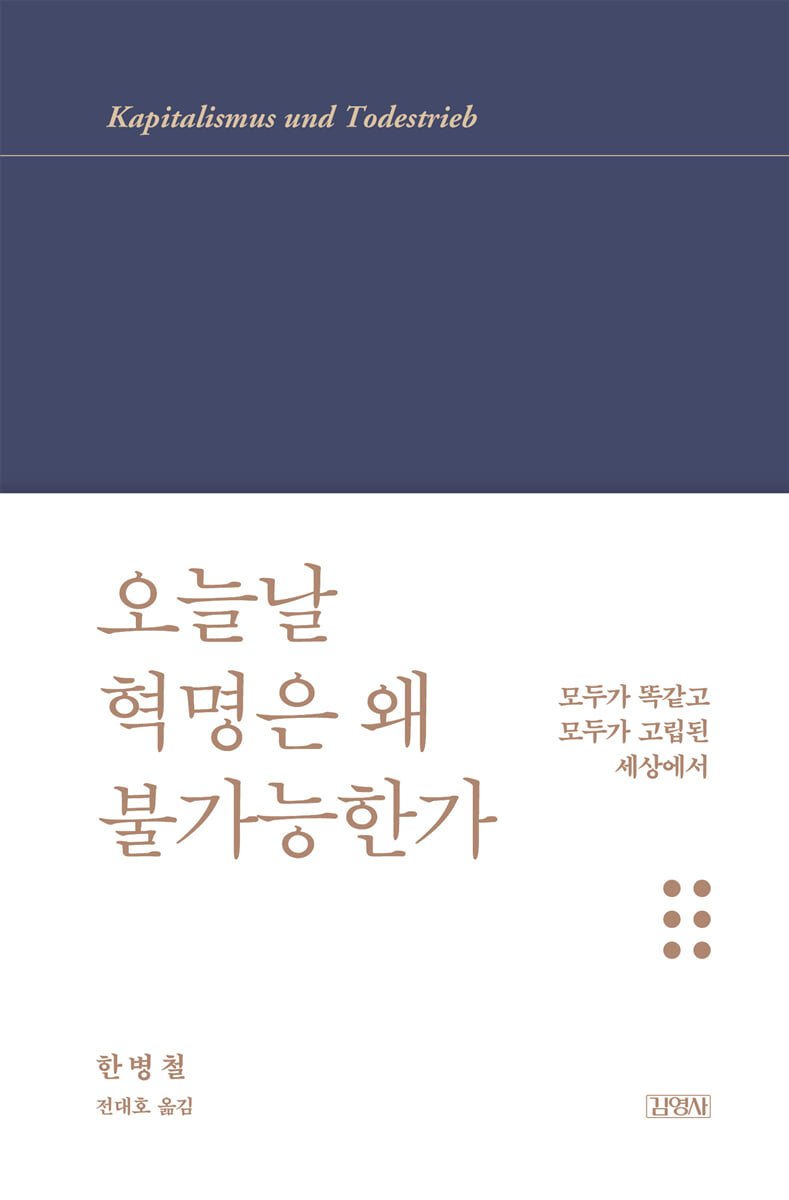
Why Revolution Is Impossible Today
 |
Description
Book Introduction
- A word from MD
- With the blueprint for a better future vanishing, philosopher Han Byung-chul analyzes the nihilism of 21st-century humanity.
Global capitalism, intoxicated by growth, is experiencing an era of excessive positivity, even amidst climate and mental crises.
Examining the thought of Freud, Fromm, and Baudrillard, we trace the origins of the present. - Son Min-gyu, Humanities PD
The writings and words of Han Byung-chul, who dreams of a philosophical uprising in a digitalized world.
A Reflection on Capitalism, Which Forces Blind Accumulation
A critique of our society, caught in an excess of positivity.
15 essays and 3 interviews that offer insight into the digital age.
An era in which revolution cannot be dreamed of, nor desired.
This is a new book by Han Byung-chul, a philosopher living in Germany who has raised hot topics of our time with sharp insights, such as in 『The Dominance of Information』 and 『The Crisis of Narrative』.
The title, "Why Revolution Is Impossible Today," simultaneously targets Marxism, which relies on outdated theories and fails to grasp the clever governance techniques of digital capitalism, and our apathetic world, which is unable to harbor any sense of resistance or critical consciousness even as it loses "freedom and dignity."
It covers a wide range of philosophical topics he has explored since his masterpiece, "The Fatigued Society," and the honest and humane interviews make it a highly readable introduction to "Han Byung-chul's philosophy."
The highlight of the book is the essay “Capitalism and the Death Drive,” which explains the essence of capitalism by connecting it to the destructive instinct of living things.
According to Han Byung-chul, what we call “growth” today is actually “the aimless proliferation of cancerous masses.”
Globalized capitalism, caught in the “intoxication of production and growth,” has long since crossed the threshold in almost all areas, causing not only ecological and social disasters but also spiritual catastrophes.
By examining the writings of Sigmund Freud, Bernard Maris (French economist), Erich Fromm, and Jean Baudrillard, Han Byung-chul examines the source of the power that drives capitalism toward blind accumulation.
A Reflection on Capitalism, Which Forces Blind Accumulation
A critique of our society, caught in an excess of positivity.
15 essays and 3 interviews that offer insight into the digital age.
An era in which revolution cannot be dreamed of, nor desired.
This is a new book by Han Byung-chul, a philosopher living in Germany who has raised hot topics of our time with sharp insights, such as in 『The Dominance of Information』 and 『The Crisis of Narrative』.
The title, "Why Revolution Is Impossible Today," simultaneously targets Marxism, which relies on outdated theories and fails to grasp the clever governance techniques of digital capitalism, and our apathetic world, which is unable to harbor any sense of resistance or critical consciousness even as it loses "freedom and dignity."
It covers a wide range of philosophical topics he has explored since his masterpiece, "The Fatigued Society," and the honest and humane interviews make it a highly readable introduction to "Han Byung-chul's philosophy."
The highlight of the book is the essay “Capitalism and the Death Drive,” which explains the essence of capitalism by connecting it to the destructive instinct of living things.
According to Han Byung-chul, what we call “growth” today is actually “the aimless proliferation of cancerous masses.”
Globalized capitalism, caught in the “intoxication of production and growth,” has long since crossed the threshold in almost all areas, causing not only ecological and social disasters but also spiritual catastrophes.
By examining the writings of Sigmund Freud, Bernard Maris (French economist), Erich Fromm, and Jean Baudrillard, Han Byung-chul examines the source of the power that drives capitalism toward blind accumulation.
- You can preview some of the book's contents.
Preview
index
Why Revolution Is Impossible Today
Capitalism and the Death Drive
Total exploitation of human beings
In the digital panopticon
Only the dead are transparent
In the crowd
Dataism and Nihilism
A painful emptiness
frontal assault
Jumping people
Where do refugees come from?
The land where monsters live
Who are refugees?
Beauty lies in the unfamiliar
Everyone is in a hurry
[conversation]
Eros conquers melancholy
Capitalism doesn't like silence.
“I’m sorry, but that’s the truth.”
main
Text source
Capitalism and the Death Drive
Total exploitation of human beings
In the digital panopticon
Only the dead are transparent
In the crowd
Dataism and Nihilism
A painful emptiness
frontal assault
Jumping people
Where do refugees come from?
The land where monsters live
Who are refugees?
Beauty lies in the unfamiliar
Everyone is in a hurry
[conversation]
Eros conquers melancholy
Capitalism doesn't like silence.
“I’m sorry, but that’s the truth.”
main
Text source
Detailed image

Into the book
Why is the neoliberal system so stable? Why is there so little resistance to it? Why do all resistances fizzle out so quickly? Why is revolution no longer possible today, despite the ever-widening gap between rich and poor?
--- p.7~8
Kindness without purpose is no longer possible.
In a society of mutual evaluation, even kindness becomes commercialized.
People become kind to get better evaluations.
The moment capitalism sells communism as a commodity, capitalism reaches perfection.
Communism as a commodity is the end of revolution.
--- p.13~14
What compels capitalism to pursue blind accumulation? Capitalism is founded on the denial of death.
Capital accumulates against death, which is an absolute loss.
Death forces production and growth.
The death drive as a wish for death makes the death just mentioned, the death expressed as anxiety, disappear.
--- p.21
The accumulation of capital has the same effect as the accumulation of mana.
Growing capital means growing power.
More capital means less death.
Capital is accumulated to escape death.
--- p.24
Just as a shaman is possessed by a god, capitalism is possessed by death.
The unconscious fear of death drives capitalism.
Capitalism's obsession with accumulation and growth awakens in the face of imminent death.
This obsession brings not only ecological disaster but also various psychological disasters.
Destructive achievement obsession combines self-assertion and self-destruction.
People optimize themselves to death.
Ruthless self-exploitation leads to mental breakdown.
--- p.25
A life without death, a life without death, is a reified, mechanical life.
Thus, immortality can only be achieved at the cost of life.
--- p.28
Now we are stripping naked voluntarily, without any compulsion or order.
We put all possible data and information about ourselves on the Internet.
Without knowing who knows what, when, and on what occasion about us.
This lack of control over one's own information is a crisis of freedom that must be taken seriously.
--- p.42
The power technologies of the neoliberal ruling system are not prohibitive or oppressive, but rather seductive.
Power is exercised not when people obey, but when they like it.
People become subject to dominant contexts as they consume and communicate, especially when they click the “like” button.
--- p.49
Wounding seems to be an attempt to feel oneself again in a state of utter despair, an attempt to rebuild the sense of feeling oneself.
The body sheds red tears.
I bleed.
Therefore, it exists.
--- p.76
To escape the painful void, people today either grab a razor blade or a smartphone.
A selfie is a smooth surface that briefly makes the empty self shine beautifully.
But when you turn the surface over, you see a scratched back side.
The back is bleeding.
The back of the selfie is scarred.
--- p.83
A beautiful garment of metaphors makes the writing erotic.
In short, clothes are essential to beauty.
The art of concealment makes interpretation an erotic activity.
The technique maximizes the pleasure derived from the text and turns reading into a sexual act.
--- p.91
It is only in terms of exhibition value that we can understand why people jump in front of the camera these days.
The moment or event commemorated by the memorial service disappears.
Everyone comes forward and shows off themselves.
I need to stand out like a brand.
Thus, the photograph loses the world.
The world becomes a beautiful backdrop for the self.
--- p.97
Kant's ideas about eternal peace reach their climax in his call for universal “hospitality.”
According to that demand, every foreigner has the right to stay in a foreign country.
He can stay there without being treated hostilely.
“If only he would behave peacefully in his place.”
--- p.107
Globalization, which makes everything the same and is nothing more than the total monetization of the world, robs people of their sense of meaning and direction.
The de-localizing violence of globalization evokes a longing for place.
Like separatist movements, identity movements are irrational responses to the violence of a global leveling system.
--- p.124~125
We live in a society that is thoroughly oriented toward production, a society that is thoroughly oriented toward positivity.
This society eliminates the negativity of others or strangers in order to accelerate the cycle of production and consumption.
Only consumable differences are allowed.
You cannot love someone who has been robbed of their differences.
You can only consume it.
--- p.144
In a transparent society, visibility is totalized and absolute, and secrets disappear completely, so it is a pornographic society.
Capitalism deepens the pornification of society by making everything visible and displayed as a commodity.
People seek to maximize exhibition value.
Capitalism doesn't know how to use sex any other way than pornography.
--- p.152
Things today are born dead.
When explosively growing production forces things to be poured out in an unnatural way because of a lack of sales markets, war breaks out.
War destroys things in unnatural ways.
Consumption destroys things in a natural way.
--- p.156~157
Machines don't have minds.
No machine can produce more than it takes in.
On the other hand, life can produce more than it takes in.
This is the wonder of life.
Life is like that.
Life is spirit.
So life is different from machines.
--- p.7~8
Kindness without purpose is no longer possible.
In a society of mutual evaluation, even kindness becomes commercialized.
People become kind to get better evaluations.
The moment capitalism sells communism as a commodity, capitalism reaches perfection.
Communism as a commodity is the end of revolution.
--- p.13~14
What compels capitalism to pursue blind accumulation? Capitalism is founded on the denial of death.
Capital accumulates against death, which is an absolute loss.
Death forces production and growth.
The death drive as a wish for death makes the death just mentioned, the death expressed as anxiety, disappear.
--- p.21
The accumulation of capital has the same effect as the accumulation of mana.
Growing capital means growing power.
More capital means less death.
Capital is accumulated to escape death.
--- p.24
Just as a shaman is possessed by a god, capitalism is possessed by death.
The unconscious fear of death drives capitalism.
Capitalism's obsession with accumulation and growth awakens in the face of imminent death.
This obsession brings not only ecological disaster but also various psychological disasters.
Destructive achievement obsession combines self-assertion and self-destruction.
People optimize themselves to death.
Ruthless self-exploitation leads to mental breakdown.
--- p.25
A life without death, a life without death, is a reified, mechanical life.
Thus, immortality can only be achieved at the cost of life.
--- p.28
Now we are stripping naked voluntarily, without any compulsion or order.
We put all possible data and information about ourselves on the Internet.
Without knowing who knows what, when, and on what occasion about us.
This lack of control over one's own information is a crisis of freedom that must be taken seriously.
--- p.42
The power technologies of the neoliberal ruling system are not prohibitive or oppressive, but rather seductive.
Power is exercised not when people obey, but when they like it.
People become subject to dominant contexts as they consume and communicate, especially when they click the “like” button.
--- p.49
Wounding seems to be an attempt to feel oneself again in a state of utter despair, an attempt to rebuild the sense of feeling oneself.
The body sheds red tears.
I bleed.
Therefore, it exists.
--- p.76
To escape the painful void, people today either grab a razor blade or a smartphone.
A selfie is a smooth surface that briefly makes the empty self shine beautifully.
But when you turn the surface over, you see a scratched back side.
The back is bleeding.
The back of the selfie is scarred.
--- p.83
A beautiful garment of metaphors makes the writing erotic.
In short, clothes are essential to beauty.
The art of concealment makes interpretation an erotic activity.
The technique maximizes the pleasure derived from the text and turns reading into a sexual act.
--- p.91
It is only in terms of exhibition value that we can understand why people jump in front of the camera these days.
The moment or event commemorated by the memorial service disappears.
Everyone comes forward and shows off themselves.
I need to stand out like a brand.
Thus, the photograph loses the world.
The world becomes a beautiful backdrop for the self.
--- p.97
Kant's ideas about eternal peace reach their climax in his call for universal “hospitality.”
According to that demand, every foreigner has the right to stay in a foreign country.
He can stay there without being treated hostilely.
“If only he would behave peacefully in his place.”
--- p.107
Globalization, which makes everything the same and is nothing more than the total monetization of the world, robs people of their sense of meaning and direction.
The de-localizing violence of globalization evokes a longing for place.
Like separatist movements, identity movements are irrational responses to the violence of a global leveling system.
--- p.124~125
We live in a society that is thoroughly oriented toward production, a society that is thoroughly oriented toward positivity.
This society eliminates the negativity of others or strangers in order to accelerate the cycle of production and consumption.
Only consumable differences are allowed.
You cannot love someone who has been robbed of their differences.
You can only consume it.
--- p.144
In a transparent society, visibility is totalized and absolute, and secrets disappear completely, so it is a pornographic society.
Capitalism deepens the pornification of society by making everything visible and displayed as a commodity.
People seek to maximize exhibition value.
Capitalism doesn't know how to use sex any other way than pornography.
--- p.152
Things today are born dead.
When explosively growing production forces things to be poured out in an unnatural way because of a lack of sales markets, war breaks out.
War destroys things in unnatural ways.
Consumption destroys things in a natural way.
--- p.156~157
Machines don't have minds.
No machine can produce more than it takes in.
On the other hand, life can produce more than it takes in.
This is the wonder of life.
Life is like that.
Life is spirit.
So life is different from machines.
--- p.207~208
Publisher's Review
An era in which revolution cannot be dreamed of, nor desired.
"Why is the neoliberal system so stable? Why is there so little resistance to it? Why does every resistance fizzle out so quickly? Why is revolution no longer possible today, despite the ever-widening gap between rich and poor?"
Han Byung-chul, a German-based philosopher who has raised hot topics of our time with sharp insights in works such as "The Dominance of Information" and "The Crisis of Narrative," is now meeting readers with a new book.
The title is “Why Revolution is Impossible Today”.
The author's core arguments, which philosophically reflect on the power mechanisms of neoliberalism and psychopolitics in the digital age, are contained in 15 essays and three interviews.
It covers a wide range of philosophical topics he has explored since his masterpiece, "The Fatigued Society," and the honest and humane interviews make it a highly readable introduction to "Han Byung-chul's Philosophy."
The title catches the eye.
Some readers might wonder, "Revolution"? The title seems too grandiose, considering that we are not living in a dictatorship.
In fact, this title is taken from the first article in which Byung-Chul Han introduces his debate with Italian political philosopher Antonio Negri (three years after the 2011 Occupy Wall Street protests, which ended in a tempest in a teacup), and it is also the title that the author himself suggested for the Korean edition (the original title is 'Capitalism and the Death Drive Kapitalismus und Todestrieb').
Negri, who calls himself a “communist revolutionary,” believes in the emergence of a “multitude” (a network of resistance and revolutionary crowds) while “yearning for the possibilities of global resistance against the neoliberal dominance,” but this, in the author’s view, is “naive.”
If the “power to maintain the system of industrial society” in the past was oppressive, the power exercised in today’s neoliberalism is “seductive.”
If in the past, “violent exploitation of factory workers provoked resistance and backlash,” today’s neoliberalism “turns workers into free managers, managers who control themselves.” In a world where even hospitality and kindness toward guests are graded and economized, in a world where girls cheer, “My life will be perfect when Primark (a European fast fashion brand) comes to town,” the author finds “revolution” absurd.
“The moment capitalism sells communism as a commodity, capitalism is complete.
“Communism as a commodity is the end of revolution.”
So, this title simultaneously targets Marxism, which relies on outdated theories and fails to grasp the clever governance techniques of digital capitalism, and our apathetic world, which is unable to harbor any sense of resistance or critical consciousness even as it loses “freedom and dignity.”
Capitalism and the Death Drive
“As a shaman is possessed by a god, so capitalism is possessed by death.
“The unconscious fear of death drives capitalism.”
The highlight of this book is the essay “Capitalism and the Death Drive,” which explains the essence of capitalism by connecting it to the destructive instinct of living things.
According to Han Byung-chul, what we call “growth” today is actually “the aimless proliferation of cancerous masses.”
Globalized capitalism, caught in the “intoxication of production and growth,” has long since crossed the threshold in almost all areas, causing not only ecological and social disasters but also spiritual catastrophes.
By examining the writings of Sigmund Freud, Bernard Maris (French economist), Erich Fromm, and Jean Baudrillard, Han Byung-chul examines the source of the power that drives capitalism toward blind accumulation.
According to Freud, life awakened in what was initially lifeless matter, and then a drive to return to a lifeless state arose to relieve the tension that arose (the 'death drive').
However, it is difficult to fully explain human 'sadism' with 'death drive' alone.
Han Byung-chul observes that the root of “sadistic violence” lies in the desire for power growth, which brings about a “feeling of immortality” within us.
“Accumulated murderous violence produces growth, strength, power, invulnerability, and a feeling of immortality.
Man masters death by killing.
“More killing violence means fewer deaths.”
This is where capitalism comes into play.
Han Byung-chul likens capital to “modern Mana.”
In the primitive violent economy, mana was considered a mystical power substance obtained by killing opponents.
“People accumulated mana to produce a feeling of power and invulnerability,” and even “ate the flesh of their opponents” to immediately absorb mana into their bodies.
Here, “the accumulation of capital has the same effect as the accumulation of mana.” As people’s capital increases, they feel that they are in control of death and moving further away from it.
So we accumulate capital “to escape from death.”
Today, capitalism is creating a new phenomenon by “pursuing life without death.”
It leads us to a state of 'neither living nor dead, but a state of 'dead life, living death'.
Our hysterical denial of death turns us into 'fitness zombies' and 'botox zombies', and digital capitalism in particular turns us into inanimate objects ('necrophilia').
Algorithms that “collect data about our spending habits, family situations, occupations, preferences, tastes, living arrangements, and incomes” “think” for us.
‘Thinking’, which was a unique human ability, is replaced by ‘calculating’, and the ability to recall is replaced by ‘mechanical memory’.
A new anthropology is needed
"What kind of lives do we want to live? Do we continue to subject ourselves to total surveillance and exploitation of our personalities, and give up our freedom and dignity? It's time to organize resistance together again."
If neoliberalism's ingenious power techniques dominate every corner of our lives, how should we live? If Han Byung-chul portrays this portrait, our society is suffering from complications caused by capitalism.
The burnout and depression created by a performance-based society, the 'total surveillance society' created by big data and the Internet of Things, and the 'transparent society' (or 'hell of sameness') where all negativity of difference and unfamiliarity has disappeared.
In a world where "everything has become a commodity" and "everyone is identical and isolated," what kind of attitude should we adopt? Wouldn't it be better to decorate your Instagram with photos of yourself jumping with a selfie stick like everyone else? And if you're going to do it, resolve to become the "best commodity," even higher and more stylish.
But “you can’t be happy in an absurd world.” We need a philosophical language that can read “a cry for love” in the children who cut their arms with razor blades in the midst of a painful emptiness.
Han Byung-chul calls for “a new way of life that resists the total commercial exploitation of human life” and “a way of life that reverses the separation between life and death and allows life to participate in death again.”
As a critic of capitalism, it is the content of the alternative life he ponders, and a clue to overcoming a world trapped in 'excessive positivity.'
We need a philosophical uprising against runaway digital capitalism.
“We need a new anthropology.
We need digital anthropology, digital epistemology, and theories of perception.
Digital social philosophy and cultural philosophy.
Heidegger's Being and Time should have been updated for the digital age long ago.”
This book, filled with original metaphors that pierce the times, sharp critical thinking, sentences that contemplate the literary form of philosophy, and new concepts, will be a great opportunity for readers who want to experience the essence of 'Han Byung-chul's philosophy.'
"Why is the neoliberal system so stable? Why is there so little resistance to it? Why does every resistance fizzle out so quickly? Why is revolution no longer possible today, despite the ever-widening gap between rich and poor?"
Han Byung-chul, a German-based philosopher who has raised hot topics of our time with sharp insights in works such as "The Dominance of Information" and "The Crisis of Narrative," is now meeting readers with a new book.
The title is “Why Revolution is Impossible Today”.
The author's core arguments, which philosophically reflect on the power mechanisms of neoliberalism and psychopolitics in the digital age, are contained in 15 essays and three interviews.
It covers a wide range of philosophical topics he has explored since his masterpiece, "The Fatigued Society," and the honest and humane interviews make it a highly readable introduction to "Han Byung-chul's Philosophy."
The title catches the eye.
Some readers might wonder, "Revolution"? The title seems too grandiose, considering that we are not living in a dictatorship.
In fact, this title is taken from the first article in which Byung-Chul Han introduces his debate with Italian political philosopher Antonio Negri (three years after the 2011 Occupy Wall Street protests, which ended in a tempest in a teacup), and it is also the title that the author himself suggested for the Korean edition (the original title is 'Capitalism and the Death Drive Kapitalismus und Todestrieb').
Negri, who calls himself a “communist revolutionary,” believes in the emergence of a “multitude” (a network of resistance and revolutionary crowds) while “yearning for the possibilities of global resistance against the neoliberal dominance,” but this, in the author’s view, is “naive.”
If the “power to maintain the system of industrial society” in the past was oppressive, the power exercised in today’s neoliberalism is “seductive.”
If in the past, “violent exploitation of factory workers provoked resistance and backlash,” today’s neoliberalism “turns workers into free managers, managers who control themselves.” In a world where even hospitality and kindness toward guests are graded and economized, in a world where girls cheer, “My life will be perfect when Primark (a European fast fashion brand) comes to town,” the author finds “revolution” absurd.
“The moment capitalism sells communism as a commodity, capitalism is complete.
“Communism as a commodity is the end of revolution.”
So, this title simultaneously targets Marxism, which relies on outdated theories and fails to grasp the clever governance techniques of digital capitalism, and our apathetic world, which is unable to harbor any sense of resistance or critical consciousness even as it loses “freedom and dignity.”
Capitalism and the Death Drive
“As a shaman is possessed by a god, so capitalism is possessed by death.
“The unconscious fear of death drives capitalism.”
The highlight of this book is the essay “Capitalism and the Death Drive,” which explains the essence of capitalism by connecting it to the destructive instinct of living things.
According to Han Byung-chul, what we call “growth” today is actually “the aimless proliferation of cancerous masses.”
Globalized capitalism, caught in the “intoxication of production and growth,” has long since crossed the threshold in almost all areas, causing not only ecological and social disasters but also spiritual catastrophes.
By examining the writings of Sigmund Freud, Bernard Maris (French economist), Erich Fromm, and Jean Baudrillard, Han Byung-chul examines the source of the power that drives capitalism toward blind accumulation.
According to Freud, life awakened in what was initially lifeless matter, and then a drive to return to a lifeless state arose to relieve the tension that arose (the 'death drive').
However, it is difficult to fully explain human 'sadism' with 'death drive' alone.
Han Byung-chul observes that the root of “sadistic violence” lies in the desire for power growth, which brings about a “feeling of immortality” within us.
“Accumulated murderous violence produces growth, strength, power, invulnerability, and a feeling of immortality.
Man masters death by killing.
“More killing violence means fewer deaths.”
This is where capitalism comes into play.
Han Byung-chul likens capital to “modern Mana.”
In the primitive violent economy, mana was considered a mystical power substance obtained by killing opponents.
“People accumulated mana to produce a feeling of power and invulnerability,” and even “ate the flesh of their opponents” to immediately absorb mana into their bodies.
Here, “the accumulation of capital has the same effect as the accumulation of mana.” As people’s capital increases, they feel that they are in control of death and moving further away from it.
So we accumulate capital “to escape from death.”
Today, capitalism is creating a new phenomenon by “pursuing life without death.”
It leads us to a state of 'neither living nor dead, but a state of 'dead life, living death'.
Our hysterical denial of death turns us into 'fitness zombies' and 'botox zombies', and digital capitalism in particular turns us into inanimate objects ('necrophilia').
Algorithms that “collect data about our spending habits, family situations, occupations, preferences, tastes, living arrangements, and incomes” “think” for us.
‘Thinking’, which was a unique human ability, is replaced by ‘calculating’, and the ability to recall is replaced by ‘mechanical memory’.
A new anthropology is needed
"What kind of lives do we want to live? Do we continue to subject ourselves to total surveillance and exploitation of our personalities, and give up our freedom and dignity? It's time to organize resistance together again."
If neoliberalism's ingenious power techniques dominate every corner of our lives, how should we live? If Han Byung-chul portrays this portrait, our society is suffering from complications caused by capitalism.
The burnout and depression created by a performance-based society, the 'total surveillance society' created by big data and the Internet of Things, and the 'transparent society' (or 'hell of sameness') where all negativity of difference and unfamiliarity has disappeared.
In a world where "everything has become a commodity" and "everyone is identical and isolated," what kind of attitude should we adopt? Wouldn't it be better to decorate your Instagram with photos of yourself jumping with a selfie stick like everyone else? And if you're going to do it, resolve to become the "best commodity," even higher and more stylish.
But “you can’t be happy in an absurd world.” We need a philosophical language that can read “a cry for love” in the children who cut their arms with razor blades in the midst of a painful emptiness.
Han Byung-chul calls for “a new way of life that resists the total commercial exploitation of human life” and “a way of life that reverses the separation between life and death and allows life to participate in death again.”
As a critic of capitalism, it is the content of the alternative life he ponders, and a clue to overcoming a world trapped in 'excessive positivity.'
We need a philosophical uprising against runaway digital capitalism.
“We need a new anthropology.
We need digital anthropology, digital epistemology, and theories of perception.
Digital social philosophy and cultural philosophy.
Heidegger's Being and Time should have been updated for the digital age long ago.”
This book, filled with original metaphors that pierce the times, sharp critical thinking, sentences that contemplate the literary form of philosophy, and new concepts, will be a great opportunity for readers who want to experience the essence of 'Han Byung-chul's philosophy.'
GOODS SPECIFICS
- Date of issue: January 17, 2024
- Format: Hardcover book binding method guide
- Page count, weight, size: 212 pages | 308g | 124*190*18mm
- ISBN13: 9788934946007
You may also like
카테고리
korean


korean

![GQ KOREA Mark (Monthly): December [2025]](http://librairie.coreenne.fr/cdn/shop/files/8ef265dbbfbf186523ed75ba7319009d.jpg?v=1765340328&width=3840)


