

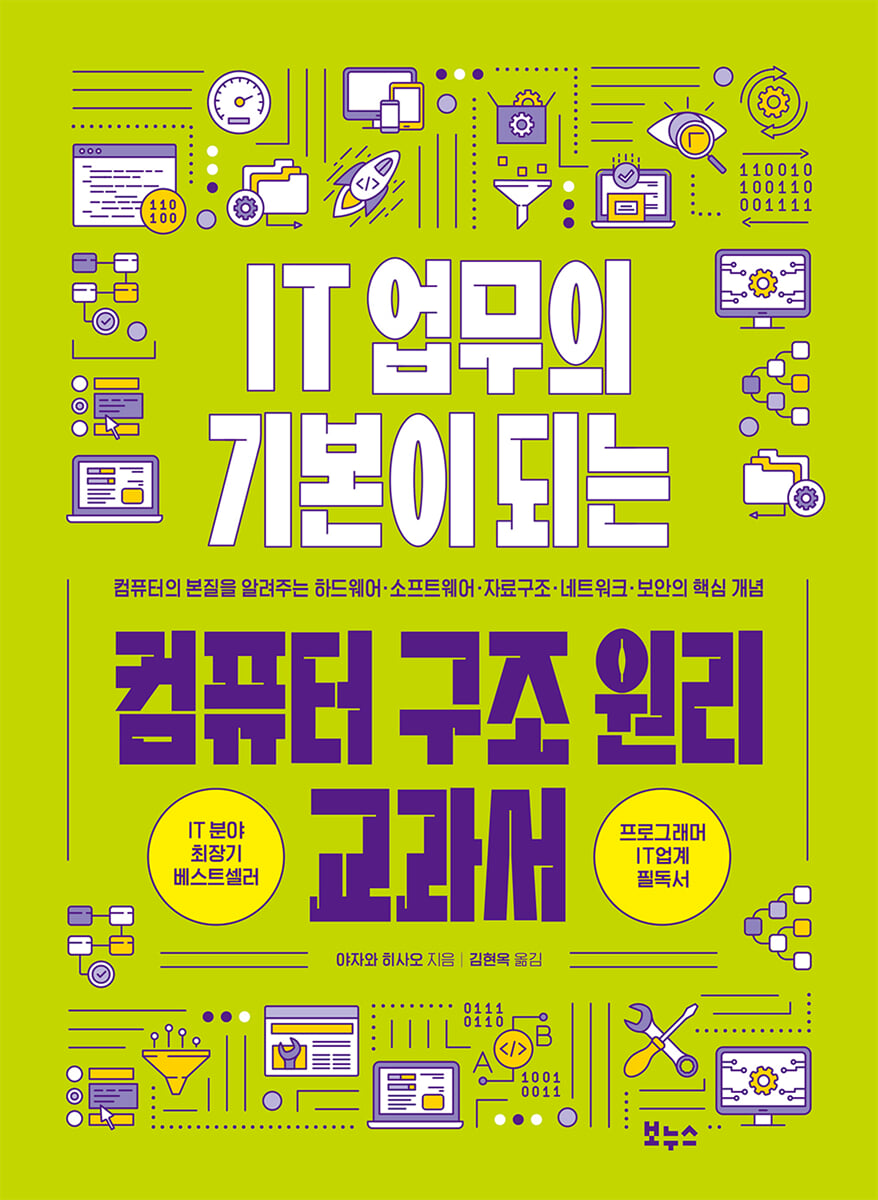
A textbook on computer architecture principles, the foundation of IT work
 |
Description
Book Introduction
This computer architecture guide focuses on understanding "the true workings of computers" beyond coding. To cultivate solid skills and application capabilities that will enable you to survive in the AI era, you must be able to answer the question, "How do computers work?"
It explains core computer technologies such as hardware, software, assembler, data structures, databases, networks, and security with abundant illustrations and examples.
In particular, it is characterized by developing the content centered around the three principles of computers: 'input-operation-output'.
This book helps readers understand the interconnectedness of hardware and software knowledge, making it ideal for aspiring programmers, new programmers, IT professionals, and anyone else who wants to build a solid foundation in computer technology.
It explains core computer technologies such as hardware, software, assembler, data structures, databases, networks, and security with abundant illustrations and examples.
In particular, it is characterized by developing the content centered around the three principles of computers: 'input-operation-output'.
This book helps readers understand the interconnectedness of hardware and software knowledge, making it ideal for aspiring programmers, new programmers, IT professionals, and anyone else who wants to build a solid foundation in computer technology.
- You can preview some of the book's contents.
Preview
index
Chapter 1: What are the three principles of computing?
There are three absolute fundamentals of computers.
The basis of hardware is input, operation, and output.
Software is a collection of instructions and data.
Computers represent everything in numbers.
Computers are constantly evolving to become closer to humans.
A light preview for the next chapter
Chapter 2: Let's Build a Computer
Devices and components that make up a computer
There are boxes inside the CPU, memory, and I/O.
How to read a circuit diagram
Wiring the power supply
Wiring data lines
Wiring the address line
Wiring the control lines
Other wiring
Wiring work completed
Chapter 3: Assembly Language: A Must-Try
High-level and low-level languages
Hardware knowledge required to create programs
Types and roles of CPU registers
There is only one assembly language syntax
Description of program contents
Obtain and install the CASL II simulator
Writing a program
Check the contents of the machine language
Check out how data is exchanged between the CPU and memory boxes.
Check the system that executes commands in order
Chapter 4: A Program Flowing Like a River
Three types of program flow
Flowchart that illustrates the program flow
Hat and pants representing repeating blocks
What is structured programming?
Let's think of an algorithm as a flowchart.
A special flow called event-driven
At the Column Seminar : PC Disassembly Practice
Chapter 5: 7 Tips for Getting Along with Algorithms
Algorithms are the 'idioms' of programming.
Point 1: The problem-solving procedure is clear and the number of attempts is limited.
Point 2: You can solve problems mechanically without relying on intuition.
Point 3: Know and apply standard algorithms.
Point 4: Take advantage of your computer's processing speed.
Point 5: Research with the goal of speeding up.
Point 6: Finding the Law of Numbers
Point 7: Think about the process from the ground up.
Chapter 6: 7 Tips for Getting Along with Data Structures
Point 1: Understand the relationship between memory and variables.
Point 2: Understand arrays, the basic data structure.
Point 3: Understand how to use arrays with standard algorithms.
Point 4: Understand the image of the standard data structure.
Point 5: Understand how to implement stacks and queues.
Point 6: Understand the structure system.
Point 7: Understand how to implement lists and binary trees.
Chapter 7: Developing the Power to Talk About Object-Oriented Programming
What is object-oriented programming?
Different ways to understand OOP
Opinion 1: Build a program by combining parts.
Opinion 2: Improve development efficiency and maintainability.
Opinion 3: It is a development technique suitable for large-scale programs.
Opinion 4: Modeling the real world
Opinion 5: Design programs with UML
Opinion 6: The program works by passing messages between objects.
Opinion 7: Use inheritance, encapsulation, and polymorphism.
Difference between classes and objects
There are three ways to use classes:
From the Column Seminar : What Programming Languages Do You Recommend When Training New Programmers?
Chapter 8: A Database You Understand Once You Create It
Database is a data base
Data files, DBMS, programs
Designing a database
Normalization by partitioning and organizing tables
Primary and foreign keys that join tables
Indexes that improve data retrieval speed
SQL statements that instruct the DBMS to perform CRUD operations
Transaction control can also be left to the DBMS.
Chapter 9: Checking the network system with network commands
What are network commands?
Check 1: View the MAC address
Check 2: View the IP address and subnet mask
Check 3: Understand the Role of a DHCP Server
Check 4: PING the default gateway
Check 5: Understand the role of TTL
Check 6: Understand the Role of DNS Servers
Check 7: Check the correspondence between IP address and MAC address.
The Role of TCP and the Layers of a TCP/IP Network
Chapter 10: Let's Encrypt Data
Encryption is a way to slightly verify something.
Encryption that changes character code
The more keys there are, the more difficult the decryption becomes.
Public key cryptography that uses different keys for encryption and decryption
Digital signature using public key cryptography
Chapter 11 What is XML?
XML is a markup language
XML is extensible
XML is a meta language
XML gives meaning to data
XML is a universal data exchange format
You can set namespaces in XML tags.
XML document structure can be strictly defined
There is a component that interprets XML.
XML is used in a variety of situations.
Chapter 12: SE is the field supervisor of computer system development.
SE is an engineer involved in the entire system.
You don't necessarily need to have programming experience to become an SE.
What are the norms for system development procedures?
Work content and documents for each process
Design means subdivision
Technical and communication skills
IT is not about introducing computers.
Success and failure of computer systems
Multiplexing to significantly increase utilization rates
Conclusion
Search
There are three absolute fundamentals of computers.
The basis of hardware is input, operation, and output.
Software is a collection of instructions and data.
Computers represent everything in numbers.
Computers are constantly evolving to become closer to humans.
A light preview for the next chapter
Chapter 2: Let's Build a Computer
Devices and components that make up a computer
There are boxes inside the CPU, memory, and I/O.
How to read a circuit diagram
Wiring the power supply
Wiring data lines
Wiring the address line
Wiring the control lines
Other wiring
Wiring work completed
Chapter 3: Assembly Language: A Must-Try
High-level and low-level languages
Hardware knowledge required to create programs
Types and roles of CPU registers
There is only one assembly language syntax
Description of program contents
Obtain and install the CASL II simulator
Writing a program
Check the contents of the machine language
Check out how data is exchanged between the CPU and memory boxes.
Check the system that executes commands in order
Chapter 4: A Program Flowing Like a River
Three types of program flow
Flowchart that illustrates the program flow
Hat and pants representing repeating blocks
What is structured programming?
Let's think of an algorithm as a flowchart.
A special flow called event-driven
At the Column Seminar : PC Disassembly Practice
Chapter 5: 7 Tips for Getting Along with Algorithms
Algorithms are the 'idioms' of programming.
Point 1: The problem-solving procedure is clear and the number of attempts is limited.
Point 2: You can solve problems mechanically without relying on intuition.
Point 3: Know and apply standard algorithms.
Point 4: Take advantage of your computer's processing speed.
Point 5: Research with the goal of speeding up.
Point 6: Finding the Law of Numbers
Point 7: Think about the process from the ground up.
Chapter 6: 7 Tips for Getting Along with Data Structures
Point 1: Understand the relationship between memory and variables.
Point 2: Understand arrays, the basic data structure.
Point 3: Understand how to use arrays with standard algorithms.
Point 4: Understand the image of the standard data structure.
Point 5: Understand how to implement stacks and queues.
Point 6: Understand the structure system.
Point 7: Understand how to implement lists and binary trees.
Chapter 7: Developing the Power to Talk About Object-Oriented Programming
What is object-oriented programming?
Different ways to understand OOP
Opinion 1: Build a program by combining parts.
Opinion 2: Improve development efficiency and maintainability.
Opinion 3: It is a development technique suitable for large-scale programs.
Opinion 4: Modeling the real world
Opinion 5: Design programs with UML
Opinion 6: The program works by passing messages between objects.
Opinion 7: Use inheritance, encapsulation, and polymorphism.
Difference between classes and objects
There are three ways to use classes:
From the Column Seminar : What Programming Languages Do You Recommend When Training New Programmers?
Chapter 8: A Database You Understand Once You Create It
Database is a data base
Data files, DBMS, programs
Designing a database
Normalization by partitioning and organizing tables
Primary and foreign keys that join tables
Indexes that improve data retrieval speed
SQL statements that instruct the DBMS to perform CRUD operations
Transaction control can also be left to the DBMS.
Chapter 9: Checking the network system with network commands
What are network commands?
Check 1: View the MAC address
Check 2: View the IP address and subnet mask
Check 3: Understand the Role of a DHCP Server
Check 4: PING the default gateway
Check 5: Understand the role of TTL
Check 6: Understand the Role of DNS Servers
Check 7: Check the correspondence between IP address and MAC address.
The Role of TCP and the Layers of a TCP/IP Network
Chapter 10: Let's Encrypt Data
Encryption is a way to slightly verify something.
Encryption that changes character code
The more keys there are, the more difficult the decryption becomes.
Public key cryptography that uses different keys for encryption and decryption
Digital signature using public key cryptography
Chapter 11 What is XML?
XML is a markup language
XML is extensible
XML is a meta language
XML gives meaning to data
XML is a universal data exchange format
You can set namespaces in XML tags.
XML document structure can be strictly defined
There is a component that interprets XML.
XML is used in a variety of situations.
Chapter 12: SE is the field supervisor of computer system development.
SE is an engineer involved in the entire system.
You don't necessarily need to have programming experience to become an SE.
What are the norms for system development procedures?
Work content and documents for each process
Design means subdivision
Technical and communication skills
IT is not about introducing computers.
Success and failure of computer systems
Multiplexing to significantly increase utilization rates
Conclusion
Search
Detailed image

Publisher's Review
IT Knowledge: The Secret to Surviving in the AI Era
Understand the essence of how computers work.
“Programming jobs will disappear,” said Herbert Simon, winner of the 1978 Nobel Prize in Economics.
This prediction ultimately proved to be wrong, but what about now?
The generative AI competition sparked by ChatGPT is having a significant impact on IT developers.
As of March 2025, job postings for software developers have decreased by 34% compared to January 2020, according to the global job portal Indeed.
The ChatGPT o3 model's coding force score is 2,727 points.
This score ranks 175th among developers worldwide.
This is where the decrease in demand for developer recruitment becomes understandable.
Will there be no need to study computers, including coding, in the future?
Will IT-related jobs naturally disappear?
While concerns and outlooks are mixed, the advice to abandon computer science is likely the worst advice. AI is a useful tool, not a leading agent.
Now and in the future, people must take on the role of deciding the direction of work and judging situations.
Therefore, it is time to develop the ability to use AI tools effectively and tell computers what we want more precisely.
The first competency required of IT developers today is not to keep up with the latest technologies, but to attain a fundamental understanding of technology.
Now is the time to really push yourself to study computers.
True skill and application come from the basics.
The structure of computer technology explained through three principles
"The Textbook of Computer Architecture Principles: The Foundation of IT Work" encourages IT professionals and aspiring IT professionals contemplating the AI era to learn the essence of technology.
Learning only the superficial use of technology is not enough to adapt to rapid technological changes. Now is the time to delve into the fundamentals of how computers work and understand their fundamental principles.
The more you solidify your fundamentals, the more your application skills will improve, and the more you will be able to maximize AI's capabilities.
The book begins by discussing the three fundamental principles that form the essence of computers.
1) Computers have the functions of input, calculation, and output.
2) A program is a collection of commands and data.
3) Computers sometimes operate differently from human senses due to the nature of their operation.
It explores how these three elements form the foundation that underpins the complexity of computer technology, clearly and engagingly demonstrating that even the most advanced technologies begin with these three principles.
Let's experience circuit diagrams and assembler.
Time to understand 'real computers' beyond coding.
Even though it is a virtual computer with a particularly simple structure, the experience of creating it yourself and programming it in assembler provides readers with useful and active learning.
First, let's take a closer look at the data flow between the CPU, memory, and I/O (input/output devices).
By drawing the circuit diagram, readers can experience how the CPU's registers (general purpose registers, program registers, stack pointer), memory address lines, and data lines work and interact with each other.
Afterwards, the essence of a program is introduced as a concept of 'a set of commands and data', and an actual example is shown using C language source code.
It explains how program source code is converted into machine language through the compilation process, while also helping you understand how instructions and data actually work through assembly language programming experience.
In this way, readers discover the connection between hardware and software knowledge by intuitively understanding the process through which the CPU processes data, how memory stores instructions, and how I/O operates.
This experience will take the perspective of those who are simply focused on learning and using technology to a higher level.
Broadening your perspective and understanding of computers is the first step toward a deeper understanding of why problems arise in your own coding and why processing in a certain way increases efficiency.
The fundamental power to overcome difficulties
Learn the core concepts surrounding computers.
The author explains the principles of how hardware and software interact, then covers general topics such as algorithms, data structures, object orientation, databases, networks, and security.
Because it is a study necessary for everyone to understand the essence of computers.
The chapter explaining algorithms emphasizes the necessity of algorithmic thinking by examining the Euclidean algorithm, the primality test, and linear search, and examines specifically how each algorithm is applied.
Data structures are one of the core subjects of computer studies.
The book tries to convey the clear differences between stacks and queues, as well as somewhat difficult concepts such as binary trees and self-referential structures, in an easy-to-understand manner.
The author emphasizes that without knowing data structures, your computer skills can never improve.
Object-oriented programming is a mountain that must be overcome when first learning programming.
The author helps readers understand complex object-oriented concepts from multiple perspectives.
For example, it clearly shows how messages pass between classes and objects, and compellingly demonstrates what principles like encapsulation, inheritance, and polymorphism mean in a real-world development environment.
When explaining databases and networks, it goes beyond theoretical explanations and provides a realistic explanation of normalization, primary and foreign key concepts, CRUD operations using SQL, and the actual network operation process, such as DHCP and DNS.
The security section presents concepts of common key and public key cryptography, and digital signatures, along with real-world examples, to help readers gain a feel for practical applications.
This book is not a theoretical book introducing the latest technology.
It focuses on understanding the essence of computers, and furthermore, discusses the perspectives and mindsets necessary to understand and study computers. The true competitive edge required in the AI era lies in understanding the fundamental principles of technology and the creativity to apply them.
In that sense, it can be said that this book helps readers position themselves as key players in the AI era.
Let's use this book as a "survival guide" to help you survive and thrive in the field, laying the foundation and building new skills and applications on top of that solid foundation.
If you want to shake off vague anxieties and fears and become a true leader in the IT industry, this book will be a wise choice.
Understand the essence of how computers work.
“Programming jobs will disappear,” said Herbert Simon, winner of the 1978 Nobel Prize in Economics.
This prediction ultimately proved to be wrong, but what about now?
The generative AI competition sparked by ChatGPT is having a significant impact on IT developers.
As of March 2025, job postings for software developers have decreased by 34% compared to January 2020, according to the global job portal Indeed.
The ChatGPT o3 model's coding force score is 2,727 points.
This score ranks 175th among developers worldwide.
This is where the decrease in demand for developer recruitment becomes understandable.
Will there be no need to study computers, including coding, in the future?
Will IT-related jobs naturally disappear?
While concerns and outlooks are mixed, the advice to abandon computer science is likely the worst advice. AI is a useful tool, not a leading agent.
Now and in the future, people must take on the role of deciding the direction of work and judging situations.
Therefore, it is time to develop the ability to use AI tools effectively and tell computers what we want more precisely.
The first competency required of IT developers today is not to keep up with the latest technologies, but to attain a fundamental understanding of technology.
Now is the time to really push yourself to study computers.
True skill and application come from the basics.
The structure of computer technology explained through three principles
"The Textbook of Computer Architecture Principles: The Foundation of IT Work" encourages IT professionals and aspiring IT professionals contemplating the AI era to learn the essence of technology.
Learning only the superficial use of technology is not enough to adapt to rapid technological changes. Now is the time to delve into the fundamentals of how computers work and understand their fundamental principles.
The more you solidify your fundamentals, the more your application skills will improve, and the more you will be able to maximize AI's capabilities.
The book begins by discussing the three fundamental principles that form the essence of computers.
1) Computers have the functions of input, calculation, and output.
2) A program is a collection of commands and data.
3) Computers sometimes operate differently from human senses due to the nature of their operation.
It explores how these three elements form the foundation that underpins the complexity of computer technology, clearly and engagingly demonstrating that even the most advanced technologies begin with these three principles.
Let's experience circuit diagrams and assembler.
Time to understand 'real computers' beyond coding.
Even though it is a virtual computer with a particularly simple structure, the experience of creating it yourself and programming it in assembler provides readers with useful and active learning.
First, let's take a closer look at the data flow between the CPU, memory, and I/O (input/output devices).
By drawing the circuit diagram, readers can experience how the CPU's registers (general purpose registers, program registers, stack pointer), memory address lines, and data lines work and interact with each other.
Afterwards, the essence of a program is introduced as a concept of 'a set of commands and data', and an actual example is shown using C language source code.
It explains how program source code is converted into machine language through the compilation process, while also helping you understand how instructions and data actually work through assembly language programming experience.
In this way, readers discover the connection between hardware and software knowledge by intuitively understanding the process through which the CPU processes data, how memory stores instructions, and how I/O operates.
This experience will take the perspective of those who are simply focused on learning and using technology to a higher level.
Broadening your perspective and understanding of computers is the first step toward a deeper understanding of why problems arise in your own coding and why processing in a certain way increases efficiency.
The fundamental power to overcome difficulties
Learn the core concepts surrounding computers.
The author explains the principles of how hardware and software interact, then covers general topics such as algorithms, data structures, object orientation, databases, networks, and security.
Because it is a study necessary for everyone to understand the essence of computers.
The chapter explaining algorithms emphasizes the necessity of algorithmic thinking by examining the Euclidean algorithm, the primality test, and linear search, and examines specifically how each algorithm is applied.
Data structures are one of the core subjects of computer studies.
The book tries to convey the clear differences between stacks and queues, as well as somewhat difficult concepts such as binary trees and self-referential structures, in an easy-to-understand manner.
The author emphasizes that without knowing data structures, your computer skills can never improve.
Object-oriented programming is a mountain that must be overcome when first learning programming.
The author helps readers understand complex object-oriented concepts from multiple perspectives.
For example, it clearly shows how messages pass between classes and objects, and compellingly demonstrates what principles like encapsulation, inheritance, and polymorphism mean in a real-world development environment.
When explaining databases and networks, it goes beyond theoretical explanations and provides a realistic explanation of normalization, primary and foreign key concepts, CRUD operations using SQL, and the actual network operation process, such as DHCP and DNS.
The security section presents concepts of common key and public key cryptography, and digital signatures, along with real-world examples, to help readers gain a feel for practical applications.
This book is not a theoretical book introducing the latest technology.
It focuses on understanding the essence of computers, and furthermore, discusses the perspectives and mindsets necessary to understand and study computers. The true competitive edge required in the AI era lies in understanding the fundamental principles of technology and the creativity to apply them.
In that sense, it can be said that this book helps readers position themselves as key players in the AI era.
Let's use this book as a "survival guide" to help you survive and thrive in the field, laying the foundation and building new skills and applications on top of that solid foundation.
If you want to shake off vague anxieties and fears and become a true leader in the IT industry, this book will be a wise choice.
GOODS SPECIFICS
- Date of issue: April 15, 2025
- Page count, weight, size: 276 pages | 604g | 172*235*17mm
- ISBN13: 9788964947432
You may also like
카테고리
korean


korean

![GQ KOREA Mark (Monthly): December [2025]](http://librairie.coreenne.fr/cdn/shop/files/8ef265dbbfbf186523ed75ba7319009d.jpg?v=1765340328&width=3840)


