

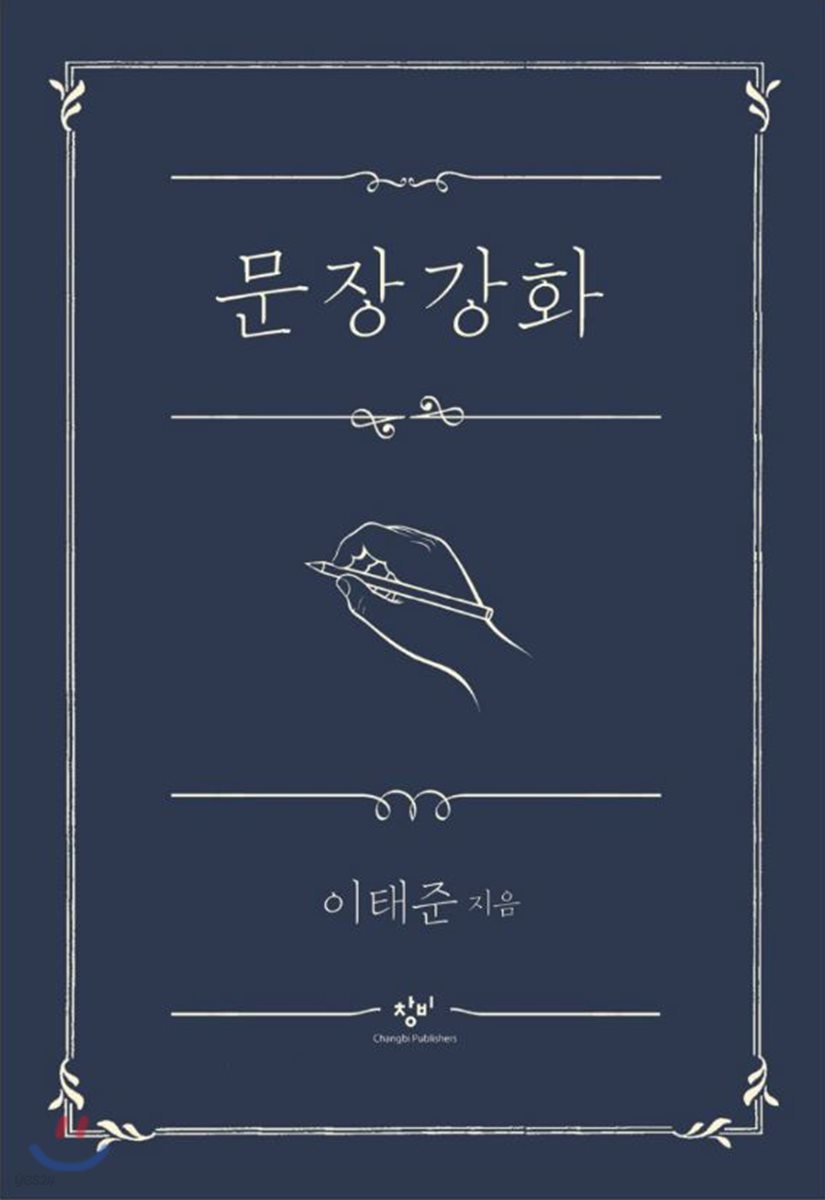
Sentence reinforcement
 |
Description
Book Introduction
The concept and standards of good sentences written in Korean,
A classic in writing studies that has lasted for decades
『Sentence Strengthening』 is Lee Tae-jun's classic writing textbook.
The author, who was known as the greatest writer of his time, “Jiyong in poetry, Taejun in sentences,” says that the best way to write is to “express what comes from your heart in your own way, without trying to force it.”
Lee Tae-jun's "Strengthening Sentences" was originally serialized in February 1939 in the first issue of the magazine "Sentences" that he edited. It is a book that vividly demonstrates the power of writing that does not lose its vitality even after decades have passed.
It is a collection of excellent achievements in our literature, with lively and rich examples that can serve as models of particularly good writing.
It was published as a single volume by Munjangsa in 1940, and later, based on the special edition published by Parkmun Publishing in 1947, it was published as a volume in the cultural library by Changbi in 1988.
In the revised edition published in 2005, the content was kept the same, but to suit the current readership, old expressions and Chinese characters were easily explained in modern language, and word and sentence definitions were carefully added so that middle and high school students could easily understand them.
A classic in writing studies that has lasted for decades
『Sentence Strengthening』 is Lee Tae-jun's classic writing textbook.
The author, who was known as the greatest writer of his time, “Jiyong in poetry, Taejun in sentences,” says that the best way to write is to “express what comes from your heart in your own way, without trying to force it.”
Lee Tae-jun's "Strengthening Sentences" was originally serialized in February 1939 in the first issue of the magazine "Sentences" that he edited. It is a book that vividly demonstrates the power of writing that does not lose its vitality even after decades have passed.
It is a collection of excellent achievements in our literature, with lively and rich examples that can serve as models of particularly good writing.
It was published as a single volume by Munjangsa in 1940, and later, based on the special edition published by Parkmun Publishing in 1947, it was published as a volume in the cultural library by Changbi in 1988.
In the revised edition published in 2005, the content was kept the same, but to suit the current readership, old expressions and Chinese characters were easily explained in modern language, and word and sentence definitions were carefully added so that middle and high school students could easily understand them.
index
Preface to the Revised Edition_On the Publication of the Revised Edition of "Sentence Strengthening" - Lim Hyeong-taek
Preface to the First Edition - Lim Hyeong-taek
Lecture 1: The New Significance of Sentence Composition
Lesson 2: Problems with Sentences and Language
Lesson 3: Poetry and Prose
Lesson 4: Tips for Various Sentences
Lecture 5: Theory and Practice of Retirement
Lesson 6: Sanctions, Introduction, Conclusion, and More
Lesson 7: Objects and Expressions
Lesson 8: On Writing Style
Lesson 9: Classical and Modern Sentences
Biographical Notes
Citation Index
Preface to the First Edition - Lim Hyeong-taek
Lecture 1: The New Significance of Sentence Composition
Lesson 2: Problems with Sentences and Language
Lesson 3: Poetry and Prose
Lesson 4: Tips for Various Sentences
Lecture 5: Theory and Practice of Retirement
Lesson 6: Sanctions, Introduction, Conclusion, and More
Lesson 7: Objects and Expressions
Lesson 8: On Writing Style
Lesson 9: Classical and Modern Sentences
Biographical Notes
Citation Index
Into the book
"Sentence Strengthening" is a book that addresses the topic of "How should we write?" and provides a detailed and serious lecture on the topic.
This book possesses a virtue that is rarely found in a pile of books piled high with sweat.
Rather than writing an editorial about how to write, it shows us what good writing looks like.
In Korean language education today, everyone emphasizes writing.
Writing is also included as a required subject in liberal arts courses at universities.
What kind of practical effects does writing education have? There are countless books on this topic, but finding one worth reading seems rare.
This 『Sentence Strengthening』 was published in response to the needs of the times and has already become a classic work. It is also a book from which I read with interest and learned a great deal in my youth.
Author Lee Tae-jun was a prose writer on par with poet Jeong Ji-yong, and this book is a classic in the study of prose that continues to live on today.
---From the “Preface to the First Edition”
Just as you speak what you see and think, if you write what you see and think, it becomes writing.
Then why are there so many people who speak easily, but so few who write easily?
Here, there is a difference between speech and writing, even though they are similar.
Writing is not something you learn naturally like speaking. You have to learn it and practice it to be able to write well.
This book possesses a virtue that is rarely found in a pile of books piled high with sweat.
Rather than writing an editorial about how to write, it shows us what good writing looks like.
In Korean language education today, everyone emphasizes writing.
Writing is also included as a required subject in liberal arts courses at universities.
What kind of practical effects does writing education have? There are countless books on this topic, but finding one worth reading seems rare.
This 『Sentence Strengthening』 was published in response to the needs of the times and has already become a classic work. It is also a book from which I read with interest and learned a great deal in my youth.
Author Lee Tae-jun was a prose writer on par with poet Jeong Ji-yong, and this book is a classic in the study of prose that continues to live on today.
---From the “Preface to the First Edition”
Just as you speak what you see and think, if you write what you see and think, it becomes writing.
Then why are there so many people who speak easily, but so few who write easily?
Here, there is a difference between speech and writing, even though they are similar.
Writing is not something you learn naturally like speaking. You have to learn it and practice it to be able to write well.
--- From the text
Publisher's Review
Deep and sophisticated perspective, practical writing spirit
Lee Tae-jun's 『Sentence Lecture』 is a writing guide that clearly and step by step answers the question, "How should I write?"
The reason this book remains a widely loved classic is probably because it offers concise insight and depth, a fresh perspective unbound by existing prejudices, and a demonstration of the richness of the Korean language, something that cannot be found in today's writing reference books that are busy teaching all sorts of tricks, shortcuts, and theories.
Moreover, this book does not contain unnecessary terms like the common "double-bracket" and "middle-bracket" or theoretical questions like "What is writing?"
The author addresses real-world problems one by one, from behind the scenes, from high school students just starting to work on their keyboards to young men struggling with their report papers.
So, this book starts with the unconventional introduction, "You should write as you speak," and then deals with dialects, onomatopoeia, and foreign words (Lecture 2), and after explaining the "tips for various sentences" (Lecture 4), it vividly shows the process of directly revising (Lecture 5).
As he himself was famous for his constant revision, the severity and meticulousness of this revision process clearly shows how the saying, “Jiyong for poetry, Taejun for sentences” came to be.
The rest of the book offers practical advice on choosing a writing theme, beginning and ending, using titles and punctuation, and more, as well as advice on developing a keen sense of writing and choosing a writing style that suits you.
Ultimately, the author states throughout the book that the most important tip for writing is to 'express what comes from your heart in your own way, without trying to force it.'
Abundant examples showing the broad world of the Korean language
If the author's powerful narrative and perspective form the backbone of this book, then the flesh of the book is its abundant examples.
The numerous examples, which make up more than half of the book, range in genre from novels, essays, and travel writings to personal diaries, letters, and even wedding invitations, and in time span from letters from King Seonjo and Queen Inmok to invitations to memorial services for Yi Sang and Kim Yu-jeong.
In addition, the diaries of Kim Eok, Yu Jin-o, Lee Byeong-gi, and others, which are difficult to find elsewhere, and the postcards of Choi Jae-seo and Jeong Ji-yong, give us an idea of the author's close relationship with the Nine-person Society at the time.
As Professor Lim Hyeong-taek said in the “Preface to the First Edition,” this can be said to “consolidate the achievements of 20 years of new literature,” and it also reflects the author’s perspective of trying to achieve a “modern” style of writing by accepting the tradition of the Korean language that has continued since the Joseon Dynasty.
* Features of the revised edition
① Old language in modern language: In this revised edition, the spirit and content of the original text were preserved, but old language and Chinese characters that made it difficult for modern readers to access were corrected into appropriate modern language.
The author's unique personality allows the content to be better presented without being damaged, making it accessible to middle and high school students who need writing guides the most.
② Added sentence and word definitions: Detailed definitions were added to numerous Chinese characters, dialects, and idioms that appear in the book.
③ Easy-to-read text design: To reduce the clutter of the first edition, which occurred when the text and quotes alternated in a small format, the format was enlarged and the quotes were colored to make them easier to distinguish.
Recommendation
Sangheo's 『Sentence Strengthening』 contains the concepts and standards for good sentences written in Korean.
Ever since I came across this book at a used bookstore in Cheonggyecheon during my student days, whenever I felt my writing was sloppy, I would look through the bookmark to calm my mind.
I, who wanted to be a writer rather than a thinker, often turned my back on those concepts and standards and then returned to them, so the teachings and example of Sang-Heo are like the home of my writing.
No, that's not all I can say.
Sang-Heo defected to North Korea in 1946 and ended his life there, but considering that the writings that were included in our Korean language textbooks, which we lived in for a long time after the Korean War, were in fact selected through this 『Sentence Strengthening』, it could be said that all the writings we use today are from there.
- Hwang Hyeon-san, literary critic
Lee Tae-jun's 1939 work, "Sentence Strengthening," is a practical book that is enjoyable to read repeatedly.
While we must also take into account the excellence of the release, books from decades ago were more in-depth and sophisticated than writing books today.
Lee Tae-jun feels like a contemporary figure.
happy.
Rather than telling you to “write like this,” this book shows you a lot of good writing.
I can't help but exclaim in admiration, "Our sentences are so rich, there are so many people who write well."
- Jeong Hee-jin, feminist scholar
A masterpiece that contains clear answers to the questions of what makes a sentence a good sentence, or in other words, what makes a piece of writing a correct piece of writing.
Before you start practicing writing blindly, I recommend reading this book line by line.
- Book columnist Choi Bo-gi
『Sentence Strengthening』, a writing textbook written in the 1930s, is still secretly read by many of today's leading writers.
In this book, author Lee Tae-jun, who, along with poet Jeong Ji-yong, formed a duopoly in contemporary Korean literature, admonishes us to please refrain from writing sentences that are fabricated without paying attention to our own thoughts, regardless of the meaning, whether the words make sense, or whether others find them interesting or not.
In contrast to this boring writing, the principle of 'new sentence writing' is explained, and this concept of 'new sentence writing' is so 'new' that it would not be out of place even if applied to the 'new sentence writing' tips of 2013, when people write with a smartphone touchpad instead of a pen 80 years later.
According to author Lee Tae-jun, in order to write well, it is important to first think that what you are trying to do is not writing, but speaking.
When I see a beautiful scenery, I want to convey my thoughts, feelings, and emotions to my friends through social media. But what is closer to my heart, thoughts, and emotions is words rather than words.
(…) The first principle of Lee Tae-jun’s writing reinforcement is that in order to write something that resonates, you must first focus on expressing your feelings by using words before burying them in the shortest distance between your heart and the written word, that is, in print.
In 『Sentence Strengthening』, written in the 1930s, the expression “There has never been an era that so desperately demands the exchange of personal feelings and thoughts as modern people do” appears.
What about today, 80 years later? The exchange of personal thoughts has become even more vital in today's world. When we see something good or experience a new emotion, we often reach for our smartphones, faster than books or letters, and write to express our feelings in real time.
Therefore, for this type of writing, it is worth listening to author Lee Tae-jun's advice to individually explore ways to express one's personal feelings well.
Because the best writing is the one that is based on personal opinions.
In fact, even on social media, people's eyes and hands are drawn to the posts of acquaintances with their own unique grammar, and even just with a tasty post about everyday life, you can get a lot of comments and followers.
“For a living person, life itself is always new.” Writer Lee Tae-jun asks whether it is possible to fully express the personal life that is created every day using only existing language and ready-made words.
Although writing cannot express one's feelings like a conversation, it is recommended that each individual explore new terminology and writing styles within the scope of what can be communicated to a third party.
This means that if you can communicate with a third party in a civilized manner, you can write more interestingly by using your own witty writing style.
- From the December 2013 issue of “A House Full of Happiness”
Lee Tae-jun's 『Sentence Lecture』 is a writing guide that clearly and step by step answers the question, "How should I write?"
The reason this book remains a widely loved classic is probably because it offers concise insight and depth, a fresh perspective unbound by existing prejudices, and a demonstration of the richness of the Korean language, something that cannot be found in today's writing reference books that are busy teaching all sorts of tricks, shortcuts, and theories.
Moreover, this book does not contain unnecessary terms like the common "double-bracket" and "middle-bracket" or theoretical questions like "What is writing?"
The author addresses real-world problems one by one, from behind the scenes, from high school students just starting to work on their keyboards to young men struggling with their report papers.
So, this book starts with the unconventional introduction, "You should write as you speak," and then deals with dialects, onomatopoeia, and foreign words (Lecture 2), and after explaining the "tips for various sentences" (Lecture 4), it vividly shows the process of directly revising (Lecture 5).
As he himself was famous for his constant revision, the severity and meticulousness of this revision process clearly shows how the saying, “Jiyong for poetry, Taejun for sentences” came to be.
The rest of the book offers practical advice on choosing a writing theme, beginning and ending, using titles and punctuation, and more, as well as advice on developing a keen sense of writing and choosing a writing style that suits you.
Ultimately, the author states throughout the book that the most important tip for writing is to 'express what comes from your heart in your own way, without trying to force it.'
Abundant examples showing the broad world of the Korean language
If the author's powerful narrative and perspective form the backbone of this book, then the flesh of the book is its abundant examples.
The numerous examples, which make up more than half of the book, range in genre from novels, essays, and travel writings to personal diaries, letters, and even wedding invitations, and in time span from letters from King Seonjo and Queen Inmok to invitations to memorial services for Yi Sang and Kim Yu-jeong.
In addition, the diaries of Kim Eok, Yu Jin-o, Lee Byeong-gi, and others, which are difficult to find elsewhere, and the postcards of Choi Jae-seo and Jeong Ji-yong, give us an idea of the author's close relationship with the Nine-person Society at the time.
As Professor Lim Hyeong-taek said in the “Preface to the First Edition,” this can be said to “consolidate the achievements of 20 years of new literature,” and it also reflects the author’s perspective of trying to achieve a “modern” style of writing by accepting the tradition of the Korean language that has continued since the Joseon Dynasty.
* Features of the revised edition
① Old language in modern language: In this revised edition, the spirit and content of the original text were preserved, but old language and Chinese characters that made it difficult for modern readers to access were corrected into appropriate modern language.
The author's unique personality allows the content to be better presented without being damaged, making it accessible to middle and high school students who need writing guides the most.
② Added sentence and word definitions: Detailed definitions were added to numerous Chinese characters, dialects, and idioms that appear in the book.
③ Easy-to-read text design: To reduce the clutter of the first edition, which occurred when the text and quotes alternated in a small format, the format was enlarged and the quotes were colored to make them easier to distinguish.
Recommendation
Sangheo's 『Sentence Strengthening』 contains the concepts and standards for good sentences written in Korean.
Ever since I came across this book at a used bookstore in Cheonggyecheon during my student days, whenever I felt my writing was sloppy, I would look through the bookmark to calm my mind.
I, who wanted to be a writer rather than a thinker, often turned my back on those concepts and standards and then returned to them, so the teachings and example of Sang-Heo are like the home of my writing.
No, that's not all I can say.
Sang-Heo defected to North Korea in 1946 and ended his life there, but considering that the writings that were included in our Korean language textbooks, which we lived in for a long time after the Korean War, were in fact selected through this 『Sentence Strengthening』, it could be said that all the writings we use today are from there.
- Hwang Hyeon-san, literary critic
Lee Tae-jun's 1939 work, "Sentence Strengthening," is a practical book that is enjoyable to read repeatedly.
While we must also take into account the excellence of the release, books from decades ago were more in-depth and sophisticated than writing books today.
Lee Tae-jun feels like a contemporary figure.
happy.
Rather than telling you to “write like this,” this book shows you a lot of good writing.
I can't help but exclaim in admiration, "Our sentences are so rich, there are so many people who write well."
- Jeong Hee-jin, feminist scholar
A masterpiece that contains clear answers to the questions of what makes a sentence a good sentence, or in other words, what makes a piece of writing a correct piece of writing.
Before you start practicing writing blindly, I recommend reading this book line by line.
- Book columnist Choi Bo-gi
『Sentence Strengthening』, a writing textbook written in the 1930s, is still secretly read by many of today's leading writers.
In this book, author Lee Tae-jun, who, along with poet Jeong Ji-yong, formed a duopoly in contemporary Korean literature, admonishes us to please refrain from writing sentences that are fabricated without paying attention to our own thoughts, regardless of the meaning, whether the words make sense, or whether others find them interesting or not.
In contrast to this boring writing, the principle of 'new sentence writing' is explained, and this concept of 'new sentence writing' is so 'new' that it would not be out of place even if applied to the 'new sentence writing' tips of 2013, when people write with a smartphone touchpad instead of a pen 80 years later.
According to author Lee Tae-jun, in order to write well, it is important to first think that what you are trying to do is not writing, but speaking.
When I see a beautiful scenery, I want to convey my thoughts, feelings, and emotions to my friends through social media. But what is closer to my heart, thoughts, and emotions is words rather than words.
(…) The first principle of Lee Tae-jun’s writing reinforcement is that in order to write something that resonates, you must first focus on expressing your feelings by using words before burying them in the shortest distance between your heart and the written word, that is, in print.
In 『Sentence Strengthening』, written in the 1930s, the expression “There has never been an era that so desperately demands the exchange of personal feelings and thoughts as modern people do” appears.
What about today, 80 years later? The exchange of personal thoughts has become even more vital in today's world. When we see something good or experience a new emotion, we often reach for our smartphones, faster than books or letters, and write to express our feelings in real time.
Therefore, for this type of writing, it is worth listening to author Lee Tae-jun's advice to individually explore ways to express one's personal feelings well.
Because the best writing is the one that is based on personal opinions.
In fact, even on social media, people's eyes and hands are drawn to the posts of acquaintances with their own unique grammar, and even just with a tasty post about everyday life, you can get a lot of comments and followers.
“For a living person, life itself is always new.” Writer Lee Tae-jun asks whether it is possible to fully express the personal life that is created every day using only existing language and ready-made words.
Although writing cannot express one's feelings like a conversation, it is recommended that each individual explore new terminology and writing styles within the scope of what can be communicated to a third party.
This means that if you can communicate with a third party in a civilized manner, you can write more interestingly by using your own witty writing style.
- From the December 2013 issue of “A House Full of Happiness”
GOODS SPECIFICS
- Date of issue: April 4, 2017
- Page count, weight, size: 376 pages | 500g | 153*224*30mm
- ISBN13: 9788936471002
- ISBN10: 8936471007
You may also like
카테고리
korean


korean

![GQ KOREA Mark (Monthly): December [2025]](http://librairie.coreenne.fr/cdn/shop/files/8ef265dbbfbf186523ed75ba7319009d.jpg?v=1765340328&width=3840)


